Why Full-Grain Belts Stretch — and How Much Is Normal
Quick answer: Full-grain leather belts stretch because the leather fibers gradually relax under daily flex stress, body heat, and natural skin oils. Normal stretch over the first year of regular wear: 0.5-1 inch of additional length. Beyond that, additional stretch is minimal — the leather has reached its natural relaxed length. Excessive stretch (2+ inches, ongoing year after year) indicates over-conditioning, poor leather quality, or structural failure. Understanding normal stretch helps with belt sizing, conditioning decisions, and identifying when a belt is reaching the end of its useful life.
Last updated: May 2026 • By BELTLEY Editorial
TL;DR:
- Normal stretch: 0.5-1 inch over the first year of wear; minimal beyond that.
- Cause: leather fibers relax under flex stress, body heat, and oil absorption.
- Excessive stretch (2+ inches) usually indicates over-conditioning or poor leather quality.
- Permanent stretch is normal; ongoing year-after-year stretch is structural failure.
- The BELTLEY 3-Material Rule belts stretch predictably; cheap belts stretch erratically.
The "my belt keeps getting longer" complaint is one of the most common belt-ownership concerns — and the honest answer surprises most owners. Normal stretch is small (0.5-1 inch over the first year) and stops; ongoing stretch indicates a problem with the leather or how it's being conditioned. Understanding the mechanism helps you predict, manage, and identify abnormal stretching. Below is the honest physics. For broader sizing context, see full-grain leather belt sizing guide.
What causes leather belts to stretch in the first place?
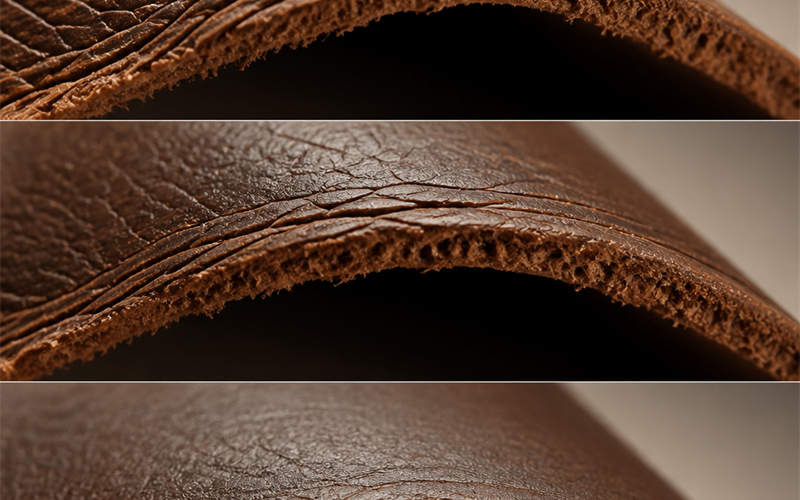
Three factors working together. (1) Fiber relaxation under repeated flex stress — every time you bend the belt (putting it on, sitting down, walking), the leather fibers experience tension and slowly relax over many cycles. The cumulative effect over months of daily wear is gentle stretching. (2) Body heat and moisture — leather absorbs warmth and slight moisture from skin contact; warm, slightly moist leather is more pliable than dry cool leather, which encourages the fibers to settle into a slightly longer relaxed state. (3) Natural oil absorption — skin oils transfer to the leather over time, lubricating the fibers and helping them slide past each other into a more relaxed configuration.

All three mechanisms together explain the predictable 0.5-1 inch first-year stretch on virtually every full-grain leather belt. The leather isn't failing; it's settling into its natural relaxed state under realistic wear conditions. See how to break in a stiff full-grain leather belt for the related break-in mechanism.
How much stretch is normal?
0.5-1 inch over the first year of regular wear. Most full-grain belts gain noticeable length within the first 4-8 weeks (the most rapid relaxation phase), then continue more slowly for the rest of the first year, then stabilize. After about 12 months of regular wear, additional stretch is minimal — the leather has reached its natural relaxed length for the wearer's flex patterns and body conditions.
Heavier or denser leathers stretch less. Hermann Oak harness, English bridle, and double-layer construction often stretch only 0.25-0.5 inch over the first year. Thinner dress leathers (3-4mm calfskin) and pull-up leathers stretch slightly more, sometimes a full inch or slightly beyond. The 0.5-1 inch range covers the typical experience across all standard full-grain belts.
Key stat: Normal full-grain leather belt stretch follows a predictable curve — roughly 60% of total first-year stretch happens in the first 8 weeks, with the remaining 40% occurring over the next 10 months. After year one, additional stretch is typically less than 0.1 inch per year under normal conditions.
What stretch is excessive and indicates a problem?
2+ inches of cumulative stretch, or ongoing year-after-year stretch. Several scenarios indicate abnormal stretching. (1) Cumulative stretch over 2 inches within the first year — the leather is either over-conditioned, low quality, or the belt is overloaded (used as a gun belt or work belt without proper construction). (2) Ongoing stretch in year 2 and beyond — normal stretch stops after about 12 months; continued stretching indicates the leather fibers are failing structurally. (3) Visible thinning at the buckle area — where weight concentrates, indicates structural over-stretching specific to load distribution.

The most common cause of excessive stretch is over-conditioning. Multiple heavy conditioner applications saturate the leather's lipid balance past its structural usefulness, weakening the fiber matrix and causing permanent ongoing stretch. See should you condition a brand-new full-grain leather belt for the over-conditioning explanation.
What causes a belt to stretch unevenly?
Concentrated load or material weakness. Normal stretch happens uniformly across the belt's length because flex stress is distributed across daily wear. Uneven stretch usually indicates one of two issues. (1) Concentrated load — wearing a tool belt, holster, or gear pouch on one section of the belt concentrates flex stress there, causing more stretch in that zone. The fix is structural — see single-layer vs double-layer full-grain belt for load-bearing construction. (2) Material inconsistency — cheap leather with variable density stretches more in weaker zones; full-grain from quality tanneries has uniform density and stretches uniformly.
A belt that stretches significantly in one area while the rest stays the original length is a structural failure indicator. The belt may continue working for a while but the affected zone is weakened and will continue degrading.
Normal vs abnormal stretch
| Pattern | Cause | Normal? |
|---|---|---|
| 0.5-1 inch uniform stretch over year 1 | Fiber relaxation under normal wear | Yes — expected |
| 1-2 inch uniform stretch over year 1 | Slightly aggressive conditioning or thinner leather | Borderline |
| 2+ inch uniform stretch over year 1 | Over-conditioning, low-quality leather | No — problem |
| Ongoing stretch year 2+ | Structural fiber failure | No — belt failing |
| Uneven stretch (concentrated zone) | Load concentration or material weakness | No — investigate |
| Stretch only at buckle/tip | Hardware attachment stress | Maybe — check construction |
| Stretch + visible thinning | Permanent structural damage | No — belt at end of life |
Does conditioning cause belts to stretch more?
Light conditioning helps natural stretch; heavy conditioning causes structural over-stretch. A single light coat of leather conditioner during break-in helps the fibers move freely as they relax — accelerating natural stretch without harming the leather. Multiple heavy conditioning applications over-saturate the fibers, weakening the matrix and causing permanent ongoing stretch.

The honest rule: condition lightly when the leather actually feels dry, not on a schedule. Most quality full-grain belts need conditioning 1-2 times per year at most. Over-frequent conditioning is one of the most common causes of belts that "keep stretching" — the user is unknowingly causing the problem through good intentions. See neatsfoot oil vs mink oil vs beeswax for the conditioner choice.
How does belt construction affect stretch?
Significantly. Several construction factors determine how much a belt stretches. (1) Leather thickness — thicker leather (5-6mm) has more total fiber to relax, so absolute stretch in inches is similar to thinner belts but proportionally smaller. (2) Leather density — Hermann Oak harness, Wickett & Craig bridle, and dense Italian calfskin all stretch less than softer lower-density alternatives. (3) Single vs double layer — double-layer construction restricts stretch (the two layers stabilize each other) by 20-40% compared to single-layer of equivalent thickness. (4) Stitching presence — belts with edge-to-edge stitching show less stretch because the thread restricts fiber movement.

For maximum stretch resistance, choose double-layer construction in 5-6mm dense leather with full-length stitching. For minimum weight with normal stretch tolerance, choose single-layer 4mm full-grain. Both are legitimate choices; the construction affects predicted stretch.
When is stretching a sign the belt is failing?
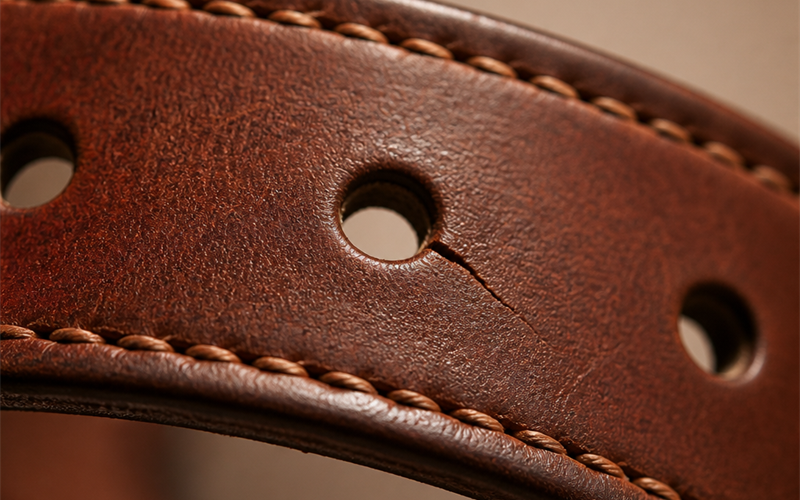
When the stretch is ongoing, uneven, or accompanied by visible material degradation. Several end-of-life indicators. (1) Continued stretching past year 2 — the leather fibers are losing structural integrity. (2) Visible thinning at high-stress zones (buckle attachment, hole region). (3) Cracking developing alongside stretch — the leather is structurally failing. (4) Belt sags noticeably without load — has lost its natural structural tension.
A belt showing these signs has reached the end of its useful life. Restoration may temporarily improve appearance but structural integrity is compromised. See how to tell if a belt can be professionally restored or should be tossed.
Why does the BELTLEY 3-Material Rule matter for stretch?
Because real full-grain stretches predictably; cheap materials stretch erratically. The BELTLEY 3-Material Rule — full-grain leather + stainless or solid brass buckle + sealed (painted or burnished) edges — describes the material combination that produces predictable, manageable stretch. Real full-grain leather stretches 0.5-1 inch over the first year and then stabilizes — buyers can size confidently knowing the future fit. Lower-grade leathers (bonded, corrected-grain) stretch erratically and continue stretching for years, making fit unpredictable and the belt eventually unusable.

A belt that fails the 3-Material Rule isn't worth the effort of understanding its stretch pattern — the underlying material problems will produce other failures within 1-3 years anyway. A belt that passes the rule will follow the predictable 0.5-1 inch first-year stretch and then provide a decade-plus of stable fit.
The Bottom Line
Full-grain leather belts stretch because the leather fibers gradually relax under daily flex stress, body heat, and oil absorption. Normal stretch is 0.5-1 inch over the first year of regular wear, mostly in the first 8 weeks, then stabilizing. Beyond that, additional stretch is minimal. Excessive stretch (2+ inches, ongoing year-after-year) indicates over-conditioning, poor leather quality, or structural failure. Heavier/denser leathers stretch less; thinner/softer leathers stretch more — but all quality full-grain belts stretch within predictable ranges. Understanding the pattern helps with belt sizing decisions and identifying when a belt is reaching end-of-life. BELTLEY's full-grain leather belt collection uses materials that stretch predictably and stabilize — backed by a 10-year warranty and our size guide for accurate sizing. Ready for a belt that fits today and still fits in a decade? Start there.
Frequently Asked Questions
Q: How much will my leather belt stretch?
About 0.5-1 inch over the first year of regular wear, with most of that happening in the first 8 weeks. After year one, additional stretch is minimal (under 0.1 inch per year). Heavier or denser leathers (harness, bridle, double-layer) stretch less; thinner dress leathers stretch slightly more.
Q: Is it normal for leather belts to keep stretching forever?
No — normal stretch stops after about 12 months of regular wear. Ongoing stretch in year 2 and beyond indicates structural failure, over-conditioning, or low-quality leather. A belt that keeps getting longer year after year is reaching the end of its useful life.
Q: Why is my belt stretching too much?
Three most common causes. (1) Over-conditioning — multiple heavy conditioner applications over-saturate the leather and weaken the fiber matrix. (2) Low-quality leather — bonded, corrected-grain, or poor full-grain stretches more and continues stretching erratically. (3) Concentrated load — using a regular belt as a gun belt or work belt overloads the construction and causes excessive localized stretch.
Q: Should I buy a belt one size smaller to account for stretch?
No — buy your actual measured size. The 0.5-1 inch first-year stretch is within the normal adjustment range of belt sizing (typically 2 inches of holes on either side of the labeled size). Buying smaller in anticipation of stretch usually means a too-tight belt during the first months and a perfect-fit belt that becomes loose. Stick to the standard sizing convention.
Q: Can a stretched-out belt be shrunk back?
Not reliably — leather doesn't easily un-stretch. Limited options include punching new holes for adjustment (effectively making the usable belt size smaller), or having a leather worker shorten the strap by removing length from the tip and re-finishing. Aggressive shrinking methods (heat, soaking) damage the leather more than they help.