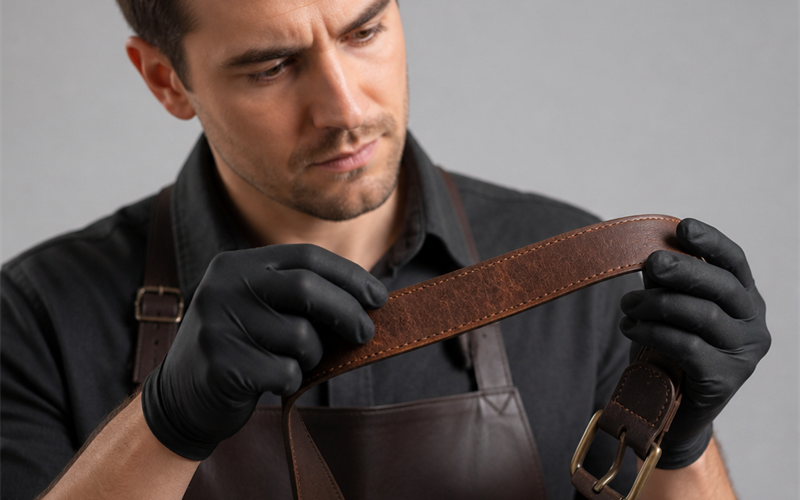
How to Tell If a Belt Can Be Professionally Restored or Should Be Tossed
Quick answer: A belt is worth restoring if (1) the leather is full-grain or vegetable-tanned and still bends without cracking, (2) the buckle is solid metal (brass or stainless), and (3) the structural seams and attachment points are intact. Toss it if the leather is bonded or "genuine" and visibly flaking, the strap has cracked clean through, or it was always low-quality with plated hardware. Pros can fix almost anything mechanical — but they can't transform bonded leather into full-grain.
Last updated: May 2026 • By BELTLEY Editorial
TL;DR:
- Restorable: full-grain or veg-tan leather, solid metal buckle, intact structure.
- Toss: bonded/genuine leather, cracked-through strap, plated buckle, low-value belt.
- Pro can fix: edges, color, stitching, hardware, length, light surface cracking.
- Pro can't fix: rotten core leather, bonded delamination, broken plated buckles.
A belt sitting in the back of your closet (or one you just inherited) deserves a 60-second triage before you spend money on restoration or guilt on throwing it away. The decision comes down to three checks — leather grade, hardware quality, and structural integrity — and you can do all three at the kitchen counter. Below is the exact assessment a pro restorer makes when you bring a belt in. If you've decided to restore it yourself, see our companion guide on how to restore an inherited belt.
Restore-or-Toss: The 60-Second Verdict
Run your belt through the gate:
| Your situation | Go with |
|---|---|
| Full-grain, bends without cracking, solid buckle | Restore — worth every dollar of a pro's time. |
| Flaking surface, "genuine leather" stamp | Toss — restoration can't outrun the grade. |
| Crack clean through the strap | Toss — severed fibers don't heal, professionally or otherwise. |
| Sentimental but structurally gone | Frame it, save the buckle, and let a new full-grain ($58+) take the shift. |
The successor option: BELTLEY's full-grain belts.
What makes a belt worth restoring at all?
Three things: leather grade, hardware quality, and intact structure. A full-grain or top-grain belt with solid brass or stainless hardware and unbroken seams is almost always worth restoring — even if it looks tired. A "genuine leather" or bonded-leather belt with a plated buckle and visible flaking is almost never worth professional restoration; the underlying materials can't be upgraded.

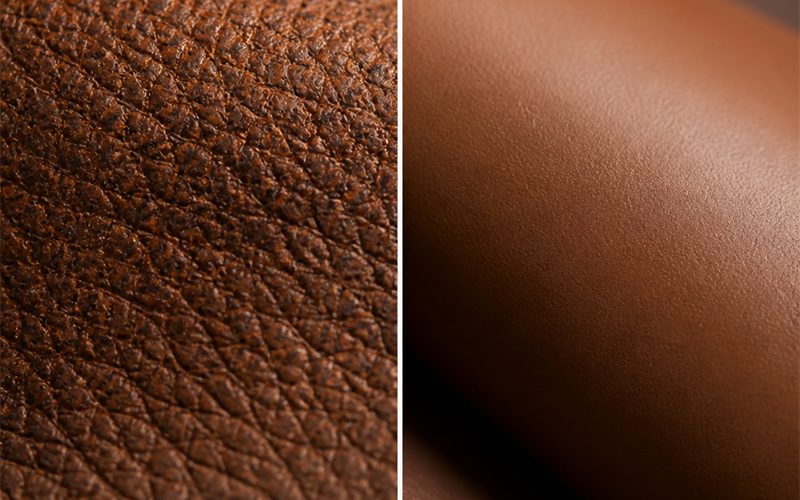
The hierarchy is unforgiving. Leather grades run from full-grain (top) down through top-grain, genuine, split, and bonded, and only the top two layers age in a way that supports restoration. Bonded leather is shredded scraps glued together — once it starts flaking, there's no putting it back. We cover the grades in how to tell if a belt is full grain leather. For belts genuinely worth saving, our full-grain leather belts collection is the modern standard.
How do you check the leather grade at home?
Three quick tests. (1) Bend it sharply. Full-grain shows fine creases that smooth out; bonded leather cracks or splits at the bend. (2) Look at the cut edge (the end of the strap or a worn-down hole). Full-grain shows a single dense fibrous layer; bonded shows distinct flakes or a foam-like layer. (3) Smell it. Real leather has a warm, complex smell; bonded leather often smells of plastic or chemical adhesive.

Test the worst-looking spot, not the best. The decision is whether the whole belt is salvageable, so check the most damaged area for signs of underlying material failure. If the strap is delaminating (peeling into layers) anywhere, the construction is compromised everywhere and restoration won't last. Our 10 most iconic leather types for belts covers what real leather looks and feels like.
How do you check the hardware quality?
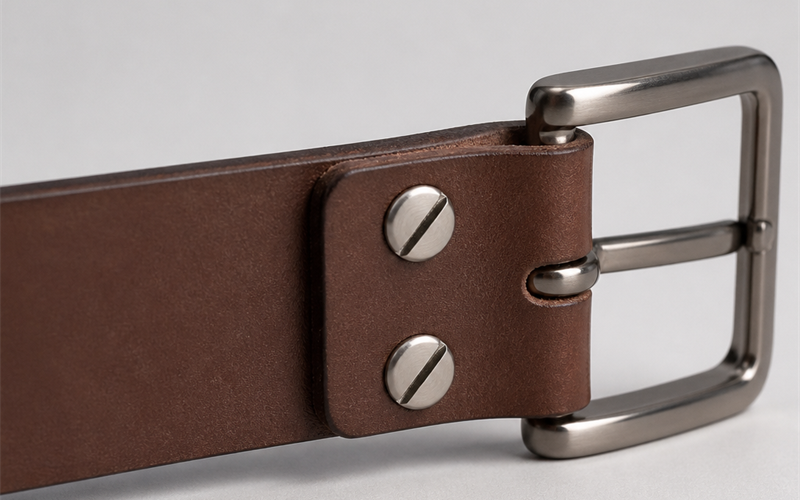
Magnet, weight, and color test. (1) Magnet: sticks to stainless steel and plated zinc but not solid brass. (2) Weight: solid brass and stainless feel substantial; plated zinc feels noticeably lighter for the same size. (3) Color underneath wear spots: if the buckle's worn corners show a different (often grey) metal beneath the finish, it's plated. Solid hardware shows the same metal all the way through.
Plated buckles are usually a lost cause. stainless steel is the marine-grade stainless used in surgical implants — restorable indefinitely. Solid brass cleans up and re-patinas beautifully. Plated zinc alloy, on the other hand, loses its plating with friction and there's no way to re-plate it cheaply. If the buckle is plated and pitted, the belt's hardware is effectively dead — and that often makes the whole restoration not worth it.
Key stat: Roughly 70% of the cost of a quality leather belt is in materials (full-grain leather + solid hardware) and 30% in construction. That means a belt built with cheap materials cannot be restored to "quality" — restoration brings back what was there, not what wasn't.
What structural problems can a pro actually fix?
A long list — but with limits. Pros routinely fix: (1) edge resealing and re-burnishing, (2) re-dyeing with custom-mixed pigment, (3) re-stitching broken seams with saddle stitch, (4) replacing Chicago screws or snaps, (5) swapping a damaged buckle with a solid replacement, (6) adding holes for size adjustment, and (7) cleaning and conditioning deep into the grain. Most full-restoration jobs run $40–$150 depending on shop and scope.

These are reversible, mechanical fixes. They put back what time wore down without changing the belt's fundamental identity. They cannot turn a chrome-tanned mall belt into a vegetable-tanned heirloom. We do this kind of work on full-grain belts in our handmade collection because the construction is built to support it — Chicago-screw hardware, saddle stitching, sealed edges.
What pros can fix vs. can't fix
| Problem | Pro can fix? | Notes |
|---|---|---|
| Faded color | Yes | Re-dye with custom-mixed pigment |
| Tarnished brass/steel buckle | Yes | Polish or replace |
| Fuzzy or chipped edge | Yes | Re-burnish or repaint |
| Loose keeper / loop | Yes | Re-stitch with saddle stitch |
| Stretched holes | Yes | Punch new holes; old ones can be sealed |
| Missing Chicago screws | Yes | Standard replacement |
| Damaged plated buckle | Usually no | Re-plating rarely cost-effective |
| Bonded leather delamination | No | Structure is gone |
| Cracked-through strap | No | Splicing is visible and weak |
| Mildew throughout the core | No | Strap is compromised |
What's a clear "toss it" verdict?
When the cost of restoration approaches or exceeds replacement. A bonded-leather belt that's flaking, a plated buckle that's pitted, a strap with through-cracks at multiple holes — these are all signs that the belt has reached the end of its life. Sentimental value can override the math (a grandfather's belt is worth keeping even if it can't be worn), but if you'd just been planning to wear it, replacement makes more sense.

The cost line is roughly $50. A full restoration usually starts around $40 and goes to $150 depending on scope. If the belt cost less than that new (which is true for most "genuine leather" mall belts), restoration doesn't make financial sense. If the belt cost $200 or $400 or is an heirloom, restoration is the easy call. We unpack the value math in how much a leather belt should cost.
BELTLEY 3-Material Rule
The 3-Material Rule = full-grain leather + stainless or solid brass buckle + sealed (painted or burnished) edges. Belts that hit all three are precisely the ones that can be restored 20 years from now. Belts that fail any leg of the rule (bonded, plated, raw edges) cannot be restored back into quality — restoration recovers what was there originally. So the rule is also a future-proofing checklist: buy belts that pass it now, and they'll be restorable for the next owner.
What questions should you ask a restorer?
Five practical ones. (1) "Can you save this leather, or is it too far gone?" — gets you an honest verdict before money changes hands. (2) "What's the total cost?" — get a written estimate. (3) "Will the color match the rest of the belt?" — re-dye matching is hard. (4) "Will the patina be preserved?" — critical for heirlooms. (5) "What's the warranty on your work?" — six months is standard.

A good restorer will answer all five clearly. Vague answers or unwillingness to commit to an estimate are red flags. If the restorer doesn't ask about your goals (preserve patina vs. restore to new), they're working to a generic template, not your belt. For exotic leather belts — crocodile, alligator, python — always ask whether they've worked on that specific leather before; the techniques are different.
The Bottom Line
A belt is worth restoring when the leather is real, the hardware is solid, and the structure holds — three quick checks at the kitchen counter. Pros can fix almost any cosmetic or mechanical issue ($40–$150 typical), but they can't upgrade the underlying materials, so a bonded-leather belt with a plated buckle is rarely worth professional work. Sentimental value can override the math, but everything else comes down to grade + hardware + structure. At BELTLEY, we build every belt around exactly the spec that supports restoration decades later — full-grain leather, stainless or solid brass hardware, hand-finished edges, and a 10-year warranty on materials and construction. Want a belt built to be restored someday? Start with our full-grain leather belts or men's collection.
Frequently Asked Questions
Q: How can I quickly tell if a belt is worth restoring?
Three checks: bend the leather (does it crease or crack?), magnet-test the buckle (solid brass or stainless?), and inspect the seams and holes (intact or torn?). A belt that passes all three is almost always worth restoring. One that fails any usually isn't.
Q: How much does professional belt restoration cost?
Typical full restorations run $40–$150 depending on the shop and the scope. Simple repairs like adding a hole or polishing the buckle can be $5–$15; a full re-dye plus re-stitch plus buckle swap is on the higher end.
Q: Can a cobbler fix bonded leather?
Not meaningfully. Bonded leather is shredded scraps glued together — once the surface starts flaking, the structure is compromised throughout and there's no way to rebuild it. Cosmetic patching is possible but won't last.
Q: Should I restore a belt that has only sentimental value?
Yes, if you'd genuinely use it again. Sentimental belts often get restored to display rather than wear — that's a valid choice too. A pro can clean, condition, and stabilize an heirloom belt even if it's too fragile for daily wear.
%20the%20leather%20is%20full-grain%20or%20vegetable-tanned%20and%20still%20bends%20without%20cracking,%20(2)%20the%20buckle%20is%20solid%20metal%20(brass%20or%20stainless),%20and%20(3)%20the%20struc...)