How to Swap a Belt Buckle: Which Belts Are "Buckle-Swappable"
Quick answer: A belt is "buckle-swappable" when its buckle is attached with Chicago screws, snaps, or a fold-back slot — not stitched permanently in place. To swap, unscrew or unsnap the existing buckle, slide the strap free, slide on the new buckle, and reattach the hardware. The whole process takes under five minutes if the belt is designed for it, and isn't worth attempting at all if the buckle is stitched on.
Last updated: May 2026 • By BELTLEY Editorial
TL;DR:
- Swappable: Chicago screw, snap closure, fold-back slot — about 5-minute job.
- Not swappable: stitched-in-place buckles (most fully finished dress belts).
- The new buckle's bar slot must match your strap width (1.25", 1.38", 1.5").
- Solid metal buckle (stainless or brass) is what makes a swap actually worthwhile.
A buckle swap is the quickest way to refresh a leather belt without buying a new strap — assuming the belt was designed for it. The trick is recognizing the construction at a glance: most casual full-grain belts open with two Chicago screws, most western and ratchet belts snap, and most fully finished dress belts are stitched and not meant to be opened. Below is how to spot the construction, swap it cleanly, and avoid wrecking a perfectly good belt. If your buckle is flaking or pitted, see belt buying mistakes I made in my 20s for why plated hardware fails in the first place.
Swappable or Not? Check Then Act
Your five-minute eligibility test:
| Your situation | Go with |
|---|---|
| Chicago screws visible | Swappable — screwdriver, two minutes, done. |
| Snaps behind the buckle | Swappable by hand — the easiest system of all. |
| Stitched fold, no hardware | Not designed for it — converting costs more than it returns. |
| New buckle in hand | Match bar width to strap width exactly — a 38mm buckle on a 32mm strap rattles forever. |
Straps and buckles in matching widths: BELTLEY's men's collection.
Which belts are "buckle-swappable"?
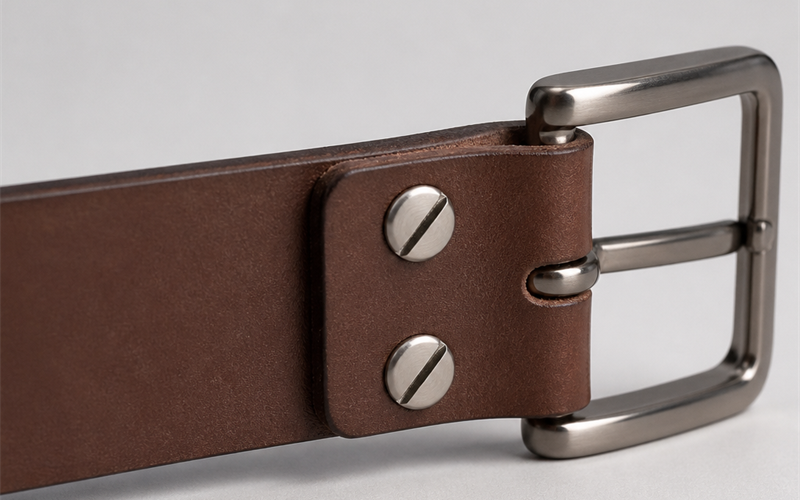
Belts with removable hardware. The three swap-friendly constructions are: Chicago screws (two visible screw heads holding the buckle fold), snap closures (one or two press snaps), and fold-back slot buckles (where the strap simply folds through and the buckle has no fasteners). Belts where the buckle is fully stitched to the strap are not designed to be opened without cutting and re-sewing.

The hardware is the giveaway. Flip your belt over and look at where the strap meets the buckle. Two flat screw heads (a few millimeters across) means Chicago screws — easy swap. A small round metal disk with a center indent means a press snap — also easy. A clean stitched seam with no visible hardware means it's sewn, and you'll need a cobbler. Our casual belts and many full-grain belts use Chicago screws specifically so customers can swap.
How do you tell the construction at a glance?
Three quick checks. (1) Look for screws or snaps on the back of the buckle fold. If you see them, the belt is swappable. (2) Look for stitching across the buckle attachment. If the stitches go right across the fold, it's sewn — not swappable. (3) Try to slide the buckle. If it has any free play in a slot, it's a fold-back design and the buckle slides off without tools.

The construction also signals belt category. Casual and western belts are usually swappable by design; finished dress belts are usually permanent. Ratchet belts technically have swappable buckles too, but the ratchet track is the whole point of the belt — swapping for a non-ratchet buckle defeats it. Our ratchet buckle belts and plaque buckle belts are good reference points for what each style looks like.
How do you do a Chicago screw swap?
Five minutes, two tools. (1) Open — use a flat-head screwdriver (or a coin) to unscrew the two Chicago screws on the back of the buckle fold. (2) Free the strap — the buckle fold opens; slide the old buckle off the leather tab. (3) Mount the new buckle — slide the buckle's center bar onto the tab. (4) Close — fold the leather back over the buckle, line up the screw holes, screw the Chicago screws back in. (5) Tighten — finger-tight is enough; don't over-torque.
The whole job is reversible. Chicago screws are designed for exactly this kind of swap — they unscrew indefinitely without damaging the leather. Be careful not to lose the smaller "male" half of the screw on the underside; it's easy to misplace on a carpet. If the screw holes in the leather have stretched over time, a tiny dab of leather glue inside the hole tightens it back up.
Key stat: A Chicago screw swap takes under 5 minutes with a flat-head screwdriver — the same time it takes to change a watch strap. Stitched buckles, by contrast, require a cobbler and 30+ minutes of professional time to swap.
What about a snap closure or fold-back slot?
Even faster. Snap closure: pry open the press snaps with your thumb (sometimes with a coin's help), slide the strap free, slide on the new buckle, press snaps closed. Fold-back slot: the strap simply pulls free of the buckle's slot — no fasteners, no tools. Slide the new buckle on the same way.

These constructions trade some permanence for convenience. Snaps will eventually loosen with years of swapping (the metal flexes), so reserve swaps for when you actually want a different look. Fold-back belts are common on ratchet styles and certain artisan designs — they're the easiest to swap but also the easiest to lose if the fit is loose. Our box & prong buckle belts often use fold-back constructions.
Buckle swap by construction
| Construction | Visible cue | Tool | Time | Swappable? |
|---|---|---|---|---|
| Chicago screws | Two flat screw heads on back | Flat-head screwdriver | 5 min | Yes |
| Press snap | Round metal disk with center | Fingers / coin | 2 min | Yes |
| Fold-back slot | Buckle slides freely on tab | None | 1 min | Yes |
| Stitched seam | Continuous stitches across fold | Cobbler tools | 30+ min | No (pro only) |
Does the new buckle have to match the strap width?
Yes — or close to it. Belt buckles are sized to specific strap widths: a 1.5" (38mm) buckle won't sit cleanly on a 1.25" (32mm) strap (it'll wobble) and vice versa (it won't fit). Always check the buckle's center-bar slot width and match it to your strap. A small mismatch (a few millimeters) can sometimes work if the buckle is slightly larger, but slightly smaller almost never works.

Width is the spec to verify. Our ultimate guide to standard belt widths in MM lists the common sizes; most casual belts are 1.5" (38mm), most dress belts are 1.25"–1.38" (32–35mm). The buckle's slot opening is what to measure. If you're shopping for a new buckle, our belt buckles collection shows the range; for solid hardware, see stainless steel buckle belts or brass buckle belts.
BELTLEY 3-Material Rule
The 3-Material Rule = full-grain leather + stainless or solid brass buckle + sealed (painted or burnished) edges. Swapping in a quality solid-metal buckle is one of the few upgrades that can move a belt across the rule's second leg. A plated zinc buckle on a full-grain strap still fails the rule; a solid stainless or brass buckle clears it. So swap up, never down.
When should you not swap a buckle?
When the belt is stitched, exotic, or a designer signature piece. Stitched buckles need a cobbler — opening one at home means cutting threads you'll have to replace. Exotic leather belts (crocodile, alligator, python) are too expensive to risk DIY hardware work. And designer belts with serialized buckles (Hermès, certain LV pieces) lose value if the original buckle is replaced.

The DIY zone is clean and narrow. Full-grain cowhide casual or work belts with Chicago screws or snaps are exactly what the swap was designed for. If you have one of our exotic leather belts, bring it to a pro instead. For everything else: the swap is one of the easiest DIYs in menswear.
The Bottom Line
A buckle swap is a five-minute job on a Chicago-screw or snap-closure belt and a non-starter on a stitched one — and recognizing which is which takes a single glance at the back of the buckle fold. Match the new buckle's slot to your strap width, go solid-metal (stainless or brass) over plated, and you've effectively given your belt a second life for the price of new hardware. At BELTLEY, we design our casual and full-grain belts with removable solid hardware specifically so they can be swapped, repaired, and passed down — and every belt comes with our 10-year warranty. Ready for a belt built to be opened, swapped, and lived in? Browse our full-grain leather belts and belt buckles collection.
Frequently Asked Questions
Q: Can every belt's buckle be swapped?
No. Belts with Chicago screws, snap closures, or fold-back slots are designed to swap. Belts with the buckle stitched in place are not — opening them requires cutting and re-sewing by a cobbler.
Q: What tool do I need to swap a Chicago-screw buckle?
A flat-head screwdriver, or sometimes just a coin. The two screws on the back of the buckle fold unscrew by hand, the strap slides free, and the new buckle slides on the same way.
Q: Does a new buckle have to be the same width as my belt?
Yes — the buckle's center-bar slot needs to match your strap width (commonly 1.25", 1.38", or 1.5"). A buckle that's wider than the strap wobbles; one that's narrower won't fit at all.
Q: Is swapping to a solid metal buckle worth it?
Almost always, yes. Plated zinc buckles flake within a year, while solid stainless or solid brass last decades. If you have a quality strap, a buckle upgrade is one of the highest-leverage repairs you can make.