Belt Buying Mistakes I Made in My 20s (Don't Repeat Them)
Quick answer: The most common belt-buying mistakes in your 20s are: buying "genuine leather" thinking it's quality, picking a plated buckle that flakes within a year, chasing logo belts you'll regret by 30, sizing by pant tag instead of natural waist, choosing the wrong width for the occasion, owning too many cheap belts instead of one good one, and ignoring the warranty page. Each of these is fixable for the price of one decent full-grain belt.
Last updated: May 2026 • By BELTLEY Editorial
TL;DR:
- "Genuine leather" is the lowest real-leather grade, not a quality stamp.
- Plated buckles flake — pay for solid stainless or solid brass.
- Logo belts date hard and limit outfit options; understated wins long-term.
- Sizing by pant tag, wrong width, too many cheap belts, and ignoring warranty round out the top seven mistakes.
Most men only start taking belts seriously in their 30s — usually after years of cracked straps, flaking buckles, and one regrettable logo belt. The good news is that the mistakes are predictable, which means they're avoidable. Below are the seven I (and most guys I know) made, what each one actually costs you, and the simple fix in each case. If you're still building your first proper rotation, pair this with our first real leather belt guide.
Mistake #1: Thinking "genuine leather" means quality
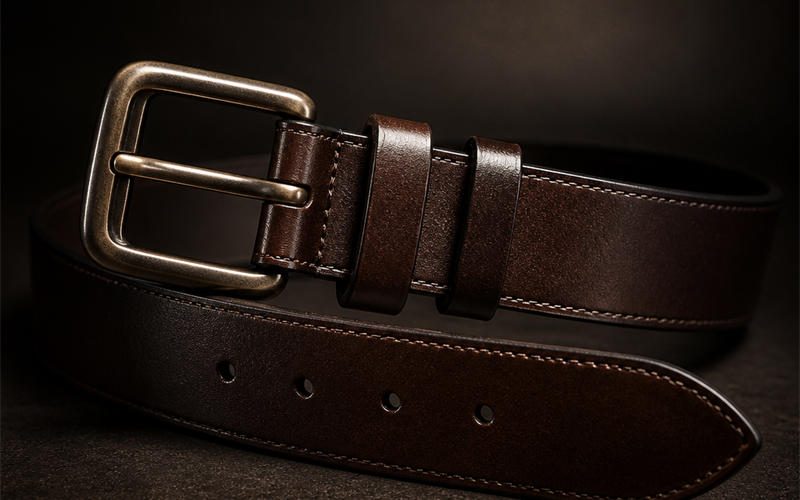
It doesn't — it usually means the opposite. "Genuine leather" is one of the lower grades in the leather industry, made from the splits or layered remnants of a hide. It's still technically leather, but it cracks, peels, and lacks the strength of higher grades. The label was designed to sound premium to shoppers who don't know the hierarchy.

The hierarchy matters. Leather grades run from full-grain (top) down through top-grain, genuine, split, and bonded — and only full-grain develops a real patina or lasts a decade. We unpack it in is a genuine leather belt real leather and full-grain leather belt vs genuine leather. Fix: only buy belts labeled full-grain — start in our full-grain leather belts collection.
Mistake #2: Falling for plated buckles
A cheap buckle ruins an okay belt. Plated buckles are zinc-alloy castings sprayed with a thin layer of chrome, nickel, or gold-tone finish. They look fine on day one but the plating chips and flakes within a year of daily wear, exposing dull grey metal underneath. Solid stainless or solid brass costs more but lasts decades.
Hardware is where corners get cut. stainless steel is the marine-grade stainless used in surgical implants — corrosion-resistant and effectively permanent. Solid brass patinas beautifully. We cover the difference in what is the point of a belt buckle. Fix: check the product page; if it doesn't say solid stainless or solid brass, it's plated. Browse stainless steel buckle belts or brass buckle belts.
Key stat: Plated buckles typically fail within 12 months of daily wear; solid stainless and solid brass commonly outlast the strap they're attached to — sometimes by 10× the lifespan.
Mistake #3: Buying a loud logo belt
It's the regret belt almost every guy owns. Big-logo belts (the obvious GG plaque, the H buckle, the double-G monogram) feel like a statement at 24 and look dated at 34. Trends shift, and a logo-front belt limits what you can wear it with. The men who buy a second logo belt are vanishingly rare.

The math is uncomfortable. A $400 logo belt with the same leather as a $60 mall belt is mostly logo tax. Even our deep-dive on are logo belts in style in 2026 lands on "subtle wins long-term." Fix: pick an understated buckle. Our dress belts and casual belts lean clean and logo-free.
Mistake #4: Sizing by your pant tag, not your waist
Pant size ≠ belt size. Belts are measured around your natural waist (where the belt actually sits), which is almost never the same as the number on your jeans tag. Trousers sit lower or higher depending on cut, and jeans vanity-size — so a "32" pant can equal a 34" or 36" belt depending on the brand and where you wear it.

The buckle hole rule. A correctly sized belt lands the buckle prong on the middle hole, giving you adjustability either way. Our size guide walks you through measuring; we also cover the common errors in should your belt be the same size as your pants. Fix: wrap a soft tape around where you wear belts and add ~2 inches.
The 7 mistakes at a glance
| # | Mistake | Cost | Fix |
|---|---|---|---|
| 1 | Buying "genuine leather" | Cracks in 1–2 yrs | Buy full-grain only |
| 2 | Plated buckle | Flakes in <12 mo | Solid stainless steel or brass |
| 3 | Big-logo belt | Dates fast, limits outfits | Understated buckle |
| 4 | Sizing by pant tag | Wrong fit on day one | Measure natural waist + 2" |
| 5 | Wrong width for occasion | Looks off under suit or jeans | 1.25" dress / 1.5" casual |
| 6 | Five cheap belts | Spend more total, own nothing good | One full-grain belt |
| 7 | Ignoring warranty | No recourse when it fails | Buy from brands with real terms |
Mistake #5: Picking the wrong width for the occasion
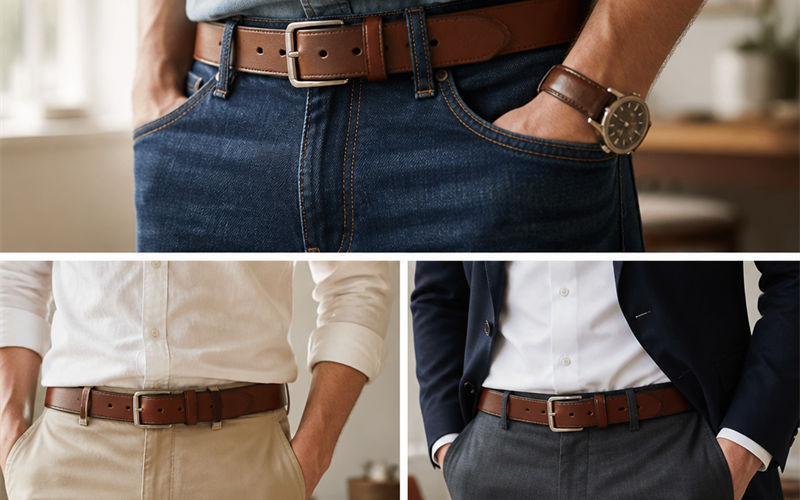
Width has to match formality. A 1.5" (38mm) belt looks chunky and wrong under a dress suit, and a 1" (25mm) belt looks dainty and lost on jeans. Most guys default to whatever was on sale, then wonder why their outfit looks off — when the answer was a millimeter problem the whole time.
Two widths cover almost everything. Our ultimate guide to standard belt widths in MM breaks it down: roughly 1.25"–1.38" (32–35mm) for dress, 1.5" (38mm) for casual. Fix: if you wear suits, own a 1.25" or 1.38" dress belt; if you're mostly in jeans, own a 1.5" casual belt. Our breakdown on thin vs thick belts for men covers the visual logic.
Mistake #6: Owning five cheap belts instead of one good one
Quantity is the enemy of quality. The cheap-belt trap: spend $25 four times because the last one cracked, instead of $100 once on a belt that lasts a decade. The total spend is the same — except after five years you have a drawer full of dead straps instead of one belt that looks better than the day you bought it.

The DTC math is brutal. A well-made full-grain belt at fair DTC pricing genuinely lasts 10+ years, while cheap belts average 12–24 months. Run the numbers on cost per year and quality wins almost every time. Fix: stop replacing. Buy one good belt, take care of it, and skip the rest.
Mistake #7: Ignoring the warranty page
The warranty tells you what the brand actually believes about its product. A vague "100% satisfaction guarantee" with no terms means nothing. A specific multi-year warranty on materials and construction means the maker has skin in the game.

It's a confidence signal. Cheap factories can't offer 10-year warranties because their belts don't last 10 years — so they don't offer them. At BELTLEY, every belt comes with a 10-year warranty on materials and construction. Fix: before you buy any belt, read the warranty page. If it isn't specific, take that as the answer.
The Bottom Line
The belt mistakes of your 20s come down to one habit: trusting labels and price tags instead of the materials and the warranty. Skip "genuine leather," demand a solid metal buckle, avoid the big-logo trap, size by your natural waist, pick width by occasion, buy one great belt instead of five cheap ones, and read the warranty page before you check out. Do that and you'll spend the next decade in a single belt that looks better every year. At BELTLEY, every belt is built around exactly those fixes — full-grain hides, stainless or solid brass hardware, hand-finished edges, and a 10-year warranty. Ready to skip the 20s mistakes entirely? Start with our full-grain leather belts or men's collection.
Frequently Asked Questions
Q: Is "genuine leather" actually leather?
Yes, technically, but it's one of the lowest grades — typically made from layered splits of the hide. It's real leather in the loosest sense, but it cracks and peels far sooner than full-grain. Treat the term as a warning label, not a quality claim.
Q: Why do plated belt buckles fail so quickly?
Plating is a thin metallic coating (often chrome or nickel over zinc alloy) that wears off with friction, sweat, and time. Once it chips, the dull base metal shows through and the buckle looks cheap. Solid stainless or solid brass has no coating to fail.
Q: Are logo belts a bad investment?
They depreciate hard. Most logo belts are highly trend-driven and date quickly, and the resale market is flooded with them. A clean, understated full-grain belt holds its style for decades.
Q: How can I tell if a brand's warranty is real?
Look for a specific duration (multiple years), specific coverage (materials and construction), and a clear claim process. If the warranty page is missing, vague, or hidden, that's your answer about how long the belt is meant to last.