The Ultimate Beginner's Glossary: 30 Leather Belt Terms Decoded
Quick answer: A belt has more named parts and material grades than most people realize — strap, billet, tongue, prong, keeper, return, drum-dyed, full-grain, top-grain, vegetable-tanned, chrome-tanned, burnished, painted edge, patina, and more. Knowing 30 core terms separates the shoppers who get talked into "genuine leather" from the ones who buy a belt that lasts a decade.
Last updated: May 2026 • By BELTLEY Editorial
TL;DR:
- Anatomy terms name the parts: strap, billet, tongue, prong, keeper, return.
- Material terms name the grade: full-grain, top-grain, genuine, bonded, splits.
- Tanning terms name the process: vegetable-tanned, chrome-tanned, drum-dyed.
- Finishing terms name the look and feel: burnished, painted edge, raw edge, patina.
Belt shopping is full of jargon — and most of it exists because lower-quality belts hide behind fuzzy labels. This glossary is the plain-English version: the 30 terms that actually decide whether a belt is worth your money. Read it once and you'll never be tricked by "genuine leather" again. For the deeper hierarchy, pair this with 10 most iconic leather types for belts.
Belt Anatomy: What are the parts of a belt called?
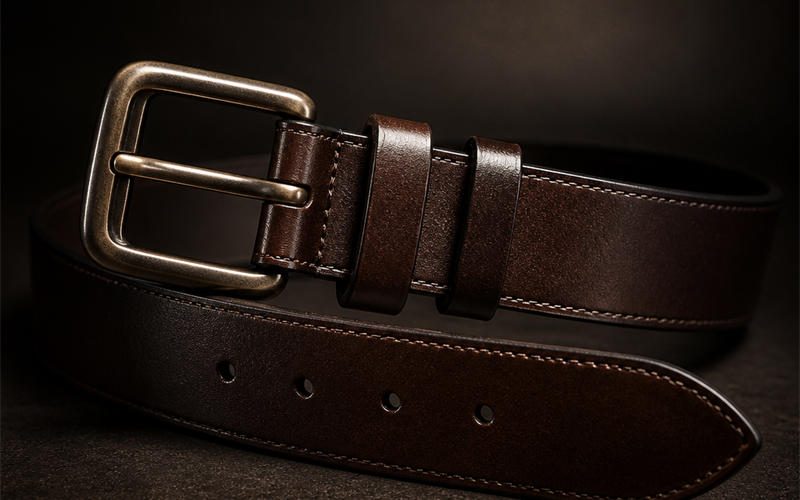
Every belt is built from the same handful of named parts. The strap is the long leather piece. The buckle is the metal hardware. The tongue is the rigid bar inside the buckle. The prong (or tang/pin) is the metal pin that drops into a hole. The keeper (or loop) is the leather or metal loop that holds the loose end down. The billet is the tip end with the holes; the return is the short fixed end attached to the buckle.

Anatomy decides fit. The holes are usually 5 to 7, evenly spaced. The buckle prong should sit on the middle hole when correctly sized — the principle we cover in how to choose a belt size for a man. If your belt has only a single keeper, that's standard; a fixed keeper plus a movable keeper is a higher-end touch.
What do the leather grade terms actually mean?
Leather grade is the single biggest quality signal. Full-grain is the top, unaltered layer of the hide — strongest, develops a real patina. Top-grain has been sanded to remove imperfections — still good, but weaker than full-grain. Genuine leather is a low grade made from splits or layered scraps — looks fine, cracks fast. Bonded leather is shredded leather dust glued together — barely leather at all. Splits are the lower layers of the hide, suede-like and weaker than the grain.

The hierarchy is non-negotiable. The standard grades run from full-grain down through top-grain, genuine, split, and bonded — and the gap between full-grain and "genuine" in real-world durability is enormous. We dig deeper in full-grain vs top-grain leather and how to tell if a belt is full grain leather. Bottom line: only full-grain (or, occasionally, top-grain) is worth your money — start in our full-grain leather belts collection.
Key stat: Of the five leather grades — full-grain, top-grain, genuine, split, and bonded — only the top two are made from the durable upper layer of the hide. The rest are weaker layers or reconstituted scraps that fail within a few years.
What do tanning terms like "vegetable-tanned" and "chrome-tanned" mean?
Tanning is how raw hide becomes leather. Vegetable tanning uses natural plant tannins (often oak or chestnut bark) and takes weeks; it produces firmer, denser, patina-friendly leather — the kind used in heirloom belts. Chrome tanning uses chromium salts and takes a day or two; it produces softer, more uniform leather, often used in clothing and cheaper belts. Drum-dyed means the leather was dyed all the way through inside a rotating drum, so the color goes deeper than a surface stain.
The process is real history. Tanning is one of humanity's oldest crafts, with vegetable-tanned methods documented for thousands of years. Vegetable-tanned leather is the gold standard for belts because it holds its shape and develops character. Italian Tuscan vegetable-tanned leather, certified by the Consorzio Vera Pelle Italiana Conciata al Vegetale, follows traditional slow-tanning methods some of our belts use.
The 30 belt terms at a glance
| Term | What it means |
|---|---|
| Strap | The long leather body of the belt |
| Buckle | The metal closure hardware |
| Tongue | The rigid bar inside the buckle |
| Prong / Tang | The metal pin that drops into a hole |
| Keeper / Loop | Holds the loose tail down |
| Billet | The tip end of the belt, where the holes are |
| Return | The fixed end attached to the buckle |
| Hole | One of the buckle openings (usually 5–7) |
| Stitching | Decorative or structural thread along the edge |
| Full-grain | Top, unaltered layer of the hide — best grade |
| Top-grain | Sanded grain — second-best |
| Genuine leather | Low grade, splits or layered scraps |
| Bonded leather | Shredded leather dust glued together |
| Splits | Lower hide layers, suede-like |
| Vegetable-tanned | Plant-tannin tanning, slow, patina-friendly |
| Chrome-tanned | Salt-based tanning, fast, softer |
| Drum-dyed | Dyed all the way through |
| Burnished edge | Edge rubbed smooth with friction and wax |
| Painted / sealed edge | Edge coated with edge paint |
| Raw edge | Untreated, fuzzy edge — usually a quality red flag |
| Patina | Natural color/sheen leather develops with use |
| stainless | Marine-grade stainless used in good buckles |
| Solid brass | Premium hardware metal, develops patina |
| Plated | Thin metal coating over zinc — usually flakes |
| Plaque buckle | Flat metal plate-style buckle |
| Box & prong | Box-shaped buckle with internal prong |
| Ratchet buckle | Hidden-track buckle, no holes |
| O-ring / D-ring | Round buckle hardware |
| Double-layer / lined | Two layers of leather stitched together |
| Reversible | Two-color belt that flips |
What do "burnished," "painted edge," and "raw edge" mean?
The edge tells you everything about the belt's quality. Burnished means the cut edge of the leather has been rubbed smooth with friction, water, and beeswax — it's slow, manual, and produces a rounded, glossy edge. Painted / sealed edge means the edge is coated with edge paint for a clean, matte finish. Raw edge means the edge is left untreated — it's fuzzy and frays over time, and it's the single fastest tell of a cheap belt.

Edges are where shortcuts show. Burnishing is one of the most time-consuming finishing steps, which is why factory belts skip it. A burnished edge feels rounded and almost waxy; a painted edge feels smooth but flat; a raw edge feels fibrous. Our handmade collection preserves the burnishing step on every belt — you can usually tell the difference with a fingernail.
What does "patina" mean for a leather belt?
A patina is the gradual color shift and sheen that quality leather develops with wear. Sun, oils from your hands, sweat, and time slowly darken and richen the surface — usually creating a deeper, warmer color and a soft glow. Only full-grain and high-grade vegetable-tanned leather develop a real patina; lower grades just crack or fade.

Patina is the long-game payoff. A patina is a film or change in the surface of a material that develops naturally over time — and on leather it's the sign of a hide aging gracefully. A cheap chrome-tanned belt looks worst on day 1000; a full-grain vegetable-tanned belt looks best on day 1000. That's the whole argument for buying real leather once.
What do hardware terms like "stainless" and "solid brass" mean?
These name the metal of the buckle. stainless is a marine-grade stainless steel — corrosion-resistant, hypoallergenic, and effectively permanent. Solid brass is a copper-zinc alloy that's rugged and develops a warm patina. Plated means a thin layer of metal sprayed over a cheaper base (usually zinc alloy) — it flakes and wears off within a year.

Hardware is half the belt. stainless steel is the marine-grade stainless used in surgical implants and dive watches — the same grade we use on most BELTLEY buckles. Browse our stainless steel buckle and brass buckle collections, or see the broader picture in types of belt buckles.
BELTLEY 3-Material Rule
The 3-Material Rule = full-grain leather + stainless or solid brass buckle + sealed (painted or burnished) edges. If you remember nothing else from this glossary, remember those three checks. They eliminate roughly 90% of bad belts on the market in a single look.
The Bottom Line
Belt jargon exists for two reasons: to describe real craft (full-grain, burnished, vegetable-tanned, stainless steel) and to hide the lack of it (genuine, bonded, plated, raw edge). Learning the 30 terms above puts the language back on your side — you can read any product page in about 30 seconds and know whether the belt is worth the asking price. At BELTLEY, every belt we make hits the right side of every term in this glossary: full-grain leather, vegetable-tanned where it counts, solid stainless or brass hardware, hand-burnished or sealed edges, and a 10-year warranty. Ready to apply the glossary? Browse our full-grain leather belts or men's collection.
Frequently Asked Questions
Q: What's the most important belt term to know?
Full-grain. It's the highest grade of leather and the only one that lasts a decade and develops a real patina. If a belt isn't labeled full-grain (or, occasionally, top-grain), it isn't worth a long-term investment.
Q: Is "genuine leather" actually leather?
Technically yes, but it's one of the lowest grades — often made from splits or layered scraps. It cracks and peels far sooner than full-grain. Treat the label as a warning, not a quality claim.
Q: What's the difference between vegetable-tanned and chrome-tanned leather?
Vegetable-tanned uses plant tannins, takes weeks, and produces firm, patina-friendly leather. Chrome-tanned uses chromium salts, takes a day or two, and produces softer, more uniform leather. Vegetable-tanned is the gold standard for heirloom belts.
Q: How can I check edge quality before buying?
Run your thumbnail along the edge. A burnished edge feels rounded and glossy; a painted edge feels smooth and even; a raw edge feels fuzzy and may release fibers. Raw edges are the single fastest tell of a cheap belt.