What "Cracking the Wallet" Means at a Belt Counter (Insider Slang)
Quick answer: "Cracking the wallet" is retail-floor slang — used by sales associates at belt and leather goods counters — for the moment a customer agrees to spend significantly more than they originally planned. It usually happens through a sequence of small upsells: better leather, fancier buckle, matching wallet, optional embossing. Knowing the phrase (and the playbook) lets you walk in, buy what you actually want, and walk out without a $400 surprise.
Last updated: May 2026 • By BELTLEY Editorial
TL;DR:
- "Cracking the wallet" = floor slang for getting a customer to upgrade their original spend.
- It's not a scam — it's standard upselling, just with a colorful name.
- The classic moves: better leather, "real" buckle, monogram, add-on wallet, "limited stock" line.
- The defense is simple: know your spec, know your budget, ask the price before you handle the product.
Walk into the leather accessories floor of any department store or designer boutique and you're walking into a script — one with its own slang, KPIs, and choreography. "Cracking the wallet" is the trade phrase for the moment that script works. It's not malicious, and good sales associates earn their commissions, but knowing the playbook stops a $90 belt run from ending in a $400 receipt. Below is the term, the moves, and the simple defense. For the buying side of this, pair it with our belt buying mistakes I made in my 20s.
What does "cracking the wallet" actually mean?
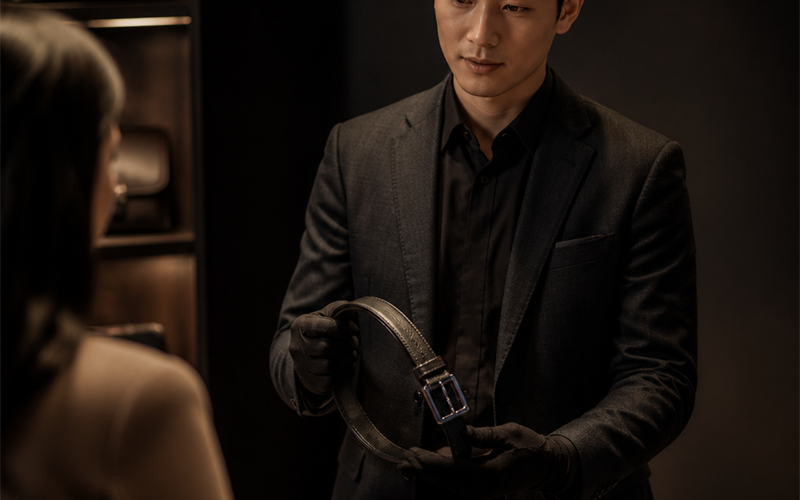
It's retail-floor slang for landing a meaningful upsell. A customer walks in to buy a $90 black belt; a skilled sales associate walks them out with a $260 belt, an $80 wallet, and a "free" gift card. That moment of agreeing to the bigger spend — the one the customer didn't plan for — is "cracking the wallet." It's industry vernacular, not a customer-facing term, and you won't hear it said to your face.

The phrase belongs to a wider vocabulary. Upselling is a standard sales technique of encouraging a customer to buy a more expensive item, upgrade, or add-on, and every retail category has its own slang for the wins ("padding the basket," "stacking," "anchoring up"). Belt counters happen to be especially good ground for it, because price ranges are wide and quality is hard to judge in 30 seconds — exactly why our guide on how much a leather belt should cost exists.
Why do belt counters use this slang?
Because belts have ideal upsell economics. A leather belt is small, easy to handle, sits at a wide price band ($30 to $1,500+), and customers usually feel they "need a good one." That combination is a sales floor's dream — short pitches, fast decisions, and a high ceiling on basket size. Add accessories (wallet, cardholder, money clip) and the average ticket multiplies.

The product is the perfect upsell vehicle. Unlike a suit (which requires fittings) or shoes (which require a try-on), a belt is a 60-second sale — making it the highest-margin, fastest-velocity item on the leather floor. Designer houses lean on this hard, which is part of why their belts are priced the way they are. The same belt that gets "cracked" up to $400 at a counter often shares leather quality with belts in our full-grain leather belts collection at a fraction of the price.
Key stat: A skilled associate can routinely lift a belt-counter sale from a customer's original budget by 2× to 4× through a sequence of small upgrades — leather grade, buckle "tier," add-on wallet, and embossing — each of which feels minor on its own.
What are the classic upsell moves at a belt counter?
There are five you'll see again and again. (1) The leather upgrade — "this one's our entry leather; for a little more you get full-grain." (2) The buckle upgrade — "this is plated; the next one is solid brass." (3) The monogram or embossing — "we can put your initials on, takes 10 minutes." (4) The matching accessory — "you should see how good this looks with the wallet." (5) The scarcity line — "this color just got restocked and it goes fast."

Each move is rational on its own. Full-grain is genuinely better than "genuine leather." Solid brass is better than plated. The trick is that they're often presented as small step-ups when they're really three or four step-ups stacked. Knowing what each step actually costs — and what you actually need — is your defense. Our first real leather belt guide gives you the five questions to walk in with.
The "cracking the wallet" playbook (and your defense)
| Move | Pitch | Real cost | Defense |
|---|---|---|---|
| Leather upgrade | "Full-grain lasts longer" | True — worth it | Already in your plan |
| Buckle upgrade | "Solid brass, not plated" | True — worth it | Already in your plan |
| Monogram | "Just a little extra" | Marginal cost | Skip if you might gift it |
| Matching wallet | "Looks great as a set" | High markup | "Just the belt today" |
| Scarcity line | "Selling fast" | Often invented | Sleep on it |
How can you walk in informed?
Decide three things before you cross the threshold. (1) Your target spec — full-grain leather, solid stainless or brass buckle, sealed edges. (2) Your target color and width — usually mid-brown or black, 1.25"–1.5". (3) Your out-the-door price ceiling. If you know those three things, every upsell either fits inside your spec (in which case, fine) or pushes you outside it (in which case, easy "no thanks").

It's a script vs. a script. Sales scripts win when the customer doesn't have one. Bring yours — the 3-question check on leather grade, buckle, and edges — and the conversation flips. You're not refusing; you're matching the offer against a list. Whether you walk out of a department store or order from a DTC brand like our men's collection, the spec is the spec.
Is "cracking the wallet" unethical?
Not inherently — it's just sales. Upselling is a normal part of retail; commissioned associates aren't villains for trying to do their job. The real ethics question is whether the upgrades they're pushing are real value or pure margin (a $200 logo plaque buckle on a $40 belt vs. a $200 belt with a genuinely better leather). Knowing the difference is the entire point of learning the slang.

The honest version of upselling is education. When a customer walks into our world, the "upgrades" we'd point them to are full-grain leather, solid hardware, and our 10-year warranty — all of which are real, named, and verifiable on the product page. That's the same conversation that makes a belt counter work for you instead of on you.
The Bottom Line
"Cracking the wallet" is just floor slang for landing the upsell — the moment your $90 belt run turns into a $300 ticket. It isn't sinister; it's the playbook, repeated thousands of times a week in every leather goods counter on the planet. The defense is unglamorous and effective: know your spec (full-grain leather, solid metal buckle, sealed edges), know your budget, ask the price before you handle the product, and skip the matching wallet unless you came in for one. At BELTLEY, we don't run that script — our belts are full-grain, our buckles are stainless or solid brass, and our prices are listed openly because we don't need a floor associate to crack anything. Ready to shop without the show? Browse our full-grain leather belts or dress belt collection.
Frequently Asked Questions
Q: Is "cracking the wallet" a real industry term?
Yes — it's informal sales-floor slang used in retail leather goods and menswear, describing the moment a customer agrees to a meaningful upsell. You won't see it printed in a training manual under that name, but the practice (upselling) is standard.
Q: Is upselling at a belt counter a bad thing?
Not by default. Upselling from "genuine" to full-grain leather, or from plated to solid brass, is real value. The problem is when upgrades are stacked aggressively or when the "upgrade" is mostly a logo plaque with no material improvement.
Q: How do I avoid being upsold at a belt counter?
Walk in with three things decided: spec (full-grain, solid metal buckle, sealed edges), color and width, and an out-the-door price ceiling. Politely decline anything that doesn't fit, and don't accept the "matching wallet" pitch unless you came in for one.
Q: Why are belts such common upsell targets?
Because they're fast, small, and span a huge price range (from $30 to $1,500+) — and most customers can't easily judge leather quality in a 60-second pitch. That combination makes the belt counter one of the highest-velocity, highest-margin spots on the leather floor.