How to Re-Dye a Faded Black or Brown Belt at Home
Quick answer: To re-dye a faded leather belt at home, deglaze and clean it, apply alcohol-based leather dye (like Fiebing's) in thin even coats with a wool dauber, let each coat dry for 20 minutes, then seal with a leather finish or conditioner. The whole process takes about an hour plus drying time. The result is a deep, uniform color — provided the belt is real leather (not chrome-tanned glossy plastic) and you don't skip the prep.
Last updated: May 2026 • By BELTLEY Editorial
TL;DR:
- Only works on real leather — full-grain and vegetable-tanned absorb dye best; chrome-tanned and "genuine" leather often won't take it evenly.
- Prep matters most — clean and deglaze before any dye touches the belt.
- Thin coats, multiple passes — 3–4 light coats beat one heavy one.
- Always seal with a finisher or conditioner so the new color doesn't transfer onto your clothes.
A faded belt isn't always a dead belt. If the leather underneath is still strong, a careful re-dye can take an old, sun-faded, or scuffed strap back to a near-new color — for the price of a $10 bottle of dye and an hour at the kitchen table. The trick is in the prep and the patience. Below is the safe method, the materials, and the mistakes that streak a belt. If you're not sure yours is worth saving, start with how to tell if a belt can be restored.
Before You Buy Dye: Is Yours a Candidate?
The re-dye eligibility check:
| Your situation | Go with |
|---|---|
| Faded veg-tan or aniline leather | Great candidate — deglaze, thin alcohol-dye coats, seal. An hour plus drying. |
| Glossy chrome-tanned surface | Poor candidate — the finish blocks absorption; expect streaks. |
| Bonded or PU belt | Not a candidate — dye sits on plastic; spend the hour shopping instead. |
| Fade is even and looks intentional | Consider keeping it — uniform sun-fade IS patina; collectors pay for that look. |
If re-dye isn't viable: BELTLEY's collection in eight colors, from $58.
Can every leather belt be re-dyed?
No — it depends on the tanning and the grade. Vegetable-tanned and full-grain leather belts absorb dye beautifully because they're porous and uncoated. Chrome-tanned belts often have a synthetic top-coat that resists dye, and "genuine leather" or bonded leather belts may dye unevenly because the surface is too processed or too plastic.

The tanning is the deciding factor. Vegetable tanning uses plant tannins and produces firm, porous leather — the kind of hide that drinks dye. Chrome tanning is faster and creates a more uniform, often coated surface that can repel topical dye. We use vegetable-tanned full-grain leather in many of our full-grain leather belts, which is exactly why those age and accept color so well. If your belt is labeled "genuine leather," test a hidden spot first — it may not take dye evenly.
What materials do you need?
A short list. (1) Leather deglazer or pure acetone — to strip the old finish. (2) Alcohol-based leather dye (Fiebing's, Angelus, or similar) in black or your matching brown. (3) Wool daubers or a soft cotton cloth for application. (4) Leather finish (resolene, acrylic, or wax-based) or a quality conditioner — to seal. (5) Nitrile gloves and a drop cloth — dye stains everything.

Match the dye to the leather. Fiebing's Pro Dye and similar alcohol-based dyes penetrate vegetable-tanned leather deeply and dry without streaks; water-based dyes sit closer to the surface and can be more forgiving for beginners. For a black belt you want a true black; for brown, pick a shade slightly darker than your target since dyes usually dry a half-shade lighter than they look wet. Browse the kind of full-grain belts that dye well in our men's collection.
How do you prep the belt before dyeing?
Clean it, then deglaze. Wipe the belt with a damp cloth to remove dust and surface dirt, let it fully dry, then apply leather deglazer (or pure acetone on a cotton ball) in long, even strokes along the grain. This strips the old wax or finish and opens the leather pores so the new dye can penetrate evenly. Skip this step and you'll get blotches.
The deglaze step is non-negotiable. Old conditioner, polish, and surface wax block dye absorption, and they're the reason most failed home dye jobs come out streaky. Work in a ventilated area — deglazer fumes are strong — and let the belt sit dry for 15–20 minutes after deglazing before any dye goes on. The leather should feel slightly drier and slightly lighter to the eye when you're ready.
Key stat: Skipping the deglaze step is the cause of roughly 80% of streaky home dye jobs. Old wax and conditioner block the dye in patches and create a leopard-spot finish that's almost impossible to fix once dry.
How do you apply the dye without streaks?
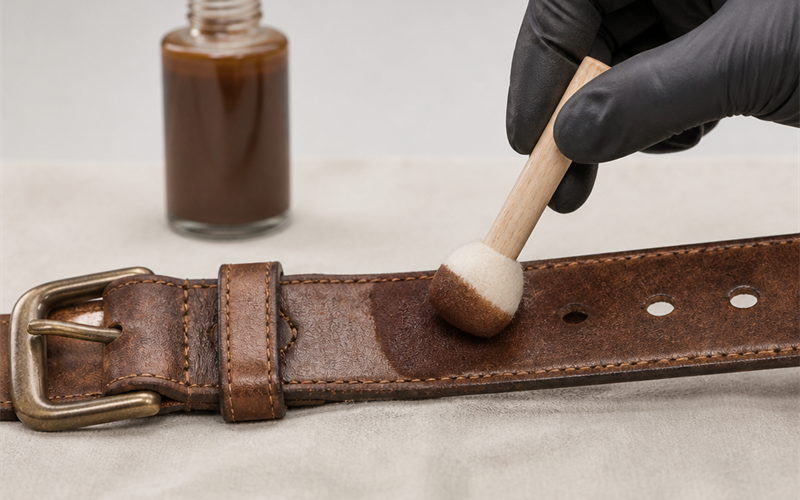
Thin coats, even strokes, in one direction. Dip the wool dauber lightly into the dye (you want it damp, not dripping), then sweep it along the belt in long strokes from buckle end to tip, overlapping each stroke slightly. Let dry 20 minutes. Apply a second coat in the opposite direction (tip to buckle). Repeat 2–4 times until the color is deep and uniform.

Patience does the heavy lifting. A single heavy coat pools and dries unevenly; three or four thin coats build a deep, saturated, streak-free color. Alternate stroke directions on each coat so the dye fills any micro-grain unevenness. Don't over-soak — the dye should color the surface, not flood through the leather. Between coats, the surface should feel touch-dry but not yet fully cured.
Re-dye step-by-step
| Step | Action | Time |
|---|---|---|
| 1. Clean | Damp wipe, let dry | 10 min |
| 2. Deglaze | Acetone or leather deglazer, even strokes | 5 min + 15 min dry |
| 3. Coat 1 | Thin dye, long strokes, one direction | 5 min + 20 min dry |
| 4. Coat 2 | Reverse direction | 5 min + 20 min dry |
| 5. Coat 3–4 | Until color is deep and even | As needed |
| 6. Buff | Soft cloth to remove excess pigment | 2 min |
| 7. Seal | Leather finish or conditioner | 5 min + 1 hr cure |
How do you seal the new color?
With a finisher or conditioner. Once the final coat is fully dry (give it at least an hour), apply a leather finish (Fiebing's Resolene is the common pick) thinned 50/50 with water, in two thin coats with 30 minutes between. For a softer matte result, use a leather conditioner instead of resolene — same application, longer cure. Sealing prevents the dye from rubbing off onto your shirt, pants, or hands.

This step saves your wardrobe. Un-sealed dye will transfer onto everything — especially black dye onto white shirts. The sealer locks the pigment into the leather and gives the surface back its conditioned, slightly waxy feel. Our leather care page covers basic conditioning if you don't already keep something on hand. After sealing, let the belt rest for 24 hours before wearing.
BELTLEY 3-Material Rule
The 3-Material Rule = full-grain leather + stainless or solid brass buckle + sealed (painted or burnished) edges. Re-dyeing only saves a belt that already hits the first leg of that rule — full-grain or vegetable-tanned leather. If the original belt was "genuine" or bonded leather, no amount of dye fixes the underlying material. Save your hour for a strap that's worth it.
What mistakes ruin the result?
Three classic ones. (1) Skipping deglaze — guarantees streaks and blotches. (2) One heavy coat — pools, drips, and dries unevenly. (3) No sealer — the dye transfers onto your clothes for weeks. A bonus mistake is using the wrong dye type (water-based on a chrome-tanned belt, for example), which often results in patchy adhesion.

Each mistake is preventable. The prep-coats-seal sequence isn't optional; it's the entire process. If you're attempting an exotic belt — crocodile, python, or alligator — don't try this at home; the scale patterns and finishes don't respond to home dye work. See our exotic leather belts collection for what those finishes actually look like factory-fresh.
The Bottom Line
A home re-dye can give a tired, faded leather belt a second life — but only if the leather is real, the prep is honest, and the coats are thin. Deglaze, dye in 3–4 thin alternating coats, seal with finish or conditioner, and cure overnight. Skip any one of those steps and you'll wear the result on the back of every white shirt for a month. At BELTLEY, our full-grain leather belts are vegetable-tanned and built to wear, condition, and even re-dye gracefully decades down the line — backed by a 10-year warranty on materials and construction. Want a belt built to last so you don't need a re-dye in the first place? Start with our men's collection.
Frequently Asked Questions
Q: Can any leather belt be re-dyed?
No — vegetable-tanned and full-grain belts absorb dye beautifully, while chrome-tanned and "genuine leather" belts often have a coated surface that resists dye. Test a hidden spot before committing to the full strap.
Q: What's the best leather dye for a home belt re-dye?
Alcohol-based dyes like Fiebing's Pro Dye or Angelus penetrate deeply and dry without streaks on full-grain leather. Water-based dyes are more forgiving for beginners but sit closer to the surface and may need more coats.
Q: Why does my home-dyed belt look streaky?
Almost always because the belt wasn't deglazed before dyeing. Old wax, polish, and conditioner block dye absorption in patches. Strip the surface with leather deglazer or acetone first, then apply dye in thin alternating coats.
Q: How long does a re-dyed belt last before fading again?
If sealed properly and conditioned every few months, a re-dyed belt holds color for years. Sunlight and constant friction will lighten it eventually — but a fresh re-dye is a 30-minute refresh rather than a full project the second time.

%20in%20thin%20even%20coats%20with%20a%20wool%20dauber,%20let%20each%20coat%20dry%20for%2020%20minutes...)