Full-Grain vs Bonded Leather Belt: Which Lasts (And Which is a Scam)
Quick answer: Full-grain leather is the unaltered top layer of a single cowhide — the strongest, longest-lasting leather grade, capable of 10–20+ years of wear. Bonded leather is shredded leather scraps glued together with polyurethane onto a fabric backing — about 10–20% real leather by composition, and it typically peels, flakes, and fails within 12–24 months. They are not in the same league, and bonded leather belts are widely sold under labels designed to hide what they are.
Last updated: May 2026 • By BELTLEY Editorial
TL;DR:
- Full-grain = unaltered top hide; ages into patina; lasts 10+ years.
- Bonded = shredded scraps + glue + fabric backing; ~10–20% real leather; peels in 12–24 months.
- Bonded is often labeled "100% genuine leather" or "real leather" — the marketing words don't mean what shoppers think.
- The price gap is real but small ($30 cheap bonded vs $80–$150 quality full-grain); the lifespan gap is enormous.
"Bonded leather" is the most misleading material in the belt aisle. It contains real leather — barely — and the marketing language around it is engineered to sound premium while disguising what the product actually is. Full-grain leather sits at the opposite end of the same hierarchy: the densest, most durable grade, the only one that develops a true patina, and the kind of belt that can be passed down. This is the long-form explanation of the difference, why it matters, and how to spot bonded leather before you spend a cent. If you want the short buying checklist instead, see first real leather belt: 5 questions to ask.
Which One's in Your Cart Right Now?
The scam-avoidance table:
| Your situation | Go with |
|---|---|
| Label says "full-grain" | Proceed — the unaltered top layer, good for 10–20+ years. From $58. |
| Label says "bonded" or just "leather" | Walk — glued scraps with a 12–24 month expiry date. |
| Label says "genuine leather" | Marketing for the lowest passing grade — barely better than bonded. |
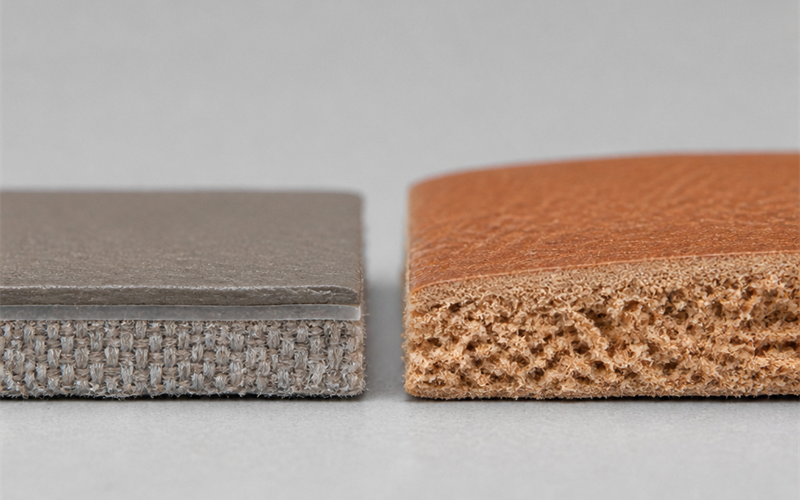
| Testing a belt you own | Check the cut edge: fibrous and uniform = real hide; layered sandwich = bonded composite. |
The grade that earns the word: BELTLEY's full-grain collection, 10-year warranty.
What is full-grain leather?
Full-grain is the top, unaltered layer of an animal hide. It includes the entire grain — the dense, tightly woven fiber structure just below the hair side — without sanding, buffing, or correction. Because nothing has been removed, full-grain retains the hide's natural strength, breathability, and ability to develop a patina over years of wear.

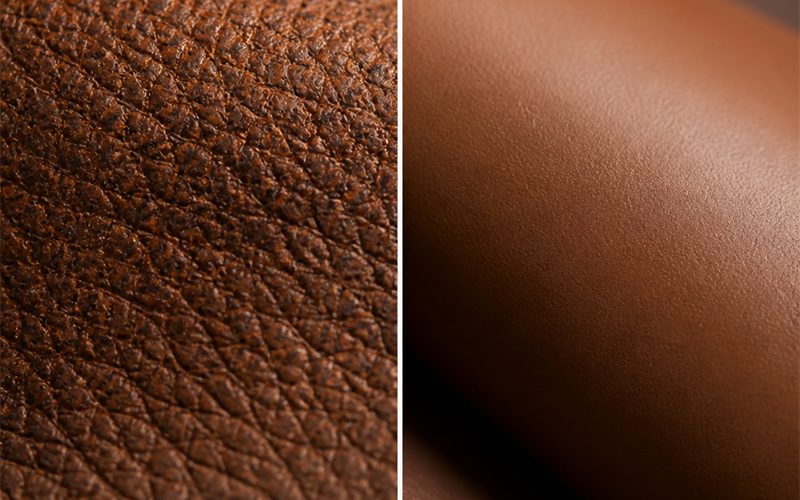
It's a single piece of hide, not a composite. Each full-grain belt strap is cut from one part of one cowhide. The grain shows natural variation — pores, healed scars, subtle texture changes — which is the visual fingerprint of real leather. Full-grain is the highest grade of leather available, and it's the standard we use across our full-grain leather belts collection.
What is bonded leather, actually?
Bonded leather is a manufactured composite — shredded leather scraps and dust, mixed with polyurethane binders or latex glue, then spread onto a fabric backing and stamped with a fake grain pattern. The leather content is usually 10–20% by composition; the rest is plastic and fabric. Industry definitions describe it as a reconstituted material similar in concept to particleboard or MDF compared to solid wood.
The "leather" in bonded leather is the offcut floor sweepings. After tanneries cut belts, bags, and shoes from prime sections of a hide, what's left over is shredded, mixed with binders, and pressed into rolls. A polyurethane top-coat is stamped with a leather-like pattern to mimic real grain. The result looks like leather for a few months — until the surface coating cracks and peels away from the fabric backing.
Key stat: Bonded leather typically contains only 10–20% real leather by composition. The rest is polyurethane, latex, and fabric backing. By comparison, full-grain leather is 100% hide, with no synthetic binders.
How long does each one actually last?
Full-grain belts routinely last 10–20+ years; bonded leather belts typically fail within 12–24 months. The difference isn't subtle. Full-grain leather's tight fiber structure handles the constant flex of being worn (bend, stretch, sweat, dry) without delaminating. Bonded leather's surface coating, once it dries out or cracks, peels in sheets — usually starting at the buckle hole or the most-flexed section.

The failure mode is the giveaway. A full-grain belt darkens, softens, and develops patina over years. A bonded leather belt cracks across the surface coating, then flakes off in chunks of grey plastic, exposing the fabric backing. By the time it starts flaking, restoration is impossible — there's no underlying leather to save.
What do the misleading labels mean?
Most bonded leather hides behind language designed to confuse shoppers. "Genuine leather" is a real industry grade — but it's one of the lowest, and it's often used as a deflection for bonded products. "Real leather" is a marketing phrase, not a grade. "Bonded leather" itself is the honest label, but it's rarely on the front of the product. The truth often appears in microscopic text on the back of the packaging or on a sewn-in tag.
The hierarchy is the only thing that matters. From highest to lowest quality:
- Full-grain — top, unaltered hide
- Top-grain — sanded grain, slightly weaker than full-grain
- Genuine leather — splits or low-grade scraps, often coated
- Split leather — lower hide layers
- Bonded leather — shredded scraps + glue + fabric
We unpack the full grade hierarchy in the truth about leather belt durability and is a genuine leather belt real leather.
How can you tell the two apart at home?
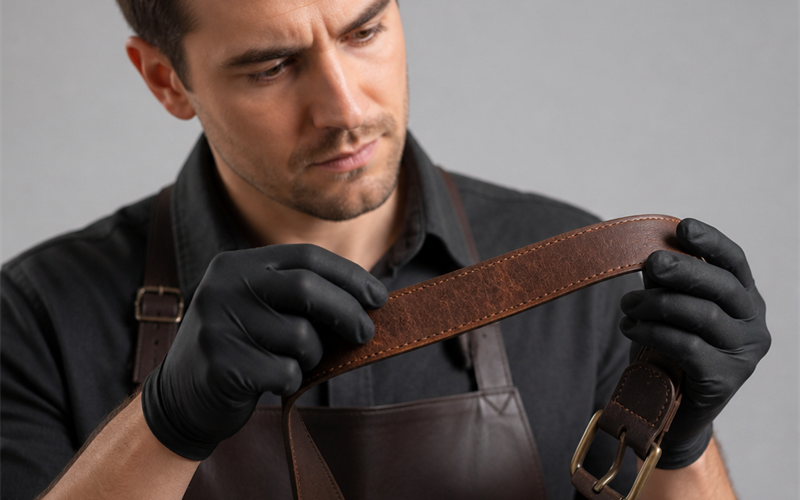
Four tests. (1) Smell — full-grain has a warm, complex leather smell; bonded leather often smells of chemical adhesive or plastic. (2) Bend — full-grain creases and smooths back; bonded leather creases and cracks. (3) Cut edge — full-grain shows a single dense fibrous cross-section; bonded shows a layered, almost cardboard-like edge with fabric visible. (4) Surface — full-grain shows natural variation (pores, scars); bonded shows a perfectly uniform stamped grain.

The cut edge is the most reliable single tell. Even when the surface looks convincing, the cut end of the belt strap exposes the construction immediately. Full-grain is one consistent layer all the way through; bonded shows distinct strata. Run a fingernail along the edge — bonded leather often releases tiny particles or fibers, while full-grain stays solid.
Full-grain vs bonded: at a glance
| Factor | Full-grain | Bonded leather |
|---|---|---|
| Composition | 100% hide, top layer | 10–20% leather + glue + fabric |
| Lifespan (daily wear) | 10–20+ years | 12–24 months |
| Patina | Yes — deepens and softens | No — cracks and peels |
| Restorable | Yes (full restoration possible) | No (no underlying leather) |
| Bend test | Creases, smooths back | Creases, cracks |
| Smell | Warm, complex | Plastic, glue |
| Cut edge | One dense layer | Layered, fabric visible |
| Price range | $80–$300+ | $15–$50 |
| Common labels | "100% full-grain leather" | "Genuine leather," "real leather," "bonded leather" |
| Sustainability | Long-lifespan, one hide per belt | Short-lifespan, mostly polyurethane |
Is bonded leather ever worth buying?
Almost never, in the long run. The temptation is the price — a bonded belt at $25 looks like a steal next to a $100 full-grain belt. The reality is that a full-grain belt routinely outlives 5–10 cycles of bonded belts. Total cost over 10 years: roughly the same. Total quality across that decade: night and day.

The math is unforgiving. Five $25 bonded belts over 10 years is $125 — more than one quality full-grain belt that would still be improving in year 10. And throughout that decade, the bonded belts are visibly cracking, flaking, and being replaced. The honest spot for bonded leather is in items you genuinely don't care about (a beater belt for yard work) or in furniture you'll replace anyway. For a daily belt, it's not the bargain it appears to be — we lay out the full cost-per-year math in are full-grain leather belts worth the investment.
BELTLEY 3-Material Rule
The 3-Material Rule = full-grain leather + stainless or solid brass buckle + sealed (painted or burnished) edges. Bonded leather can't clear the first leg of the rule by definition — and bonded leather belts almost universally fail the second and third legs too, because cheap material is paired with cheap hardware and unsealed edges. The rule isn't an arbitrary checklist; it's a single litmus for whether a belt belongs in your wardrobe for 12 months or 12 years.
Why is bonded leather so common in stores?
Because the margins are spectacular. Bonded leather is cheap to produce (scraps that would otherwise be waste, mixed with industrial glue) and can be sold for "leather belt" prices, especially when labeled "genuine." A mall belt counter can earn 5x the margin on bonded leather versus full-grain. The economic incentive to put bonded leather on shelves under vague labels is overwhelming, which is why most non-specialist retailers carry it.
The DTC counter-pressure is recent. Direct-to-consumer leather brands started competing in earnest in the 2010s by skipping the markup chain and selling genuine full-grain belts at the same price points mall retailers were charging for bonded. At BELTLEY, our DTC pricing on full-grain belts overlaps with the mall's bonded-leather range — we don't add a brand tax on top, and we don't need bonded scraps to hit a price.
What about sustainability?
Full-grain wins here too, despite the surface impression. Bonded leather looks sustainable because it reuses scraps, but it's about 80% non-biodegradable polyurethane and fabric backing — and its short lifespan means a constant replacement cycle. Full-grain leather, by contrast, is largely biodegradable, and a single belt that lasts 15 years replaces 5–10 short-lifespan straps.

The long-life argument is the real one. The most sustainable belt is the one you don't replace. A quality full-grain belt — vegetable-tanned, hand-finished, with solid hardware — extends its useful life by an order of magnitude over bonded. Our leather care page covers how to extend a full-grain belt's life with simple conditioning.
The Bottom Line
Full-grain and bonded leather are not the same product at different price points — they're fundamentally different materials sold under deceptively similar names. Full-grain is the top, unaltered layer of a single hide, capable of decades of wear and a real patina. Bonded leather is 10–20% shredded scrap leather glued to fabric and plastic, capable of about a year of wear before it starts flaking. The price gap is small; the lifespan gap is enormous; the labels often hide the difference deliberately. At BELTLEY, every belt we make is full-grain leather, paired with solid stainless or brass hardware and hand-finished edges, backed by a 10-year warranty. Ready to skip the bonded leather trap entirely? Browse our full-grain leather belts or men's collection.
Frequently Asked Questions
Q: Is bonded leather real leather?
Technically yes, but only 10–20% by composition. The rest is polyurethane binders, latex, and fabric backing. The leather content is shredded scrap dust pressed into a sheet — closer in structure to particleboard than to a hide.
Q: How can I tell if a belt is full-grain or bonded leather?
Look at the cut edge — full-grain shows one dense fibrous layer; bonded shows distinct strata with fabric visible. Bend the belt — full-grain creases and smooths back; bonded creases and cracks. And smell it — full-grain has a warm leather smell; bonded often smells of glue or plastic.
Q: How long does a bonded leather belt last?
Typically 12–24 months of daily wear before the surface coating cracks and starts peeling away from the fabric backing. A full-grain belt, by comparison, routinely lasts 10–20+ years and only gets better with age.
Q: Why is bonded leather labeled "genuine leather"?
"Genuine leather" is a vague legacy industry term that gets applied to bonded products even though the leather content is minimal. The label sounds premium but actually represents one of the lowest grades. Always look for the explicit word "full-grain" if you want quality.
Q: Is full-grain leather really worth the price difference?
Yes — the math favors it strongly. Five cheap bonded belts over 10 years usually costs more than one full-grain belt that's still going strong in year 10. And the full-grain belt looks better every year, while bonded looks worst within months.