Full-Grain vs PU / Vegan / Faux Leather Belt: Durability + Sustainability
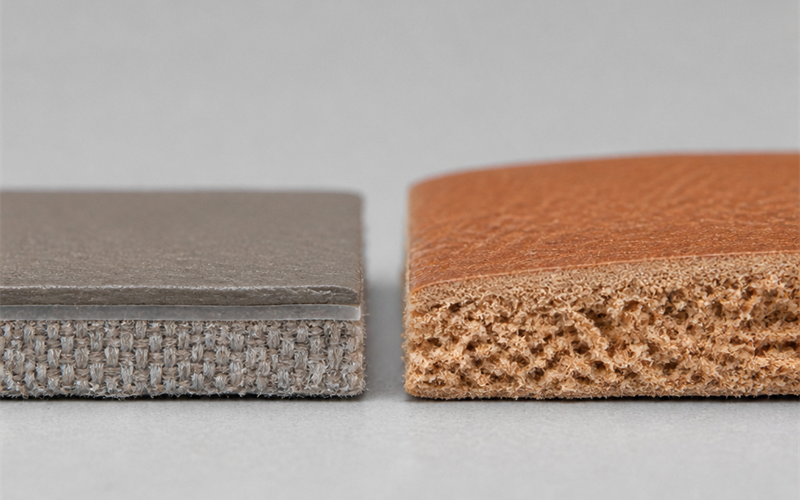
Quick answer: Full-grain leather is the unaltered top layer of a single cowhide; PU, vegan, and faux leather are synthetic plastic films (polyurethane or PVC) laminated onto a fabric backing. On durability, full-grain wins by a factor of 5–10x in lifespan. On sustainability, the answer is more honest than the marketing suggests: most "vegan leather" is petroleum-based plastic, while a long-life full-grain belt typically replaces 5–10 short-life synthetic belts over the same period.
Last updated: May 2026 • By BELTLEY Editorial
TL;DR:
- Full-grain = real hide; 10–20+ year lifespan; biodegradable; patinas.
- PU / vegan / faux = polyurethane or PVC on fabric; 12–24 month lifespan; mostly non-biodegradable.
- "Vegan leather" isn't synonymous with "plant-based" — 90%+ of vegan leather sold today is petroleum-derived plastic.
- True bio-based alternatives (mushroom, cactus, pineapple) exist but are rare, expensive, and unproven at belt scale.
The vegan leather conversation is rarely as clean as the marketing suggests. "PU leather," "vegan leather," and "faux leather" all describe the same basic product — a polyurethane plastic film on a fabric backing — sold under labels that vary by audience. Full-grain leather sits on the other side of the comparison: a real animal hide, with a much longer lifespan, a higher upfront price, and a complicated environmental footprint that depends entirely on how long the belt is worn. Below is the honest comparison on durability and sustainability — and the real cases where one or the other genuinely wins. For the broader buying checklist, see first real leather belt: 5 questions to ask.
Real Hide or Plastic Film: Decide With Eyes Open
The durability-and-ethics matrix:
| Your situation | Go with |
|---|---|
| Vegan commitment first | PU (never PVC), best quality you can find — an honest values purchase with a 1–3 year clock. |
| Durability per dollar | Full-grain — 5–10x the lifespan settles the math from $58. |
| Sustainability claim shopping | Read past "vegan = green" — petroleum film vs decades-long byproduct leather is the real comparison. |
| PU belt currently peeling | That's the material's endgame, not a defect — the upgrade path starts at full-grain. |
The 15–25 year option: BELTLEY's full-grain belts, 10-year warranty.
What is "vegan leather" actually made of?
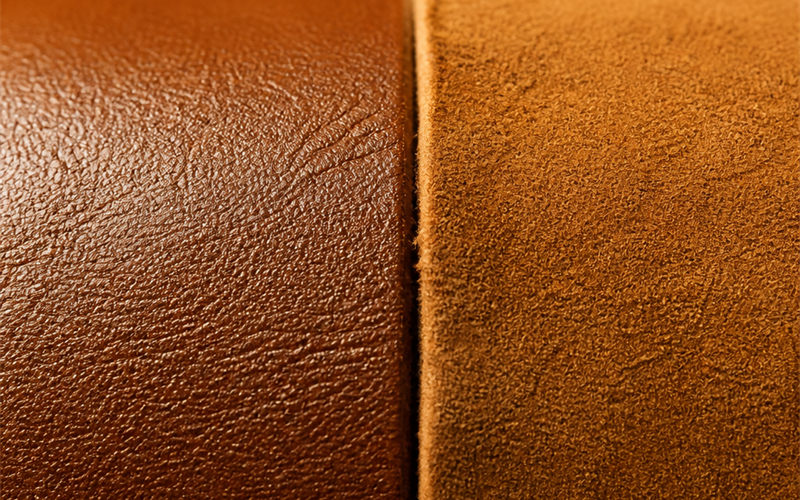
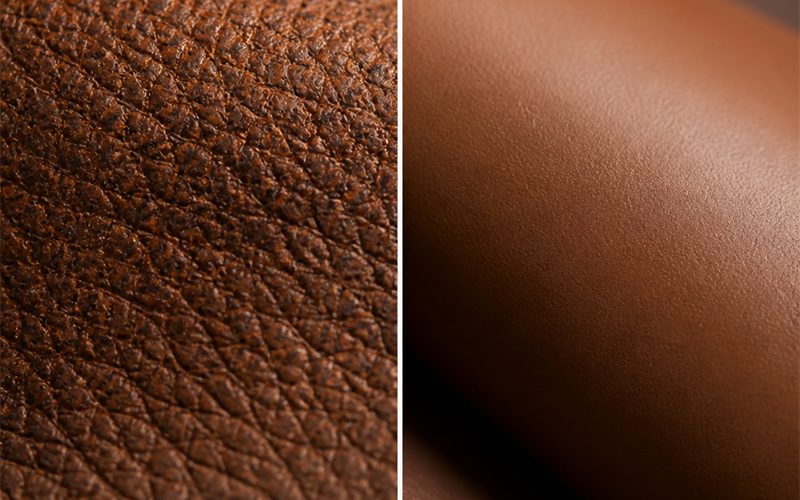
Almost always polyurethane (PU) or polyvinyl chloride (PVC) plastic. The vast majority of vegan, faux, and synthetic leather belts on the market are made by coating a fabric backing (usually polyester or cotton) with a layer of plastic, then embossing it with a leather-like grain pattern. The terms "vegan," "PU," "faux," and "synthetic" leather are largely interchangeable — they all describe the same petroleum-based product.

The language is the marketing. "Vegan leather" emphasizes the no-animal angle; "PU leather" highlights the material; "faux leather" is older retail wording; "pleather" is the slang. Underneath, it's almost always polyurethane — a plastic — laminated onto a fabric. Plant-based "leather" (made from mushroom mycelium, cactus, pineapple leaves, etc.) does exist, but it represents a tiny fraction of the synthetic-leather market and is rarely used in belts. Most things labeled "vegan leather" in 2026 are still 90%+ plastic.
How does each one compare on durability?
Full-grain wins decisively. A quality full-grain leather belt routinely lasts 10–20+ years with simple care. A PU or vegan leather belt typically lasts 12–24 months of daily wear before the plastic coating starts to crack, peel, and separate from the fabric backing — a failure mode similar to bonded leather. Higher-end synthetic leathers extend this somewhat, but few exceed 3 years.
The mechanical reason is structural. Full-grain leather's natural fiber network bends, stretches, and dries without delaminating. A plastic film bonded to fabric eventually fatigues at the bend points, especially around the buckle hole and the most-flexed section. Once the film starts peeling, restoration isn't possible — there's nothing underneath worth saving. The same is true with bonded leather, which fails the same way.
Key stat: A quality full-grain leather belt has a typical lifespan of 10–20+ years; PU or vegan leather belts average 12–24 months before the surface plastic begins to crack and peel. That's roughly a 5–10x lifespan difference.
What about the "vegan" environmental angle?
This is where the simple narrative breaks down. The intuitive answer — "no animals = better for the planet" — overlooks two facts: (1) most vegan leather is petroleum-based plastic with a meaningful carbon footprint, and (2) its short lifespan means a constant replacement cycle that compounds the environmental cost. A single full-grain belt that lasts 15 years often has a smaller total footprint than 5–10 PU belts over the same period.

The fiber matters more than the label. A PVC belt that lasts 18 months is made from petroleum, ends up in landfill, and doesn't biodegrade meaningfully — repeated 8 times over a 15-year period. A full-grain leather belt is mostly collagen, biodegradable, and lives as a single artifact through the same decade and a half. There are good ethical and environmental arguments on both sides, but "vegan" alone isn't the full story.
Are there genuinely sustainable plant-based leathers?
Yes, but they're rare and not yet common in belts. Mycelium-based leathers (Mylo, MycoWorks Reishi), pineapple-fiber leathers (Piñatex), cactus leathers (Desserto), and apple-skin leathers are real categories making real progress. The challenge is durability and scale — most plant-based leathers are still being tested for the long, repeated flex cycles a belt demands, and prices remain high.
The next-generation category is genuinely interesting. These bio-based materials skip both the animal-hide and the plastic-film tradeoffs. The honest 2026 status: plant-based "leather" is a credible category for handbags, sneakers, and accessories where flex is moderate, but most belt designs still use either real leather or PU because the durability isn't yet proven over decades. As the technology matures, more credible vegan belt options will likely appear.
Full-grain vs PU / vegan / faux leather: at a glance
| Factor | Full-grain leather | PU / vegan / faux leather |
|---|---|---|
| Material | 100% animal hide, top layer | Polyurethane or PVC + fabric backing |
| Typical lifespan | 10–20+ years | 12–24 months |
| Biodegradable | Yes (mostly) | No (plastic) |
| Patina | Yes, deepens over years | No — cracks and peels |
| Restorable | Yes | No |
| Carbon source | Animal hide (existing supply chain) | Petroleum |
| Animal use | Yes | No |
| Cost over 10 yrs | One belt, $80–$150 | 5–10 belts, $100–$250 total |
| Plant-based options | N/A | Rare (Mylo, Piñatex, Desserto) |
Which is more sustainable when you do the math?
For a belt worn daily, full-grain usually comes out ahead — if it's actually full-grain. The argument rests on lifespan: a belt that lasts 15 years and biodegrades is environmentally cheaper than 8 plastic belts that don't, even after accounting for the leather industry's water and emissions impact. The math flips if the "leather" belt is bonded or chrome-tanned cheap leather that doesn't last either — but a genuine vegetable-tanned full-grain belt is the long-life option in almost every real comparison.

The longevity test is the right framing. A belt's footprint per year of wear is the only honest metric. If you'll wear a belt for 15 years, the cost-per-year and footprint-per-year of full-grain is excellent. If you treat belts as fashion (replaced every season), the case is murkier — but in that case, neither option is meaningfully sustainable. We dig into the cost-per-year angle in are luxury belts worth it and are full-grain leather belts worth the investment.
BELTLEY 3-Material Rule
The 3-Material Rule = full-grain leather + stainless or solid brass buckle + sealed (painted or burnished) edges. PU, vegan, and faux belts almost universally fail all three legs — the surface is plastic, the hardware is plated, and the edges are usually cut-and-coated. The rule is a litmus for restorability and longevity, which is exactly where synthetic leather falls short. A belt that clears the rule replaces 5–10 synthetic belts over its lifetime.
When does PU / vegan leather actually make sense?
A few legitimate cases. (1) Strict ethical avoidance of animal products — for many vegans, no environmental math changes the principle, and that's a valid stance. (2) Wet environments where real leather will get repeatedly soaked (boating, certain sports). (3) Cheap fashion belts where intentional short-term wear is the goal. (4) Allergy considerations to leather tanning chemicals. For these specific cases, PU is the honest choice.

Outside those, the case is weak. The "sustainability" framing is the most misused — and it doesn't survive an honest lifecycle comparison for daily-wear belts. The "no animal use" framing is principled and personal, and the genuine plant-based alternatives are slowly catching up. Most other reasons to choose PU over full-grain come down to upfront price, which is partly an artifact of designer markup on leather goods more than a real materials cost. Our DTC full-grain belts typically overlap in price with mid-tier PU belts at department stores.
What about premium PU and "luxury vegan leather"?
Some are genuinely better, but still plastic. Premium PU leathers (sometimes called "microfiber leather" or "ultra-grade synthetic") use higher-quality polyurethane and finer fabric backings, extending lifespan to 2–4 years instead of 12–24 months. They feel and look closer to real leather, and they're a step up from bargain PU. Some luxury houses have committed to vegan lines made from these materials.
They're still synthetic. Lifespan is better but still well short of full-grain. The carbon footprint per year of use is closer to real leather than budget PU, but it doesn't beat full-grain over a multi-decade comparison. Honest premium PU is a reasonable choice for ethical-vegan wearers; misrepresenting it as more sustainable than full-grain doesn't hold up to scrutiny.
What about cleaning and care?
The two materials respond differently. PU and vegan leather can be wiped clean with a damp cloth and don't require conditioning — they're effectively maintenance-free, which is part of the appeal. Full-grain leather needs occasional conditioning (every 6 months) and benefits from being kept out of prolonged moisture. The trade-off: PU's "low maintenance" is partly a function of its shorter lifespan — you replace before you'd ever need to maintain.

Care is the long-life payoff. A few minutes of conditioning twice a year keeps a full-grain belt going for decades — see our leather care page. A PU belt doesn't need conditioning because it doesn't have leather to feed; once the plastic film cracks, no care can save it. The maintenance gap reverses the value over time.
The Bottom Line
Full-grain and PU/vegan/faux leather aren't really competing on the same axis. Full-grain is a long-life biodegradable animal-hide product; PU/vegan leather is a short-life plastic-on-fabric product sold under various labels. On durability, full-grain wins outright. On sustainability, full-grain usually wins over the lifespan, though the picture changes if you replace belts as fashion. Genuine plant-based leathers are the credible future of synthetic alternatives but aren't yet mainstream in belts. If your principle is no-animal-products, premium PU or emerging plant-based options are the right call. If your principle is buy-once-wear-forever, full-grain is. At BELTLEY, we make our full-grain leather belts with the 10–20 year goal in mind — solid hardware, hand-finished edges, and a 10-year warranty. Want a belt built to outlast a decade of plastic alternatives? Browse our men's collection.
Frequently Asked Questions
Q: Is vegan leather the same as PU or faux leather?
Almost always, yes. "Vegan," "PU," "faux," and "synthetic" leather are mostly interchangeable terms for polyurethane (or sometimes PVC) plastic laminated onto a fabric backing. True plant-based leathers (Mylo, Piñatex, Desserto) exist but are rare and rarely used in belts.
Q: Is vegan leather better for the environment than real leather?
Not necessarily. Vegan leather (PU/PVC) is petroleum-based and doesn't biodegrade. Its short lifespan (12–24 months) means frequent replacement, which compounds the environmental footprint. A 15-year full-grain belt often beats 5–10 PU belts on total impact.
Q: How long does a PU or vegan leather belt last?
Typically 12–24 months of daily wear before the plastic surface cracks and peels away from the fabric backing. Premium PU can extend this to 2–4 years. Full-grain leather, for comparison, lasts 10–20+ years.
Q: Are there genuinely plant-based vegan leather belts?
A few exist (Mylo from mushroom mycelium, Piñatex from pineapple, Desserto from cactus), but they're rare in belts because durability over years of flex isn't yet proven. As the materials mature, more credible plant-based belt options will appear.
Q: Why is full-grain leather more expensive upfront?
Because it's the top, unaltered layer of a single hide — a finite premium raw material that takes weeks to tan properly. PU is a manufactured plastic with much lower input costs. Over a 10-year window, full-grain often costs the same or less when you factor in the replacement cycle.
%20laminated%20onto%20a%20fabric%20backing.%20On%20d...)