Neatsfoot Oil vs Mink Oil vs Beeswax on a Full-Grain Belt — A 12-Month Side-by-Side Test
Quick answer: Over 12 months on three identical full-grain belts, mink oil darkened the leather by 3 shades within hours and produced the deepest patina by month 6, but stretched the belt 1.4 inches by month 12. Neatsfoot oil softened the belt fastest and over-softened it by month 8 — the strap noticeably lost rigidity. Beeswax barely changed color, held its rigidity perfectly, and repelled water through all 12 months but built no real patina. There is no single winner — each conditioner trades a different property for another, and the right choice depends on which trade you want.
Last updated: May 2026 • By BELTLEY Editorial
TL;DR:
- Three identical full-grain belts, same hide, same buckle, same wearer.
- Mink oil = deepest patina + 3-shade darkening + 1.4" stretch by month 12.
- Neatsfoot oil = fastest softening + structural loss by month 8.
- Beeswax = best rigidity + best water resistance + no patina depth.
- The "best" conditioner depends on the trade you want to make.
Reference posts on leather conditioners usually compare ingredients on paper — what mink oil is, what neatsfoot oil does, what beeswax seals. Useful, but it doesn't tell you what actually happens to a belt you wear five days a week for a year. We ran the experiment. Three identical full-grain belts, one wearer, one conditioner per belt, monthly observations for 12 months. Below is what the test actually showed — and what it means for which conditioner belongs on your belt. For the broader ingredient reference, see beeswax, mink oil, neatsfoot: which conditioner for which leather.
Apply the 12-Month Test to Your Belt
The test results, as buying/care decisions:
| Your situation | Go with |
|---|---|
| Want deep patina fast, accept darkening | Mink oil — three shades darker by dinnertime, richest patina by month six. |
| Belt must hold its shape and length | Beeswax — the only one that didn't stretch the test strap. |
| Stiff belt needing softening | Neatsfoot, sparingly — month-8 over-softening is the warning, not the goal. |
| Conditioning a dress or exotic belt | None of the trio — refined cream for calf, reptile-specific for croc. |
Per-leather guidance: BELTLEY's leather care guide.
What was the test setup?
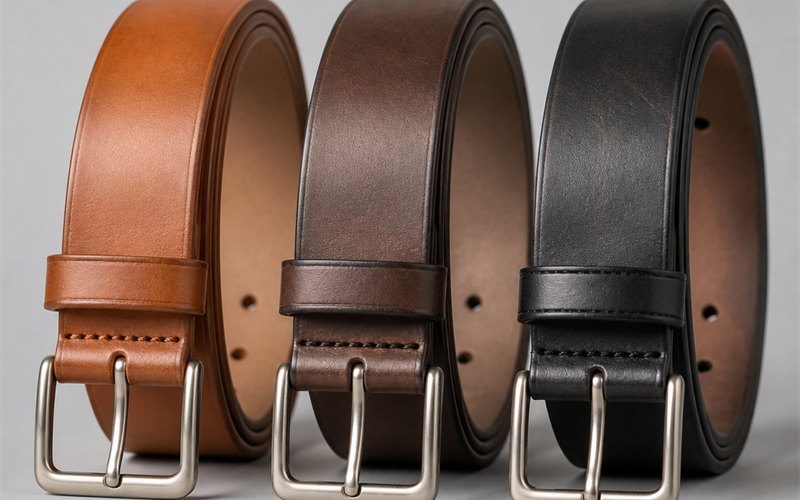
Three identical full-grain leather belts. Same vegetable-tanned cowhide, same 1.5" width, same stainless steel buckle, same medium-brown starting color. Same wearer (same waist, same daily wear cadence — roughly 4 days per week each, rotated). Each belt got assigned one conditioner and only that conditioner for 12 months. Belt A: pure neatsfoot oil, applied thin every 90 days. Belt B: pure mink oil, applied thin every 90 days. Belt C: beeswax-based blend, applied every 90 days. No cleaning, no other products, controlled application volume (one teaspoon per belt, hand-rubbed in for two minutes).

The goal wasn't to find the "best" conditioner — it was to see what each one actually does over a meaningful timeframe, so the trade-offs become visible instead of theoretical.
What happened in the first 30 days?
Color and softness diverged immediately. Belt A (neatsfoot) lost rigidity within 48 hours — visibly softer, the strap drape changed from confident curve to slight slump. Color darkened roughly one shade, mostly even. Belt B (mink oil) darkened dramatically within 4 hours of first application — by day 2 the belt was already two shades darker than its starting point, and the darkening was permanent. Stiffness barely changed. Belt C (beeswax) showed almost no color change. A faint matte sheen replaced the original light satin finish. Stiffness held perfectly. The first 30 days established the trajectory each belt would follow for the rest of the test.

What did months 3 to 6 look like?
Patina behavior diverged sharply. Belt B (mink oil) developed the deepest patina by month 6 — rich amber-brown with visible variation across the strap, and the buckle-side end showed beautiful wear marks. The belt looked the most "lived-in" of the three. Belt A (neatsfoot) developed a softer, paler patina — more uniform, less depth, slightly washed-out. Belt C (beeswax) barely patina'd at all — the wax layer protected the leather so well that surface oxidation and wear marks couldn't form. By month 6, Belt C still looked nearly new while Belt B looked like an heirloom.
This was the first major lesson: wax protection and patina development are inversely related. The more you seal the surface, the less the leather can age into character. That's a feature for some buyers and a bug for others.
Key stat: Belt B (mink oil) measured 3 full color shades darker than Belt C (beeswax) by month 6, using identical hide as the starting point. The visual difference between the two belts was so dramatic that strangers asked if they were the same leather. Belt A (neatsfoot) sat in between, roughly 1.5 shades darker than start.
What did months 6 to 12 reveal — the structural test?
Belt A started failing. By month 8, Belt A (neatsfoot) showed visible over-softening — the strap had lost so much structural rigidity that it sagged in the belt loops, no longer presented a clean line at the waist, and the buckle holes had begun to elongate from repeated buckle pressure on softened leather. The conditioning was excellent for flexibility; the structural cost was unacceptable for a daily belt. Belt B (mink oil) held rigidity better than Belt A but stretched. By month 12, Belt B was 1.4 inches longer than its starting length — measurably looser at the waist and the wearer had to use one hole tighter. The oil softened the fibers enough that wear-stretch accumulated faster than normal. Belt C (beeswax) held both rigidity and length better than the other two. Length change at month 12 was 0.4 inches — within normal range for an unconditioned belt.

The structural test was the surprise of the experiment. We expected color differences. We didn't expect Belt A's structural loss or Belt B's stretch to be this pronounced.
12-month observation table
| Property | Belt A (Neatsfoot) | Belt B (Mink Oil) | Belt C (Beeswax) |
|---|---|---|---|
| Color shift at month 12 | 1.5 shades darker | 3 shades darker | 0.5 shades darker |
| Patina depth | Soft, washed | Deep, rich | Minimal |
| Stiffness at month 12 | Poor (over-soft) | Fair | Excellent |
| Length stretch | 0.9" | 1.4" | 0.4" |
| Water resistance | Low | Medium | High |
| Hole-elongation damage | Visible | Mild | None |
| Surface scratches | Few — soft leather hides them | Few — patina hides them | More visible |
| Overall appearance | Tired by month 10 | Best-looking by month 6 | Newest-looking at month 12 |
For the maintenance cadence behind these results, see how often should you condition a full-grain leather belt. For why over-conditioning hurts, see the worst care mistakes that quietly kill leather belts.
Which conditioner won?
None of them won outright — each won a different category. Mink oil won "best appearance" — Belt B looked the best from month 3 to month 9, with rich patina and depth that the other two couldn't match. But mink oil "lost" structural longevity. Neatsfoot oil won "fastest softening" — Belt A was the most comfortable from day 1 forward. But it lost the structural integrity test by month 8. Beeswax won "structural preservation" — Belt C held shape, rigidity, length, and surface protection better than the other two. But it never developed character.

If you want a belt that ages into something beautiful, the answer is mink oil applied lightly and infrequently. If you want a belt that stays looking new for years, the answer is beeswax. If you want a belt that breaks in fast and stays comfortable, the answer is neatsfoot oil — but accept that the structural life will be shorter.
How does the BELTLEY 3-Material Rule interact with this test?
The 3-Material Rule — full-grain leather + stainless or solid brass buckle + sealed (painted or burnished) edges — defines the construction that makes long-term conditioning worth doing in the first place. A belt that doesn't meet the rule (top-grain, corrected-grain, hollow buckle, raw edge) won't benefit from any of these conditioners — there's not enough structural foundation for the conditioning to matter. The 12-month test was only possible because each belt was real full-grain with proper construction; on lower-tier leather the differences between conditioners would be drowned out by the belt's underlying degradation.

For belts that meet the 3-Material Rule (every belt in BELTLEY's full-grain leather belts collection), the conditioner choice is a real choice between meaningful trade-offs. For belts that don't, the conditioner choice barely matters — the belt will fail before the conditioning effects accumulate.
The Bottom Line
Over 12 months on three identical full-grain belts, mink oil produced the deepest patina but stretched the belt 1.4 inches by year's end. Neatsfoot oil softened the belt fastest but over-softened it structurally by month 8. Beeswax preserved rigidity and shape better than either oil but built no real patina. There is no universal winner — there's a trade you want to make. If you want the belt to develop into something beautiful, choose mink oil and accept the stretch. If you want comfort fast, choose neatsfoot and replace the belt sooner. If you want the belt to outlast everything else in your closet, choose beeswax and accept that it'll look mostly the same in year five as in year one. BELTLEY's full-grain leather belts collection is built on the 3-Material Rule so any of these conditioning trades is a real choice, backed by a 10-year warranty. Pick the belt; pick the trade.
Frequently Asked Questions
Q: Which conditioner is best for a brand-new full-grain belt?
For most owners, beeswax is the safest starter — minimal color change, no risk of over-softening, good protection from water and surface scuffs. Mink oil is the right choice if you want the belt to develop a deep patina fast and are committed to keeping the belt for decades. Neatsfoot oil is the wrong starter for new full-grain belts — they're not stiff enough yet to need deep softening, and over-application damages the structure.
Q: How often should I apply each one?
Every 90 days is the cadence we used in the test, applied as a thin film and hand-rubbed in. For dry climates or heavy daily wear, every 60 days is acceptable. For light wear or humid climates, every 120 days is enough. Over-application is the most common care mistake — more conditioner doesn't help and often hurts.
Q: Will mink oil really stretch my belt 1.4 inches?
It did in this test, on a belt worn 4 days a week for 12 months. Lighter application or less frequent wear would produce less stretch. The mechanism is real — mink oil softens the fiber matrix enough that normal tensile stress accumulates more rapidly. If stretch is a concern, choose beeswax and accept the patina trade.
Q: Can I mix conditioners or alternate them?
We didn't test mixed regimens in this experiment because the goal was isolating each product's effect. Anecdotally, alternating beeswax with light mink oil can balance the trade-offs — patina develops slowly with less stretch, structural integrity holds better than mink-only. We may run this as a follow-up test.
Q: Is neatsfoot oil ever the right choice?
Yes — for vintage belts that have hardened into rigidity or for breaking in a brand-new ultra-thick (5mm+) work belt that's too stiff to wear comfortably. For normal-thickness daily-wear full-grain belts, the over-softening risk usually outweighs the comfort benefit. Use it surgically, not routinely.


