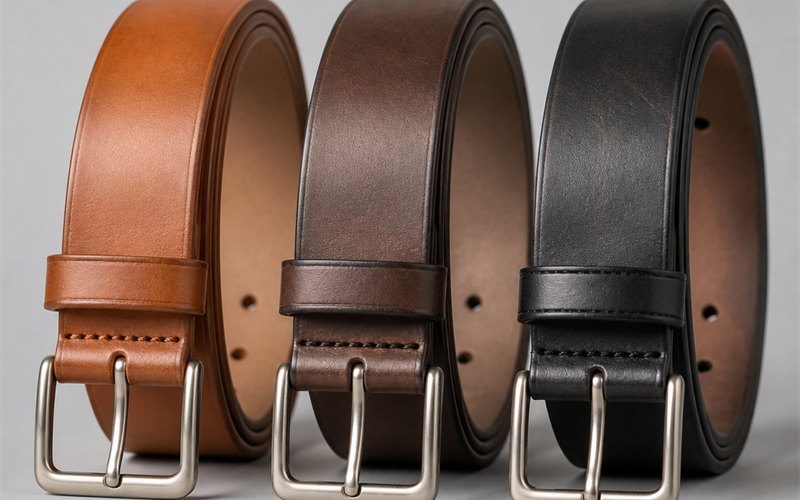
Full-Grain Leather Gun Belt vs Kydex-Reinforced Belt for IWB Carry
Quick answer: Both belt types hold a holster well for IWB carry — the choice depends on whether you prioritize aesthetics or maximum rigidity. Full-grain leather gun belts (double-layer or 5-7mm single-layer) offer excellent rigidity, classic appearance that works at work and on the range, and natural aging with patina. Kydex/polymer-reinforced belts insert a thin polymer stiffener between leather or nylon layers for extreme rigidity per dollar — best for heavy carry loads or visible tactical aesthetics. For office-friendly CCW where the belt also has to look like a normal dress or casual belt, full-grain leather is the standard. For pure performance with tactical aesthetics acceptable, Kydex-reinforced is the option.
Last updated: May 2026 • By BELTLEY Editorial
TL;DR:
- Both belt types work for IWB carry — choice depends on aesthetics vs maximum rigidity priority.
- Full-grain leather gun belt: classic look, ages well, works office-to-range, $150-$300.
- Kydex/polymer-reinforced: maximum stiffness per dollar, tactical aesthetic, $60-$150.
- Leather wins on appearance and dual-use; Kydex wins on stiffness-to-cost.
- BELTLEY 3-Material Rule applies to leather gun belts; Kydex belts use different criteria.
The leather-vs-Kydex debate is one of the most active discussions in CCW circles — and the honest answer is that both belt types work for IWB (inside the waistband) carry. The choice depends on what you're optimizing for: aesthetics and dual-use (work-to-range) wear vs maximum rigidity per dollar with tactical styling. Below is the honest comparison. For broader gun belt construction, see best full-grain leather gun belt for CCW and EDC.
Leather or Kydex Core: Your Carry, Your Call
The IWB decision by priority:
| Your situation | Go with |
|---|---|
| Office dress code + daily carry | Double-layer full-grain — holster-grade rigidity that still looks like a dress belt. |
| Maximum rigidity, looks secondary | Kydex-reinforced — the polymer core never relaxes. |
| One belt for range and restaurant | 5–7mm single-layer harness leather — the crossover spec. |
| Current belt sags by afternoon | It's a fashion belt doing structural work — either reinforcement path fixes it. |
Heavy-duty full-grain construction: BELTLEY's collection.
How does each belt type actually work?
Different rigidity-engineering approaches. Full-grain leather gun belts use either double-layer construction (two layers of full-grain laminated together for 6-7mm total) or single-layer 5-7mm dense harness/bridle leather. The rigidity comes from the leather's natural fiber density combined with construction thickness. Kydex/polymer-reinforced belts insert a thin (typically 0.06"-0.1") polymer stiffener between two outer layers of leather or nylon. The polymer provides most of the rigidity; the outer layers provide comfort and aesthetics.

Both approaches deliver the structural stiffness IWB carry requires (holster stays vertical, belt doesn't sag under firearm weight). The mechanical paths to that stiffness differ. Leather's stiffness is uniform and comes from natural fiber density; Kydex's stiffness comes from the embedded polymer plate. Both work; both have tradeoffs.
Which is stiffer — leather or Kydex-reinforced?
Kydex-reinforced is typically stiffer per dollar. A $80 Kydex-reinforced belt is often stiffer than a $150 standard leather gun belt — the embedded polymer plate is structurally efficient and inexpensive. At equivalent price points, Kydex tends to deliver more rigidity. At premium price points ($200+), top-quality double-layer leather gun belts can match or exceed Kydex stiffness, but the cost-per-stiffness math favors Kydex at lower budgets.
Practical implication: if maximum stiffness on a tight budget is the priority, Kydex-reinforced is the more cost-efficient choice. If you can spend $200+ and want leather, a premium double-layer gun belt matches Kydex performance. For typical CCW loads (compact 9mm + mag, ~2-3 lbs), both belt types are sufficient — the rigidity difference matters more for heavy carry loads or magazine-pouch-heavy setups.
Key stat: A typical Kydex-reinforced gun belt has roughly 20-40% greater stiffness than a single-layer leather gun belt of equivalent price — the polymer insert is mechanically efficient per dollar. Premium double-layer leather gun belts close the gap at the $200+ price tier, sometimes exceeding Kydex performance, but at meaningfully higher cost.
Which looks better in everyday wear?
Leather, unambiguously. Real full-grain leather gun belts look identical to standard full-grain dress or casual belts — they pair with business attire, casual outfits, and tactical wear with equal credibility. Kydex-reinforced belts often have visible tactical aesthetic cues (heavier construction, often visible polymer at the buckle area, nylon-heavy outer fabric on some models) that read distinctly utility-focused.

This is the key differentiator for many CCW users. A leather gun belt at the office reads as a normal belt; a tactical-styled Kydex belt at the office may signal "carrying" to observant viewers. For permitless or open-carry contexts where tactical signaling is acceptable, Kydex works fine. For discreet office CCW, leather is the more practical choice. See best full-grain leather gun belt for CCW and EDC for the leather option detail.
Leather gun belt vs Kydex-reinforced belt
| Feature | Full-grain leather | Kydex-reinforced |
|---|---|---|
| Construction | Double-layer or 5-7mm single | Leather/nylon + polymer insert |
| Stiffness per dollar | Lower at sub-$150; equivalent $200+ | Higher at sub-$150 |
| Maximum stiffness | High (premium tier matches Kydex) | Very high |
| Appearance | Classic, works in any context | Often tactical, may signal carry |
| Aging | Develops patina, ages beautifully | Mostly stable; nylon fades, polymer doesn't change |
| Weight | Moderate (heavier than dress belt) | Slightly lighter than equivalent leather |
| Comfort against skin | Natural, breaks in | Initially stiff, less breathable |
| Lifespan | 8-15+ years | 5-10+ years (varies by quality) |
| Cost range | $150-$300+ | $60-$150 |
| Best use case | Office CCW, dual-use work/range | Heavy carry, range-focused, tactical |
| BELTLEY 3-Material Rule | Applies | Different criteria |
When is Kydex-reinforced the better choice?
Four scenarios. (1) Heavy carry loads — full-size pistol + multiple magazines + light + knife; the extreme rigidity excels here. (2) Tight budget with maximum performance priority — Kydex delivers more stiffness per dollar at sub-$100 prices. (3) Pure range or tactical use — the tactical aesthetic isn't a concern. (4) Climates where leather suffers — extreme heat/humidity (where leather molds or degrades) or extreme cold (where leather stiffens unevenly).
For these specific use cases, Kydex's mechanical efficiency makes it the right tool. The aesthetic compromise doesn't matter for range-focused or pure tactical use, and the rigidity advantage is real.
When is leather the better choice?
Five scenarios. (1) Office CCW where the belt also has to look normal — leather's appearance is irreplaceable for discreet carry. (2) Dual-use work-to-range wear — one belt that works in business casual settings and on the range. (3) Long-term ownership focus — quality leather gun belts last 15+ years and develop personality. (4) Aesthetic preference for classic menswear — leather pairs better with traditional outfits. (5) Lighter carry loads — compact carry (single-stack 9mm + spare mag, ~2 lbs) doesn't need Kydex-level rigidity.

For the average CCW user with a compact pistol and standard daily carry needs, leather is usually the more versatile choice. The "office invisible" advantage matters more for daily users than the "absolute maximum rigidity" advantage matters for typical loads.
How does the BELTLEY 3-Material Rule apply here?
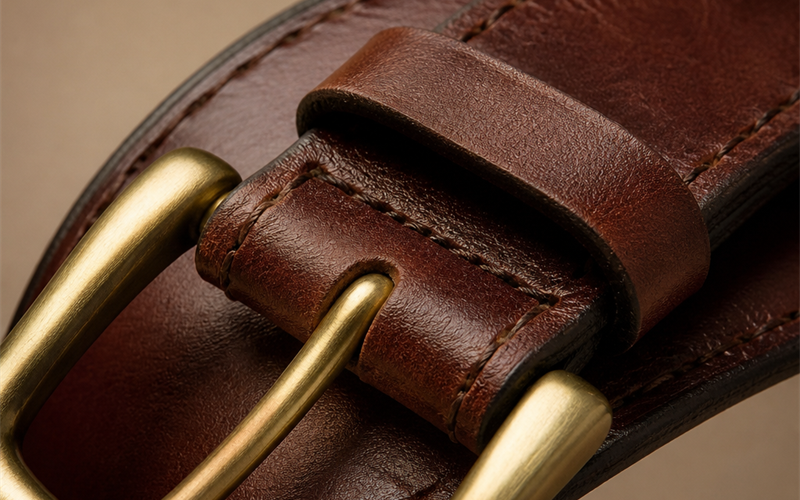
To leather gun belts; Kydex-reinforced uses different criteria. The BELTLEY 3-Material Rule — full-grain leather + stainless or solid brass buckle + sealed (painted or burnished) edges — applies to leather gun belts directly. A leather gun belt passing the rule is a 10-15+ year piece of carry gear. For Kydex-reinforced belts, the equivalent quality criteria are: full-grain or quality nylon outer layers, genuine Kydex (not generic ABS plastic) polymer insert, solid hardware, and reinforced stitching at the polymer boundary.

Both quality frameworks share the same underlying principle: real materials in solid hardware lasted with quality construction. Brand or marketing isn't the predictor; component quality is. See single-layer vs double-layer full-grain belt for the leather construction context.
What about hybrid belts — leather with polymer inserts?
Increasingly popular middle-ground option. Some manufacturers produce hybrid belts that combine full-grain leather outer construction with a polymer insert for extra rigidity. These belts look like quality leather belts (full appearance, classic aesthetic) while delivering Kydex-tier stiffness. The tradeoffs: typically more expensive than either pure leather or pure Kydex ($200-$400), and the polymer-leather interface can sometimes fail at the seam if the construction isn't tight.
For buyers who want both the rigidity of Kydex and the appearance of leather, hybrid belts are a reasonable compromise. Quality varies significantly — well-made hybrids are excellent multi-use belts; poorly-made ones suffer from both leather and polymer failure modes. Examine specifications carefully.
Which belt lasts longer?
Both can last 10+ years; leather lasts longer at the premium tier. Quality full-grain leather gun belts often last 15+ years with regular CCW use, particularly Hermann Oak or Wickett & Craig harness leather pieces. Quality Kydex-reinforced belts typically last 8-12 years before the polymer insert may show fatigue stress at flex points, or the outer layer separates from the polymer. Premium Kydex hybrids can match leather longevity but rarely exceed it.

The lifespan difference matters more for buyers planning 15-20+ year ownership. For 5-10 year ownership focus, both belt types are functionally equivalent on longevity.
The Bottom Line
Both full-grain leather gun belts and Kydex-reinforced belts work for IWB carry — the choice depends on what you're optimizing for. Leather wins on appearance, dual-use work-to-range wear, and long-term ownership; Kydex-reinforced wins on stiffness-per-dollar and maximum rigidity for heavy carry loads. For the average office CCW user with compact carry, leather is the more practical choice. For tactical-focused or heavy-load carriers on a tight budget, Kydex-reinforced is the cost-efficient option. The BELTLEY 3-Material Rule (full-grain + stainless or solid brass + sealed edges) applies to leather gun belts and identifies the long-term quality construction. BELTLEY's full-grain leather belt collection includes double-layer gun belt styles built for CCW use, backed by a 10-year warranty. Ready for a gun belt that works office to range? Start there.
Frequently Asked Questions
Q: Is a leather gun belt as stiff as a Kydex-reinforced belt?
At equivalent price points, no — Kydex-reinforced typically delivers more stiffness per dollar at sub-$150 prices. At premium price points ($200+), quality double-layer leather gun belts can match or exceed Kydex stiffness. For typical CCW loads (compact pistol + mag), both belt types are sufficient.
Q: Can I wear a Kydex-reinforced belt to the office?
Sometimes — depends on the belt's specific aesthetic. Some Kydex-reinforced belts look like standard leather belts (with the polymer hidden internally); others have visibly tactical construction (heavy nylon, visible polymer at the buckle area). For discreet office CCW, leather is usually the safer aesthetic choice.
Q: Which lasts longer — leather or Kydex?
Both can last 10+ years; leather often lasts longer at the premium tier. Quality full-grain gun belts routinely last 15+ years; quality Kydex-reinforced belts typically last 8-12 years before polymer fatigue or outer layer separation. For 15-20+ year ownership focus, leather has the edge.
Q: Are hybrid leather + polymer belts a good middle ground?
Sometimes — depends on construction quality. Well-made hybrid belts deliver both the appearance of leather and the rigidity of Kydex; poorly-made hybrids suffer from leather wear and polymer-leather interface failures. Examine specifications carefully; expect $200-$400 for quality hybrids.
Q: What's the most important feature for IWB carry?
Rigidity sufficient to hold the holster vertical under the firearm's weight, without belt sag or stretch over time. Both leather and Kydex-reinforced belts can provide this when properly constructed. Standard 4mm casual belts cannot — they sag within months of holster wear regardless of leather quality. The dedicated gun belt construction is the critical variable.