
Single-Layer vs Double-Layer Full-Grain Belt — When Each Makes Sense
Quick answer: Single-layer full-grain belts are made from one piece of leather (typically 3-6mm thick) — simpler, more flexible, and the standard for most dress and casual wear. Double-layer belts laminate two pieces of full-grain leather together (total 5-7mm) for greater rigidity — designed for heavy-duty applications like gun belts, work belts, and tool-belt support. Both are legitimate constructions; the choice depends on use. For everyday wear, single-layer is lighter and more comfortable. For load-bearing applications, double-layer holds its shape under stress. The BELTLEY 3-Material Rule applies equally to both — full-grain leather, solid hardware, sealed edges.
Last updated: May 2026 • By BELTLEY Editorial
TL;DR:
- Single-layer = one piece of leather, lighter, more flexible — standard for dress and casual.
- Double-layer = two laminated pieces, more rigid — standard for gun belts, work belts, heavy duty.
- Density of single-layer 5-6mm harness leather often matches double-layer rigidity.
- Double-layer has a distinctive lined edge appearance from the seam between layers.
- Price overlap exists — both constructions span the $80-$250 range depending on materials.
The single-vs-double-layer question comes up most often when buyers are looking at gun belts, work belts, or heavy-duty leather belts and notice the construction difference described in product specs. Both constructions are legitimate; both can produce excellent belts. The choice depends on intended use — and a top-quality single-layer 5-6mm harness belt can rival or exceed a budget double-layer belt in real-world performance. Below is the honest comparison. For load-bearing applications specifically, see best heavy-duty full-grain work belt for tradesmen and best full-grain leather gun belt for CCW and EDC.
One Layer or Two: Sized to the Job
Construction by load:
| Your situation | Go with |
|---|---|
| Dress and everyday wear | Single-layer 3–6mm — flexible, classic, all most waists ever need. |
| Tool belt, holster, real load | Double-layer 5–7mm — laminated rigidity built for weight. |
| Want stiffness without bulk | Dense single-layer harness leather — quality density rivals lamination. |
| Double-layer at a suspicious price | Check what's between the layers — cheap "double" belts hide filler, not full-grain. |
Honest construction specs: BELTLEY's full-grain collection.
What's the difference in construction?
Single-layer = one piece; double-layer = two pieces laminated together. Single-layer uses a single piece of full-grain leather cut to belt thickness (typically 3-6mm). The belt's strength comes from the natural fiber density of the leather itself. Double-layer laminates two thinner pieces of full-grain leather together (each typically 2-3mm) using adhesive and stitching, creating a total thickness of 5-7mm. The two layers combined are more rigid than either layer alone — sometimes more rigid than even a thicker single-layer belt.

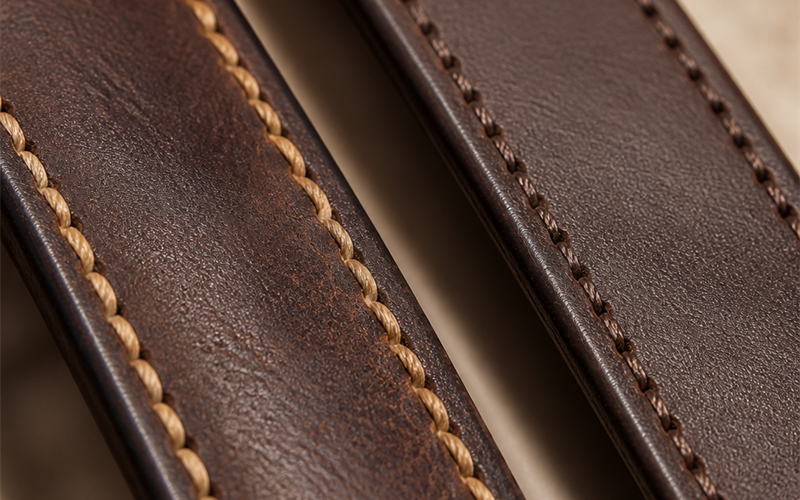
The visual difference is most apparent at the edges. Single-layer belts show a single solid cross-section. Double-layer belts show a visible seam where the two layers meet, often emphasized by a parallel row of stitching along each edge. The "lined" or "seamed" edge appearance is a quick visual identifier for double-layer construction.
When does single-layer make more sense?
Three scenarios. (1) Dress and business wear — single-layer 3-4mm full-grain calfskin is the dress belt standard; lighter, slimmer, more refined. Double-layer would be visually bulky and unnecessarily rigid. (2) Standard casual wear — single-layer 4-5mm pull-up or harness leather is the standard for jeans-and-chinos casual belts; flexible enough for comfort, durable enough for everyday use. (3) Heritage and traditional makers — most US heritage tannery belts (Hermann Oak, Wickett & Craig, Horween) are sold as single-layer because the leather density is sufficient on its own.
For 80%+ of belt buyers, single-layer construction in quality full-grain leather is the right answer. The exceptions are specific load-bearing applications (gun, work, heavy-duty) where the extra rigidity matters. See best full-grain leather dress belt for men and best full-grain casual belt for jeans and chinos for the standard applications.
When does double-layer make more sense?
Three scenarios. (1) Gun belts and CCW use — the rigidity prevents the belt from sagging under holstered firearm weight; standard for concealed-carry applications. (2) Tradesman and tool-belt support — the extra structural stiffness distributes tool weight better than single-layer. (3) Heavy-duty everyday use — buyers who carry pliers, multitools, or pouches on their belt benefit from the extra rigidity.

Double-layer construction earns its premium specifically in load-bearing contexts. For someone who carries nothing on their belt, double-layer is overkill — heavier and less flexible than needed. For someone who carries 1-3 pounds of gear daily, double-layer is the right tool. The use case determines whether the extra weight and rigidity are features or drawbacks.
Key stat: A typical double-layer 6mm full-grain belt has roughly 30-50% greater rigidity than a single-layer 4mm belt and 10-20% greater rigidity than a single-layer 5mm belt. The premium is real for load-bearing use but adds 40-60% to the belt's weight — noticeable in daily wear if you don't need the rigidity.
How do single-layer and double-layer compare in lifespan?
Both can last 10-15+ years with proper care; the failure modes differ. Single-layer belts may eventually develop fiber wear at high-flex points (back of the belt where it wraps around the body) over many years. Double-layer belts may eventually develop delamination at the seam between layers if the adhesive fails (rare with quality construction, more common with cheap construction). Both are decade-plus belts when made with quality materials and reasonable care.

The lifespan question is more about leather quality and construction quality than single-vs-double-layer specifically. A premium single-layer belt outlasts a budget double-layer belt; a premium double-layer outlasts a budget single-layer. Material and craft matter more than the layering decision.
Single-layer vs double-layer comparison
| Feature | Single-layer | Double-layer |
|---|---|---|
| Construction | One piece full-grain | Two pieces laminated |
| Total thickness | 3-6mm | 5-7mm |
| Edge appearance | Single cross-section | Visible seam between layers |
| Stitching | Often single-row or none | Often double-row along edges |
| Weight | Lighter | Heavier (40-60% more) |
| Flexibility | Higher | Lower (more rigid) |
| Best for | Dress, casual, everyday | Gun belts, work, heavy-duty |
| Lifespan | 10-15+ years | 10-15+ years |
| Failure mode (rare) | Fiber wear at flex points | Layer delamination |
| Price range | $80-$250 | $100-$300 |
| Heritage tradition | US and Italian tannery belts | Some specialty heavy-duty |
Does a dense single-layer match double-layer rigidity?
Often yes — top-quality 5-6mm harness or bridle leather can equal double-layer stiffness. Hermann Oak, Wickett & Craig, and Horween harness leather in 5-6mm thickness is one of the densest, most rigid belt materials available — sometimes more rigid than a budget double-layer construction. The "more layers = stiffer" intuition isn't always true; leather density and quality matter more than layer count.
This is why some heritage US gun belt makers produce single-layer 6mm harness belts that rival or exceed double-layer competitors in real-world performance. Layer count is one variable; leather quality is another. For premium budgets, a dense single-layer harness belt and a quality double-layer belt are roughly equivalent for load-bearing applications. See saddle vs harness vs bridle leather.
How does the BELTLEY 3-Material Rule apply here?
Equally to both constructions. The BELTLEY 3-Material Rule — full-grain leather + stainless or solid brass buckle + sealed (painted or burnished) edges — describes the material foundation, regardless of single-vs-double-layer construction. A quality single-layer belt passes the rule; a quality double-layer belt passes the rule. A poor-quality double-layer belt (cheap leather, plated zinc buckle, raw edges) fails the rule despite the "premium" double-layer marketing.

The 3-Material Rule is the more important filter than layer count. A belt passing the rule is a real long-term piece; a belt failing the rule is disposable regardless of construction. Layer count is a use-case decision; the 3-Material Rule is the quality threshold.
What about price differences?
Overlap exists; expect $80-$300 across both constructions. Single-layer belts span $80-$250 depending on materials and craft (heritage tannery leather and small-batch makers at the higher end; DTC standard at the lower end). Double-layer belts span $100-$300 — slightly higher entry price due to the extra leather and construction labor, with similar upper range. The same brand may offer both constructions at similar premium-tier prices for premium customers; the construction choice is use-case rather than premium signaling.

A double-layer belt isn't automatically "better" than a single-layer belt; it's different. A budget double-layer belt with corrected-grain or plated hardware is worse than a premium single-layer belt with quality leather and solid hardware, despite the layer-count advantage. See why is full-grain leather so expensive for the broader cost framing.
The Bottom Line
Single-layer vs double-layer full-grain belts is a use-case decision, not a quality decision. Single-layer is the standard for dress, casual, and everyday wear — lighter, more flexible, more refined. Double-layer is the standard for load-bearing applications — gun belts, work belts, tool-belt support — where rigidity matters. Both can produce excellent belts; both can be cheap and poor-quality. The BELTLEY 3-Material Rule (full-grain leather + stainless or solid brass buckle + sealed edges) applies equally to both. For 80%+ of buyers, single-layer is the right answer; for load-bearing use, double-layer earns its premium. Match construction to use, not to assumed quality. BELTLEY's full-grain leather belt collection and men's collection include both single-layer and double-layer styles in real full-grain leather — backed by a 10-year warranty. Ready for a belt matched to how you'll actually use it? Start there.
Frequently Asked Questions
Q: What's better — single-layer or double-layer leather belt?
Neither is universally better — they serve different uses. Single-layer is best for dress, casual, and everyday wear (lighter, more flexible). Double-layer is best for load-bearing applications like gun belts, work belts, and heavy-duty everyday carry (more rigid). Match the construction to your actual use case.
Q: Are double-layer belts heavier than single-layer?
Yes — typically 40-60% heavier for similar leather quality. A single-layer 4mm belt feels light and flexible; a double-layer 6mm belt feels substantial and rigid. The weight difference is noticeable in daily wear and is the main reason single-layer is preferred for non-load-bearing use.
Q: Can a single-layer belt match a double-layer belt for stiffness?
Yes, if the leather is dense enough. Top-quality 5-6mm harness or bridle leather (Hermann Oak, Wickett & Craig, Horween) in single-layer construction can equal or exceed double-layer rigidity for load-bearing applications. Layer count matters less than leather quality and total thickness.
Q: Do double-layer belts last longer than single-layer?
Not necessarily — both can last 10-15+ years with quality construction. The failure modes differ: single-layer may eventually show fiber wear at flex points; double-layer may eventually show delamination at the seam if adhesive fails. Material and craft quality matter more than the layering decision.
Q: Is a double-layer belt always more expensive?
Slightly, on average — double-layer entry pricing is $100-$120 vs $80-$100 for single-layer entry pricing — but premium ranges overlap entirely at $200-$300. A budget double-layer belt isn't automatically better than a premium single-layer belt; check the material and construction quality first.

%20%E2%80%94%20simpler,%20more%20flexible,%20and%20the%20standard%20for%20most%20dress%20and%20casual%20wear.%20Double-layer%20belts...)