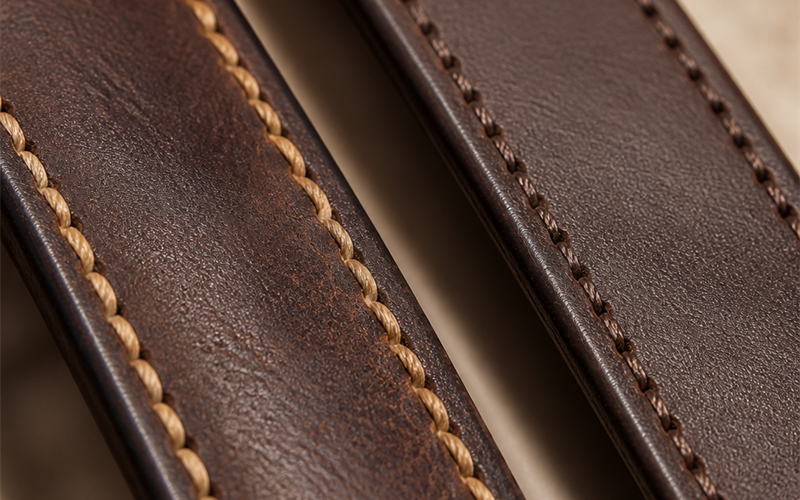
Hand-Stitched vs Machine-Stitched Full-Grain Belts — Honest Comparison
Quick answer: Hand-stitched (specifically "saddle stitched") leather belts use two needles working from opposite sides of the leather, creating a stronger lock-stitch that won't unravel if one thread breaks. Machine-stitched belts use a single thread with a bobbin underneath — faster to produce, slightly less robust if a stitch fails. For most belts in normal use, both stitching methods last 10-15+ years; hand-stitching offers a marginal durability edge and significantly higher craft value. The honest reality: most claims of "hand-stitched" leather belts under $200 are partial — usually only visible stitching is done by hand. True full hand-stitching is rare and signals a $250+ price tier.
Last updated: May 2026 • By BELTLEY Editorial
TL;DR:
- Hand-stitched (saddle stitch) = two needles, lock-stitch; won't unravel if a thread breaks.
- Machine-stitched = single thread + bobbin; faster, slightly less robust at failure.
- Both last 10-15+ years in normal use — the difference is craft value more than durability.
- "Hand-stitched" labels on sub-$200 belts often refer only to visible stitching, not full construction.
- True full hand-stitching is a $250+ price tier and slow production process.
The hand-stitched vs machine-stitched debate generates more confusion than most leather construction comparisons. Marketing claims of "hand-stitched" belts at $80 price points coexist with genuinely hand-stitched belts at $400 — the same label covers very different products. The honest truth: both stitching methods produce excellent belts when applied to quality leather; the practical durability difference is small; the craft and price differences are significant. Below is the honest comparison. For broader construction context, see single-layer vs double-layer full-grain belt.
Is Hand-Stitching Worth It on YOUR Belt?
The honest allocation:
| Your situation | Go with |
|---|---|
| Heavy daily wear, decades intended | Saddle-stitched — the two-needle lock that survives a broken thread. |
| Normal wear, fair budget | Quality machine stitching serves fine — density and thread quality matter more than method. |
| Verifying a "hand-stitched" claim | Look for the slight angle in each stitch — machine rows are laser-straight; hand stitches lean. |
| Paying double for the word alone | Don't — pay for it where it counts: the buckle loop and keeper, the stress points. |
Stress-point stitching done right: BELTLEY's men's collection.
What's the actual difference in stitching technique?
Two fundamentally different stitch structures. Saddle stitch (hand-stitched) uses two needles, one on each end of the same thread, passing through pre-punched holes from opposite sides of the leather. Each stitch creates an interlocking knot inside the hole that locks the thread in place — if one stitch breaks, the surrounding stitches don't unravel because each is independently locked. Machine stitch (lockstitch) uses a single needle threaded from above and a bobbin thread below, with the two threads interlocking at each stitch point. Fast, consistent, and strong — but if one stitch breaks, the surrounding stitches can gradually unravel along the row.

Both methods produce strong seams. Saddle stitching has a slight failure-mode advantage; machine stitching has a major production-speed advantage. For most belts in most use cases, both methods last for the belt's full lifespan without any stitch failure occurring.
How can you tell hand-stitching from machine-stitching?
Three visual differences. (1) Stitch angle — hand-stitching shows slightly angled stitches because each is pulled by hand at a consistent angle (often visible as a "diagonal" appearance). Machine-stitching shows perfectly perpendicular stitches at uniform angle. (2) Stitch consistency — hand-stitching shows minor variation in stitch length and tension (very slight, but detectable to a trained eye). Machine-stitching shows mechanical perfection across every stitch. (3) Back-side appearance — hand-stitching looks identical front and back (because both sides are sewn simultaneously). Machine-stitching often shows slight asymmetry between the top stitch and the bobbin-side stitch.
Most consumers can't reliably distinguish the two from photos. The most reliable identification is examining the back of a stitched seam — true hand-stitching has identical character on both sides; machine-stitching shows the bobbin pattern beneath.
Does hand-stitching last longer than machine-stitching?
Marginally, in failure scenarios — but in normal use, both last 10-15+ years. The lock-stitch advantage of saddle stitching matters only if a stitch actually fails — and on full-grain leather belts in normal use, individual stitch failure is rare. Both stitching methods produce seams that outlast the leather itself in most cases. The "hand-stitched lasts longer" claim is technically true but practically rarely matters.

Where saddle stitching does matter: high-stress applications (saddles, harnesses, heavy-duty work gear) where individual stitch failure is more likely and where the lock-stitch advantage compounds over decades. For everyday belt use, the practical durability difference is small enough to not be a decisive factor.
Key stat: True saddle stitching takes roughly 8-15x longer to produce than machine stitching for an equivalent belt length — a 36-inch belt might require 20-40 minutes of hand-stitching vs 2-3 minutes of machine stitching. The production time difference is the entire reason hand-stitched belts cost significantly more.
What does "hand-stitched" usually mean in marketing?
Often less than the label implies. Many belts labeled "hand-stitched" at the $80-$200 price point are actually mostly machine-stitched with hand-stitching only on visible decorative areas (the keeper loop attachment, the buckle keeper, or a small visible section). The bulk of the belt's structural stitching is machine-sewn for production efficiency; the hand-stitching is a craftsmanship signal rather than a structural element.

This isn't necessarily deceptive — partial hand-stitching does add craft value and visual appeal. But buyers should understand that "hand-stitched" on a $100 belt usually doesn't mean every stitch is hand-sewn. True full hand-stitching is rare and typically signals a $250+ price tier with small-batch artisan production. See american vs italian full-grain leather belts for the heritage maker context.
Stitching comparison
| Feature | Hand-stitched (saddle) | Machine-stitched |
|---|---|---|
| Stitch structure | Two-needle lock-stitch | Single-thread + bobbin |
| Failure resistance | Won't unravel if one stitch breaks | Can unravel along the row |
| Production time per belt | 20-40 min | 2-3 min |
| Stitch consistency | Slight handmade variation | Mechanical uniformity |
| Front-back symmetry | Identical | Slight asymmetry |
| Typical price tier | $250+ (true full hand-stitching) | $50-$300 |
| Common at $80-$200 | "Partial" hand-stitching only | Standard |
| Practical lifespan | 10-15+ years | 10-15+ years |
| Craft / artisan value | High | Low |
When is hand-stitching genuinely worth paying for?
Three scenarios. (1) Premium small-batch makers — buying from a named artisan or workshop where hand-stitching is part of the maker's signature; the craft attribution is the value. (2) Heavy-duty leather goods — saddles, harnesses, and very heavy-duty belts genuinely benefit from saddle-stitch's failure resistance over decades. (3) Aesthetic and craft appreciation — for buyers who value visible craft work, hand-stitching is a meaningful detail.
When hand-stitching is less critical: standard dress and casual belts in normal use, where machine-stitching delivers equivalent practical lifespan at significantly lower cost. The honest framing: hand-stitching is a craft choice as much as a durability choice. If craft attribution matters to you, pay for it; if functional durability is the priority, machine-stitching delivers equivalent results.
Does stitch type affect the belt's appearance?
Yes, subtly. Hand-stitched belts often have a slightly more "handmade" character — the minor variation in stitch length and tension reads as authentic craft. Machine-stitched belts look perfectly uniform — clean, modern, and consistent. Both look professional; the visual character is different.

The visible difference is most apparent on belts where the stitching runs along visible edges (the entire belt length stitched). On belts where stitching is minimal or only at attachment points, the type matters less visually. For dress belts, machine-stitching's clean uniformity often looks more appropriate; for casual heritage-style belts, hand-stitching's visible craft character can be the right aesthetic.
What about double-row stitching (one method or both)?
Mostly machine-stitched. Most belts with double-row stitching along both edges use machine stitching for both rows — the production efficiency makes double-row practical. True hand-stitched double-row belts exist (typically heritage or small-batch makers) but are uncommon and very expensive. See single-layer vs double-layer full-grain belt for the construction context where double-row stitching often appears.

Double-row stitching itself is a quality signal — it's mechanically stronger than single-row and typically appears on better belts. Whether the rows are hand or machine stitched is a separate question. A machine-stitched double-row belt often outperforms a hand-stitched single-row belt for structural strength; both can be excellent.
The Bottom Line
Hand-stitched vs machine-stitched leather belts is mostly a craft and price decision, not a practical durability decision. Saddle stitching has a slight failure-mode advantage (won't unravel if one stitch breaks) and significantly higher craft value; machine stitching has a major production-speed advantage and equivalent practical lifespan in normal use. Both methods last 10-15+ years on full-grain leather belts when properly executed. "Hand-stitched" labels on sub-$200 belts often refer to partial decorative stitching only; true full hand-stitching is a $250+ price tier. For most buyers, machine-stitched belts in quality full-grain leather are the right value; for buyers who value visible craft attribution, hand-stitching is worth the premium. BELTLEY's full-grain leather belt collection includes tight machine stitching with reinforced attachment points designed for decade-plus durability — backed by a 10-year warranty. Ready for a belt where craft signals match real durability? Start there.
Frequently Asked Questions
Q: Is hand-stitched leather better than machine-stitched?
Slightly more durable in failure scenarios (won't unravel if one stitch breaks) but in normal use, both produce belts that last 10-15+ years. Hand-stitching has significantly higher craft value and price; machine-stitching has equivalent practical lifespan at lower cost. The right answer depends on whether craft attribution matters to you.
Q: How can you tell if a belt is really hand-stitched?
Look at the back of a stitched seam — true hand-stitching is identical on both sides because both are sewn simultaneously by two needles. Machine-stitching shows the bobbin pattern beneath the visible top stitch, with slight asymmetry between front and back. Hand-stitching also shows slight variation in stitch length and tension; machine-stitching shows mechanical uniformity.
Q: Why are hand-stitched belts so expensive?
Production time. True saddle stitching takes 8-15x longer than machine stitching for an equivalent belt length — 20-40 minutes per belt vs 2-3 minutes. The labor cost difference accounts for most of the price premium. A $250+ price tier typically reflects genuine full hand-stitching; sub-$200 prices usually indicate partial or decorative hand-stitching only.
Q: Will machine-stitched belts unravel over time?
Rarely, in normal use. If a single stitch breaks on a machine-stitched belt, the surrounding stitches can theoretically unravel — but quality machine stitching on full-grain leather with proper thread typically doesn't break individual stitches within the belt's lifespan. The unravel risk is theoretical for most users, not a practical concern.
Q: Is saddle stitching the same as hand-stitching?
Effectively yes, in modern leather goods context. "Saddle stitching" specifically refers to the two-needle interlocking technique used historically for saddles, harnesses, and heavy leather goods. Modern hand-stitched leather belts use the saddle stitch technique. The two terms are often used interchangeably for premium leather belt construction.


%20leather%20belts%20use%20two%20needles%20working%20from%20opposite%20sides%20of%20the%20leather,%20creating%20a%20stronger%20lock-stitch%20that%20won't%20unravel%20if%20one%20thr...)