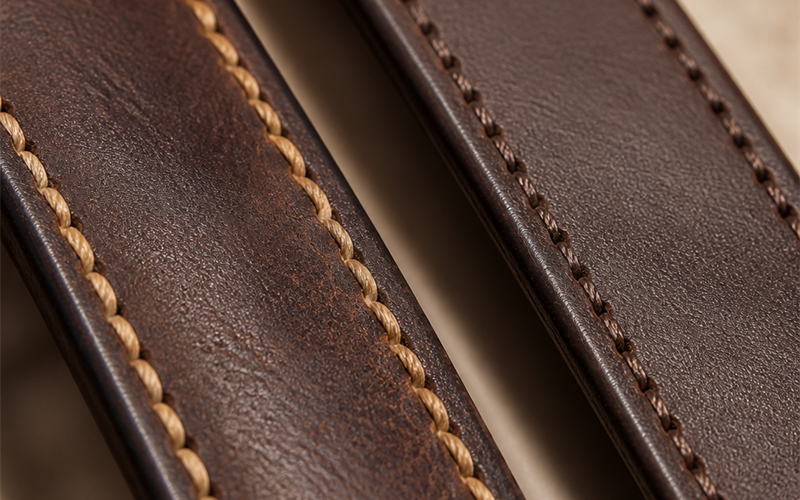
Raw Edge vs Burnished Edge vs Painted Edge — Full-Grain Finishing
Quick answer: Three standard edge treatments for full-grain leather belts. Raw edges are left unfinished — fastest to produce, fray over time, almost always indicate a cheap or unfinished belt. Burnished edges are mechanically smoothed and waxed using heat and friction — the heritage tradition; smooth, slightly rounded, ages beautifully. Painted edges are sealed with leather edge paint (typically polyurethane-based) — slick, color-matched, more weather-resistant but can chip over years of wear. Both burnished and painted edges signal quality; raw edges almost always signal cost-cutting. The BELTLEY 3-Material Rule requires sealed edges (burnished or painted) — not raw.
Last updated: May 2026 • By BELTLEY Editorial
TL;DR:
- Raw edges = unfinished, prone to fraying — almost always a quality red flag.
- Burnished edges = heritage tradition, smoothed by heat/friction, ages with the leather.
- Painted edges = sealed with leather edge paint, slick finish, slightly more weather-resistant.
- Both burnished and painted are quality; choose based on aesthetic preference.
- Sealed edges (either method) are part of the BELTLEY 3-Material Rule.
Edge finishing is one of the most overlooked quality signals on a leather belt — and one of the most reliable. A belt's edges reveal more about its overall construction quality than any other single detail. Raw, unfinished edges almost always indicate budget production; quality burnished or painted edges signal real craft attention. Below is the honest comparison of all three edge treatments. For the broader quality framework, see what does "100% full-grain leather" actually mean.
Edge Check: What's on the Belt You're Holding?
Three edges, three verdicts:
| Your situation | Go with |
|---|---|
| Raw, fuzzy, unfinished edge | Put it down — the maker stopped before the belt was done; fraying follows. |
| Smooth waxed burnished edge | The heritage standard — ages with the strap and refreshes with wax at home. |
| Glossy painted edge | The dress standard — sharp and boutique; budget an edge re-seal around year three. |
| Buying for hardest daily wear | Burnished — nothing to chip, everything to develop. |
Finished edges, never raw: BELTLEY's full-grain belts, from $58.
What does each edge treatment actually mean?
Three distinct finishing approaches. Raw edges are simply the cut surface of the leather, left unfinished after the strap is cut from the hide. The fibers are visible and exposed. Burnished edges are mechanically smoothed using a burnishing tool (often a wooden or canvas wheel under high friction) combined with water, beeswax, or gum tragacanth. The friction-generated heat and lubricant compress the leather fibers into a smooth, slightly rounded edge. Painted edges are sealed with a polyurethane-based leather edge paint applied in multiple thin coats, sanded smooth between coats, then cured to a slick color-matched finish.

The visual difference is unmistakable. Raw edges show visible fiber strands; burnished edges show a smooth natural-leather-colored rounded edge; painted edges show a slick uniformly-colored finish (often black, brown, or matched to the belt's main color). All three serve different aesthetic and quality goals.
Why are raw edges a quality concern?
Because they fray over time and almost always indicate budget production. A raw leather edge is exposed fiber — over months of wear, friction with belt loops, clothing, and skin causes the fibers to fray, fuzz, and eventually unravel. The result is a rough, frayed edge that looks unfinished within months and ratty within 1-2 years.
Raw edges also signal manufacturer cost-cutting. Edge finishing (burnishing or painting) takes 5-15 minutes per belt and requires skill. Skipping the step saves production cost — and brands willing to skip edge finishing typically cut corners on other construction details too. Raw edges on a leather belt are almost never a deliberate aesthetic choice; they're a cost choice that owners pay for in shortened belt lifespan.
Key stat: A raw-edge leather belt typically shows visible fraying within 3-6 months of regular wear; a properly burnished or painted edge stays smooth and intact for 10-15+ years. The edge finishing step is one of the cheapest quality signals to verify and one of the most predictive of overall belt longevity.
What's the burnished edge tradition?
Heritage workshop standard. Burnishing is the traditional edge finishing technique used by saddlemakers and heritage leather workshops for centuries. The process: apply water, gum tragacanth, or beeswax to the cut edge; rub repeatedly with a burnishing tool (wooden block, canvas wheel, or specialized burnisher) until friction heat compresses the fibers into a smooth, polished edge; finish with additional beeswax for water resistance and gloss.

The result is a smooth, slightly rounded edge that maintains the leather's natural color, develops patina with the rest of the belt, and ages beautifully over decades. Burnished edges are the heritage US tannery standard (Hermann Oak, Wickett & Craig, Horween belts often feature burnished edges) and the small-batch artisan standard worldwide. See american vs italian full-grain leather belts for the heritage context.
Edge treatment comparison
| Feature | Raw edge | Burnished edge | Painted edge |
|---|---|---|---|
| Process | Left unfinished | Heat/friction smoothing | Multiple thin paint coats |
| Production time | None | 5-10 min per belt | 10-15 min per belt |
| Visual character | Visible fibers, rough | Smooth, rounded, natural | Slick, color-matched, sharp |
| Aging | Frays over months | Develops patina with belt | Can chip slowly over years |
| Water resistance | Low | Medium | High |
| Repair if damaged | Difficult | Re-burnish (easy) | Sand and repaint |
| Quality signal | Negative — cost-cutting | Positive — heritage | Positive — modern luxury |
| Common at price | Sub-$50 | $80+ | $100+ |
| Lifespan | 1-2 years before visible fraying | 10-15+ years | 10-15+ years |
| BELTLEY 3-Material Rule | Fails | Passes | Passes |
What's the modern painted-edge tradition?
Italian and modern luxury standard. Painted edge finishing emerged from Italian luxury leather goods makers in the 20th century and has become the standard for modern dress and luxury belts. The process: sand the cut edge smooth; apply 3-6 thin coats of polyurethane-based leather edge paint, sanding between coats; cure with heat or air-dry; finish with a clear sealant. The result is a slick, glassy, color-matched edge — usually in black, dark brown, or precisely matched to the belt color.
Painted edges have a more refined, modern look than burnished edges — slick rather than soft, sharp rather than rounded. They're the standard for dress belts and luxury fashion belts. Italian makers excel at painted edges; the technique is widely used by quality DTC brands seeking a refined aesthetic. See american vs italian full-grain leather belts.
When is burnished better, and when is painted better?
Match the edge treatment to the belt's aesthetic. Choose burnished for: heritage casual belts, harness and pull-up leather styles, rugged or workwear aesthetics, and belts where the natural leather edge color complements the overall design. Choose painted for: dress belts, fine calfskin or smooth leather styles, luxury fashion belts, and any belt where a slick uniform edge enhances the refined look.

The two finishing techniques aren't interchangeable. A burnished edge on a dress belt looks rustic; a painted edge on a heritage pull-up belt looks out of character. Match the finish to the belt's design intent. Both are equally durable when properly executed; both signal quality work.
How can you tell if the edge finishing is high quality?
Five quality signals across both burnished and painted edges. (1) Smooth uniform surface — no visible fibers, ridges, or paint drips. (2) Consistent color — burnished edges should be uniformly leather-colored; painted edges should be uniformly the chosen color. (3) Clean alignment with the belt surface — no overlap onto the visible flesh or grain side. (4) Slight rounding (burnished) or crisp definition (painted) — both should feel deliberate, not raw or sloppy. (5) No fraying or chipping at attachment points — particularly near the buckle and tip.

Poor edge finishing shows the opposite: rough texture, uneven color, visible fibers (incomplete burnishing) or paint overlap (incomplete painting). Quality belts have edge finishing that looks intentional from end to end.
Does the BELTLEY 3-Material Rule require a specific edge type?
Sealed, not raw — either burnished or painted. The BELTLEY 3-Material Rule — full-grain leather + stainless or solid brass buckle + sealed (painted or burnished) edges — explicitly allows both burnished and painted edges. The choice between them is aesthetic. The exclusion is raw edges; any belt with unfinished raw edges fails the rule regardless of other materials.
This matters because raw edges are one of the cheapest quality-signaling shortcuts. A belt with real full-grain leather and a solid buckle but raw edges is still failing the construction quality threshold. The 3-Material Rule treats edge finishing as an essential construction signal, not an optional aesthetic choice. See related quality framework in first real leather belt: 5 questions to ask before you buy.
Can edge finishing be repaired if damaged?
Yes — both burnished and painted edges are repairable. Burnished edges can be re-burnished with the same heat/friction/wax process; minor damage often resolves with a clean cloth, water, and beeswax rubbed over the affected area. Painted edges can be sanded smooth and repainted with leather edge paint; the repair is visible up close but blends acceptably from arm's length. Raw edges, once frayed, are essentially unrepairable — the damage is too uniform and structural.

The repairability advantage of burnished and painted edges is part of what makes them long-term investments. A 10-year-old burnished edge with minor scuffing can be refreshed in 5 minutes; a 10-year-old raw edge with fraying needs the belt retired or professionally restored at significant cost. See how to restore a cracked or dried-out full-grain leather belt.
The Bottom Line
Edge finishing is one of the most reliable quality signals on a leather belt. Raw edges signal budget production and fray within months; burnished edges signal heritage craft tradition and age beautifully over decades; painted edges signal modern luxury craft and provide slick water-resistant finishes. Both burnished and painted are quality choices — pick based on aesthetic (heritage casual vs refined dress); raw is essentially never the right choice for a long-term belt. The BELTLEY 3-Material Rule (full-grain leather + stainless or solid brass buckle + sealed edges) treats edge finishing as essential — burnished or painted, never raw. BELTLEY's full-grain leather belt collection uses burnished edges on heritage casual styles and painted edges on dress styles, matched to each belt's design intent — backed by a 10-year warranty. Ready for a belt where every detail signals quality? Start there.
Frequently Asked Questions
Q: What's the difference between burnished and painted edges?
Burnished edges are mechanically smoothed using friction and heat, maintaining the leather's natural color and developing patina with the belt. Painted edges are sealed with polyurethane-based leather edge paint in multiple coats, creating a slick uniformly-colored finish. Both are quality; the choice is aesthetic — burnished for heritage casual, painted for refined dress.
Q: Are raw leather edges acceptable on a quality belt?
Almost never. Raw edges are unfinished cut leather that frays within months of regular wear. They almost always indicate budget production cost-cutting. Quality belts have either burnished or painted edges; raw edges signal a belt that won't last more than 1-2 years in regular use.
Q: Can painted edges chip over time?
Yes — painted edges can develop minor chipping over many years of wear, particularly at flex points or where the belt rubs against rough surfaces. The chips are usually small and can be repaired by sanding smooth and repainting. Quality painted edges (5+ thin coats, properly cured) chip much more slowly than thin or hastily applied edges.
Q: Do burnished edges look better than painted edges?
It depends on the belt's design intent. Burnished edges look heritage and rugged — right for harness, pull-up, and casual leather belts. Painted edges look refined and modern — right for dress, fine calfskin, and luxury fashion belts. Each is the "right" choice for different aesthetic categories.
Q: How can I tell if a belt's edges are well-finished?
Look for smooth uniform surface, consistent color, clean alignment with the belt's main surface, and no visible fraying or chipping. Run your fingertip along the edge — it should feel deliberate (smooth and rounded for burnished; smooth and crisp for painted), not rough or fibrous. Edge finishing is one of the easiest quality details to verify with the naked eye.