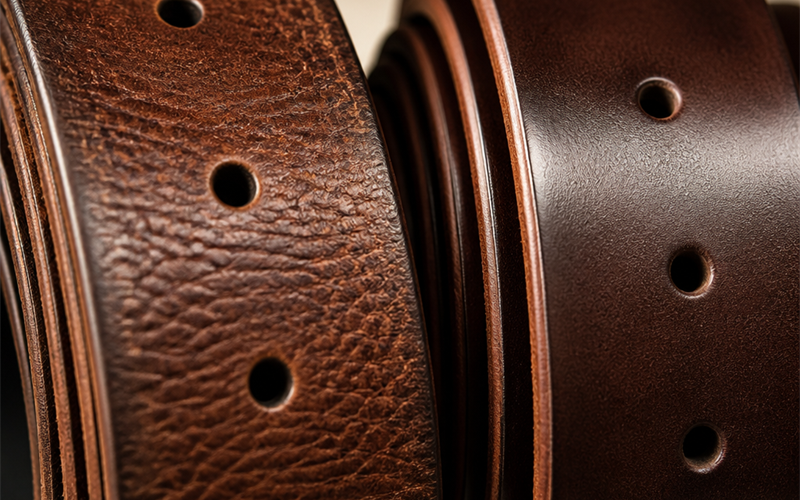
American vs Italian Full-Grain Leather Belts: The Tannage Showdown
Quick answer: American full-grain leather (from tanneries like Hermann Oak and Wickett & Craig) is typically firmer, denser, and slower to patina — built for saddlery, harness, and rugged heritage belts. Italian full-grain leather (from Tuscan vegetable-tanning consortia like Pellealvegetale) is typically more supple, more vibrant in color, and faster to develop a glossy patina — built for dress belts, refined accessories, and a softer drape. Both are world-class; the choice is about feel and use, not quality.
Last updated: May 2026 • By BELTLEY Editorial
TL;DR:
- American leather (Hermann Oak, Wickett & Craig) = firmer, denser, heritage workhorse feel.
- Italian leather (Tuscan veg-tanned) = softer, more colorful, faster patina, dressier drape.
- Both are vegetable-tanned and full-grain at their best — the difference is style and use, not grade.
- Buy American for casual/work/heritage belts; buy Italian for dress belts and supple accessories.
The American-vs-Italian leather debate is one of the older arguments in leather goods, and like most genuine craft debates, both sides are right — they just optimize for different things. American tanneries trace back to 19th-century saddlery and harness traditions and tend to produce firmer, denser hides built for rugged use. Italian tanneries — particularly the Tuscan vegetable-tanning consortia — produce softer, more vibrant, more sculpted leather built for high-end goods. Below is the real comparison, the houses behind each tradition, and which kind of belt fits which wardrobe. For the broader hierarchy, see our 10 most iconic leather types for belts.
American Firm or Italian Supple?
The tannage showdown as a personal pick:
| Your situation | Go with |
|---|---|
| Rugged structure, slow patina | American tradition — saddlery-dense, built to resist before it relents. |
| Supple hand, fast glossy patina | Italian Tuscan veg-tan — vibrant and quick to develop character. |
| Dress belt decision | Italian finishing leans dressier; American leans heritage-casual. |
| Either tradition, fair price | The grade is the constant — full-grain veg-tan from $58 at DTC pricing serves both aesthetics. |
Both characters in stock: BELTLEY's full-grain collection.
What is American full-grain leather?
American full-grain leather is, broadly, leather tanned by U.S. tanneries using methods derived from 19th-century saddlery and harness traditions. The two cornerstone houses are Hermann Oak (St. Louis, founded 1881) and Wickett & Craig (Pennsylvania, founded 1867) — both still operating, both producing slow-tanned vegetable-tanned leather using oak bark and similar tannins. American tanned leather tends to be firm, dense, and built for hard wear.

The use case dictates the temper. American tanneries grew up serving the saddle, harness, and equestrian markets — applications that demand stiff, structured leather that holds shape under tension. That heritage carries into modern belt leather: American full-grain typically has more "snap" in the hand, holds a fold sharply, and breaks in slowly over months of wear. Heritage-style belts, double-layer belts, and rugged Westernwear use American tannage almost exclusively.
What is Italian full-grain leather?
Italian full-grain leather is, broadly, leather tanned by Italian tanneries — most famously the Tuscan consortium of vegetable tanners known as Consorzio Vera Pelle Italiana Conciata al Vegetale. This consortium, based around Pisa and the surrounding Tuscan towns, certifies a specific slow, plant-tannin process that's been documented for centuries. Italian veg-tanned leather is usually softer, more supple, and more saturated in color than American equivalents.
The use case is luxury accessories. Italian leather grew up serving the high-end goods market — wallets, handbags, dress shoes, dress belts — where the leather needs to drape softly, take vivid color, and feel refined in the hand. Tuscan veg-tan is also famous for developing a glossy, deep patina more quickly than American tannages, often within months of regular wear. It's the leather of Florence's leather markets and the supply chain behind many luxury Italian leather goods houses.
Key stat: Italian Tuscan vegetable-tanned leather is certified by the Consorzio Vera Pelle Italiana Conciata al Vegetale, the consortium that protects the "Pelle Conciata al Vegetale in Toscana" trademark — one of the few leather certifications backed by a registered consortium of tanneries.
How do the two tanning traditions differ?
Both are vegetable-tanned, but with different tannin sources, different times, and different finishing steps. American veg-tanning leans heavily on oak bark tannins, with longer pit-tanning cycles and minimal post-tan softening — producing dense, firm, durable hides. Italian veg-tanning uses a broader mix of tannins (chestnut, mimosa, oak, and tara), with extended drum-rotation tanning and significant post-tan softening — producing supple, malleable, color-vibrant hides.

The chemistry is similar but the finishing diverges. Tanning is the process of converting hides to durable leather, and both traditions use plant-based tannins (as opposed to chrome tanning, which is faster and produces a uniform, often less natural feel). The difference between American and Italian veg-tan isn't in the chemistry of tanning itself — it's in temper, color, and aftercare. American leather is finished firmer; Italian leather is finished softer and richer.
Which one patinas faster?
Italian — visibly faster. Tuscan veg-tan leather often develops a noticeable color deepening and glossy sheen within the first 1–3 months of regular wear. American oak-tanned leather develops patina more slowly — usually visible after 6–12 months — but the underlying density means it patinas for longer (decades, rather than just a few years).
Speed isn't the same as quality. Italian's quick patina is part of the appeal — you see the belt becoming "yours" within weeks. American's slower patina is its own kind of appeal — a heritage belt that you build over years. Both develop into beautiful end states; the timeline differs. Our full-grain leather belts collection includes both American and Italian leather options depending on the style.
American vs Italian veg-tan leather
| Factor | American (Hermann Oak / Wickett & Craig) | Italian (Tuscan / Pellealvegetale) |
|---|---|---|
| Heritage market | Saddlery, harness, work goods | Luxury accessories, dress leather |
| Tannin source | Oak bark dominant | Chestnut, mimosa, oak, tara mix |
| Temper | Firmer, denser | Softer, more supple |
| Drape | Holds shape, stiff break-in | Drapes immediately |
| Color | Earthy, restrained, natural | Vibrant, saturated, varied |
| Patina speed | Slow (6–12 mo to show) | Fast (1–3 mo) |
| Patina duration | Decades | Years (then plateaus) |
| Best for | Casual, work, heritage, double-layer | Dress, fashion, drape, color-led pieces |
| Common thickness | 3.5–5.0mm for belts | 2.5–4.0mm for belts |
| Heritage cert. | None (tannery reputation) | Pellealvegetale consortium |
Who are the famous American tanneries?
Two names dominate. Hermann Oak Leather Company (St. Louis, Missouri, founded 1881) is one of the last full-line vegetable tanneries in the United States, producing skirting, harness, latigo, and bridle leather used by saddlery houses and heritage menswear brands. Wickett & Craig (Curwensville, Pennsylvania, founded 1867) is the other anchor — producing English bridle, harness, and vegetable-tanned leather to the same heritage spec. A third major name, Horween Leather Company (Chicago, founded 1905), is famous for specialty tannages like Chromexcel and Shell Cordovan but operates in a different niche.

These three tanneries supply most of the U.S. heritage leather industry. If you see a heritage menswear or work-goods brand advertise "American veg-tan leather," it almost certainly comes from one of these three (or a smaller specialty house). We unpack the head-to-head between the three in Wickett & Craig vs Hermann Oak vs Horween: US tannery showdown. For belt applications specifically, Hermann Oak and Wickett & Craig are the workhorses; Horween's Chromexcel shows up in casual belts and Shell Cordovan in rare formal pieces.
Who are the famous Italian tanneries?
The Italian story is collective, not individual. The Tuscan vegetable-tanning region around the towns of San Miniato, Santa Croce sull'Arno, and Ponte a Egola contains roughly 25–30 historic tanneries operating under the Pellealvegetale consortium. Individual member tanneries include Conceria Walpier (famous for its Buttero leather), Conceria Volpi, Conceria Italia 95, Conceria Wet Blue, and many others. The consortium certifies the process and the provenance — the trademark "Pelle Conciata al Vegetale in Toscana" — rather than naming a single dominant house.
This consortium model is itself a heritage. The Tuscan tradition goes back centuries, and the consortium model protects the certified slow-tanning process from being knocked off by faster chrome-tanned imitations. Belts and accessories using consortium-certified leather usually carry a hangtag or stamp identifying the provenance. Our men's belts collection includes Italian veg-tan options for dress-belt applications where the supple drape matters.
BELTLEY 3-Material Rule
The 3-Material Rule = full-grain leather + stainless or solid brass buckle + sealed (painted or burnished) edges. Both American and Italian full-grain veg-tanned leathers clear the first leg comfortably — they're the gold standard for the rule. Pair either with solid hardware and proper edge work and the belt is restorable, durable, and patina-friendly for life. The American-vs-Italian choice is purely about feel and use once the rule is met.
Which feel is right for which belt?
Match the leather to the strap's job. For a dress belt (1.25"–1.38" wide, thin, paired with a suit), Italian veg-tan's supple drape and refined finish is the better choice — it sits flat under a jacket without bulk. For a casual or work belt (1.5" wide, thicker, paired with jeans or chinos), American veg-tan's firmness and density is the better fit — it holds heavy buckles, resists daily abrasion, and breaks in into a heritage piece.

The thickness and rigidity matter too. American leather at 4–5mm is ideal for double layer belts and heavy-duty designs — Italian leather of the same thickness would feel over-tempered for a dressy use. Italian leather at 2.5–3mm is ideal for dress belts where the drape and the gloss are the point. Neither is "better" — they're optimized for different parts of your wardrobe.
Which lasts longer?
Both last decades with proper care, but they age differently. American oak-tanned leather is structurally longer-lived (the firmer fiber temper resists deformation over time). Italian veg-tan is aesthetically longer-loved (the faster, deeper patina makes the belt feel like a personal artifact within months). Daily wear over 20 years generally favors American for durability; over 5–10 years, Italian wins on character.
Lifestyle is the deciding variable. If your belt sees rough use (work, outdoor, heavy buckles, multiple holes used per week), American leather pulls ahead. If your belt is a dress companion (worn under a blazer, taken off carefully, conditioned regularly), Italian holds its own and looks better doing it. Our leather care page covers maintenance for both.
What about price?
Roughly comparable at the same quality tier. Both American Hermann Oak / Wickett & Craig and Italian Pellealvegetale-certified leathers sit in similar premium tiers — meaningfully more expensive than commodity chrome-tanned leather but in the same range as each other. Marketing markup (Italian leather is often perceived as more luxury, so brands sometimes charge a premium) is the bigger variable than raw materials cost.

DTC pricing levels the field. Designer Italian leather belts can be priced 3–5x what the leather actually costs — the brand markup is the dominant line item. A DTC brand selling Italian veg-tan at fair pricing is in the same range as a DTC brand selling American veg-tan; the difference is taste, not value. We make the broader case in why are designer belts so expensive.
The Bottom Line
American and Italian full-grain veg-tanned leathers are both world-class — they're just optimized for different parts of a wardrobe. American oak-tanned leather (Hermann Oak, Wickett & Craig) is firm, dense, heritage, and built for casual or rugged belts that age slowly into work-worn classics. Italian Tuscan veg-tan is supple, vibrant, and built for dress belts and refined accessories that patina quickly into glossy personal artifacts. The choice isn't quality; it's use and feel. For a one-belt wardrobe, lean American for durability or Italian for drape, depending on whether your daily wear is casual or dressier. For a two-belt rotation, own one of each. At BELTLEY, we source both depending on the style, with solid hardware, hand-finished edges, and a 10-year warranty on every belt. Ready to start with the right tannage for your life? Browse our full-grain leather belts or dress belts.
Frequently Asked Questions
Q: Is American or Italian leather better quality?
Neither is universally better — they're optimized for different uses. American leather (Hermann Oak, Wickett & Craig) is firmer and built for rugged, heritage belts. Italian leather (Tuscan vegetable-tanned) is softer and built for dress belts and luxury accessories. Both are top-tier at their best.
Q: Which patinas faster, American or Italian leather?
Italian. Tuscan vegetable-tanned leather typically develops noticeable patina within 1–3 months of regular wear. American oak-tanned leather patinas more slowly (6–12 months) but continues developing for decades.
Q: What's the Pellealvegetale consortium?
The Consorzio Vera Pelle Italiana Conciata al Vegetale — a consortium of Tuscan tanneries that certify a specific slow, plant-tannin process and protect the "Pelle Conciata al Vegetale in Toscana" trademark. Member tanneries include Walpier, Volpi, and many others.
Q: Who are the main American leather tanneries for belts?
Hermann Oak (St. Louis, founded 1881) and Wickett & Craig (Pennsylvania, founded 1867) are the two heritage workhorses for belt leather. Horween Leather (Chicago, founded 1905) is a third major name, famous for Chromexcel and Shell Cordovan specialty tannages.
Q: Should I buy an American or Italian leather belt first?
It depends on what you wear daily. For casual or work-leaning wardrobes, American leather is the better first belt — firmer, more durable. For dressier wardrobes, Italian leather is better — softer drape, refined finish. Own one of each if you can afford the second.
%20is%20typically%20firmer,%20denser,%20and%20slower%20to%20patina%20%E2%80%94%20built%20for%20saddlery,%20harness,%20and%20rugged%20heri...)