Full-Grain vs Suede Belt: The Common Confusion Finally Cleared
Quick answer: Full-grain and suede come from different layers of the same hide. Full-grain is the top, unaltered grain side — the strongest, most durable leather grade. Suede comes from the inner split layer (the underside) finished on the flesh side to produce its signature fuzzy nap. Suede is much weaker, less water-resistant, and more delicate than full-grain, but it has a soft, casual texture that full-grain can't reproduce.
Last updated: May 2026 • By BELTLEY Editorial
TL;DR:
- Full-grain = top, unaltered hide; strongest grade; develops patina; 10–20+ years.
- Suede = inner split layer, fuzzed on the flesh side; soft and casual; far less durable.
- Suede is not nubuck — nubuck is top-grain sanded; suede is from the lower split layer.
- Suede belts are great as a second/third belt for casual texture; full-grain is the everyday workhorse.
Suede is one of the most-misunderstood leather categories. People often assume it's a separate kind of leather or a "fuzzy version" of regular leather; in fact, it's a specific finish made from a specific layer of the hide, structurally weaker than full-grain. That doesn't make suede bad — it's a legitimate, beautiful material — but it does make it the wrong choice for an everyday daily-wear belt. Below is the real comparison, the structural reason, and which belt belongs where. For the related nubuck question (often confused with suede), see full-grain vs nubuck leather belt.
Top of the Hide or the Fuzzy Underside?
The confusion, cleared into choices:
| Your situation | Go with |
|---|---|
| One durable everyday belt | Full-grain — the strong top layer; suede is the soft inner split. |
| Texture for fall layering | Suede earns the seasonal slot — just keep it from rain and rotation-heavy duty. |
| Suede look, real durability | Matte or brushed full-grain — the texture register without the fragility. |
| Caring for suede you own | Brush, don't condition — suede care is its own discipline entirely. |
The durable default: BELTLEY's full-grain belts, from $58.
What is full-grain leather?
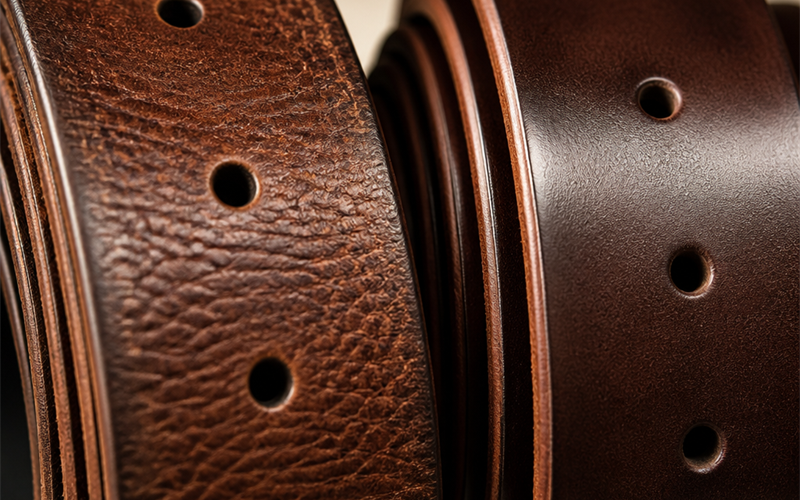
Full-grain is the top, unaltered layer of an animal hide. The grain side — the densest, naturally textured top of the hide — is kept intact without sanding or correction. It's the highest-grade leather available and the only one that develops a real patina from years of wear.

The top layer is the strong layer. Full-grain represents the densest, most tightly woven part of the hide, which is why it's used for belts, boots, and saddle work. Patina deepens the color and adds a warm sheen over years. Our full-grain leather belts collection is built around this material standard.
What is suede leather?
Suede is leather made from the inner split layer of the hide — the underside, beneath the grain — finished on the flesh side to produce a soft, fuzzy nap. The hide is "split" horizontally into two or more layers; the top layer becomes full-grain or top-grain leather, and the underside (the split) becomes suede.
The split layer is much weaker. Suede is napped leather typically made from the underside of the hide split, and the fiber structure of that lower layer is far less dense than the top grain. Suede's signature softness comes from short, exposed fibers — beautiful to the touch, but vulnerable to water, oil, scuffs, and stretching. It's been used for clothing and accessories since the 19th century specifically because of its tactile appeal.
Key stat: Suede comes from the inner split layer of the hide, which has roughly 30–50% the tensile strength of the top grain layer. That structural gap is the entire reason a suede belt stretches and wears faster than a full-grain belt of the same thickness.
Is suede the same as nubuck?
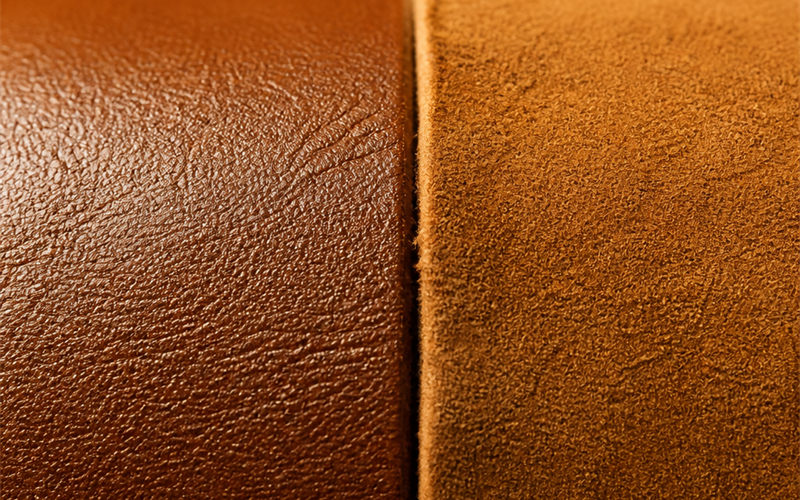
No — even though they look similar. Both have a fuzzy/napped surface, but they're made from completely different layers of the hide. Nubuck is top grain lightly sanded on the grain side to raise a fine nap. Suede is the inner split layer finished on the flesh side. The visual texture is similar; the underlying strength is very different.

The construction difference matters. Nubuck inherits the top hide's natural durability; suede inherits the split's natural weakness. A nubuck belt and a suede belt at the same price are not equivalent products — nubuck will outlast suede by years in daily wear. We unpack this in full-grain vs nubuck leather belt. For belts specifically, the structural difference is meaningful because the strap takes constant flex.
Which is more durable?
Full-grain — by a wide margin. A full-grain belt routinely lasts 10–20+ years; a suede belt typically lasts 3–7 years of daily wear before stretching, fraying at the holes, or developing serious surface damage. Suede's softness is also its vulnerability — the loose fiber structure stretches, absorbs liquid quickly, and shows oil and water marks dramatically.
The flex life is the killer. A belt is bent, pulled, and rubbed continuously every time you put it on. Full-grain handles that cycle for decades; the split layer in suede simply isn't built for the load. Suede stretches at the holes over time, and the napped surface compresses and shines at high-friction points (where the belt rubs against pants, where the buckle sits). It's not a flaw in suede — it's the material's limit.
What's the right belt occasion for each?
Full-grain is the all-rounder; suede is the casual statement. Full-grain works in every context — dress, business, casual — and its smooth surface and developing patina look correct under a blazer, with jeans, or with chinos. Suede is at home with casual outfits — chinos, denim, soft sport coats — where its texture is the point and the wearer's softness is the visual cue.

Suede with a tucked-in dress shirt almost never works. The texture reads relaxed by nature, and pairing it with a strict dress outfit creates a tonal mismatch. Suede pairs beautifully, however, with casual belts territory: brown chinos, denim, soft loafers, or suede chukka boots. For an everyday belt, full-grain remains the right answer — see the one belt wardrobe test.
Full-grain vs suede at a glance
| Factor | Full-grain | Suede |
|---|---|---|
| Hide layer | Top grain | Inner split (underside) |
| Strength | Highest leather grade | Significantly weaker |
| Surface | Smooth, dense, natural grain | Fuzzy nap |
| Water resistance | Higher | Very low |
| Stain resistance | Higher | Low (shows oil, water easily) |
| Lifespan (daily wear) | 10–20+ years | 3–7 years |
| Patina | Color deepens, glossy sheen | Texture compresses, shines |
| Care | Conditioner every 6 mo | Suede brush + protector spray |
| Best for | Daily / dress / work | Casual, statement, second belt |
| Restorable | Yes (re-dye, polish) | Limited — surface damage often permanent |
How do you care for a suede belt?
Differently than smooth leather. The kit: (1) a suede brush (brass-bristle or rubber-tipped) to lift the nap and remove dust, (2) a suede protector spray applied before first wear (critical for water resistance), (3) a gum eraser for spot stains, (4) avoid liquid leather conditioners — they flatten the nap and create dark spots.
Prevention is the only real strategy. Once suede gets oiled, deeply stained, or seriously water-marked, restoration is difficult and sometimes impossible. The protector spray is a non-negotiable step on a new suede belt — apply it before you ever wear it. Brushing weekly keeps the nap looking fresh. Our general leather care page covers full-grain conditioning; suede needs the specialty products.
How do you tell the two apart at a glance?
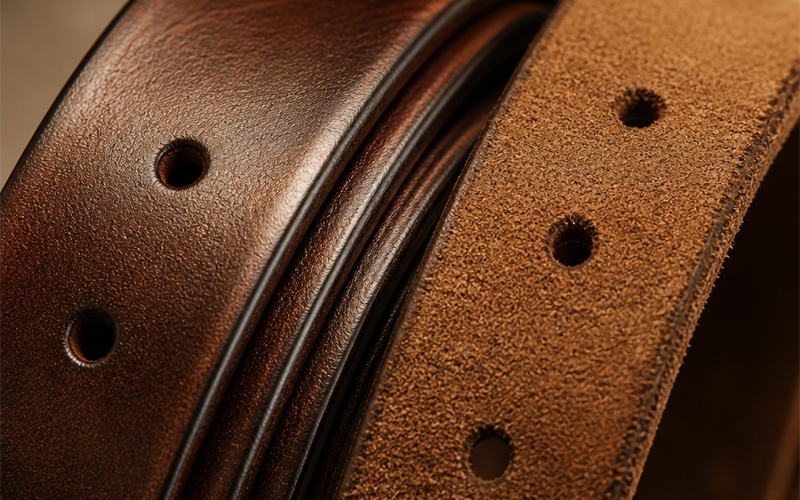
Three checks. (1) Surface texture — full-grain is smooth and uniform; suede has a visible fuzzy nap. (2) Hand feel — full-grain feels firm; suede feels soft and "warm." (3) Cut edge — full-grain shows a single dense fiber cross-section; suede shows a fuzzier, less compact cross-section because it's from the lower hide layer.

Both are real leather, but they sit at very different points in the hierarchy. Suede is genuine leather (made from a real hide), but it's structurally far from full-grain. Neither is a fake or a scam in the way bonded leather is — they're both honest products at their own price and use case.
Are suede belts worth buying?
Yes — as a second or third belt for casual styling. A quality suede belt at $60–$120 adds texture and softness to your rotation that full-grain can't replicate. The mistake is buying a suede belt to be your only belt or for daily dress wear; it'll wear too fast and look wrong in formal contexts.
The honest position: own a full-grain belt first. Once you have a reliable everyday brown full-grain belt, a suede belt becomes a great second pickup — particularly in a contrasting tone (tan, navy, or olive) for casual outfits. Our unique belts collection includes textured and statement leathers that can play the same casual role with longer life.
What if I want the casual texture without the fragility?
Choose nubuck or a textured full-grain. Nubuck gives you the soft napped surface on top of the strong grain layer — see full-grain vs nubuck leather belt. Textured full-grain finishes (pull-up, distressed, oil-tanned) give a worn, casual look while keeping full-grain strength. Either gives you the visual relaxedness without the structural compromise of true suede.

The choice is about why you want suede. If you want softness for its own sake and accept the shorter life, true suede is the answer. If you want the look without the durability cost, nubuck or distressed full-grain delivers — and a distressed full-grain belt can age for 10+ years instead of 3–5.
The Bottom Line
Full-grain and suede aren't really competitors — they're from different layers of the same hide, with different strengths and different jobs. Full-grain is the durable, all-occasion daily belt; suede is the soft, casual second belt that prioritizes texture over longevity. Both are real leather; neither is a scam. The right answer for you depends on whether you want one workhorse belt or a varied rotation with textured options. If you can only own one, make it full-grain — the case is overwhelming. At BELTLEY, our full-grain leather belts are built for daily decades of wear, with solid hardware and a 10-year warranty. Ready to start with the everyday workhorse? Browse our men's collection.
Frequently Asked Questions
Q: Is suede real leather?
Yes — suede is genuine leather, made from the inner split layer of the hide. It's just from a different (weaker) part of the hide than full-grain, which is why it's softer but less durable.
Q: What's the difference between suede and nubuck?
Suede is made from the underside (split layer) of the hide and finished on the flesh side. Nubuck is made from the top grain layer and lightly sanded on the grain side. They feel similar but nubuck is far more durable because its base material is the strong top layer.
Q: How long does a suede belt last?
A quality suede belt lasts about 3–7 years of daily wear, depending on care. Without a suede protector spray and regular brushing, the surface compromises faster. Full-grain belts, by comparison, last 10–20+ years.
Q: Can I wear a suede belt with a suit?
Generally no. Suede reads casual by texture and clashes with the formality of a dress suit. Suede belongs with chinos, denim, and softer sport coats — not strict business or formal wear. For suits, go with full-grain or a polished dress belt.
Q: How do I clean a stained suede belt?
A gum eraser is the safest first try for surface spot stains. A suede brush lifts dust and refreshes the nap. For deep oil stains, take it to a leather goods professional — DIY solvents typically make suede stains worse, not better.