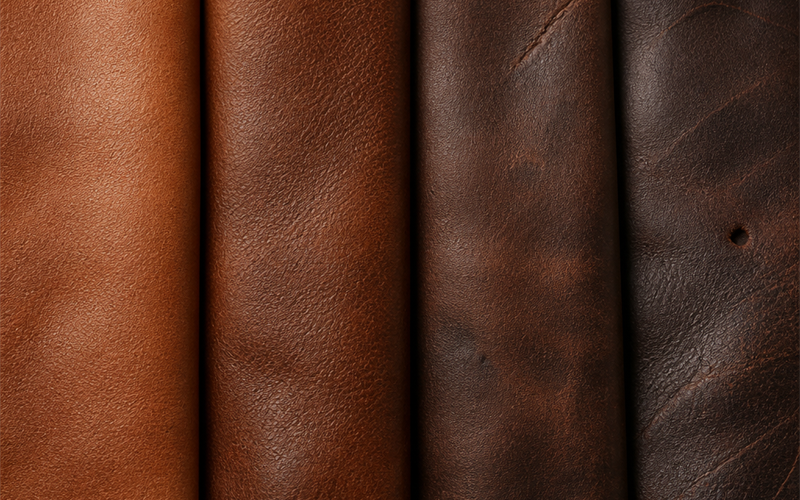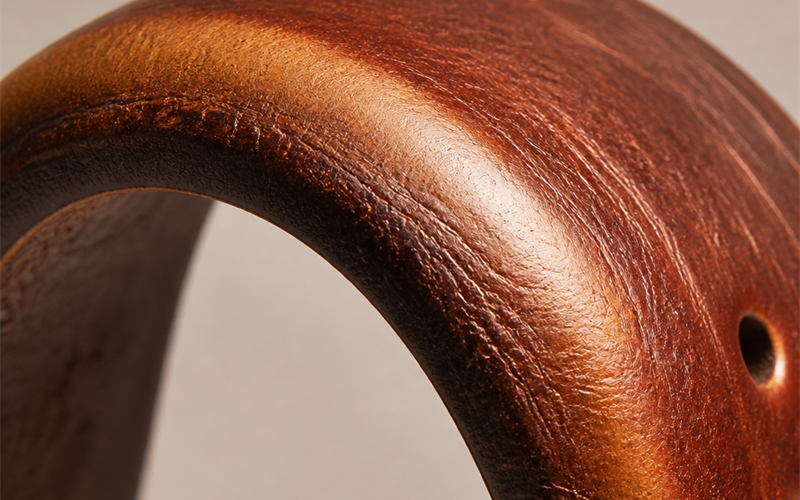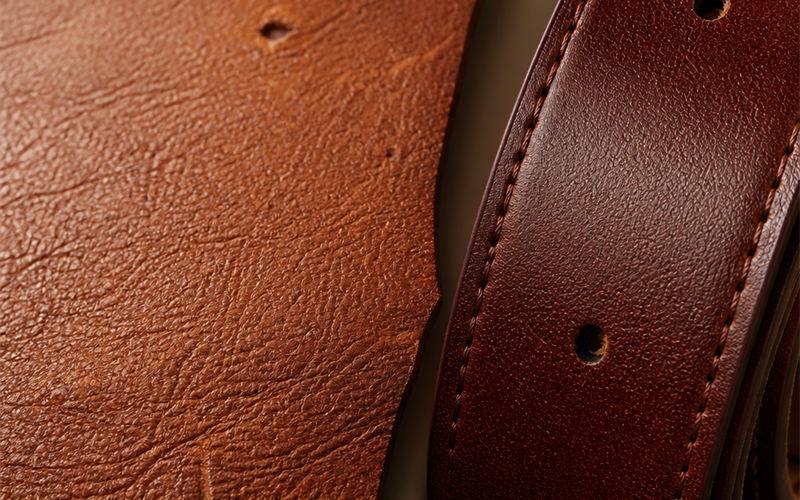
What "100% Full-Grain Leather" Actually Means (Labels Are Abused)
Quick answer: "100% full-grain leather" should mean the belt or item is made entirely from the top, unaltered layer of an animal hide — the strongest, most durable grade. In practice, the label is widely abused: brands use it on top-grain (sanded), corrected-grain (heavily buffed and coated), and even bonded-on-fabric products. Without industry-wide enforcement, the only honest verification is to inspect the leather yourself with four simple tests — bend, smell, cut edge, and surface variation.
Last updated: May 2026 • By BELTLEY Editorial
TL;DR:
- "100% full-grain leather" should mean the entire item uses full-grain — the top unaltered hide layer.
- In practice, the label is abused on top-grain, corrected-grain, and even composite products.
- No global enforcement exists — the term isn't legally regulated in most markets.
- The honest verification is four physical tests on the actual leather, not the tag.
"100% full-grain leather" is the gold-standard label in the belt and leather goods world — and exactly because it's the gold standard, it's the most-abused term in the industry. There's no enforcement body that prevents a brand from putting the phrase on a belt that's actually corrected-grain or even partially synthetic. The result is a marketplace where the label means "premium leather" to shoppers but doesn't always mean what shoppers think. Below is what the label is supposed to mean, the loopholes brands exploit, and the simple verification process that doesn't rely on trust. For the broader grade hierarchy, see full-grain vs bonded leather belt.
What is full-grain leather supposed to be?
Full-grain leather is the top, unaltered layer of an animal hide. It includes the entire grain — the dense, naturally textured upper surface — without sanding, buffing, or surface correction. Because nothing has been removed, full-grain retains the hide's natural strength, breathability, and ability to develop a real patina over years of wear.

The word "full" is the operative one. "Full" means unaltered — the full grain is intact. Top-grain leather is the same upper hide layer but lightly sanded; corrected-grain is heavily sanded with an artificial grain stamped on top; bonded leather is reconstituted scrap. The grade hierarchy is real: from full-grain at the top down through top-grain, genuine leather, splits, and bonded. Our full-grain leather belts collection sticks to the strict definition.
What does "100% full-grain leather" usually mean on a label?
In theory, that the entire leather portion of the product is full-grain (not partially top-grain, not partially split). In practice, it varies. Some brands use the label honestly. Some use it on products that contain some full-grain (a thin top layer over a less-quality core). Some use it on products that are technically top-grain or corrected-grain but priced and marketed as if they were full-grain. And some use it dishonestly on bonded or composite products that wouldn't survive a five-minute inspection.
The label has no legal force in most markets. The U.S., E.U., and most major economies don't have specific enforcement for the term "full-grain" the way they do for, say, "organic" or "fair trade." That means there's no fine and no recall when a brand misuses it — only reputational risk, which most cheap-belt retailers shrug off. A misleading "100% full-grain leather" label is more common than buyers realize, especially in fast-fashion, off-brand, and mall-tier products.
Key stat: Unlike "organic" food or "fair trade" coffee, the term "full-grain leather" is not legally regulated in the U.S., E.U., or most major leather markets. There is no certification body, no audit, and no penalty for misuse — only the brand's own credibility on the line.
What are the common loopholes?
Five recurring patterns. (1) The "leather portion" loophole — the product contains some full-grain leather (in a visible panel) while the rest is bonded, fabric, or synthetic. (2) The top-grain disguise — the leather is technically top-grain (sanded), and the brand calls it full-grain because there's no enforcement. (3) The corrected-grain swap — the surface has been buffed and stamped with artificial grain, but the brand sticks to the full-grain label. (4) The split confusion — the leather is a split (lower hide layer) coated to look like grain leather. (5) The translated-label dodge — labels in different languages use ambiguous terms that translate as "full-grain" but mean something less specific in the source language.

Each loophole exists because no one's enforcing the term. A serious brand wouldn't risk reputation by misusing the label — but in a market with thousands of unbranded or thinly-branded leather goods, the consequences for mislabeling are minimal. The result: the more reputable the brand, the more reliable the label; the cheaper and less-known the brand, the less the label means.
How can you verify "full-grain" yourself?
Four physical tests on the actual leather. (1) Surface variation — true full-grain shows natural variation: subtle pores, healed scars, slight color shifts, faint texture changes. A perfectly uniform "grain" pattern is usually corrected-grain stamped on a buffed surface. (2) Bend test — full-grain bends sharply and the crease smooths back; corrected-grain shows visible cracking at the bend. (3) Smell test — full-grain has a warm, complex leather smell; corrected or bonded leather often smells of plastic or chemical adhesive. (4) Cut edge — full-grain shows a single dense fibrous cross-section; lower grades show layered or composite structure.

These tests don't require expertise. Anyone can do them in 30 seconds with a candidate belt in hand. We unpack the full method in how to tell if a belt is full-grain leather. The cut edge is the single most reliable signal — even a convincing top surface can't fake the cross-section.
Real full-grain vs. mislabeled "full-grain"
| Test | Real full-grain | Mislabeled product |
|---|---|---|
| Surface | Natural variation, subtle pores, real grain | Uniform stamped pattern |
| Bend test | Creases and smooths back | Cracks at the bend |
| Smell | Warm, complex leather | Plastic, glue, chemical |
| Cut edge | Single dense fiber layer | Layered or composite |
| Sheen | Natural, ages | Artificial, fades |
| Texture (under magnification) | Real pores | Stamped repeating pattern |
What brands are most likely to be honest about the label?
Two patterns. (1) DTC heritage brands that name their tannery (Hermann Oak, Wickett & Craig, Horween, Pellealvegetale) — they have skin in the game and the tannery name to defend. (2) Brands with named designers or craftspeople behind the product — small leather goods makers whose reputation is the brand. Both have reasons to be honest beyond just consumer trust.
The least-reliable patterns are off-brand mall belts, fast-fashion accessories, and unbranded marketplace listings. These rarely name a tannery, often source from commodity suppliers, and operate at price points where bonded or corrected leather is the only way to hit margin. Our full-grain leather belts collection names the tannery source where the leather origin matters.
BELTLEY 3-Material Rule
The 3-Material Rule = full-grain leather + stainless or solid brass buckle + sealed (painted or burnished) edges. The rule is partly designed to bypass the label-trust problem entirely. Instead of asking "is this really full-grain?", check three observable properties of the belt itself. A belt that fails the bend test, smell test, or cut-edge test is failing the first leg of the rule regardless of what the label says. The rule converts the verification from trust to observation.
What about top-grain or corrected-grain leather — is it bad?
Not bad — just different. Top-grain leather is the same upper hide layer as full-grain, lightly sanded to remove minor imperfections. It's still genuinely good leather and usually labeled honestly. Corrected-grain is more heavily sanded and stamped with an artificial grain pattern, then often coated for uniformity — this is where the line into "lower-quality" leather is crossed. Bonded leather and "genuine leather" are below both.

The honest grade hierarchy:
- Full-grain — top, unaltered; best
- Top-grain — top, lightly sanded
- Corrected-grain — top, heavily sanded + stamped grain
- Genuine leather — low-grade splits or scraps, often coated
- Bonded leather — shredded scraps + glue + fabric backing
We compare these in full-grain vs bonded leather belt and full-grain vs nubuck leather belt. The grade isn't the only thing that matters — tannage, hardware, and construction also count — but the grade sets the ceiling on how long the belt can possibly last.
What's the simplest single rule for buyers?
If a brand doesn't name the tannery, treat the "full-grain" label with skepticism. Reputable full-grain leather goods makers name their tannery (Wickett & Craig, Hermann Oak, Horween, Italian Tuscan veg-tan) because the tannery name carries weight. Brands that say "premium full-grain leather" without specifying whose full-grain are often using commodity leather that may or may not actually be full-grain.

Pair the tannery check with the four physical tests and you've done as much verification as anyone reasonably can. We name our leather sources on product pages where the heritage tannage matters, and we stick to verifiable full-grain across our men's collection.
The Bottom Line
"100% full-grain leather" is supposed to mean the entire leather portion is unaltered top-of-hide leather — the most durable grade. In a market with no enforcement, the label is widely abused on top-grain, corrected-grain, and even bonded products. The fix isn't legal — there's no enforcement coming — it's observational. Run the four physical tests (surface variation, bend, smell, cut edge) on any leather goods you're considering, and trust brands that name their tannery. A real full-grain leather belt will pass every test, and it'll last decades doing so. At BELTLEY, we name our leather sources, stick to verifiable full-grain across our full-grain leather belts collection, and back every piece with a 10-year warranty. Ready to buy from a brand that earns the label? Browse our men's collection.
Frequently Asked Questions
Q: Is "100% full-grain leather" a legally protected term?
No — not in the U.S., E.U., or most major markets. Unlike "organic" or "fair trade," there is no certification body or legal penalty for misusing the "full-grain" label. The term is enforced only by brand reputation, which means it can be misused widely.
Q: How can I verify a belt is really full-grain?
Run four tests: check the surface for natural variation (real grain pores vs uniform stamped pattern), bend it sharply (full-grain creases and smooths; corrected-grain cracks), smell it (warm leather vs plastic/glue), and look at the cut edge (single dense layer vs layered composite).
Q: What's the difference between full-grain and top-grain?
Full-grain is the top, unaltered hide layer. Top-grain is the same layer but lightly sanded to remove minor imperfections. Top-grain is still good leather; corrected-grain (heavily sanded plus stamped artificial grain) is where the quality drops meaningfully.
Q: Why do brands abuse the "full-grain" label?
Because there's no enforcement. The term carries premium-quality connotations that justify higher prices, but no legal body audits the label or penalizes misuse. Cheap retailers exploit the gap; reputable brands don't because their reputation is on the line.
Q: What's a quick rule for trusting "full-grain" labels?
If the brand names the tannery (Hermann Oak, Wickett & Craig, Horween, Italian Tuscan veg-tan), the label is usually reliable. If the brand says "premium full-grain" without specifying whose, treat it as marketing language until you can verify the leather physically.