Pull-Up Leather Belts Explained: The "Marks Tell a Story" Finish
Quick answer: Pull-up leather is full-grain leather that's been stuffed with oils and waxes so heavily that bending or scratching the surface temporarily displaces those oils — making the leather lighten at the bend or scratch, then darken back as it relaxes. Every mark, every fold, every scuff becomes part of a permanent visible history. Pull-up leather belts age into deeply personal, character-rich artifacts no other leather can match.
Last updated: May 2026 • By BELTLEY Editorial
TL;DR:
- Pull-up leather = full-grain leather hot-stuffed with oils/waxes that displace when bent.
- The lightening effect at bends and scratches is the defining visual signature.
- Every mark becomes permanent character — pull-up leather belts age into one-of-a-kind pieces.
- Common examples: Horween Chromexcel, Horween Dublin, certain Italian veg-tans, oil-pull-up bridle leathers.
Pull-up leather is the most photogenic and most personal of the heritage leathers — the kind that makes a single belt look like it has its own life history. The effect is mechanical, not magical: oils and waxes inside the hide displace when the leather flexes, lightening the surface temporarily. The result is a belt where every bend, scuff, and crease is visible, permanent, and somehow beautiful. Below is what pull-up leather actually is, how to spot it, and why it inspires more cult devotion than any other tannage. For the specific Chromexcel comparison, see Horween Chromexcel vs English Bridle for belts.
What is pull-up leather?
Pull-up leather is full-grain leather that's been hot-stuffed with heavy doses of oils and waxes during finishing. The stuffing penetrates deeply into the hide's fiber structure, saturating the leather from the inside. When you bend the leather sharply or scratch the surface, those internal oils and waxes get displaced — locally, at the point of stress — and the surface lightens. Flatten the leather or rub the scratched area and the oils flow back, partially restoring the darker color.

The effect is mechanical. Pull-up isn't a dye or a coating — it's a physical property of oil-saturated leather. The pull-up "lightens" because you're seeing slightly more of the underlying lighter leather color where the dark oils have moved away. Different tannages produce different pull-up intensities: some leathers (Chromexcel) have dramatic pull-up; some (mild oil-tanned bridle) have subtle pull-up; some (untreated veg-tan, dress leather) have none at all.
What does the "pull-up" actually look like?
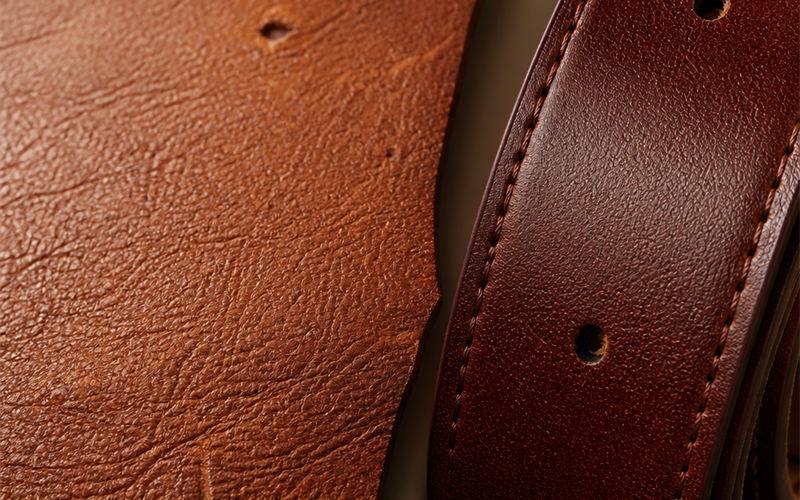
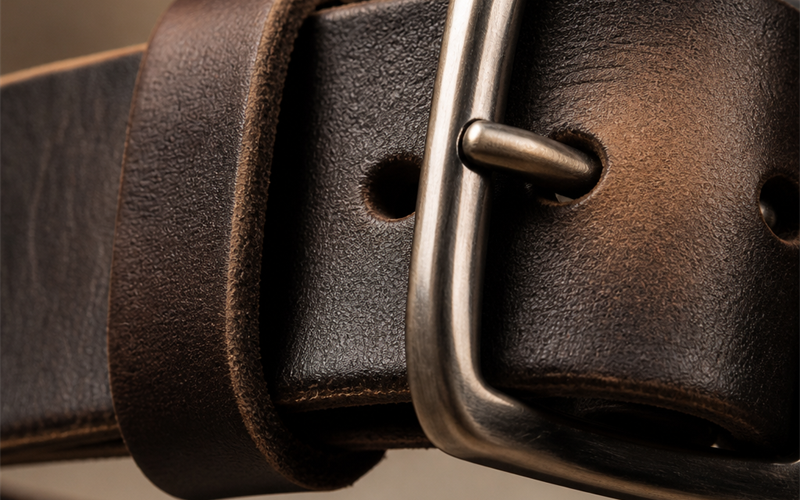
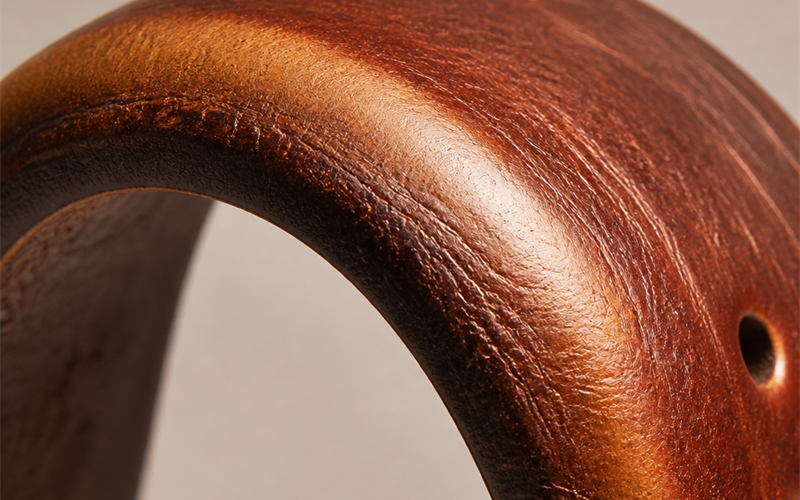
Three visible phenomena. (1) Lighter creases at bends — when the belt loops through a buckle or flexes at a hole, the bend point lightens. (2) Lighter scratches that look like brush strokes — a scuff or fingernail mark shows up brighter than the surrounding leather, sometimes immediately. (3) Color variation over time — high-friction zones (where the belt rubs pants or the buckle sits) darken slightly while flex zones lighten, producing a varied multi-tonal patina.
The result is a belt with visible history. A new pull-up belt looks uniformly colored. A six-month-old pull-up belt looks like it has been "lived in" — slightly varied, slightly faded at flex points, slightly darkened at friction points. A five-year-old pull-up belt looks unmistakably personal — every scratch and crease is part of its character. No two pull-up belts in the world age identically.
Key stat: Pull-up leather can show a color shift of 15–30% lightness at sharp bends and scratches — visible at arm's length and dramatic at close range. Less-dramatic "mild pull-up" leathers show 5–10% shift; non-pull-up leathers show 0%.
What leathers have a pull-up effect?
Several heritage tannages, with different intensities. Horween Chromexcel is the most famous — dramatic pull-up, soft hand, dramatic patina. Horween Dublin is similar but more refined (wax-stuffed). Italian veg-tan oil pull-ups (often from Conceria Walpier or similar Tuscan tanneries) have moderate pull-up with a Tuscan veg-tan character. Latigo has subtle pull-up at sharp bends. Standard English Bridle has no pull-up (the wax-finished surface doesn't displace), while distressed bridle or oil-stuffed bridle variants can have mild pull-up.

The tannage and finishing both matter. Chrome-tan-only leathers rarely have pull-up because they're not deeply oil-stuffed. Pure veg-tan leathers without oil-stuffing also don't pull up. The recipe needs to be: full-grain leather + deep oil/wax stuffing. We compare specific pull-up leathers in Horween Chromexcel vs English Bridle for belts and latigo leather belts explained.
How do you spot pull-up leather at a glance?
Bend it. A dramatic visible lightening at the bend means you have pull-up leather; uniform color means you don't. Three additional tests: (1) scratch test — a light fingernail drag will leave a temporary lighter mark on pull-up leather; (2) flex test — folding the belt sharply produces lighter creases that fade when flattened; (3) sheen test — pull-up leathers usually have a glossy oil-rich sheen versus a matte finish.
Online, look for product photos. Reputable brands show their leather flexed and scratched specifically because that's how pull-up leather looks its best. Marketing copy that says "develops character" or "marks tell a story" usually signals pull-up. We feature flex shots on our pull-up leather products specifically to set buyer expectations — see our handmade collection for examples.
Is the pull-up effect permanent or temporary?
Both. Pull-up marks are visually temporary in the short term — a fresh fold lightens, then darkens back as you flatten the belt. But over years of daily wear, those repeated lightening/darkening cycles deposit permanent variation into the surface. The fold that's been there for 1,000 wears is permanently lighter than the rest of the strap; the high-friction zone where the buckle sits is permanently darker. The patina becomes the belt's life record.

This is the deep appeal. A pull-up belt's surface is a continuous live document of how it has been worn. Belt enthusiasts collect dramatic pull-up belts specifically because each one becomes unique within months of wear. A pull-up leather belt you wear for 10 years tells the story of those 10 years in a way no other belt does — see patina for the broader phenomenon. It's also the right kind of belt for someone who doesn't want to baby their leather — scratches and marks aren't damage, they're added character.
Pull-up leather vs other tannage finishes
| Factor | Pull-Up Leather | English Bridle | Saddle Leather |
|---|---|---|---|
| Defining feature | Lightens at bends and scratches | Smooth, low-glare, refined | Firm, raw, minimal finishing |
| Oil content | Heavy (hot-stuffed) | Curried with tallow/wax | Light |
| Sheen | Glossy, oil-rich | Matte to semi-matte | Restrained, natural |
| Pull-up effect | Yes (dramatic to subtle) | No | No |
| Patina over time | Multi-tonal, varied | Uniform color deepening | Slow deep heritage patina |
| Marks visible | Yes — turn into character | No — minor scuffs disappear | Yes — but slowly |
| Best for | Casual / heritage / personal | Dress / formal | Rugged / heritage workhorse |
| Cult level | High | Dress-enthusiast cult | Niche heritage |
How do you wear a pull-up leather belt?
Casual to business-casual settings, mostly. Pull-up leather's varied, oil-rich surface reads relaxed by default — paired with chinos, denim, casual sport coats, boots, sneakers, and weekend wear. It's not the right pick for a strict dress code where the belt should be quiet and uniform (English Bridle is for that).
It also wears more comfortably out of the box. Because the leather is already oil-saturated, pull-up belts don't have the stiff break-in period of pure veg-tan straps. From day one, a Chromexcel or Dublin belt is supple and easy to wear, just with the dramatic visual character developing over the months that follow. For someone who wants character without stiffness, pull-up is the friendliest entry into heritage leather.
How do you care for pull-up leather?
Minimal care, and a light hand. Pull-up leather is already heavily oil-stuffed, so it doesn't need frequent conditioning. Wipe with a damp cloth to clean, and apply a tiny amount of neutral leather conditioner only when the leather feels noticeably dry — once a year is usually more than enough. Over-conditioning is the most common mistake; it makes the surface gummy and dulls the pull-up effect.

To "refresh" pull-up marks on a well-worn belt, you can rub the leather gently with a soft cloth — the friction warms the oils and helps redistribute them, restoring some of the original sheen. Don't try to "fix" individual scratches; they're part of the belt's record. Our leather care page covers the general approach.
Are pull-up belts good investments?
Yes — they're among the most rewarding belts to own long-term. A quality pull-up leather belt (Chromexcel, Dublin, latigo, or Italian oil pull-up) at fair pricing typically runs $80–$200 and lasts 10–20+ years. Over that decade-plus, the belt develops a unique patina that grows in personal value year by year — it's the closest thing in menswear to an heirloom that you make yourself.
The cost-per-year math is excellent. Pull-up belts last as long as any other heritage leather, with the bonus of a richer, more personal aging process. We unpack the value math in are full-grain leather belts worth the investment. DTC pricing on pull-up leather is the fair-value zone — designer markup on Chromexcel and similar leathers can be 2–4x what the leather actually costs.
What's the downside of pull-up leather?
Two honest concerns. (1) Visible marks aren't for everyone. Some people want a belt that stays uniform and quiet — pull-up leather is the opposite of that. If marks bother you, English Bridle or refined veg-tan dress leather is a better choice. (2) Not appropriate for strict dress. The varied, oil-rich surface doesn't sit cleanly under a suit; for formal use, choose a quieter leather.

Outside those cases, pull-up is one of the great pleasures of heritage leather. It's the leather that turns a daily belt into a personal artifact, and the leather that makes ordinary wear into a story. Our men's collection and casual belts include pull-up leather options.
The Bottom Line
Pull-up leather is the cult finish for people who want their belts to age into something deeply personal. It's full-grain leather hot-stuffed with oils and waxes so the surface lightens dramatically at bends and scratches, then darkens back — over years, repeated wear deposits permanent variation that makes every pull-up leather belt unique. Chromexcel, Dublin, latigo, and Italian oil pull-ups are the famous examples. The look reads casual to business-casual; the durability is excellent; the patina is incomparable; the care requirement is minimal. If you want a belt that becomes more yours by the year, this is the leather to buy. At BELTLEY, we work with pull-up and oil-stuffed heritage leathers across our full-grain leather belts collection, paired with solid hardware, hand-finished edges, and a 10-year warranty. Ready for a belt that earns its character? Browse our handmade collection.
Frequently Asked Questions
Q: What is pull-up leather?
Pull-up leather is full-grain leather hot-stuffed with heavy doses of oils and waxes. When you bend or scratch it, those internal oils displace locally — the surface lightens at the bend or scratch and slowly darkens back as the oils redistribute. The effect is what gives the leather its character.
Q: Is pull-up leather durable?
Yes, very. Pull-up leathers like Horween Chromexcel, Dublin, and latigo are oil-saturated full-grain leathers built for decades of wear. The oils protect the fibers from drying out and add some weather resistance. Lifespan with normal care is 10–20+ years.
Q: Do pull-up marks go away?
Short-term, yes — flatten the bend or rub the scratched area and the oils flow back, partially restoring the color. Long-term, repeated wear deposits permanent variation, and the patina becomes the belt's personal life record over years.
Q: Can I wear pull-up leather with a suit?
Generally no. Pull-up leather's varied, oil-rich surface reads casual to business-casual — it doesn't sit cleanly under a formal suit. For dress wear, English Bridle leather is the better choice. Pull-up shines with chinos, denim, and smart-casual outfits.
Q: How do you care for pull-up leather?
Minimally. Wipe with a damp cloth, let air-dry if wet, and apply a tiny amount of neutral conditioner only when the leather feels noticeably dry — typically once a year at most. Over-conditioning makes the surface gummy and dulls the pull-up effect, so use a light hand.