
Saddle vs Harness vs Bridle Leather: The Heavy-Duty Trio Explained
Quick answer: All three are heavy-duty vegetable-tanned leathers from the equestrian tradition, and they differ mainly in finishing. Saddle leather (or saddle skirting) is the densest, used for saddle seats and structural tack; it's firm and rugged. Harness leather is stuffed with oils and tallow to be weather-resistant and flexible under tension. Bridle leather is finished with waxes for a smooth, refined, low-glare surface — the dressiest of the three. Same hide layer, different finishing for different jobs.
Last updated: May 2026 • By BELTLEY Editorial
TL;DR:
- Saddle leather = densest, firmest, built for structural tack — rugged heritage belts.
- Harness leather = oil-stuffed for weather resistance and flex — outdoor/work belts.
- Bridle leather = wax-finished for refined matte surface — dress and heritage-craft belts.
- All three are vegetable-tanned and full-grain at their best — the differences are in finishing, not grade.
The saddle/harness/bridle trio is the most-confused naming in heritage leather goods. Most people assume they're three different kinds of leather; in fact, they're three different finishing recipes for the same kind of leather (vegetable-tanned, full-grain, equestrian-grade). Each finishing optimizes the hide for a specific equestrian job, and each translates into a distinct belt style. Below is the long-form difference and which one belongs on which kind of belt. For the broader heritage tannage context, see Wickett & Craig vs Hermann Oak vs Horween: US tannery showdown.
The Equestrian Trio: Which Is Your Belt?
Three heavy-duty veg-tans, assigned:
| Your situation | Go with |
|---|---|
| Maximum density and structure | Saddle leather — the firmest of the three; work-belt territory. |
| Weather exposure, flexible wear | Harness — oil-and-tallow stuffed for rain and strain. |
| Dressiest of the rugged options | Bridle — wax-finished smooth face that passes at smart-casual. |
| Just want one heritage-grade belt | Bridle-style full-grain — the most versatile member of the trio. |
Heritage-weight builds from $58: BELTLEY's full-grain collection.
What is saddle leather?
Saddle leather is the densest, firmest grade of vegetable-tanned full-grain leather, typically made from the back and shoulder sections of large cowhides. It's traditionally used for the structural parts of a saddle — the seat, the skirts, the fenders — where it has to hold shape under a rider's weight for years. American tanneries like Hermann Oak and Wickett & Craig produce saddle skirting in heavy weights, usually 4–6mm (10–14 oz) thick.

The density is the headline. Saddle leather is barely flexible when new — you bend it slowly and it holds the bend. A saddle belt feels substantial in the hand, breaks in over months, and ages into a deeply patinated, work-worn classic. The finishing is minimal — the leather is veg-tanned, lightly oiled, and finished without heavy wax stuffing. It's the "raw heritage" of the trio.
What is harness leather?
Harness leather is vegetable-tanned leather that's been stuffed with oils, greases, and sometimes tallow to make it weather-resistant, flexible under tension, and able to survive repeated wet/dry cycles. It's traditionally used for horse harness — the straps that take constant tension, sweat, rain, and friction. American tanneries produce harness leather using a finishing process called "currying" that works oils deep into the hide.
The functional priority is weather. A harness has to work in the rain, in heat, in dust, and through years of use without cracking. Harness leather's oil content gives it a darker, richer color than saddle leather and a slightly waxy feel. It's more pliable than saddle leather (it has to flex around buckles and bend through countless cinch cycles) but still firm and durable. It's the "weatherproof workhorse" of the trio. We use harness leather in many of our heavy-duty rugged belts.
Key stat: Harness leather is typically stuffed with oils and greases equivalent to 15–25% of the leather's dry weight during currying — a substantially heavier oil load than saddle leather, which is what gives harness its weather resistance and slight waxy feel.
What is bridle leather?
Bridle leather is vegetable-tanned leather curried (stuffed) with a mixture of tallow and waxes from the inside out, then finished with hand-applied waxes on both sides for a smooth, matte, low-glare surface. It's traditionally used for horse bridles — the straps around a horse's head — where it has to be refined enough to sit against the animal cleanly while still surviving years of tension and weather. Wickett & Craig and Hermann Oak both produce bridle leather; the term "English Bridle" is the U.S. naming for this finishing tradition.

The finishing is the refinement step. Bridle leather is the dressiest of the three because the wax finish closes the surface, creates a clean low-glare appearance, and feels smooth in the hand. It's still vegetable-tanned and dense, but the surface treatment makes it appropriate for refined uses where saddle and harness leather would read too rough. English Bridle belts are the gold standard for refined American dress belts — see Horween Chromexcel vs English Bridle for belts.
How do they differ in finish and feel?
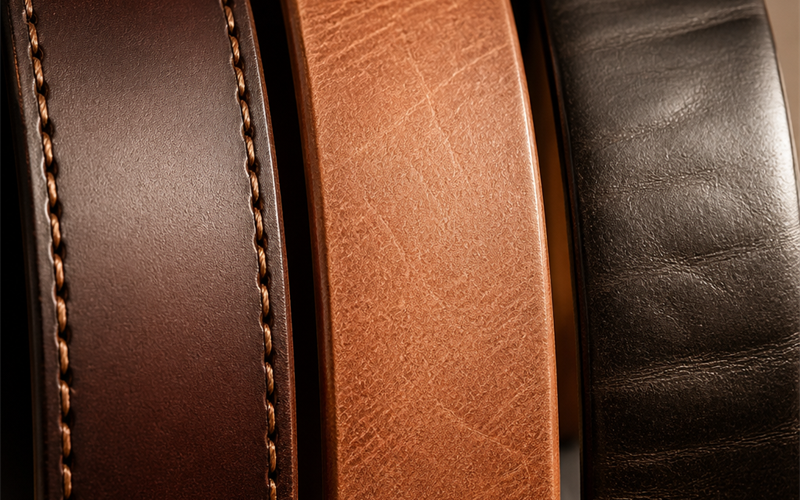
The differences are real and immediately tactile. Saddle leather feels firm, slightly dry, and natural — the surface shows minimal finish work. Harness leather feels firm but warm, with a noticeable oily/waxy character and a darker, often pull-up-style appearance. Bridle leather feels firm and smooth, dry-to-the-touch despite being wax-stuffed, with a matte to semi-matte finish.
The visual side splits the same way. Saddle leather looks raw and heritage — patina develops slowly and deeply. Harness leather looks oily, lived-in, and rugged — patina develops faster and includes a slight pull-up effect at flex points. Bridle leather looks refined and quiet — patina develops slowly and uniformly, deepening color without changing texture.
Saddle vs harness vs bridle: at a glance
| Factor | Saddle Leather | Harness Leather | Bridle Leather |
|---|---|---|---|
| Equestrian use | Saddle seat, fenders, skirts | Horse harness straps | Horse bridles, headstalls |
| Finishing | Minimal — light oil only | Heavy oil/grease/tallow stuffing | Tallow + wax stuffing, hand-waxed |
| Temper | Very firm, dense | Firm, slightly pliable | Firm, smooth |
| Surface feel | Slightly dry, natural | Oily/waxy, warm | Smooth, dry-to-touch, matte |
| Color | Earthy, natural | Dark, oil-darkened | Restrained, often saturated |
| Patina | Slow, deep | Fast at flex points (pull-up) | Slow, uniform |
| Weather resistance | Moderate | High (oil-stuffed) | High (wax-finished) |
| Best for | Rugged heritage / work belts | Outdoor / work belts | Dress / formal heritage belts |
| Thickness (belts) | 4–5mm | 3.5–5mm | 4–5mm |
| Refinement | Raw, work-aesthetic | Functional, work-aesthetic | Polished, refined |
Which one is dressiest?
Bridle leather, clearly. Its wax-finished, smooth, matte surface and refined low-glare appearance read formal — it sits cleanly under a suit and pairs correctly with polished dress shoes. Saddle leather reads rugged and heritage; harness leather reads weatherproof and work-y. For a dress belt, bridle leather is the obvious choice.
The visual cue is the surface. A bridle leather belt looks intentional and refined; a saddle or harness belt looks earned and functional. Both aesthetics are valid — the question is what your outfit demands. Our dress belts collection leans toward bridle-style finishes; our casual belts and double layer belts include saddle and harness leather options.
Which one is the most weather-resistant?
Harness leather wins. The deep oil-stuffing makes harness leather survive moisture, sweat, sun, and dust better than either saddle or bridle leather. It's the leather of outdoor work and equestrian gear specifically because it doesn't crack or stiffen when soaked and dried repeatedly. Bridle leather is also water-resistant (the wax finish helps), but harness leather has the better internal moisture resistance.

For an outdoor or rugged-use belt, harness leather is the right choice. If your belt regularly gets caught in rain, sweat, or dirt — work belts, ranch belts, outdoors belts — harness leather will outlast both alternatives. Saddle and bridle leather will hold up too, but with more visible water-marking and slower recovery.
Which one ages most interestingly?
Honest answer: depends on what "interesting" means. Saddle leather develops the deepest, slowest patina — it can look 30 years older after 5 years of hard wear, with rich color shifts and natural scratches integrated into a work-worn surface. Harness leather develops a faster pull-up-style patina with visible character at flex points within months. Bridle leather develops the most refined patina — slow, uniform deepening of color without dramatic texture change.
Three different aesthetics of aging. Saddle = heritage workhorse evolution. Harness = oily, characterful, daily-use story. Bridle = quiet, dignified, "always looked good" evolution. None is universally "better aged" — they're three different visual philosophies of what a great leather belt should show.
BELTLEY 3-Material Rule
The 3-Material Rule = full-grain leather + stainless or solid brass buckle + sealed (painted or burnished) edges. All three of these leathers — saddle, harness, and bridle — clear the first leg of the rule by definition; they're the standard for high-end veg-tanned leather. Pair any of them with solid stainless or solid brass hardware and proper edge finishing, and you have a belt that satisfies the rule for decades. The choice between the three is about wardrobe role, not quality.
What about thickness and width?
All three are typically thick — that's the heavy-duty family signature. Saddle leather belts often run 4–5mm thick at 1.5" wide. Harness leather belts also run 3.5–5mm at 1.25"–1.5" wide. Bridle leather belts can run thinner (3–4mm) at 1.25"–1.38" wide for dress applications, or thicker for refined heritage casual belts.

Heavier doesn't mean better. For a refined dress belt, a 3–3.5mm bridle leather strap is correct — a 5mm bridle belt would feel cumbersome under a jacket. For a rugged casual or work belt, 4–5mm saddle or harness leather is correct — a 3mm strap of either would feel insubstantial. The thickness should match the belt's job. Our ultimate guide to standard belt width in MM covers width matching.
Which one for which belt?
The split is clean. Saddle leather is the right pick for rugged heritage and Western-style belts where firmness and slow heritage patina are the point. Harness leather is the right pick for outdoor, work, and weather-exposed belts where oil-stuffing's weather resistance matters. Bridle leather is the right pick for dress, business, and refined heritage belts where the wax-finished smooth surface is the look you want.
A one-belt wardrobe most often calls for bridle leather, because it covers dress and casual better than either alternative. A two-belt rotation is bridle + saddle (one refined, one rugged). A three-belt rotation can include all three, each in its right slot.
What about chrome-tanned leather of similar names?
Avoid. Some commodity belts are labeled "saddle leather" or "bridle leather" but are actually chrome-tanned with a coating designed to look like the heritage tannage. Real saddle, harness, and bridle leather are vegetable-tanned — period. If the leather is labeled chrome-tanned, it's not the heritage product even if the marketing reuses the name.

The honest check is the brand's transparency. Reputable brands name the tannery (Hermann Oak, Wickett & Craig, Horween, etc.) and the tannage process. Brands that don't name either are usually selling commodity chrome leather under a heritage-sounding name. We name our leather sources on product pages where the heritage tannage matters.
The Bottom Line
Saddle, harness, and bridle leather aren't three different kinds of leather — they're three different finishings of the same heritage hide tradition, each optimized for a different equestrian use. Saddle leather is the dense, raw, heritage workhorse. Harness leather is the oil-stuffed, weather-resistant outdoor specialist. Bridle leather is the wax-finished, refined dress aesthetic. All three are full-grain, vegetable-tanned, and built for decades of wear at their best. The right one for your belt depends on what your belt is for — rugged use (saddle), outdoor/weather (harness), or refined wear (bridle). At BELTLEY, we use the right heritage tannage for each style, paired with solid hardware, hand-finished edges, and a 10-year warranty. Ready to start with a belt built from heritage equestrian leather? Browse our full-grain leather belts or men's collection.
Frequently Asked Questions
Q: What's the difference between saddle, harness, and bridle leather?
All three are vegetable-tanned full-grain leather from the equestrian tradition, differing in finishing. Saddle leather is firm and minimally finished. Harness leather is oil-stuffed for weather resistance. Bridle leather is wax-finished for a refined, low-glare surface — the dressiest of the three.
Q: Which is the dressiest heritage leather?
Bridle leather — its wax-finished smooth surface and matte appearance read formal and refined. It sits cleanly under a suit and pairs correctly with polished dress shoes. Saddle and harness leather both read more rugged and casual.
Q: Which is the most weather-resistant?
Harness leather. Its deep oil-stuffing makes it survive moisture, sweat, and dust better than saddle or bridle leather. It's the right choice for outdoor work belts and rugged daily use where the belt sees real weather.
Q: Are these leathers chrome-tanned or vegetable-tanned?
Real saddle, harness, and bridle leather are vegetable-tanned — that's the heritage definition. Some commodity belts label themselves "saddle leather" while being chrome-tanned imitations. Trust brands that name the tannery (Hermann Oak, Wickett & Craig).
Q: How thick are these belts typically?
Saddle leather belts often run 4–5mm. Harness leather belts run 3.5–5mm. Bridle leather belts run 3–5mm depending on dress vs casual use. Heavier doesn't equal better — the thickness should match the belt's wardrobe role.

%20is%20the%20densest,%20used%20for%20sa...)