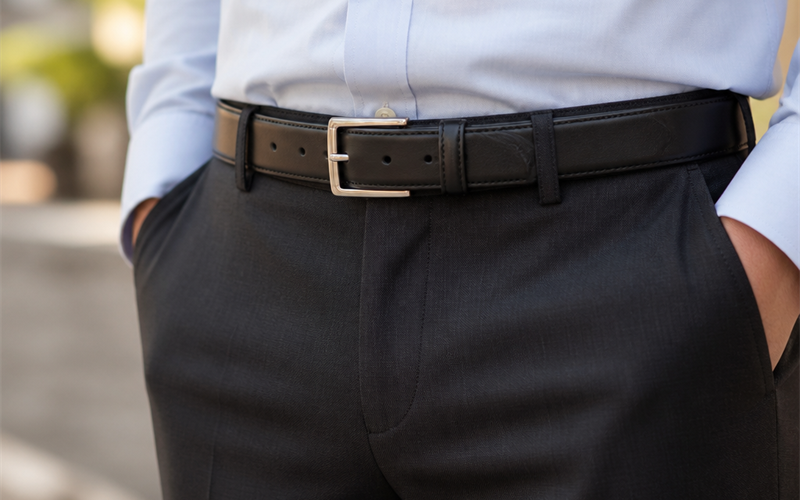
Best Full-Grain Leather Dress Belt for Men (Suit Edition 2026)
Quick answer: The best full-grain leather dress belt for men is 1.25" or 1.38" wide (32-35mm), full-grain calfskin or fine-grain cowhide in black or dark brown, with a slim single-prong or quiet plaque buckle in brushed or polished stainless steel. The leather should be smooth and even (no pebble or distressed grain), edges painted to match, and the strap thin enough to slide easily through dress trouser loops. BELTLEY's slim full-grain dress belt styles cover the suit standard.
Last updated: May 2026 • By BELTLEY Editorial
TL;DR:
- Suit-appropriate width: 1.25" or 1.38" (32-35mm) — anything 1.5" or wider reads casual.
- Color: black for navy/charcoal/grey suits; dark brown for brown/tan/blue suits.
- Leather finish: smooth full-grain calf or fine cowhide — no pebble, no pull-up, no distressed.
- Buckle: slim single-prong or quiet plaque in brushed or polished stainless steel — no flashy plate, no logo.
- The belt should match your shoe color, not your suit.
The dress belt is one of the most over-thought and under-mastered pieces in men's wardrobes. Most guys default to a 1.5" casual belt with a suit — which reads slightly off without anyone being able to articulate why. The fix is simple: a true dress belt is narrower (1.25"-1.38"), thinner (lower profile), and finished more smoothly than a casual belt. Combined with the right color and buckle, it disappears into the outfit the way a great dress belt should. Below is the buyer's standard and how to spot the right one. For sizing, see our size guide.
Dress Belt Spec, Confirmed in Four Rows
The suit-edition checklist:
| Your situation | Go with |
|---|---|
| Charcoal/black suits, black shoes | Black 1.25" smooth full-grain or calfskin, polished prong — the uniform answer. |
| Navy/grey suits, brown shoes | Espresso 1.25"–1.38", matched in tone to the shoe. |
| One dress belt only | Black — it covers the occasions where rules are enforced. |
| The connoisseur version | Glazed black crocodile ($118–$289) — same rules, finer execution. |
Dress-spec straps: BELTLEY's men's collection, calfskin $100–$148.
What width should a dress belt be?
1.25" or 1.38" (32-35mm) — narrower than a casual belt. Standard dress trouser belt loops are sized for narrow straps; a 1.5" belt physically fits but reads slightly bulky against a tailored suit. The classic dress width is 1.25" (32mm) for traditional formalwear and 1.38" (35mm) for modern business suits — both work, both look elegant, and both slide through suit trouser loops without stretching them.

The 1.5" width is a casual standard — perfect for jeans and chinos, slightly out of place with a tailored suit. The difference is subtle to a casual observer but unmistakable in a coordinated outfit. If your existing "dress belt" is 1.5", it isn't a true dress belt — it's a casual belt being used dressy.
What color dress belt works with which suit?
Match the belt to your shoes, not your suit. (1) Black belt with black shoes — pairs with navy, charcoal, grey, and black suits. (2) Dark brown belt with brown shoes — pairs with brown suits, tan suits, blue suits (mid-blue or lighter), and certain greys. (3) Burgundy/oxblood belt with burgundy or oxblood shoes — niche but classic with navy and grey. The belt-to-shoes match is the rule; the suit color is mostly irrelevant.

Two belt colors cover 95% of business wardrobes: a black full-grain dress belt and a dark brown full-grain dress belt. Together with their matching shoes, they pair with virtually every standard business suit. A third belt (oxblood or mid-brown) adds versatility but isn't required.
Key stat: Roughly 80% of men's business wardrobe pairings can be handled with two dress belts — one black, one dark brown — and the matching pair of shoes for each. The "I need five belts" instinct is fashion marketing, not actual closet need.
What buckle works on a dress belt?
Slim, simple, low-profile. Three buckle styles work for dress belts: (1) Single-prong buckle — the traditional dress standard, slim and elegant. (2) Quiet plaque buckle — flat metal plate, no protruding tongue, very modern and minimal. (3) Reversible buckle — flips between black and brown belt sides, common in entry-level dress belts. Avoid: oversized buckles, flashy plate buckles with prominent logos, novelty shapes, and ornate detailing.
Material: stainless steel or solid brass with a brushed or polished finish. Brushed reads modern; polished reads classic. Both are appropriate; choose what matches your watch and other metal accessories. Plated zinc-alloy buckles flake within 1-2 years and should be avoided — see first real leather belt: 5 questions to ask before you buy.
Dress belt buyer's standard
| Element | Dress standard | Casual (not for suits) |
|---|---|---|
| Width | 1.25"-1.38" (32-35mm) | 1.5"+ (38mm+) |
| Leather finish | Smooth full-grain | Pebble, pull-up, distressed |
| Color | Black, dark brown, oxblood | Tan, light brown, two-tone |
| Buckle | Single-prong or quiet plaque | Heavy plate, novelty, logo |
| Buckle finish | Brushed/polished stainless or brass | Antiqued, hammered, gold-plated |
| Edges | Painted, smooth, color-matched | Sometimes raw, sometimes burnished |
| Thickness | 3-4mm | 4-5mm+ |
| Hardware tone | Subtle | Bold |
What leather finish should a dress belt have?
Smooth full-grain calfskin or fine cowhide. The grain should be visible but subtle — natural pores, no embossed pattern, no pebble texture, no distressed effect. The surface should reflect light evenly when polished. Pull-up leather (which darkens dramatically when flexed) reads casual; pebbled or distressed leather reads casual; smooth fine-grain reads dressy.

Italian calfskin is the traditional dress standard for its fine, even grain and refined finish. US full-grain cowhide can also work for dress belts if the finish is smooth and even, but coarser-grained US harness or bridle leather reads casual against a tailored suit. For background on the differences, see american vs italian full-grain leather belts.
How thick should a dress belt strap be?
3-4mm — thinner than casual. Casual belts run 4-5mm or more (for visual presence and weight); dress belts run 3-4mm so they slide easily through dress trouser loops and lie flat under a suit jacket. A thick belt strap creates a visible bulge through a fitted suit; a thin dress belt disappears under tailoring.

The thinness has to come from leather choice and skiving (a beveling technique that thins the strap edges), not from cheap construction. A 3mm full-grain belt with painted edges is the dress ideal; a 3mm bonded leather belt is a disposable mall belt that happens to be thin. The thickness matters; what makes it work is the underlying material.
Are there any dress belts to avoid?
Yes — several common mistakes. (1) 1.5"+ width with suits — reads casual no matter the leather. (2) Pebbled or distressed leather with suits — reads casual or rugged. (3) Logo-stamped buckles — date quickly and read fashion-driven. (4) Reversible belts at any price above $50 — convenient but never look as refined as a dedicated single-color dress belt. (5) "Genuine leather" at any price — corrected-grain or low-grade material that won't last. See belt buying mistakes I made in my 20s.

The single biggest mistake is using one casual belt for everything. The 1.5" pull-up tan belt that works perfectly with jeans is wrong for a charcoal suit; the 1.25" smooth black dress belt that works perfectly with a suit is wrong for jeans. Two belts cover both wardrobes; one belt always compromises somewhere.
The Bottom Line
The best full-grain leather dress belt for men is 1.25"-1.38" wide, smooth full-grain calfskin or fine cowhide in black or dark brown, with a slim single-prong or quiet plaque buckle in brushed or polished stainless steel. Match the belt to your shoes, not your suit — two belts (black and dark brown) with their matching shoe colors handle 80%+ of business wardrobes. Avoid 1.5"+ widths with suits, pebbled or distressed leather, logo-stamped buckles, and "genuine leather" labels at any price. BELTLEY's slim dress belt styles in the full-grain leather belt collection and broader men's collection are built for this brief — real full-grain calfskin, slim 32-35mm widths, painted edges, solid hardware, backed by a 10-year warranty. Ready for a belt that disappears into your suit the way a great dress belt should? Start with our slim full-grain styles.
Frequently Asked Questions
Q: What size dress belt do I need for a suit?
For a suit, choose a 1.25" (32mm) or 1.38" (35mm) width — narrower than casual belts. The 1.5" casual standard reads slightly bulky with tailored trousers. For length, your dress belt should be one to two sizes larger than your pant waist size (e.g., size 36 belt for size 34 pants). See our size guide for full sizing.
Q: Should my dress belt match my suit or my shoes?
Your shoes, always. The belt-and-shoes color match is the foundational rule — black belt with black shoes, dark brown belt with brown shoes. The suit color is mostly irrelevant; a navy suit with black shoes takes a black belt, a navy suit with brown shoes takes a brown belt.
Q: What's the difference between a dress belt and a casual belt?
Width, leather finish, and buckle style. Dress belts are 1.25"-1.38" wide with smooth full-grain leather and a slim single-prong or plaque buckle; casual belts are 1.5"+ with pebble or pull-up leather and bolder hardware. A dress belt looks wrong with jeans; a casual belt looks wrong with a suit. Most men need both — one of each.
Q: Is a reversible belt acceptable as a dress belt?
Functional but never as refined as a dedicated single-color dress belt. Reversible belts use thicker leather, bulkier buckles, and have visible color seams. They work as entry-level versatility for travel, but two dedicated dress belts (one black, one brown) look more refined and last longer.
Q: What's the best buckle for a dress belt?
A slim single-prong or quiet plaque buckle in stainless steel or solid brass — brushed or polished finish. Avoid oversized plate buckles, logo-stamped designs, and novelty shapes. The buckle should be the quietest element of the outfit, not a focal point.


,%20full-grain%20calfskin%20or%20fine-grain%20cowhide%20in%20black%20or%20dark%20brown,%20with%20a%20slim%20single-prong%20or%20quiet%20p...)