Why Some Calfskin Belts Feel Stiff and Others Feel Buttery
TL;DR:
- Hand-feel differences come from tannage, finishing, fiber density, and hide source — not just brand or price.
- Vegetable-tanned calfskin feels firmer and more structured. Chrome-tanned feels softer and more pliable.
- Heavily-finished box calf feels crisper. Lightly-finished aniline feels softer and more natural.
- Full-grain calfskin from quality European tanneries (Haas, Annonay, Tempesti) feels distinctly more "luxurious" than industrial chrome-tanned calf.
- Stiff isn't always bad — it can mean a belt that holds its shape for 20+ years. Buttery isn't always good — it can mean over-finished or low-density.
You pick up two calfskin belts. Same color. Same width. Similar price. One feels firm, almost crisp. The other feels soft, buttery, almost melted. They're both labeled "full-grain calfskin." What's actually different?
This guide explains the real reasons calfskin belts feel different in hand — from tannage method to finishing choices to which tannery the hide came from. If you've ever wondered why your $200 calfskin belt feels nothing like your buddy's $200 calfskin belt, the answer is here.
Which Hand-Feel Should You Buy?
Stiff vs buttery is a fit question, not a quality ranking:
| Your situation | Go with |
|---|---|
| Dress belt that holds a crisp line | Firmer veg-tan or box calf — structure is the feature. |
| Comfort-first daily wearer | Chrome-tanned or aniline calf — buttery from the first wear. |
| Belt feels like cardboard, not structure | That's low-grade hide, not firm tannage — density and stiffness are different things. |
| Buying online, can't touch it | Tannage listed = your proxy: veg-tan reads firm, chrome reads soft. BELTLEY calfskin runs $100–$148. |
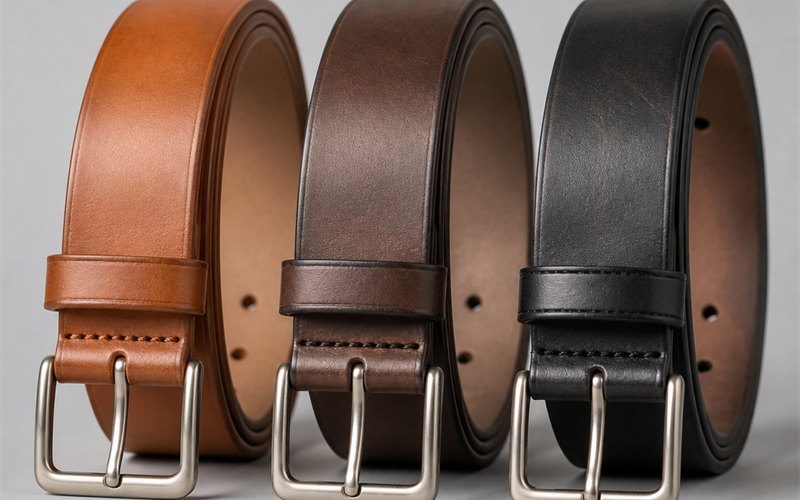
Both hand-feels in genuine calfskin: BELTLEY's men's collection.
What actually creates the difference between stiff and buttery calfskin?
Four factors create hand-feel differences in calfskin: tannage method (vegetable vs chrome vs combination), finishing process (how much wax, oil, and glazing the leather receives), fiber density (calf age, hide source, density of the specific hide), and belt construction (single-layer, double-layer, lined, or backed). Change any one of these and the belt feels different, even from the same starting hide.

The variables at a glance:
| Factor | Stiff Side | Buttery Side |
|---|---|---|
| Tannage | Vegetable, combination | Chrome, aniline |
| Finishing | Heavy wax, glazing | Light, oil-finished |
| Hide source | Older calves, denser hides | Younger calves, looser hides |
| Construction | Double-layer, structured | Single-layer, unlined |
| Conditioning | Light from tannery | Heavily oiled at tannery |
Britannica's leather entry covers the tannage and finishing variables, but the practical takeaway is that "calfskin" is a category, not a single product. Two belts can both honestly be called full-grain calfskin and feel completely different. We covered the tannage axis in detail in our vegetable vs chrome-tanned calfskin post.
Why does vegetable-tanned calfskin feel stiffer?
Vegetable-tanned calfskin feels stiffer because the plant-based tannins (oak, chestnut, quebracho) bind tightly with the leather's collagen fibers, creating a denser, more structured hide. The tannage process also takes longer (weeks to months in tannery pits), which deposits more tannin into the fiber matrix. The result: firm leather that holds its shape well, breaks in slowly, and develops a beautiful patina over years.
Veg-tanned calfskin characteristics:
- Firm, structured hand-feel out of the box
- Slower break-in (still much faster than veg-tanned cowhide)
- Develops dramatic patina with age
- Heavier per square foot than chrome-tanned equivalents
- More resistant to stretching
This isn't a defect — it's the design. Traditional luxury houses still prefer vegetable tanning for items where structure matters: belts, briefcases, briefcase handles, saddlery. The trade-off is upfront softness.
Why does chrome-tanned calfskin feel buttery?
Chrome-tanned calfskin feels soft and buttery because chromium salt tannage produces a more pliable, supple hide right out of the tannery. The process is fast (24–48 hours vs months for veg-tan), uses less tannin penetration, and leaves the leather with a softer fiber matrix. Add aniline dyeing and minimal finishing, and you get a calfskin that feels melted on the hand.

Chrome-tanned characteristics:
- Soft, supple, "buttery" hand-feel from day one
- Faster break-in (essentially instant)
- Less dramatic patina development (chrome locks in some color)
- Lighter per square foot
- Slightly more stretch-prone over years
This is why most luxury fashion houses use chrome-tanned or chrome-veg-combination calfskin for their famous "buttery soft" handbags and dress belts. The feel sells. The trade-off is structure: chrome-tanned calfskin can lose shape over a decade in ways veg-tanned wouldn't.
Stridewise's tanner interview series covers exactly this trade-off — the same starting hide can become firm or buttery depending on the tannage chosen, and neither answer is universally "better."
Why does finishing affect feel so much?
Finishing — the wax, oil, glazing, and surface treatment applied after tannage — has as big an impact on hand-feel as tannage itself. A heavily finished box calf with multiple wax and glazing passes feels crisp, almost slick. A lightly finished aniline calfskin with only minimal surface treatment feels soft, natural, almost velvety. Same hide, different finishing, completely different feel.

The finishing spectrum, from crisp to soft:
- Patent leather — full plastic-like coating, very crisp surface
- Heavy box calf — multiple wax/glazing passes, polished feel
- Standard box calf — moderate finishing, traditional dress belt feel
- Semi-aniline — light topcoat, soft but uniform
- Full aniline — minimal finishing, natural and soft
- Nubuck / suede — surface broken to expose fibers, velvety
We covered the finishing axis in our polished vs matte calfskin belt post. The principle: stiffness/softness can be engineered at the finishing stage independently of what the base hide is like.
Does hide source actually affect feel?
Yes — and significantly. Calfskin from older calves (8–9 months) has slightly denser, firmer fiber structure than calfskin from younger calves (4–6 months). Calfskin from European tanneries with strict feed and welfare standards (Haas, Annonay, Tempesti, Walpier) consistently feels different from industrial commodity calfskin out of less controlled supply chains. The difference is subtle but real.
What affects hide source quality:
- Calf age at slaughter — younger = softer and finer, older = firmer and stronger
- Diet and welfare — directly affects hide thickness, fiber density, surface quality
- Climate — calves from temperate climates tend to produce cleaner hides than calves from extreme climates
- Tannery selection standards — premium tanneries reject more hides than commodity ones
The Leather Working Group audits tanneries on environmental and traceability standards, and the audit ratings correlate strongly with end-product quality. We covered tannery-specific differences in our Italian vs French calfskin tannery post.
Is stiffer calfskin actually better quality?
Not necessarily — stiffness doesn't equal quality, and softness doesn't equal cheapness. Both can be high-quality results from intentional design choices, and both can be low-quality results from cutting corners. Stiffness is "better" only if you want a belt that holds its shape for 20+ years. Softness is "better" only if you want immediate comfort and a slim, flexible feel.

The honest version:
- Stiff and high-quality: Veg-tanned, full-grain, heavy box calf finishing — feels firm, looks crisp, lasts decades
- Stiff and low-quality: Bonded leather with stiff fiber backing — feels rigid like cardboard, cracks within months
- Buttery and high-quality: Chrome-tanned full-grain aniline calfskin from a premium tannery — feels soft, ages beautifully
- Buttery and low-quality: Heavily oiled split leather — feels soft but stretches, loses shape, develops cracks
The reliable signal isn't softness or stiffness — it's whether the leather is full-grain. We unpack the authentication side in our how to spot real calfskin vs fake post. Once you've confirmed full-grain, stiff vs buttery is a preference question, not a quality question.
Which feel should you actually choose?
Choose based on use case, not on which sounds better. For dress belts that hold shape against suit trousers, lean stiffer (veg-tanned or combination, heavier box calf finish). For everyday belts worn under casual clothes, lean buttery (chrome-tanned, lightly finished aniline). For investment belts you want to last 20+ years with dramatic patina, lean stiffer veg-tanned. For immediate comfort with no break-in, lean buttery.

The wardrobe-based answer:
- One dress belt for suits: Vegetable-tanned or combination-tanned box calf — structure matters under tailoring
- Daily business-casual belt: Combination-tanned semi-aniline — middle of the road, versatile
- Smart-casual everyday belt: Chrome-tanned aniline — soft, supple, easy
- Heirloom 20-year belt: Vegetable-tanned, lightly finished — patinas dramatically over time
We talk through the rotation logic in our 4 quality markers of a calfskin belt post.
The Bottom Line
Stiff vs buttery isn't a quality contest — it's a design choice. Vegetable-tanned, heavily finished calfskin feels firm because it's engineered to hold structure for decades. Chrome-tanned, lightly finished aniline calfskin feels buttery because it's engineered for immediate comfort. Both can be high-quality. Both can be junk. The actual quality signal is full-grain hide from a reputable tannery — feel is preference after that.
At BELTLEY, our dress belts use full-grain calfskin in combination tannage with traditional box-calf finishing — structured enough to hold shape under tailoring, supple enough to wear comfortably from day one. The 10-year warranty is built on the underlying leather quality, not on whether the belt feels firm or soft. Either feel can deliver the warranty; the leather has to be real either way.
Find the feel that fits your wardrobe in our calfskin belt collection.
Frequently Asked Questions
Q: Is buttery soft calfskin a sign of quality?
Sometimes — but not always. High-quality chrome-tanned aniline calfskin from premium tanneries feels buttery and is genuinely premium. Low-quality split leather can also feel buttery soft (because it's been over-conditioned to disguise low density). Softness isn't the quality signal — full-grain hide is.
Q: Should a dress belt feel stiff?
A dress belt should feel structured, not floppy. "Stiff" is too strong — a quality dress belt feels firm and substantial, with enough flex to wrap comfortably around your waist but enough body to hold its shape under a jacket. If it feels like rubber, it's too soft for dress wear.
Q: Will a stiff calfskin belt soften over time?
Yes, slightly. All leather softens with wear as natural oils from your skin work into the strap. But a vegetable-tanned belt designed for structure won't become buttery soft — it stays firm by design. That's the point.
Q: Why does my expensive belt feel stiffer than my cheap one?
Probably because the expensive one is veg-tanned full-grain calfskin and the cheap one is over-conditioned split leather. Stiffness from quality hide and stiffness from cardboard backing are different things — and the cheap soft belt will fail faster than the firmer quality one.
Q: Can I make my stiff belt feel softer?
A light conditioning every 3–6 months will gradually soften any calfskin belt slightly. Don't over-condition — too much oil makes leather feel saturated and reduces structural strength. A well-built belt is meant to feel the way it feels.