The 4 Quality Markers of a Calfskin Belt: Stitching, Edge, Buckle, Suppleness
TL;DR:
- A premium calfskin belt comes down to four quality markers: stitching, edge finish, buckle hardware, and leather suppleness.
- Real saddle stitching beats glued or single-thread machine stitching. Look for 6–8 stitches per inch (SPI).
- Burnished or hand-painted edges beat raw or painted-plastic edges. Run your finger along them — they should feel smooth and continuous.
- 316L stainless steel or solid brass buckles beat plated zinc alloy. Weight is the giveaway.
- Calfskin should feel dense, warm, and slightly alive in your hand — not stiff, plasticky, or floppy.
- Check all four in about 60 seconds. If three or more are wrong, the belt isn't what it claims.
So you've narrowed down to a few calfskin belts and they all look fine in the photos. They all use the word "premium" somewhere on the page. The price ranges from $80 to $400. How do you actually tell which one is worth the money? Easy — you check the four things the marketing copy never wants to talk about. Once you know what to look for, the quality (or lack of it) reveals itself in seconds.
Why These 4 Markers?
Because they're the four places brands can quietly cheap out without it being obvious in photos. A belt can look gorgeous on Instagram and still have glued seams, painted-plastic edges, a zinc buckle, and stiff bonded leather. Photos don't show stitching density. They don't show buckle weight. They don't show how leather behaves in your hand. The four markers do — and a brand that nails all four is rarely faking anything else.

If you only have 60 seconds to evaluate a belt, spend 15 seconds on each. Stitching, edge, buckle, leather. Let's go through them.
Marker 1: What Does Good Stitching Look Like?
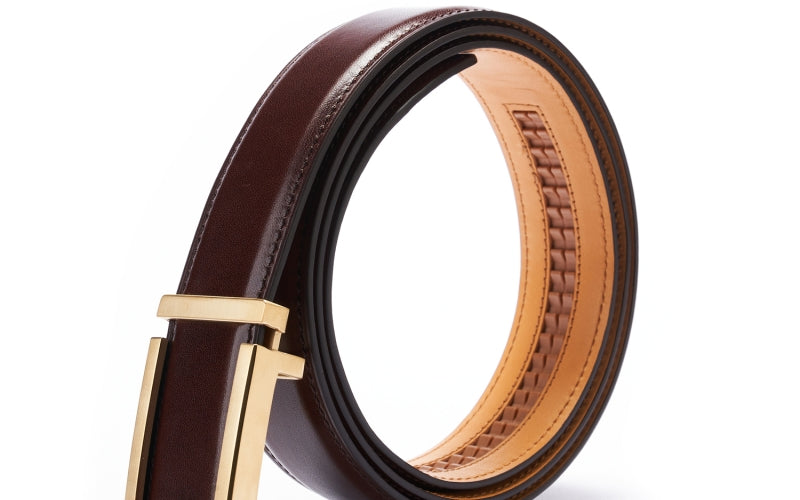
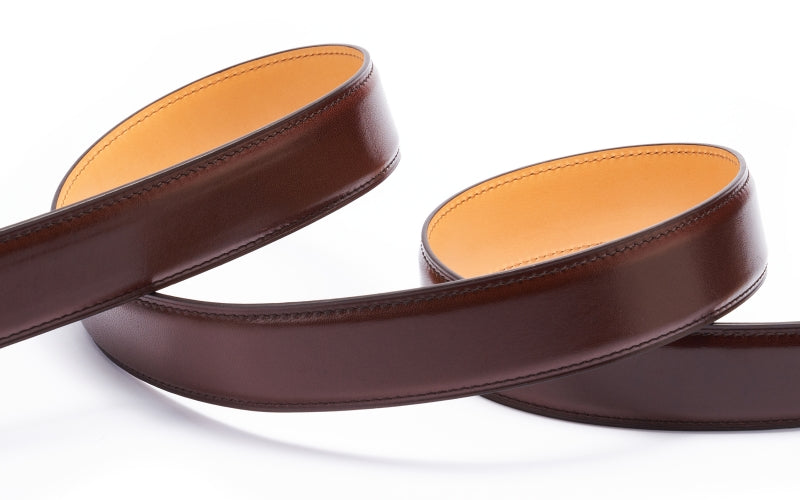
Quality calfskin belts use real stitching — not glue — with even, tight stitches at 6–8 stitches per inch (SPI). The best belts use saddle stitching (two-needle hand stitch). Look for visible thread on both sides, consistent stitch length, and stitches that sit flat without puckering. Cheap belts use glue, single-thread machine stitching, or no stitching at all.
What to check:
- Saddle stitch vs machine stitch. Saddle stitching uses two needles passing through each hole in opposite directions, creating an interlocking thread pattern. If one stitch breaks, the whole row doesn't unravel. Machine stitching uses a single thread with a bobbin — if it breaks, the row can come apart. Saddle stitching is the heritage standard; quality machine stitching is fine for most belts.
- Stitches per inch (SPI). Premium belts: 6–8 SPI. Mass-market: 4–5 SPI. Anything below 4 is bargain-bin work.
- Stitch density and evenness. Run your eye along the stitch line. Quality work has perfectly even spacing. Cheap work has visible variation, skipped stitches, or puckering.
- Thread material. Premium belts use linen or polyester-bonded thread that's heavier than basic sewing thread. You can usually see the substance of the thread.
A belt with no visible stitching anywhere is almost always glued or laminated. For dress belts, that's a serious quality flag. For background on what real construction signals, see our complete guide to calfskin leather.
Marker 2: What's the Right Edge Finish?
Quality calfskin belts have burnished or hand-painted edges — smooth, sealed, and rounded so they feel continuous with the strap. Cheap belts have painted-plastic edges that look slick but feel hard and rubbery, or raw edges that show fraying fibers. Edge finishing is the single most underappreciated craft detail.
What you'll encounter:
- Burnished edges (premium) — the leather edge is dampened, slicked, sometimes waxed, then rubbed at speed to seal the fibers. The result is a smooth, slightly darker edge that feels like an extension of the leather. Survives decades of wear.
- Hand-painted edges (premium) — a thin paint or finish is applied by hand in multiple layers, sanded smooth between coats. Hermès does this. So do top heritage makers.
- Painted-plastic edges (mass-market) — a thick coat of acrylic paint applied quickly. Looks shiny in photos. Feels hard and cracks within years.
- Raw / unfinished edges (varies) — common on rustic / heritage belts intentionally; a red flag on dress belts.
How to check: run your fingernail along the edge. Quality burnished or painted edges feel smooth and continuous. Cheap edges feel like a hard rubber strip glued onto the leather, often with visible seam lines where the paint stops.
Marker 3: Which Buckle Materials Should You Trust?
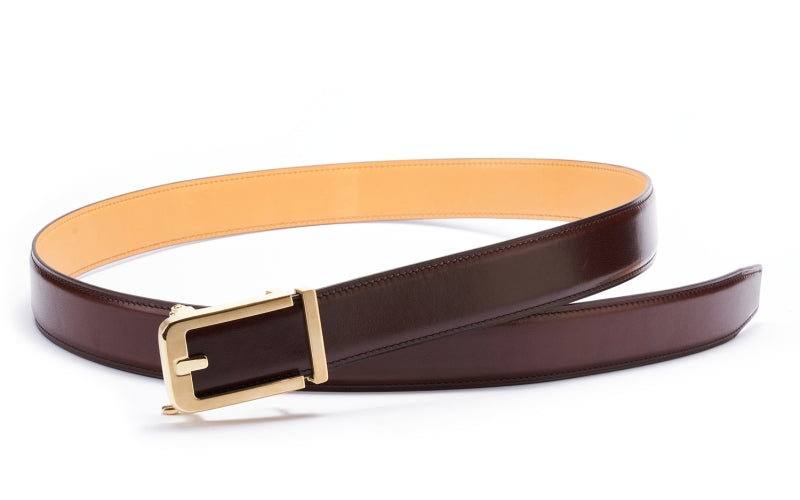
Premium buckles use 316L stainless steel or solid brass. Mid-tier uses 304 stainless or quality brass. Cheap belts use zinc alloy with a plated finish that wears off in 6–12 months. The giveaway is weight — real metal feels noticeably heavier than zinc. A buckle weight test takes 5 seconds and is the most reliable hardware check.

The materials hierarchy:
- 316L stainless steel — corrosion-resistant, hypoallergenic, the gold standard. Used by serious luxury brands and quality DTC.
- Solid brass — heavy, ages beautifully (develops patina), classic. Common on heritage-style belts.
- 304 stainless — good, slightly less corrosion-resistant than 316L.
- Zinc alloy with plating — what most "designer-looking" cheap belts use. Plating wears off, revealing dull base metal. Heavier than aluminum but lighter than steel/brass.
- Aluminum or coated plastic — avoid for any serious belt.
How to verify:
- Weight. A 1.5" stainless steel or brass buckle weighs 80–150g. A zinc-alloy buckle of the same size weighs 40–70g. Pick it up.
- Magnet test. 316L stainless is not magnetic. Zinc isn't either, but cheap plated steel is. Combined with the weight test, you can usually triangulate.
- Look at the prong tip. Quality buckles have smooth, polished prong tips. Cheap buckles have visible burrs or rough casting marks.
For more on what to look for hardware-wise, our piece on how to tell if a belt is full-grain leather covers complementary checks.
Marker 4: How Should Quality Calfskin Feel In Your Hand?
Quality calfskin feels dense, warm to the touch after a few seconds, slightly supple but not floppy, and "alive" in a way you can't quite articulate. Cheap leather or PU feels cool, light, either too stiff or too soft, and stays the same no matter how long you hold it. Trust your hand. It knows.
The four sub-checks for suppleness:
- Temperature response. Hold the belt in your palm for 10 seconds. Real calfskin warms to skin temperature; PU stays cool.
- Density per millimeter. Pinch a section between thumb and forefinger. Quality calfskin feels solid and firm. Cheap leather feels spongy or hollow.
- Flex behavior. Bend the belt gently. Quality calfskin creases smoothly and recovers; cheap leather either cracks or stays bent.
- Weight relative to size. Real calfskin is heavier than it looks. A 1.5" × 40" calfskin belt should weigh 150–250g. Lighter usually means thinner / lower-grade material.
According to Encyclopaedia Britannica's overview of leather production, the density and "hand" of leather are direct consequences of the hide's collagen structure and tanning process — which is why real leather behaves like a living material and synthetic doesn't. For a deeper science angle, see our piece on calfskin hide anatomy and density.
The 60-Second Quality Check
Here's the full routine, in order:

- 5 seconds: weight test on the buckle. Pick up the buckle end and feel the heft. Real metal = heavy. Zinc = light. Done.
- 15 seconds: stitching inspection. Look along both sides of the strap. Real stitching, consistent SPI, even tension. No glue lines.
- 15 seconds: edge check. Run your nail along the edge. Burnished or painted = smooth and continuous. Plastic-painted = hard and clearly applied.
- 15 seconds: leather hand-feel. Hold the strap in your palm. Bend it gently. Feel for warmth, density, and flex behavior.
- 10 seconds: smell test. Inhale near the leather. Real calfskin = organic, faintly sweet. Plastic / chemical smell = bad sign.
Total: 60 seconds. You'll catch 95%+ of quality problems. For the broader authentication workflow (real vs fake leather entirely), see our piece on how to spot real calfskin vs a fake.
When All 4 Markers Are Right
When stitching is real and even, edges are burnished or hand-painted, the buckle is heavy 316L stainless or solid brass, and the leather feels dense and alive — you're holding a quality belt regardless of the brand on the label. Conversely, a belt with all four markers wrong is junk no matter what the marketing says.
What this means for shopping:
- All 4 right + reasonable price = excellent value (DTC and craft tier territory).
- All 4 right + luxury price = paying for brand prestige, not better quality (Hermès / designer tier).
- 2 of 4 right + premium price = brand tax masquerading as quality.
- 0–1 of 4 right + any price = walk away.
The four markers are how you distinguish honest pricing from brand inflation. The leather and construction quality plateau much earlier than price does. For more on this, see our pieces on Hermès box calf vs designer calfskin brand tax and 2026 calfskin belt price tiers.
Quality Marker Cheat Sheet
| Marker | Premium | Mid | Cheap |
|---|---|---|---|
| Stitching | Saddle stitch, 6–8 SPI, linen thread | Quality machine stitch, 5–6 SPI | Glued or 4 SPI bargain |
| Edge | Burnished or hand-painted, smooth | Acceptable paint finish | Hard plastic paint or raw fraying |
| Buckle | 316L stainless / solid brass, heavy | 304 stainless or quality brass | Zinc alloy with plating |
| Suppleness | Dense, warm, alive, springs back | Solid but less responsive | Stiff plastic or floppy bonded |
| Smell | Organic leather, faintly sweet | Mild leather + finish | Chemical / glue / vinyl |
| Weight (1.5"×40") | 150–250g | 100–150g | Under 100g |
What to Avoid Regardless of Brand
A few non-negotiables that cancel out everything else:

- Plastic-painted edges that feel hard or cracked — even on expensive belts.
- Zinc buckles with peeling plating — usually visible at the prong tip.
- Glued construction with no real stitching — won't survive 3 years.
- "Genuine leather" as the only spec — low-tier real leather, not full-grain calfskin.
- No warranty — quality makers stand behind quality. Our warranty page covers BELTLEY's 10-year guarantee as a reference standard.
If you're shopping in person, do all four checks. If you're shopping online, demand the brand publish enough detail to answer all four — leather grade, hardware material, construction method, edge finish. Brands that can't answer those questions plainly are usually hiding something.
The Bottom Line
Quality in a calfskin belt isn't a vibe or a brand or a price — it's four specific things you can check with your hands in less than a minute. Real stitching at 6–8 SPI. Burnished or hand-painted edges. 316L stainless or solid brass buckle. Calfskin that feels dense, warm, and alive. Get those four right and you've got a belt worth wearing for a decade or more. Skip any of them and you've got a belt with an expiration date.
Frequently Asked Questions
Q: How many stitches per inch should a quality belt have?
6–8 stitches per inch (SPI) is the premium range. 5 SPI is acceptable for mid-tier. 4 SPI or fewer suggests bargain-grade work. Heritage saddle-stitched belts are sometimes denser at 8–10 SPI for visual effect.
Q: Is saddle stitching really better than machine stitching?
For longevity, yes — saddle stitching's two-needle interlock means a broken stitch doesn't unravel the row. For most everyday belts, quality machine stitching is perfectly fine. The difference matters most on heritage / lifetime pieces.
Q: How can I tell if a buckle is 316L stainless steel?
Weight (heavy for its size), no magnetic response, smooth polished finish, and a slight blue-gray tone rather than a yellow tint. Reputable brands specify "316L stainless steel" plainly. If a brand says just "stainless" or "alloy," it's usually a lower grade or zinc.
Q: What does "burnished edge" mean?
Burnishing is the process of dampening leather edges, applying a finish (often gum tragacanth or beeswax), and rubbing the edge at speed to seal the fibers. The result is a smooth, slightly darker edge that's structurally part of the leather. Far more durable than painted-plastic edges.
Q: Should real calfskin feel stiff or supple when new?
Depends on the tanning method. Chrome-tanned calfskin is supple from day one. Vegetable-tanned calfskin starts firmer and softens over months of wear. Both should feel dense and warm — neither should feel plasticky or floppy. See our vegetable-tanned vs chrome-tanned calfskin guide.