Best Calfskin Belt Thickness for Dress Wear (And Why 3 mm Is the Sweet Spot)
TL;DR:
- For dress wear, 3 mm is the sweet spot for calfskin belt thickness. It's thick enough to feel substantial and last decades, thin enough to drape elegantly through suit belt loops.
- In leather industry terms, 3 mm = about 8 oz. Standard dress-belt range: 6–8 oz / 2.4–3.2 mm.
- Too thin (under 2 mm): flimsy, buckle holes blow out, looks cheap.
- Too thick (over 3.5 mm): bulky under tailored trousers, looks casual or "work belt" instead of dress.
- A 3 mm calfskin dress belt with proper construction lasts 10–20 years and pairs cleanly with any suit.
Here's a fun bit of tailoring trivia almost nobody talks about: the difference between a dress belt that looks right with a suit and one that looks slightly off is usually about one millimeter. Three millimeters of leather drape and behave one way; four millimeters drape and behave differently enough that even non-experts notice without knowing why. So if your "calfskin dress belt" looks chunky under your trousers, the thickness is probably the reason. Let's break down exactly why 3 mm is the right answer for dress wear, and what changes when you go thinner or thicker.
Thickness Check Before You Buy
The 3mm rule, applied to your purchase:
| Your situation | Go with |
|---|---|
| Standard dress belt purchase | 2.4–3.2mm (6–8 oz), with 3mm the bullseye — substantial yet suit-loop elegant. |
| Belt under 2mm in hand | Pass — holes blow out and the strap flutters. Flimsy is forever. |
| Belt over 3.5mm marketed as "dress" | It's a casual belt in dress clothing — fine for chinos, wrong under tailoring. |
| Spec missing from the listing | Ask or move on — thickness is the spec lazy makers hide first. |
Thickness published on every page: BELTLEY's dress belts, calfskin $100–$148.
What Is the Best Thickness for a Dress Calfskin Belt?
For dress and business-formal wear, 3 mm is the gold standard. It hits the structural strength to last decades, the drape to flow elegantly through suit belt loops, and the visual proportion to look refined rather than rugged. Anything between 2.5–3.2 mm works well; outside that range, you start losing either function or aesthetics.

If you want a single number to shop with, 3 mm. If you want a range, 2.5–3.2 mm. Anything billed as a "dress belt" outside that range deserves a second look.
How Is Belt Thickness Measured?
Leather thickness is measured two ways: millimeters (mm) and ounces (oz). One ounce equals roughly 0.4 mm. So a 6 oz belt is about 2.4 mm; a 7 oz belt is about 2.8 mm; an 8 oz belt is about 3.2 mm. Premium brands usually publish in mm. Heritage / craft brands sometimes publish in oz.
Quick conversion table:
| oz | mm | Typical Use |
|---|---|---|
| 4 oz | 1.6 mm | Thin watch straps, very fine wallets |
| 5 oz | 2.0 mm | Minimum dress belt thickness |
| 6 oz | 2.4 mm | Dressy belts (slim profile) |
| 7 oz | 2.8 mm | Standard dress belts |
| 8 oz | 3.2 mm | Premium dress / business |
| 9–10 oz | 3.6–4.0 mm | Casual / heavy-duty belts |
| 12 oz+ | 4.8 mm+ | Work belts, heritage bridle |
For the broader thickness discussion across all leather types, see our piece on the best leather thickness for an everyday full-grain belt.
Why 3 mm? The Engineering Sweet Spot
Three millimeters isn't a marketing number. It's a structural and aesthetic optimization based on three real constraints:
Structural strength. Below 2.5 mm, calfskin starts to lose tear resistance around the buckle holes. Pulling tension from the buckle prong over years gradually elongates the hole, and thinner leather fails first. At 3 mm, the holes stay tight for decades.
Drape behavior. Suit and dress trousers typically have belt loops sized for ~30–40 mm wide belts at 2.5–3.5 mm thick. A 3 mm belt slides smoothly through, lies flat, and follows the contour of your waist. Thinner belts bunch up; thicker belts strain against the loops.
Visual proportion. Tailored trousers and dress shirts have specific proportional rules. A 3 mm belt looks intentional and refined under those rules. A 4 mm belt looks "heavy" — your eye picks up the bulkiness even before you can articulate it. Tailors have known this for over a century.
For background on why thickness alone isn't the only quality marker — density matters too — see our piece on calfskin hide anatomy: why density beats thickness.
What Happens If a Calfskin Belt Is Too Thin?
Below 2 mm, calfskin belts start to fail in three predictable ways: holes elongate quickly from buckle prong stress, the belt feels flimsy and "cheap" in hand, and the strap can twist or curl rather than lying flat. Thin isn't always bad — it's just usually wrong for dress wear specifically.

Sub-2 mm calfskin is the right thickness for:
- Watch straps (1.5–2.0 mm).
- Wallet construction (1.0–1.8 mm).
- Decorative or fashion-style belts where structure matters less.
- Lining inside heavier belts.
Sub-2 mm is the wrong thickness for:
- Dress belts you want to wear with suits for 10+ years.
- Anything that needs to hold belt holes under regular use.
- Belts visible through trousers as a structural waistband.
If you bought a "dress belt" and it bends like a ribbon in your hand, it's probably under 2 mm and won't survive serious wear.
What Happens If a Calfskin Belt Is Too Thick?
Above 3.5 mm, calfskin starts crossing into "casual" or "work belt" territory. The belt looks bulky under tailored trousers, stresses dress-trouser belt loops, and visually communicates "rugged" rather than "refined." Thick calfskin is fantastic — just not in a dress context.
A 4–5 mm calfskin belt is the right pick for:
- Casual wear with jeans, chinos, boots.
- Heritage / vintage style outfits.
- Anyone who wants visible substance in their belt.
- Heavy duty daily-driver belts.
A 4–5 mm calfskin belt is wrong for:
- Pairing with a tailored suit.
- Black-tie or formal events.
- Slim business-suit trousers with smaller belt loops.
In other words, thickness is one of the strongest formal/casual signals. Slim and dressy at 3 mm. Substantial and casual at 4 mm+. The leather can be identical; the thickness changes the entire mood.
Should a Dress Belt Be Lined or Single-Ply?
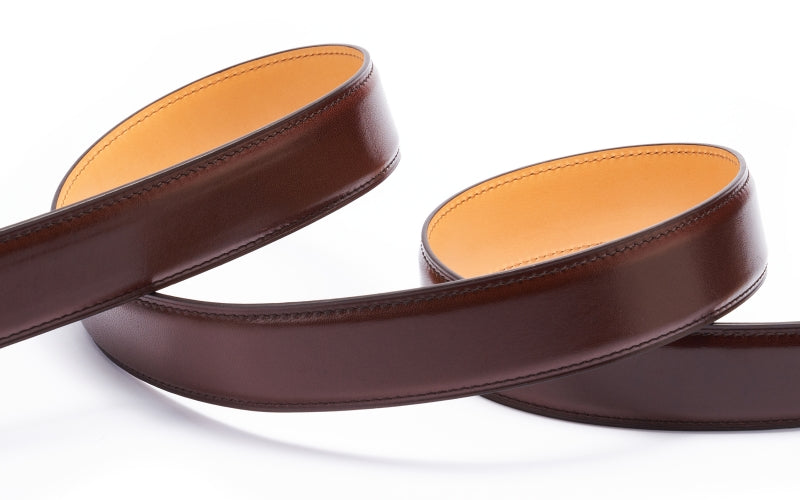
Premium dress calfskin belts can be single-ply (one piece of 3 mm calfskin) or lined (two thinner layers laminated together for a finished 3 mm total). Both are legitimate; single-ply is the more traditional construction. What matters is the finished thickness and how the leather lies flat.

Single-ply construction (one solid piece of calfskin):
- Heritage / dress-shoe-maker approach.
- Both sides show real leather (grain side and flesh side).
- Slightly stiffer initially; ages beautifully.
Lined construction (two laminated layers):
- More common in modern luxury / DTC.
- Allows reversible belts (two different colors).
- Can be slightly more flexible from day one.
- Quality depends on the bonding adhesive and outer layer.
Neither is universally better. Lined construction is often used for reversible belts and for belts where the maker wants extreme uniformity; single-ply is often used by heritage makers and for belts designed to age with a single coherent patina. For the broader craftsmanship discussion, see our piece on the 4 quality markers of a calfskin belt.
How Thickness Pairs With Belt Width
A quick proportional rule:
| Belt Width | Best Thickness | Wardrobe Match |
|---|---|---|
| 25–28 mm (1") | 2.5–3.0 mm | Very dressy / women's slim |
| 30–32 mm (1.18–1.25") | 2.8–3.2 mm | Dress to dressy-casual |
| 32–35 mm (1.25–1.38") | 3.0–3.2 mm | Standard men's dress |
| 38 mm (1.5") | 3.2–4.0 mm | Business casual / casual |
| 40 mm+ (1.6"+) | 3.5–5.0 mm | Casual / heritage / workwear |
Narrow + thin = dressy. Wide + thick = casual. The proportions reinforce each other. A 30 mm × 3 mm belt is unmistakably dressy. A 40 mm × 4 mm belt is unmistakably casual. Mismatched proportions (wide + thin, or narrow + thick) look awkward.
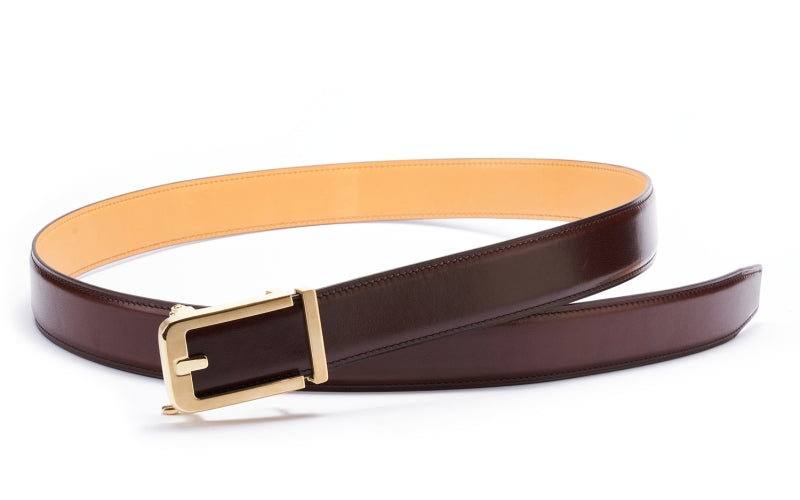
Our Classic Calfskin Dress Belt sits at 1.38" (35 mm) width with appropriate dress-belt thickness — proportionally tuned for tailored wear.
How Thickness Affects Aging and Patina
Thicker calfskin develops a more dramatic patina because there's more material to slowly oxidize, absorb oils, and respond to wear. Thinner calfskin patinas more subtly — the changes happen on a smaller surface area, so the effect is gentler.
For a dress belt specifically, this means:
- 3 mm calfskin develops a refined, layered patina over 5–10 years.
- 2 mm calfskin develops a softer, less dramatic aging — closer to "stays looking new."
- 4 mm calfskin develops a deeper, more characterful patina — but reads more casual visually.
If you want patina without sacrificing dress aesthetics, 3 mm is again the sweet spot. For more on patina specifically, see our piece on vegetable-tanned vs chrome-tanned calfskin belts.
Common Thickness Standards by Belt Type
| Belt Type | Typical Thickness | Notes |
|---|---|---|
| Black-tie dress belt | 2.5–3.0 mm | Slim, refined, minimal hardware |
| Business dress belt | 3.0–3.2 mm | The sweet spot |
| Business casual belt | 3.2–3.6 mm | Slightly more substance |
| Casual everyday belt | 3.5–4.0 mm | Cowhide territory more than calfskin |
| Heritage / heavy belt | 4.0–5.0 mm | Bridle, vegetable-tanned cowhide |
| Work / utility belt | 5.0–6.0 mm+ | Tool belts, ranch belts |
How to Check Belt Thickness Before Buying
Look for thickness specified in mm or oz on the product page. If it's not listed, that itself is a quality red flag — serious brands publish this number. If you have the belt in hand, you can measure with calipers or compare the edge to a US dime (1.35 mm) or quarter (1.75 mm). Two dimes stacked ≈ 2.7 mm; a dime + quarter ≈ 3.1 mm.

What to do:
- Check the product spec. Premium brands publish thickness (mm or oz). Brands that don't are usually hiding something.
- Compare to coins if shopping in person — quick approximation tool.
- Cross-check with belt width. Dress belts at 32–35 mm should be ~3 mm thick. Major mismatches signal poor craft.
- Trust your hand. A dress belt should feel substantial but not chunky. If it feels floppy or rigid, the thickness is probably wrong.
For BELTLEY's full sizing context, see our size guide. For more general guidance on dress vs. casual choices, see dress belt vs casual belt.
The Bottom Line
Three millimeters isn't a magic number — it's the result of structural engineering, tailored-trouser geometry, and visual proportions all converging on the same answer. A 3 mm calfskin dress belt fits suit belt loops cleanly, holds buckle holes for decades, drapes elegantly, and reads as refined rather than rugged. Go thinner and you sacrifice durability and substance. Go thicker and you sacrifice the dress aesthetic. At BELTLEY we build dress belts in this sweet spot because that's where calfskin actually does its best work — and we publish the thickness plainly so you can verify it instead of trusting marketing copy. When in doubt, reach for 3 mm. The math, the tailors, and the leather all agree.
Frequently Asked Questions
Q: How thick should a calfskin dress belt be?
3 mm (about 8 oz) is the gold standard for dress wear. Acceptable range: 2.5–3.2 mm. Below 2.5 mm risks structural issues; above 3.5 mm starts looking casual rather than dressy.
Q: What does "oz" mean in leather belt specs?
Ounces measure leather thickness in the leather industry. One ounce = approximately 0.4 mm. A 6 oz belt = 2.4 mm; a 7 oz = 2.8 mm; an 8 oz = 3.2 mm. Premium brands often publish in mm; heritage makers often publish in oz.
Q: Is a thicker belt always higher quality?
No — thickness and quality are different things. A thick low-grade leather belt is still low-grade. A 3 mm full-grain calfskin belt is genuinely premium. Thickness should match the use case (dress vs casual), not be treated as a quality proxy. See our piece on calfskin hide anatomy: why density beats thickness.
Q: Can I wear a 4 mm calfskin belt with a suit?
Technically yes, but visually it'll look slightly off — too chunky for tailored wear. Stick to 2.5–3.2 mm for suit wear and reserve 4 mm+ belts for business casual or casual outfits.
Q: Will a 3 mm calfskin belt last as long as a thicker one?
For dress wear, yes — a quality 3 mm full-grain calfskin belt easily lasts 10–20 years. Lifespan depends more on leather grade, construction, and care than on thickness. See our calfskin care 101 guide for the routine that maxes out either belt.