The Anatomy of a Calfskin Hide: Why Density Beats Thickness
TL;DR:
- A leather hide has two layers: a fine outer papillary layer and a thicker, fibrous reticular layer underneath.
- Calfskin's papillary layer is exceptionally dense because the calf is young — fibers haven't stretched yet.
- Density (how tightly packed the fibers are) matters more for strength-per-millimeter than thickness (total layer depth).
- That's why a 1 mm full-grain calfskin belt can out-tear a much thicker piece of low-grade leather.
- Thickness still matters in absolute terms — but it's the wrong number to obsess over when judging quality.
Most belt buyers ask one question first: "How thick is it?" It feels like a smart question. Thicker = stronger, right? Sometimes. But there's a second, less famous number that matters more — fiber density — and it's the reason luxury houses spend top dollar on calfskin that's a fraction of the thickness of a cheap work belt. Let's get inside the hide and see what's actually going on.
Use the Density Lesson When You Shop
The anatomy below becomes these buying rules:
| Your situation | Go with |
|---|---|
| Comparing two belts by thickness | Stop — pinch and flex instead; dense thin calfskin out-tears thick spongy leather every time. |
| Slim dress belt that must last | Full-grain calfskin — density is why 1mm of it works where 2mm of low-grade fails. |
| A belt that feels marshmallow-soft | Loose fibers — that's the reticular layer doing all the work. Pass. |
| Judging online without touching | Look for "full-grain calfskin" stated plainly plus real thickness specs — density hides behind honest labeling. |
Dense, honest calfskin at $100–$148: BELTLEY's men's collection.
The Thickness Myth
Thickness alone doesn't tell you how strong a leather is. A dense 1 mm hide can outperform a loose 3 mm hide in real tear and tensile tests. What matters is how tightly packed the collagen fibers are within that thickness — the density.

This is the single most misunderstood thing in leather buying. People see "4 mm thick" on a label and assume premium. But 4 mm of poorly tanned, loose-fibered hide from an old, stretched cow is structurally weaker than 1.5 mm of tight, dense full-grain calfskin. The bulk fools you. The fiber math doesn't lie.
What's Inside a Leather Hide?
Every hide has two main layers that matter for how the finished leather behaves:
- The papillary layer (top) — the dense, fine-fibered outer surface. This is where hair follicles, natural grain, and the strongest fiber packing live. It's usually 20–30% of total hide thickness but does most of the structural and aesthetic heavy lifting.
- The reticular layer (bottom) — the thicker, looser, more open fiber layer beneath the papillary layer. Contributes bulk, flex, and overall thickness, but is structurally weaker per millimeter.
According to Encyclopaedia Britannica's overview of leather production, the papillary layer is where leather gets its smooth surface, its grain pattern, and most of its tensile strength. Cut it off (the way "top-grain" leather production does) and you lose the best part of the hide. That's why our piece on full-grain vs. top-grain leather keeps emphasizing the value of an intact top layer.
Full-grain calfskin keeps the entire papillary layer. That layer happens to be denser in calf hides than in any other commercial leather source. That's the whole magic trick.
Why Calf Hides Are Denser Than Adult Cowhides
Calf hides are denser because the animal hasn't grown enough to stretch the skin. The collagen fibers and hair follicles are still tightly packed in their original, compact arrangement. As cattle age, their skin literally expands to cover a much bigger body — and the fibers spread apart.
A master tanner interview on Stridewise's calf vs. cow leather breakdown puts it bluntly: "The hair follicles are much more tightly packed because of the age of the animal." Same species, same anatomy, completely different fiber spacing. A four-year-old cow has hide that's been stretched across a body roughly six times the size of a six-month-old calf's body. Those fibers don't snap back. They permanently spread.
So the "premium" in calfskin isn't just marketing — it's anatomy. You're paying for fiber density per square inch that the supply chain can't replicate in any adult bovine. For more on what makes calfskin different from the start, see our complete guide to calfskin leather.
What Does "Density" Actually Mean for a Belt?
Density determines how much real structural material is packed into every cubic millimeter of leather. Higher density = more collagen fibers = better tear resistance, tensile strength, and aging behavior per unit of thickness. It's the difference between a steel rod and a piece of foam pretending to be the same diameter.

A few things higher density gives you in a finished belt:
- Better tear resistance — fibers can't separate as easily.
- Cleaner edges — denser leather burnishes to a smoother finish.
- Tighter dye absorption — color sits more uniformly.
- Longer patina life — the leather has more "material" to slowly oxidize.
- Less stretching — your belt holes don't blow out as quickly.
This is also why our piece on why full-grain calfskin is the gold standard emphasizes density alongside intact-grain — the two together are what put full-grain calfskin at the top.
Density vs Thickness: The Honest Trade-off
Now the trade-off, because there is one.
Density wins on strength-per-millimeter. Thickness wins on absolute durability under extreme abuse. A 1 mm calfskin belt is structurally beautiful — but it's still 1 mm of leather. If you bury it under a tractor tire, the thicker work belt is going to fare better in absolute terms simply because there's more material in the way.
That's why the right answer for a heavy-duty work belt is thick + dense (full-grain cowhide), and the right answer for a dress belt is thin + extremely dense (full-grain calfskin). For a deeper look at when thickness matters, our guide on the best leather thickness for an everyday belt covers the oz/mm trade-offs.
The point isn't that thickness doesn't matter. It's that thickness alone is a bad proxy for quality.
How Density Translates to Tensile Strength
Tensile strength — how hard you can pull leather before it tears — scales with fiber count, not just total cross-section area. Denser leather packs more fibers per millimeter, so per unit of cross-section, it resists pulling forces better. That's why calfskin's tensile strength is often surprisingly high relative to its thickness.

Standardized leather testing tracks this. Tanneries certified by the Leather Working Group routinely measure tensile strength, tear strength, and break elongation as part of quality control. The leather that scores best on a strength-per-millimeter basis is almost always full-grain hide from younger animals.
Translation: if you cut a 1 mm strip of calfskin and a 1 mm strip of cowhide and pulled them both, the calfskin would often hold longer. The math is in the fiber count.
Why a 1mm Calfskin Belt Can Out-Wear a Thicker Cheap Belt
Because cheap belts aren't actually thick leather — they're thin layers of finished material glued or laminated together, often with low-grade split leather inside. A "3 mm" fast-fashion belt frequently has only 0.5 mm of real grain on the surface, and the rest is bonded fiber or filler that breaks down within months.
You'll see this in real-world failure patterns: cheap belts crack at fold lines, separate along the edges, and blow out at the buckle holes within 1–3 years. A real 1 mm full-grain calfskin belt has more actual leather in its structure than a 3 mm bonded belt has total material that holds together over time.
This is the entire reason "real leather" labels aren't enough. Look for "full-grain" + a real hide origin + a tannery you can name. The leather grades explained guide breaks down the official hierarchy.
How to Judge Hide Density By Hand
You can't see density. But you can feel it. A few tests that work in person:
- The bend test. Bend the belt sharply. Dense leather creases smoothly and recovers. Loose leather wrinkles in big, ugly folds.
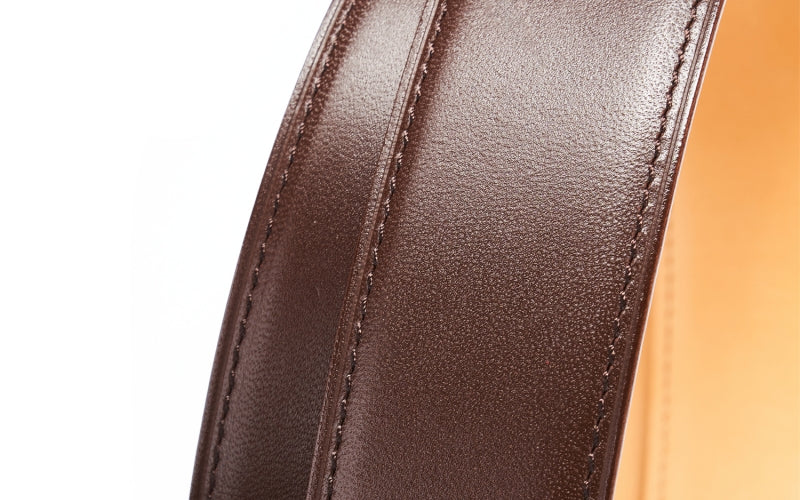
- The edge test. Look at the cut edge of the strap. Dense leather has a tight, almost solid-looking cross-section. Loose leather looks fluffy or layered.
- The squeeze test. Pinch a section between thumb and forefinger. Dense leather feels firm and "alive." Loose leather feels spongy or compressible.
- The weight test. Pick the belt up. Dense leather is heavier than its thickness suggests. Loose leather feels surprisingly light.
- The smell test. Real, dense leather smells like leather. Anything that smells like glue, plastic, or vinegar is concealing something.
These tests work on calfskin, cowhide, and exotics alike. They're the same checks a good leather buyer does at a tannery.
Density at a Glance
| Hide Type | Typical Thickness | Fiber Density | Best For |
|---|---|---|---|
| Full-grain calfskin | 0.6–1.2 mm | Very high | Dress belts, fine bags, premium wallets |
| Full-grain cowhide | 2.5–5 mm | High | Work belts, casual belts, saddlery |
| Top-grain calfskin | 0.6–1.0 mm | Medium-high (sanded surface) | Mid-luxury accessories |
| Top-grain cowhide | 1.5–3 mm | Medium | Mainstream belts |
| "Genuine" / split leather | 1.5–3 mm | Low | Avoid for belts |
| Bonded "leather" | varies | Very low (glued fragments) | Avoid entirely |
What This Means for Buying a Belt
Stop asking "how thick is it?" and start asking "what hide, what grain, what density?" A real answer would include the animal age (calfskin / adult cowhide), the grain (full-grain / top-grain), and ideally the tannery. If a brand can't tell you those three things plainly, the price is hiding something.

The simplest move: buy from brands that specify "full-grain" plainly, name their hide source, and back it with a real warranty. At BELTLEY we use full-grain calfskin for our dress pieces — our Classic Calfskin Dress Belt is built on the density advantage we've been talking about. Our dress belts collection is the broader lineup.
The Bottom Line
Thickness is the question every belt buyer asks. Density is the question they should ask. A leather hide isn't a uniform slab — it's a layered structure where the top millimeters do most of the work, and the value of those millimeters depends entirely on how tightly the fibers are packed inside them. Calfskin sits at the top of the leather hierarchy not because it's thick (it isn't) but because it's denser than any adult bovine hide on the market.
Frequently Asked Questions
Q: Is denser leather always better than thicker leather?
For strength-per-millimeter and refinement, yes. For absolute toughness under extreme abuse (heavy work belts, holsters, saddles), thickness still matters. The best leather is both — dense and thick, which is full-grain cowhide territory.
Q: How thick should a calfskin belt be?
For dress wear, 0.8–1.2 mm full-grain calfskin is the sweet spot. Any thinner risks flimsy structure; any thicker reads more like a casual belt and pairs awkwardly with a suit.
Q: How can I tell if a belt is high-density leather?
Bend it, look at the cut edge, pinch a section, and lift it. Dense leather creases smoothly, has a tight cross-section, feels firm, and is heavier than it looks. Loose or bonded leather fails each of these tests visibly.
Q: Why is full-grain leather denser than top-grain?
Top-grain leather has the densest part of the hide — the papillary layer — sanded off for cosmetic uniformity. What's left is mostly the looser reticular layer. Full-grain keeps everything intact, including the dense top fibers. See our full-grain vs top-grain guide.
Q: Does leather density change as a belt ages?
Slightly. Well-cared-for leather maintains its density throughout its lifespan — the fibers don't disappear, they just patina. Neglected leather (especially dried out, water-damaged, or untreated) can lose density as fibers weaken and separate. Our leather care guide explains how to keep the density advantage intact for decades.