Leather Grades Explained: The Complete Buyer's Guide
TL;DR:
- There are 4 main leather grades — full-grain, top-grain, genuine, and bonded — each from a different layer of the hide with dramatically different durability
- Full-grain is the highest grade, retaining the natural surface of the hide intact; it lasts 20–40+ years with basic care
- "Genuine leather" is real animal hide, but it's typically the lowest usable grade — and for belts, it's a poor investment
- Bonded leather is shredded scraps glued with polyurethane; it fails within months under belt tension and is not real leather in any practical sense
- The grade of leather determines not just durability, but whether a piece develops a rich patina or cracks and peels by year two
You've seen the labels: "genuine leather," "top-grain," "full-grain," "bonded leather." They sound like a quality scale — and they are. But nobody explains what those labels actually mean in plain terms. Retailers use them interchangeably, marketing teams bury the distinctions, and most buyers end up with a $60 belt that cracks by year two wondering what went wrong.
This guide cuts through it all. You'll learn exactly what each leather grade means, where it comes from in the hide, how long each grade realistically lasts, and — critically — how to spot quality before you buy. Whether you're purchasing your first real leather belt or upgrading to something built for decades of daily wear, understanding leather grades is the single most valuable knowledge you can bring to a purchase decision.
Which Grade Should You Buy?
The four grades collapse into simple buying rules:
| Your situation | Go with |
|---|---|
| Belt you want for 20+ years | Full-grain, no substitutes — the only grade that improves with age. From $58. |
| Tight budget, decent quality | Top-grain — a real compromise, not a scam; just don't expect patina. |
| Label says "genuine leather" | Translate it as "lowest passing grade" and keep walking. |
| Label says "bonded leather" | That's leather dust in glue. It will peel. It always peels. |
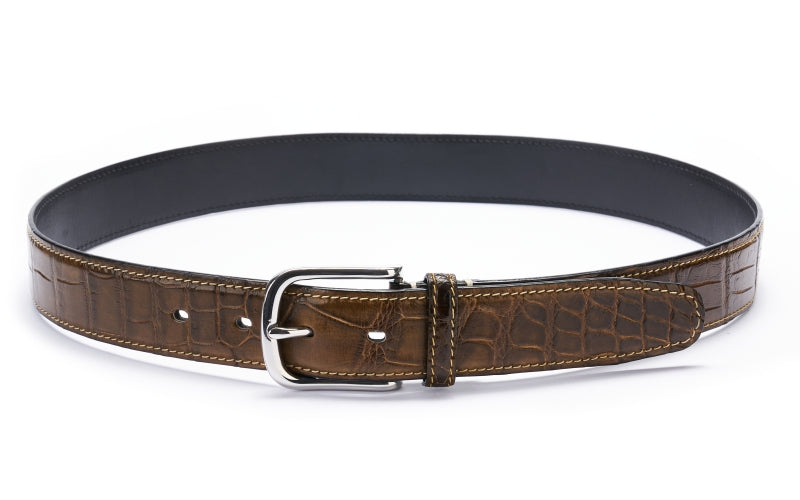
| Beyond cowhide entirely | Exotics (croc $118–$289, python from $112) sit above the grading system — graded by hide quality and cut instead. |
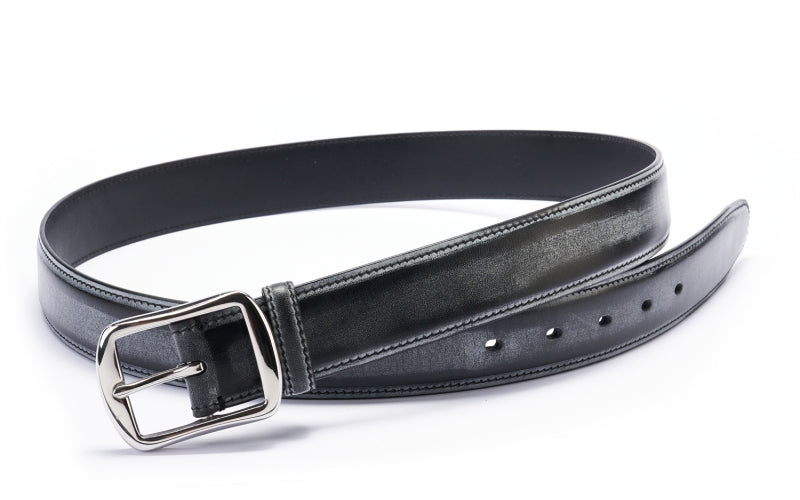
Top of the chart, honestly priced: BELTLEY full-grain and exotics.
What Are the 4 Grades of Leather?
Leather grades are a hierarchy based on which layer of the animal hide the leather comes from and how much it has been processed afterward. From best to worst: full-grain, top-grain, genuine leather, and bonded leather. Each step down means more processing, less structural integrity, and a significantly shorter lifespan.

Think of a cowhide as a layer cake. The outermost layer — the one that faced the world — is the densest, most durable, and most valuable. The deeper you cut into the hide, the looser the fiber structure becomes. Leather grades tell you how far down the slice was made, and what was done to the surface afterward. This is why two belts labeled "leather" can behave completely differently after two years of use.
Understanding these four grades also helps you decode pricing. A $180 full-grain belt from a DTC brand and a $350 designer belt made from "genuine leather" are not equivalent quality — not even close. The Leather Research Laboratory's surface classification guide outlines exactly where each grade falls in the processing hierarchy.
What Is Full-Grain Leather?
Full-grain leather is the highest quality leather available. It comes from the outermost layer of the hide, directly beneath the animal's hair, with the natural grain surface left completely intact — no sanding, no buffing, no surface corrections. Every grain variation, subtle scar, and natural marking is preserved.
That intact surface is the key to everything. The outermost layer of a hide contains the most tightly packed collagen fibers of the entire skin. Those dense fibers are what give full-grain leather its legendary strength, flex resistance, and longevity. According to leather fiber research published by the University of Northampton's Leather Technology Centre, the structural fiber integrity of untreated full-grain leather substantially exceeds that of any processed grade — which is why it outlasts lower grades by decades.
What Makes Full-Grain Leather Stand Apart?
The fundamental distinction between full-grain and every lower grade is that nothing is removed from the surface. No imperfections are sanded away. No artificial grain is stamped on. The hide is simply tanned, dyed, and finished — the original surface completely intact. This demands higher-quality source hides (those without excessive natural scarring), which drives material cost up but creates a structurally superior product.
This also means full-grain leather develops a patina — that rich, deepening sheen that builds over years as the leather absorbs natural oils from your skin and the environment. Patina is a living document of the leather's life. Lower-grade leathers, with their sanded and sealed surfaces, cannot absorb oils the same way and therefore cannot develop this quality. A genuine leather belt doesn't get better with age. A full-grain belt does.
At BELTLEY, every piece in our full-grain leather belt collection is sourced from hides selected for their natural grain consistency. We don't cover imperfections with heavy coatings — we select hides that don't need them.
How Long Does Full-Grain Leather Last?
With regular conditioning and basic care, full-grain leather lasts 20 to 40+ years. A well-made full-grain belt, rotated occasionally and conditioned once or twice a year, can realistically outlast a decade without any visible degradation — and the best examples outlast their owners. Some collectors have full-grain pieces from the 1980s still in active rotation.
This longevity isn't a marketing claim. Because the natural fiber structure remains intact, full-grain leather flexes, breathes, and recovers from stress in ways that processed leathers cannot. It gets better with age. A new full-grain belt looks good; a 10-year-old full-grain belt in good hands looks extraordinary.
BELTLEY backs this confidence with a 10-year warranty on materials and construction — because when you build from genuine full-grain leather, a decade is only the beginning of a belt's useful life.
What Is Top-Grain Leather?
Top-grain leather is the second-highest grade. It comes from the same outer layer of the hide as full-grain, but the surface has been sanded or buffed to remove natural imperfections, then coated or embossed with an artificial grain pattern. The result is a more visually uniform, consistent surface — but at a measurable cost to structural quality.
The sanding process removes some of the densest surface fibers of the hide. Those fibers are precisely what gives full-grain its strength. Removing them produces a cleaner-looking surface but sacrifices some durability and eliminates the leather's capacity to develop a genuine patina, a trade-off documented in detail by the Leather Conservation Centre's research program.
Is Top-Grain Leather Good Quality?
Top-grain leather is genuinely good quality — significantly better than genuine or bonded leather. A well-made top-grain leather belt typically lasts 5–10 years under regular use, and premium top-grain products from strong source hides can hold up well. What top-grain cannot do is match the lifespan, patina development, or raw structural integrity of an equivalent full-grain product.
For many leather goods — certain wallets, some handbags, casual shoes — top-grain is an entirely respectable choice. For belts, which experience daily tension at the buckle point and repetitive bending at the same locations, full-grain's superior fiber density becomes significant. Top-grain belts are more prone to surface cracking at stress points over time.
Top-grain is also the grade most commonly used by major fashion houses for their "leather" products. Many premium-priced designer belts use top-grain, not full-grain. This is one reason why understanding grades matters more than trusting brand names or price tags — the FTC's Leather Guides (16 CFR Part 24) set disclosure rules for leather labeling in the US, but establish no quality floor for what gets called "leather."
What Is "Genuine Leather," Really?
"Genuine leather" means the product is made from real animal hide — but it does not mean the leather is good quality. In industry practice, "genuine leather" is typically a label applied to split leather: the inner layers of the hide left over after the outer layers are cut away for full-grain and top-grain production.

Split leather is structurally weaker. Once separated from the dense outer fibers, the remaining hide has a loose, coarser texture that lacks the strength of the surface layers. Manufacturers typically sand this surface, apply a heavy polymer or polyurethane coating, and stamp an artificial grain pattern on top. The result looks like leather on the shelf and feels like leather when new. But it behaves very differently under use.
Why "Genuine Leather" Is Often a Red Flag
The marketing paradox of genuine leather is that the label sounds premium while signaling the opposite. According to the Leather Working Group, there is no universally standardized quality hierarchy for consumer leather labeling in most markets — meaning brands can legally call any real-animal-hide product "genuine leather" regardless of quality tier. The term carries no minimum standard of durability or construction quality.
In practice, a genuine leather belt typically shows visible degradation — surface cracking, peeling, stiffening — within 2–5 years of regular wear. The heavy coating that covers the processed surface is the first to fail. Once it begins peeling, the split leather underneath breaks down rapidly.
This comparison is stark enough that we wrote an entire breakdown on it: the full-grain leather belt vs. genuine leather guide covers the real-world differences with specific examples and what to look for at purchase.
What Is Bonded Leather?
Bonded leather is not real leather in any functional sense. It is manufactured from leather dust and scraps — the waste byproduct of hide processing — that are shredded, mixed with polyurethane or latex binders, and adhered onto a fiber mesh or fabric backing. The result resembles leather in appearance and may carry leather's scent for a short time, but has none of its structural properties.
A product labeled "bonded leather" contains anywhere from 10% to 20% actual leather fiber by composition. The rest is plastic binder and backing material. Under 16 CFR Part 24, the FTC requires bonded leather products to disclose their actual leather fiber percentage — a requirement routinely ignored by budget brands.
How Long Does Bonded Leather Last?
Bonded leather typically begins to delaminate and peel within 6–18 months of regular use. For belts specifically, the constant tension at buckle and punch-hole stress points accelerates failure dramatically — often within a single season of daily wear. The polyurethane surface separates from the mesh backing, cracks, and flakes in sheets.
No serious leather goods maker uses bonded leather for belts. It has no structural integrity under repeated tension. If you encounter a belt labeled "bonded leather" or suspiciously priced under $20, treat it as disposable from the moment of purchase — because it is.
How Leather Is Tanned: Vegetable vs. Chrome
Tanning is the process that converts raw animal hide into stable, usable leather. It is separate from the grading system but significantly affects the final product's quality, feel, environmental footprint, and aging characteristics. The two dominant methods are vegetable tanning (vegtan) and chrome tanning.

Vegetable tanning uses natural plant-based extracts — tree bark, leaves, roots — to cure the hide over a period of weeks or months. The result is firmer, denser leather that ages beautifully, develops a deep patina, and is biodegradable at end of life. Vegetable-tanned leather is the traditional choice for high-quality belts, holsters, and goods that need to hold structural form. It is more expensive and labor-intensive to produce.
Chrome tanning uses chromium sulfate salts and can transform a raw hide into finished leather in 24–48 hours. The result is softer, more pliable, more uniform leather that accepts dye more consistently and resists moisture more effectively. The vast majority of modern fashion leather — including most goods from major designer houses — is chrome-tanned. Chrome-tanned full-grain leather is still excellent material; it simply ages differently than vegtan.
Which Tanning Method Produces Better Leather for Belts?
For belts, vegetable-tanned full-grain leather is the pinnacle combination. Vegtan leather is firmer and develops structural rigidity over time, making it ideal for the constant tension of a belt buckle and the repetitive bending at the same wear points. It also ages with the most visual richness, developing patina that tracks the belt's life story. Chrome-tanned leather stays supple longer and handles exposure to moisture better — strong attributes for bags and footwear. For belts, the density and rigidity of vegtan typically wins over time — a comparison the Leather Working Group covers in their tanning methods overview alongside the environmental trade-offs of each approach.
How to Identify Leather Grades Without a Label
Most leather goods don't include a grading certificate. You have to read the product itself — its texture, smell, cut edges, flexibility, and surface behavior under light. Here's a practical method you can use in any store.
Examine the cut edge. This is the most reliable test. Full-grain and top-grain leather show a clean, consistent cut edge with tight, visible fiber structure. Genuine leather (split leather) often shows a rougher, fibrous edge. Bonded leather reveals a mesh or fabric backing and may already show delamination at the edge seam.
Smell it. Full-grain leather has a rich, organic, slightly earthy smell. The more processed the leather, the more chemical or plasticky the smell becomes. Bonded leather often smells like plastic even when brand new. This is not subtle — trust your nose.
Look at the grain under light. Full-grain leather has natural grain variation — no two areas are identical. Top-grain has a more uniform, slightly artificial-looking grain from the embossing process. Genuine leather often has a very flat, perfectly regular embossed pattern. Bonded leather looks almost plastic when held at an angle under direct light.
Test flexibility. Gently flex the leather in your hands. Full-grain flexes naturally and returns to shape. Bonded leather often feels rigidly stiff when new, then becomes brittle as the binder ages. Genuine leather with heavy surface coating often has a waxy resistance to flex.
Can You Tell Leather Quality by Touch?
With experience, yes — but not always reliably. Full-grain leather has a distinctive warmth and subtle natural irregularity under your fingers. Top-grain is smoother and more uniform. Genuine leather often feels slightly waxy or plasticky from its surface coating. Bonded leather feels uniformly stiff or has a plastic-surface quality that doesn't respond naturally to warmth or pressure. The most reliable tells are the edge cut (harder to fake) and the smell (near impossible to fake). For belt-specific tests, our how to tell if a belt is full-grain leather guide covers every visual and tactile test in detail.
Which Leather Grade Is Best for Belts?
For belts, full-grain leather is the only grade worth buying if you want something that lasts more than a few years. Belts endure unique mechanical stress compared to most leather goods: constant buckle tension, repetitive bending at the exact same point day after day, and daily contact with sweat, friction, and body heat. These conditions expose weaknesses in lower-grade leathers rapidly and unforgivingly.
Full-grain's intact fiber structure handles belt-specific stress far better than any processed grade. The dense outer fibers resist cracking at buckle stress points, recover from repetitive bending without losing shape, and develop a natural rigidity over time that actually improves belt performance. A quality full-grain belt molds subtly to your body over the first months of wear and becomes better with time — not worse.
Top-grain is an acceptable second choice if budget is a hard constraint. Genuine leather is a false economy — you'll replace it more frequently and spend more in total over five years than if you'd bought full-grain once. Bonded leather should not be considered for belt use under any circumstances.
For real-world durability comparisons, what is the most durable leather belt and the truth about leather belt durability break down lifespan data by leather type and construction method in more detail.
Where Do Exotic Leathers Fit in the Grading System?
Exotic leathers — crocodile, alligator, elephant, python, and other rare skins — operate on a different quality plane than standard bovine grades. Most exotic leather used in premium goods is processed to preserve the natural scale or skin surface intact, equivalent in approach to full-grain processing of cowhide. The "grade" concept still applies in terms of which section of the skin is used, but exotic leather selection is primarily about natural pattern quality, scale symmetry, and absence of surface blemishes rather than the split-layer hierarchy that governs bovine grading.

Crocodile and alligator belly leather — the belly scales being the most uniform and visually striking — represents the top tier of exotic leather for belts. The natural osteoderm (bony plate) structure embedded in crocodilian scales creates exceptional rigidity and a distinctive three-dimensional texture that no embossed cowhide can replicate authentically. CITES regulates all international crocodilian skin trade through a universal tagging system — widely cited as one of the convention's most effective wildlife conservation programs.
This structural difference is why exotic leather belts carry significant price premiums — they are not just a different aesthetic, but a fundamentally different material with unique properties no processed cowhide alternative can match. Our exotic leather belt collection and crocodile and alligator belt collection feature hides selected for natural pattern quality and scale consistency — not post-processed to mask defects.
For buyers exploring the full range of leather types available for belts, the 10 most iconic leather types for belts is a comprehensive companion resource.
The Math: Cost Per Year of Use
The upfront sticker price of leather goods is a misleading data point. The meaningful metric is cost per year of use — total spend divided by realistic lifespan.
| Grade | Example Price | Realistic Lifespan | Cost Per Year |
|---|---|---|---|
| Bonded leather | $25 | 1 year | $25.00/yr |
| Genuine leather | $60 | 3 years | $20.00/yr |
| Top-grain leather | $110 | 8 years | $13.75/yr |
| Full-grain leather | $150 | 25+ years | $6.00/yr or less |
The full-grain belt is not just the best quality choice — it is the most economical option over any multi-year horizon. And unlike lower grades, full-grain leather does not degrade in year two. It gets better.
This is the math that drives the BELTLEY DTC model. By removing middlemen and eliminating brand-tax markup, full-grain leather quality becomes accessible at prices that make the cost-per-year comparison even sharper. A $130 belt lasting 25 years costs $5.20 per year — less than most people spend on a single coffee — a case backed by peer-reviewed research on leather longevity and sustainable consumption.
The full-grain leather belt vs. top-grain leather comparison goes deeper into this value equation with specific product examples and real wear data.
The Bottom Line
Leather grades are not marketing nuance — they are a fundamental quality hierarchy rooted in the physical structure of animal hide. Full-grain is the intact outer layer with maximum fiber density and a 20–40+ year lifespan. Top-grain is processed for visual consistency at a durability cost. Genuine leather is the split layer of the hide, marketed with a label that sounds better than the material deserves. Bonded leather is leather scraps glued with plastic — it should not be called leather by any meaningful standard.
For belts specifically, there is no real competition at the grade level: full-grain leather is the right material for anyone who wants a piece that improves with age rather than deteriorating under it. Pair that with vegetable tanning, a quality buckle (stainless steel, not plated zinc), and basic conditioning once or twice a year, and you have a belt that will outlast trends, outlast the brand that made it, and outlast most things in your wardrobe.
BELTLEY's full-grain leather belt collection is built exactly on these principles — handcrafted in small batches by master artisans, backed by a 10-year warranty, and priced without a brand tax. If you're ready to buy the last belt you'll need to replace for a very long time, that's where to start.
Frequently Asked Questions
Q: What are the 4 grades of leather in order from best to worst?
The four grades are full-grain (best), top-grain, genuine leather, and bonded leather (worst). Full-grain retains the outermost natural surface of the hide with its fiber structure fully intact. Each subsequent grade involves more surface processing, lower-quality hide layers, or — in the case of bonded — compressed leather scraps rather than intact hide.

Q: Is genuine leather the same as real leather?
Genuine leather is real animal hide and is not synthetic or fake. However, the "genuine leather" label in practice typically indicates the lowest usable grade of real leather — made from split hides, the inner layers left over after the outer layers are cut for full-grain and top-grain processing. It is technically real leather but far inferior in durability and longevity to any higher grade.
Q: How long does genuine leather last compared to full-grain?
Genuine leather typically shows significant wear — cracking, surface peeling, stiffening — within 2–5 years of regular use. Full-grain leather with basic care lasts 20 years or more, and quality examples outlast that considerably. The lifespan difference between these two grades is not marginal — it is measured in decades, not months.
Q: Is bonded leather worth buying for a belt?
No. Bonded leather contains very little actual leather fiber and has no structural integrity under repeated tension. Belt buckle stress and daily bending cause bonded leather to delaminate and peel rapidly — often within 6–12 months. It is not a durability compromise; it is a product that will fail on a predictable schedule. Avoid it entirely for any belt application.
Q: What's the difference between vegetable-tanned and chrome-tanned leather?
Both tanning methods can be applied to any leather grade. Vegetable tanning uses plant extracts, takes weeks to months, and produces firmer leather with superior patina development. Chrome tanning uses chromium salts, takes 24–48 hours, and produces softer, more consistent leather that resists moisture better. For belts, vegetable-tanned full-grain leather is the highest quality combination. Chrome-tanned full-grain is also excellent, particularly for softer, more supple dress belts.
Q: Can I identify leather grade by the cut edge?
Yes — edge examination is one of the most reliable identification methods available without lab testing. Full-grain and top-grain leather show a clean, solid edge with tight, consistent fiber structure. Genuine leather (split hide) typically shows a rougher, fibrous edge. Bonded leather reveals its mesh or fabric backing at the edge and may show delamination lines. If a retailer won't let you examine the belt edge, that tells you something.
Q: Does full-grain leather always cost more than genuine leather?
Generally yes, but not always by as much as you'd expect when comparing across different distribution models. Some DTC brands offer full-grain leather at prices that overlap with genuine leather from traditional retail channels, because they eliminate middleman markup. The price gap between grades is often compressed — or inflated — by distribution model and brand premium rather than material cost. Knowing the grade matters more than trusting the price tag.
Q: Does leather grade affect how I should care for it?
Yes, significantly. Full-grain and top-grain leather both benefit from regular conditioning — the natural or lightly processed surface absorbs conditioner oils and benefits from moisture replenishment. Genuine leather's heavy polymer coating limits conditioner penetration, making it less responsive to care. Bonded leather should not be conditioned at all; moisture can accelerate delamination of the binder layer. For specific care instructions by leather type, see our leather care guide.