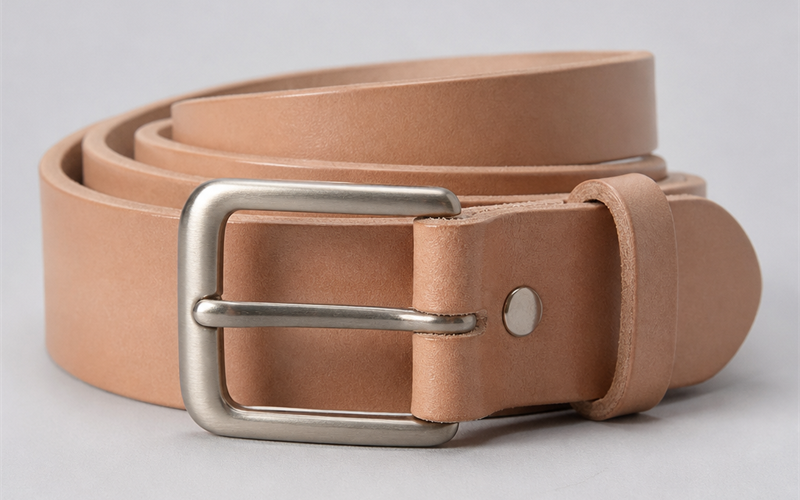
Should You Condition a Brand-New Full-Grain Leather Belt?
Quick answer: Usually not — at least not immediately. A quality full-grain leather belt arrives from a reputable maker already conditioned at the tannery and finishing stage. Adding additional conditioning to a new belt is often counterproductive — it can over-saturate the fibers, cause permanent stretch, darken the leather more than you want, and accelerate softening past the point of structural usefulness. The right approach: wear the belt for 2-4 weeks, evaluate whether it actually feels dry, and only condition if the leather genuinely needs it. Most new full-grain belts don't.
Last updated: May 2026 • By BELTLEY Editorial
TL;DR:
- A new full-grain belt is already conditioned at the tannery — additional conditioning is usually unnecessary.
- Wear for 2-4 weeks before evaluating whether the leather actually feels dry.
- Over-conditioning a new belt causes permanent stretch, over-darkening, and structural weakness.
- If you must condition early: one thin coat of mink oil only, then wait 6+ months before repeating.
- The "always condition a new belt" advice is one of the most common leather care myths.
The "should I condition my new leather belt?" question is one of the most common leather care confusions — and the conventional advice ("yes, always, before first wear") is almost always wrong. Quality full-grain belts arrive already conditioned at the tannery; adding more conditioner on day one can damage the leather rather than protect it. Below is the honest answer that contradicts most online guides. For broader care, see our leather care page.
New Belt in Hand: Condition or Wait?
The day-one decision:
| Your situation | Go with |
|---|---|
| Quality belt from a reputable maker | Wait — it arrived conditioned from the tannery; adding more over-saturates. |
| Belt arrived visibly dry or dusty | One thin coat of light conditioner — that's stock-room neglect, not normal. |
| Heard "always condition before first wear" | Old advice from the era of unconditioned saddle leather — modern finished belts skip it. |
| Planning the first real conditioning | Month 3–6 of wear, then the regular 3–6 month cycle begins. |
The schedule by leather type: BELTLEY's leather care guide.
Why is conditioning a new leather belt usually a mistake?
Because it's already been conditioned at the tannery. A quality full-grain leather belt goes through finishing stages that include oiling, waxing, and conditioning before it ever leaves the production facility. The leather arrives at the customer with its lipid balance already at the appropriate level — neither too dry nor over-saturated. Additional conditioning at this point adds oils the leather doesn't need, which then sit in the fibers and cause problems.

The visible effects of over-conditioning a new belt. (1) Permanent stretch within 1-3 months (the over-saturated fibers can't hold their original tension). (2) Excessive darkening (1-2+ shades darker than the intended color). (3) Structural softness past the point of usefulness (the belt sags and loses shape under buckle weight). (4) Reduced lifespan over years (over-conditioned leather oxidizes and degrades faster than well-balanced leather).
What does the "always condition before first wear" advice get wrong?
It assumes all leather is dry; most quality leather isn't. The "condition before first use" advice comes from two contexts that don't apply to most new belts. (1) Heritage saddlery practices — historical saddle and harness leather often arrived raw or under-finished and needed conditioning before use. Modern tannery finishing has solved this problem. (2) Storing leather for extended periods — leather that's been sitting in inventory for years may genuinely need rehydration. Most new belts from reputable brands haven't been sitting that long.

For most quality full-grain belts from modern brands, the leather arrives correctly conditioned and ready to wear. The "always condition new" advice is well-intentioned but often results in over-conditioning rather than appropriate care. See neatsfoot oil vs mink oil vs beeswax for the conditioner selection question once conditioning is genuinely warranted.
Key stat: A new full-grain belt over-conditioned at first wear typically loses 20-30% of its structural integrity within the first year, compared to a belt that's worn naturally and conditioned only when actually needed. The "extra care" actually shortens the belt's effective lifespan.
How do you tell if a leather belt actually needs conditioning?
Three signs that legitimate conditioning is warranted. (1) Dry, papery feel — the leather feels stiff in a "dehydrated" way rather than "new and dense" way; runs your fingernail across the surface and it feels rough or chalky. (2) Visible surface dryness — the leather has lost its natural sheen; looks dull and slightly faded. (3) Difficulty bending or flexing — the leather resists normal flex motion past what break-in stiffness would explain.
Signs that the leather does NOT need conditioning, despite first impressions. (1) Just feels stiff — that's break-in, not dryness; wear it for 2-4 weeks first. (2) Looks "factory shiny" — that's the original finish, not lack of conditioning. (3) Hasn't been worn yet — by definition, hasn't had time to lose its conditioning. See how to break in a stiff full-grain leather belt for the break-in vs dryness distinction.
When to condition vs not condition
| Situation | Action |
|---|---|
| Brand new belt, just arrived | Don't condition — wear first |
| Brand new belt, feels dry/papery after 30 days | Single light coat of mink oil |
| Belt 6-12 months old, feels fine | Don't condition |
| Belt 6-12 months old, feels dry | Single light coat |
| Belt has visible water stains or marks | Address marks first, then condition |
| Inherited or vintage belt that's been stored | Multiple conditioning coats over days |
| Belt damaged in rain/snow | Air-dry fully, then light conditioning |
| Belt feels permanently soft and stretched | Stop conditioning; over-conditioned already |
What if you do want to condition a new belt anyway?
One thin coat of mink oil, then patience. If you've decided to condition a new belt despite the case against it. (1) Use mink oil, not neatsfoot — moderate penetration, less risk of over-saturation. (2) Apply one very thin coat with a clean cloth — less is more. (3) Let absorb for 24-48 hours before wearing. (4) Don't repeat for at least 6 months. (5) Watch for signs of over-conditioning (permanent stretch, excessive darkening, sagging at the buckle).

The thin-coat-once-then-wait approach is the safest path if conditioning a new belt is non-negotiable for you. It adds minimal lipid to leather that probably doesn't need it, but at least doesn't over-saturate the fibers. Avoid heavy conditioning, multiple coats in sequence, or repeating the application within months.
Why does the BELTLEY 3-Material Rule matter here?
Because the 3-Material Rule belts arrive correctly conditioned. The BELTLEY 3-Material Rule — full-grain leather + stainless or solid brass buckle + sealed (painted or burnished) edges — describes belts built by makers who finish the leather correctly at the tannery and assembly stage. These belts don't need additional conditioning at first wear. The leather, hardware, and edge treatment are all already at their intended condition.

Lower-grade belts (bonded, corrected-grain, or unfinished leather) sometimes do need additional treatment at first wear because the manufacturer cut corners on finishing. But adding oil to a bonded leather belt won't make it good leather — it'll just be slightly less bad bonded leather. Conditioning improves quality belts; it can't elevate cheap materials. See why is full-grain leather so expensive for the broader material cost context.
When should you first condition a quality leather belt?
After 6-12 months of regular wear, evaluate honestly. The right timing for a quality full-grain belt's first owner-applied conditioning is when the leather genuinely starts showing signs of dryness — typically after 6-12 months of regular wear, sometimes longer for indoor or office-only use. At that point, a single thin coat of mink oil or beeswax-based conditioner refreshes the surface and maintains the leather's structural oils for another 6-12 months.

Annual or semi-annual conditioning is the long-term sweet spot for most quality belts. Less often than annually leaves the leather under-protected over time; more often than every 6 months risks gradual over-saturation. The 1-2x per year cadence matches what the leather actually needs.
The Bottom Line
A brand-new full-grain leather belt usually does NOT need conditioning at first wear — it arrives from the tannery already correctly conditioned, and adding more oil at this stage often causes over-saturation, permanent stretch, excessive darkening, and structural weakening. Wear the belt for 2-4 weeks first, evaluate whether the leather actually feels dry (not just stiff from break-in), and only condition if the leather genuinely needs it. If you must condition early, one thin coat of mink oil only, then wait 6+ months. The "always condition new" advice is one of the most common leather care myths and shortens belt lifespan more often than it extends it. BELTLEY's full-grain leather belt collection arrives properly finished and ready to wear — backed by a 10-year warranty. Ready for a belt that doesn't need fixing from day one? Start there.
Frequently Asked Questions
Q: Should I condition a new leather belt before wearing it?
Usually no. A quality full-grain belt arrives already conditioned at the tannery; adding more oil at first wear often causes over-saturation, permanent stretch, and excessive darkening. Wear the belt for 2-4 weeks first, then evaluate whether it actually needs conditioning. Most quality new belts don't.
Q: What happens if you over-condition a leather belt?
Permanent stretch, structural softening, excessive darkening, sagging at the buckle area, and reduced long-term lifespan. Over-conditioned leather may feel softer initially but loses its shape and oxidizes faster than well-balanced leather. The "extra protection" backfires within months.
Q: How do you know if a belt needs conditioning?
Three signs of legitimate dryness: papery or chalky feel, dull surface that's lost its sheen, and unusual stiffness past what break-in would explain. If the belt just feels stiff or new, it doesn't need conditioning — that's break-in, not dryness. Wear it for 2-4 weeks before evaluating.
Q: What's the best conditioner for a new leather belt if I have to use one?
Mink oil — moderate penetration, lower over-saturation risk than neatsfoot oil, mild darkening. Apply one very thin coat, let absorb 24-48 hours, then wait at least 6 months before repeating. Avoid neatsfoot oil for new belts unless the leather is genuinely very dry.
Q: How often should you condition a leather belt?
1-2x per year for most full-grain belts in normal use. The first conditioning should typically come 6-12 months after first wear, not before. More frequent conditioning gradually over-saturates the leather; less frequent leaves it under-protected. The annual or semi-annual cadence matches what most quality leather actually needs.


