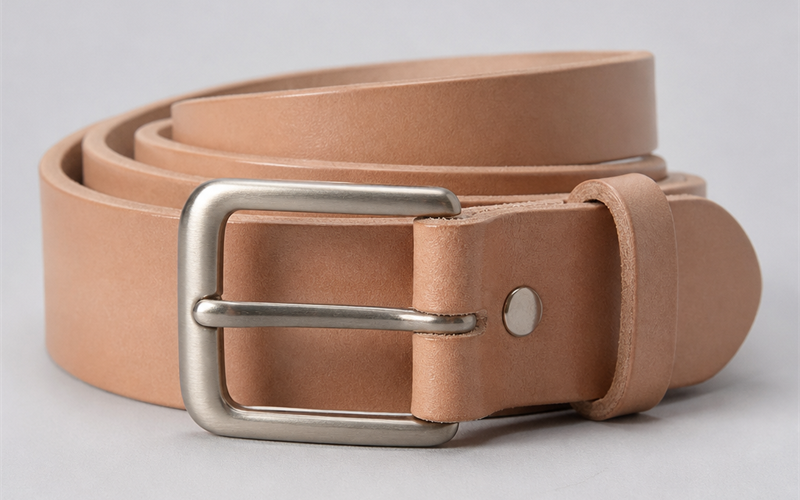
Full-Grain Leather Belt Sizing Guide — Pant Size ≠ Belt Size
Quick answer: Your belt size is typically 2 inches larger than your actual pant waist measurement — not your "pant size" on the label. A man with a 34" pant waist usually wears a size 36 belt; a woman with a 30" pant waist usually wears a size 32 belt. The +2 inch convention assumes the belt fits at the middle hole with 2 extra holes on either side for adjustment. To measure precisely: wrap a soft tape around your waist where the belt will sit, then add 2 inches. Don't trust the number on your pants — modern pant sizing runs inaccurate by 1-3 inches.
Last updated: May 2026 • By BELTLEY Editorial
TL;DR:
- Belt size = actual waist measurement + 2 inches (not pant label size).
- Modern pant labels run inaccurate by 1-3 inches — measure your actual waist, don't trust the tag.
- Belt sizes are listed by the middle hole position, with 2-3 extra holes for adjustment.
- For high-rise wear: measure at natural waist. For low-rise: measure at hip bones.
- Buy too long rather than too short — extra length can be trimmed; short belts can't grow.
The single most common belt-buying mistake is matching belt size to pant label size. A man buying "size 34 pants" doesn't necessarily have a 34" waist — modern men's pants run 1-3 inches larger than the label due to vanity sizing. The right way to buy a belt is to measure your actual waist where the belt will sit, then add 2 inches for proper fit. Below is the honest sizing guide that prevents the most common "this belt is too small/big" disappointment. For brand-specific sizing, see our size guide.
Your Size in 20 Seconds
The sizing rule by your starting point:
| Your situation | Go with |
|---|---|
| Know your pant waist | Add 2 inches — a 34 pant wears a 36 belt. Done. |
| Have a belt that fits well | Measure buckle-to-used-hole — that number IS your belt size, more accurate than any formula. |
| Between sizes | Size up — holes can be added inward; leather can't be grown. |
| High-rise vs low-rise wardrobe | Measure where the belt actually sits — natural waist and hip can differ by 2+ inches. |
The full method with photos: BELTLEY's size guide.
Why isn't your pant size your belt size?
Two reasons. (1) Vanity sizing on pants — modern men's and women's pants typically run 1-3 inches larger than the label number, so a "size 34" pair of pants often fits a 35-36 inch actual waist. The label size is a marketing convention, not a precise measurement. (2) Belt sizing convention — belt sizes refer to the position of the middle hole (the size you "wear" comfortably), measured from the buckle's prong attachment. A belt's actual physical length is longer than its labeled size by 3-6 inches, with holes spaced at 1-inch intervals.

The math: actual waist measurement + 2 inches = belt size. Pant label size is irrelevant to belt sizing because pant labels don't reliably reflect waist measurement. If you know your actual waist measurement, you can buy any brand's belt confidently; if you know only your "pants label size," you're guessing.
How do you measure your waist for a belt?
A three-step measurement. (1) Identify where the belt will sit — typically through belt loops on the pants you'll wear with this belt. (2) Use a soft measuring tape — wrap it around your waist at that position, snug but not tight. (3) Record the measurement in inches — this is your "true waist measurement" for belt sizing.
Two measurement nuances. (1) Pant rise affects belt position — high-rise pants sit at the natural waist (typically narrower); low-rise pants sit at the hip bones (typically wider). Measure at the position you'll actually wear the belt. (2) Measure over the clothing you'll wear — if you always tuck shirts in, measure over the shirt; if you wear loose layers, measure with that in mind. Most people measure over thin underwear or directly on skin for the most accurate baseline.
Key stat: Modern men's pants typically run 1-3 inches larger than their label size due to vanity sizing. A "size 34" pair of pants frequently fits a 35-36 inch actual waist. The gap is larger for casual pants (jeans, chinos) and smaller for tailored dress pants — but the principle applies almost universally.
How are belts actually sized?
By the middle hole position, with adjustment room on either side. Standard belt sizing convention: the size label (e.g., "size 36") refers to the distance from the buckle's prong attachment to the middle hole — typically the hole the wearer uses comfortably. Most belts have 5 holes total, with the middle hole at the labeled size and 2 holes on either side providing 1-inch adjustment increments.

A "size 36" belt typically has:
- Hole 1 (tightest): fits 34" waist
- Hole 2: fits 35" waist
- Hole 3 (middle, the labeled size): fits 36" waist
- Hole 4: fits 37" waist
- Hole 5 (loosest): fits 38" waist
The 2-inch adjustment range in each direction handles normal weight fluctuation, layering variations, and the slight differences between high-rise and low-rise pants. See our size guide for brand-specific measurements.
Belt sizing reference
| Your actual waist | Belt size to order | Notes |
|---|---|---|
| 28" | Size 30 | Middle hole at 30 |
| 30" | Size 32 | |
| 32" | Size 34 | |
| 34" | Size 36 | Most common men's size |
| 36" | Size 38 | |
| 38" | Size 40 | |
| 40" | Size 42 | |
| 42" | Size 44 | |
| 44" | Size 46 | Big-and-tall territory |
| 46" | Size 48 | |
| 48"+ | Size 50+ | See big and tall belt guide |
What if you're between sizes?
Round up, not down. If your actual waist is 35", choose a size 38 belt rather than a size 36 — the 38 sits at the 4th hole comfortably with two extra holes for tightening. A size 36 belt at the 4th-loosest position is at the edge of its adjustment range with no room to tighten further if you lose weight.

Belt sizing convention is generous on the loose side (you can always tighten by going to a closer hole) but restrictive on the tight side (you can't make the belt longer without modification). When in doubt, larger is the safer choice. See how to stretch a full-grain leather belt one size up for what's possible if you order too small (limited) and how to add a hole to a leather belt without a punch tool for tightening adjustments.
How do you measure an existing belt that fits you well?
Measure from the buckle's prong base to the hole you currently use. (1) Lay the belt flat. (2) Locate the buckle's prong (the metal piece that goes through the hole). (3) Measure with a ruler or soft tape from the base of the prong attachment to the hole you wear at the middle setting. (4) That measurement in inches is your effective belt size.
Don't measure the full length of the belt — that includes the buckle attachment and the tail length, neither of which corresponds to your size. The size that matters is buckle prong to middle hole. This is how belt manufacturers label sizes, so measuring this way gives you the right number for ordering new belts.
Do different brands size belts differently?
Slightly — but the +2 inch convention is widely consistent. Most quality belt brands use the same "size = waist + 2 inches" convention, with the size number matching the middle hole position. Some brands list sizes by the tip-to-buckle total length (less common, sometimes seen on European brands); some list by S/M/L/XL (less precise but increasingly common for women's belts).

When ordering from a new brand, check their size guide for the exact convention. If a brand provides measurements in both "belt size" and "fits waist [X]", use the "fits waist" number to match your actual waist measurement. For BELTLEY's specific sizing, see our size guide.
What about high-rise vs low-rise pants?
Measure at the actual position. High-rise pants sit at the natural waist (above the navel, typically narrower); low-rise pants sit on the hip bones (below the navel, typically wider). Your "waist measurement" for belt sizing should reflect where the belt will actually be — at the natural waist for high-rise pants, at the hip line for low-rise pants.

If you wear both high-rise and low-rise pants, the simplest solution is to size for low-rise (the larger measurement, more belt holes worth of adjustment) and use a tighter hole for high-rise. Most adjustment ranges handle the difference within the standard +/-2 inch range.
The Bottom Line
Belt size is your actual waist measurement + 2 inches — not your pant label size. Modern pants run 1-3 inches larger than the label due to vanity sizing, so trusting the pant tag leads to wrong-sized belts. Measure with a soft tape around your waist where the belt will sit, add 2 inches, and order that size. The middle hole at your size, with 2 extra holes on either side for 1-inch adjustment increments, gives you the right fit. When in doubt, size up — extra length can be trimmed; too-short belts can't grow. BELTLEY's full-grain leather belt collection is sized using the standard +2 inch convention, with our size guide detailing exact measurements — backed by a 30-day return window and 10-year warranty. Ready for a belt that actually fits? Start there.
Frequently Asked Questions
Q: What size belt do I need for a 34" waist?
Size 36 — the standard belt sizing convention is waist measurement + 2 inches, so a 34" actual waist wears a size 36 belt. This puts the middle hole at the comfortable position with 2 inches of adjustment in each direction.
Q: Is belt size the same as pant size?
No — pant sizes are notoriously inaccurate due to vanity sizing (modern pants typically run 1-3 inches larger than the label). A "size 34" pair of pants often fits a 35-36 inch actual waist; if you bought a size 34 belt to match, the belt would be too small. Always measure your actual waist for belt sizing.
Q: How do I measure my belt size?
Wrap a soft measuring tape around your waist where the belt will sit, snug but not tight. Read the measurement in inches; add 2 inches; that's your belt size. Alternatively, measure an existing belt that fits you well from the buckle's prong base to the middle hole you wear.
Q: What if I'm between belt sizes?
Round up. Larger is safer because you can tighten with a closer hole, but you can't lengthen a belt that's too short. A 35" actual waist should choose a size 38 belt over a size 36 — the adjustment range handles the difference comfortably.
Q: Are all belt brands sized the same way?
Most quality belt brands use the same convention (size = waist + 2 inches, sized by middle hole position), but check each brand's size guide for any variations. Some European brands list sizes by total belt length; some women's lines use S/M/L/XL. When unsure, look for a brand's "fits waist [X]" reference and match to your actual waist measurement.