How to Break In a Stiff Full-Grain Leather Belt (2026 Guide)
Quick answer: To break in a stiff full-grain leather belt safely, wear it daily for 2-4 weeks — the body heat, motion, and natural skin oils soften the leather without damage. To speed the process: gently flex the belt by hand for 1-2 minutes daily, apply a thin coat of leather conditioner once during week one, and store the belt naturally curved (around a hanger or chair back) when not in use. Avoid the destructive shortcuts: never soak the belt in water, never use a heat gun or hair dryer, never over-condition. Patience is the entire technique.
Last updated: May 2026 • By BELTLEY Editorial
TL;DR:
- A real full-grain belt takes 2-4 weeks of daily wear to fully break in.
- Safe accelerators: hand-flexing, light single conditioning, natural curved storage.
- Destructive shortcuts: water soaking, heat, over-conditioning — all ruin the leather.
- A stiff belt is a feature, not a flaw — it's why the belt will last 10-15 years.
- The BELTLEY 3-Material Rule (full-grain + stainless or solid brass + sealed edges) ensures the belt will break in beautifully rather than fail.
A new full-grain leather belt feels stiff. That's not a defect — it's evidence that the leather is dense, intact, and built to last. Cheap belts feel "broken in" on day one because the leather is thin, sanded, or pre-flexed by chemical treatments; they're soft because they're weak. Real full-grain leather softens through use, not chemistry, and the break-in period is part of the belt-ownership experience. Below is the safe break-in protocol and the shortcuts to avoid. For broader care, see our leather care page.
How long does it take to break in a full-grain leather belt?
2-4 weeks of daily wear. A real full-grain leather belt softens progressively as body heat, motion, and natural skin oils work into the leather. Most belts feel noticeably more flexible after the first week, comfortably broken in by week two, and fully conformed to the wearer's shape by week four. Denser leathers (Hermann Oak harness, English bridle, 5-6mm thickness) can take 4-8 weeks; standard 3-4mm full-grain typically breaks in faster.

The break-in is permanent. Once a belt has fully broken in, it stays soft and conformed to your shape for the rest of its lifespan. There's no "rebreaking in" needed seasonally; the work is one-time. See first real leather belt: 5 questions to ask before you buy for context on why stiffness is a quality signal.
What's the safest way to speed up break-in?
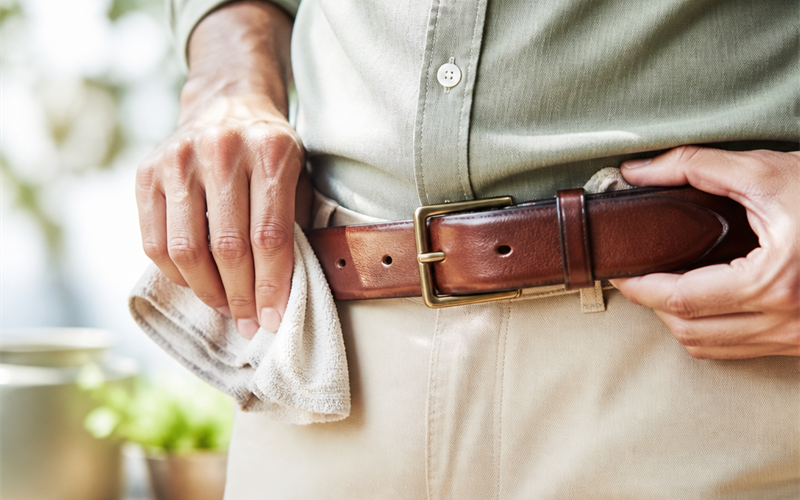
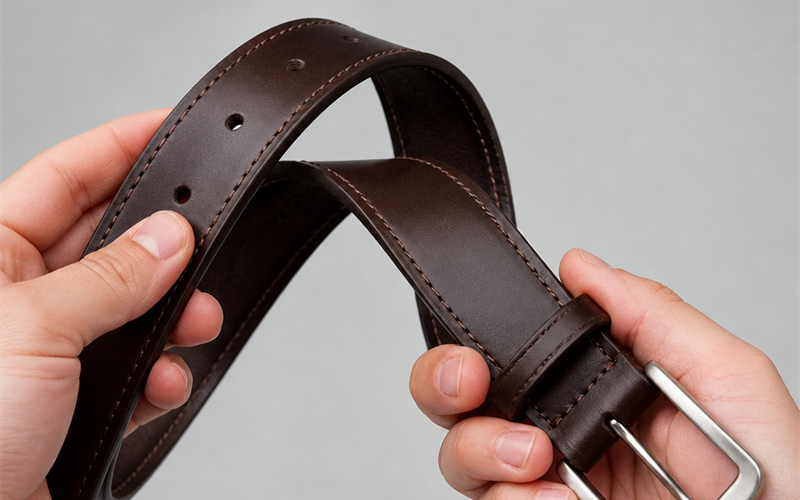
Three gentle accelerators. (1) Hand-flex daily — for 1-2 minutes, gently bend the belt back and forth along its length, paying attention to the section that wraps your back (which sees the most flex stress). Don't fold or crease aggressively. (2) Light conditioning once — apply a thin coat of leather conditioner (neatsfoot oil, mink oil, or beeswax-based) during week one only; let it absorb fully over 24 hours. Don't repeat for at least 3 months. (3) Natural curved storage — when not worn, hang the belt on a belt hanger or drape it over a chair back so it stays in a soft natural curve, not folded or flat.

The three accelerators together typically cut break-in time from 4 weeks to 2 weeks without damaging the leather. They work because they replicate the conditions of normal wear — flex, moisture (from conditioning), and natural curving — accelerated slightly.
Key stat: Real full-grain leather can absorb roughly 5-15% of its weight in oils and conditioners during initial break-in without damage. Going beyond that ratio over-saturates the fibers and softens the leather past the point of structural usefulness — the belt loses its shape and stretches permanently.
What should you NEVER do to break in a leather belt?
Five destructive shortcuts that ruin leather. (1) Soaking in water — destroys the fiber structure; the belt may temporarily feel soft when wet but dries hard, cracked, and warped. (2) Heat (hair dryer, radiator, sunlight) — same as wet-leather damage in reverse; the leather fibers shrink and harden when dried fast, leading to cracking. (3) Over-conditioning — multiple heavy conditioner applications over-saturate the fibers, leaving the belt soft but structurally weak (stretches permanently, sags in the buckle area). (4) Aggressive flexing or folding — sharp bends create permanent creases that show as light-colored stress marks. (5) Microwave or oven heating — sometimes recommended online for "softening" leather. It destroys the leather. Don't.
The common thread is shortcuts that traumatize the leather rather than work with it. Full-grain leather softens beautifully through gentle use; it fails catastrophically when forced. The "break in faster" tricks circulating online are often advice from people who've ruined their first belt and want validation. Trust the 2-4 week timeline.
Safe vs destructive break-in methods
| Method | Effect | Recommended |
|---|---|---|
| Daily wear (2-4 weeks) | Natural, complete softening | Yes — the foundation |
| Gentle hand-flexing daily | Speeds break-in safely | Yes |
| Light single conditioning | Helps fibers move | Yes (once in week 1) |
| Curved storage | Maintains shape | Yes |
| Heavy / repeated conditioning | Over-saturates, weakens | No |
| Soaking in water | Destroys fiber structure | Absolutely not |
| Heat gun / hair dryer | Shrinks and cracks fibers | Absolutely not |
| Microwave / oven | Destroys the leather | Absolutely not |
| Folding / aggressive bending | Permanent stress marks | No |
When should you condition a new belt?
Once, during week one — and not again for months. A light coating of neatsfoot oil, mink oil, or beeswax-based conditioner during the first week helps the leather fibers move more freely as you break in the belt. After that single application, the leather has enough lubrication for natural break-in to continue — don't re-condition until the belt actually feels dry to the touch (typically 3-6+ months later).

For full-grain belts specifically, conditioning is more about preventing dryness than triggering softness. The leather softens through use; the conditioner just keeps the fibers supple while that happens. See should you condition a brand-new full-grain leather belt for the full discussion. For the conditioner-type debate, see neatsfoot oil vs mink oil vs beeswax for full-grain belts.
Why does the BELTLEY 3-Material Rule matter for break-in?
Because shortcut materials don't break in — they just degrade. The BELTLEY 3-Material Rule — full-grain leather + stainless or solid brass buckle + sealed (painted or burnished) edges — describes the only material combination that actually rewards the break-in process. A bonded leather belt doesn't soften with wear; it cracks. A corrected-grain belt doesn't develop patina; it peels. A belt that fails the 3-Material Rule will feel "broken in" within a week, but only because it's structurally falling apart at the same rate.

A belt that passes the 3-Material Rule goes through the genuine break-in curve: stiff for 2-4 weeks, then softens permanently into a comfortable, conformed shape. The patience pays off across the next decade-plus of wear. If your new belt feels comfortable on day one, check whether the materials are real — see what does 100% full-grain leather actually mean.
What if the belt is still stiff after a month?
Two possibilities. (1) Very dense leather — heavy-duty harness, bridle, double-layer construction, or 5-6mm full-grain takes 4-8 weeks instead of 2-4. Just keep wearing. (2) Conditioning shortfall — if the leather feels rigid and dry rather than rigid and supple, apply a second light coat of conditioner and continue normal wear.

Genuine "permanently stiff" belts are rare; almost all stiffness resolves with continued wear and light conditioning. If a belt feels rigid after 8 weeks of daily wear plus two light conditionings, the issue is unusual — contact the brand. See how to tell if a belt can be professionally restored for related troubleshooting.
The Bottom Line
Breaking in a stiff full-grain leather belt takes 2-4 weeks of daily wear — accelerated gently by hand-flexing, a single light conditioning during week one, and curved storage when not worn. Avoid the destructive shortcuts: water soaking, heat application, over-conditioning, and aggressive folding all ruin the leather. The stiffness is a feature, not a flaw; it's what tells you the leather is real and built to last 10-15+ years. A belt that feels "broken in" on day one is usually corrected-grain or bonded — soft because it's weak, not soft because it's good. BELTLEY's full-grain leather belts and broader men's collection are built to reward proper break-in — backed by a 10-year warranty. Ready for a belt that softens into your shape over a few weeks and stays that way for years? Start there.
Frequently Asked Questions
Q: How long does a leather belt take to break in?
2-4 weeks of daily wear for standard 3-4mm full-grain belts; 4-8 weeks for heavy-duty harness, bridle, or 5-6mm thick belts. Body heat, motion, and skin oils soften the leather progressively. The belt feels noticeably more flexible after week one and fully broken in by week four.
Q: Can I speed up the break-in process safely?
Yes — three gentle accelerators work: daily hand-flexing for 1-2 minutes, a single light conditioning during week one, and curved storage when not worn. These together cut break-in time roughly in half without damaging the leather. Avoid heat, water, microwave, or repeated heavy conditioning — these destroy the leather.
Q: Why does a new leather belt feel so stiff?
Because real full-grain leather is dense, intact, and not pre-softened by chemical treatments. Cheap belts feel soft on day one because the leather is thin, sanded, or chemically pre-flexed; they're soft because they're weak. A stiff new belt is evidence of real material — and that stiffness softens permanently within a few weeks of wear.
Q: Will conditioning make my belt soft faster?
A single light coat during week one helps — beyond that, repeated heavy conditioning over-saturates the fibers and weakens the structure. The belt may feel softer faster, but it'll stretch permanently, sag in the buckle area, and lose its shape within months. The break-in itself comes from wear, not conditioner.
Q: Should I oil a new leather belt before wearing it?
A light single coat of conditioner during the first week is helpful; saturating the belt before first wear is not. Apply a thin layer of neatsfoot oil, mink oil, or beeswax-based conditioner, let it absorb for 24 hours, then wear the belt normally. Don't re-condition for at least 3-6 months.