Is Full-Grain Leather Ethical and Sustainable? An Honest Gen-Z Answer
Quick answer: It's complicated, and the honest answer doesn't fit on a slogan. Full-grain leather is a byproduct of the meat industry — the hide comes from animals that were already going to be slaughtered for food. It's biodegradable, long-lasting (10–20+ years per belt), and made from a real material. But the meat industry's environmental footprint is large, tanning processes vary in their environmental impact, and some leather supply chains have real animal welfare and labor issues. Vegan leather isn't a clean alternative — most "vegan leather" is plastic that lasts 1–2 years and doesn't biodegrade. The most ethical choice depends on which values you weight most heavily.
Last updated: May 2026 • By BELTLEY Editorial
TL;DR:
- Most leather is a byproduct of the meat industry — hides would otherwise be waste.
- Full-grain leather is biodegradable and long-lasting (10–20+ years).
- The meat industry's footprint is large; the leather portion is debated.
- Vegan leather is usually plastic (PU/PVC); it's not a cleaner alternative.
- The most ethical choice depends on your priorities (animal welfare, environment, longevity).
The sustainability question is the conversation Gen-Z buyers ask first, and they deserve an honest answer — not the marketing version. Leather is neither the environmental villain that PETA-led narratives sometimes suggest nor the eco-savior that some heritage-leather marketing implies. It's a complicated material with real trade-offs across animal welfare, environmental impact, and longevity. Below is the honest case for and against full-grain leather, the honest case for and against vegan alternatives, and a framework for choosing based on your actual priorities. For the direct vegan-leather comparison, see full-grain vs PU vegan faux leather belt.
Where does leather actually come from?
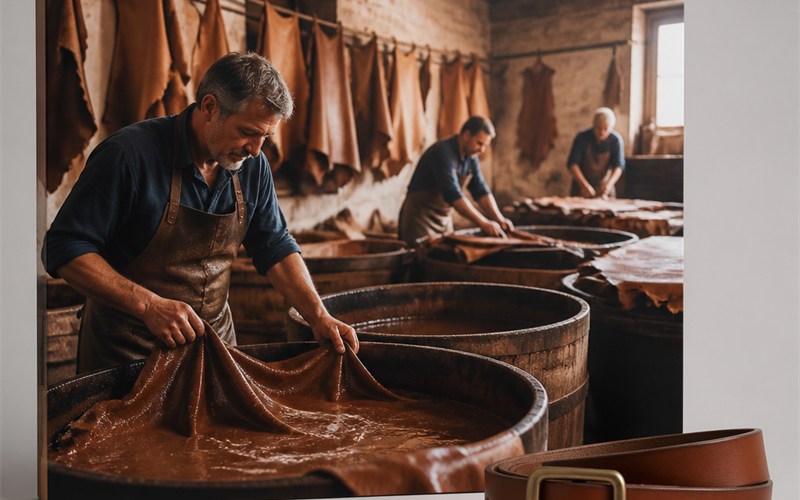
Almost all commercial leather is a byproduct of the meat industry. Cattle are raised primarily for meat and dairy; the hides are a secondary product sold to tanneries after slaughter. This is the central ethical fact of leather: no cattle are raised primarily for leather production in commercial-scale supply chains. Without the meat industry, the hides would still exist as waste — and would have to be landfilled or composted at scale.

The byproduct economics are real, with caveats. Industry estimates suggest hides represent ~5–10% of the value of a cow at slaughter (the meat and dairy are the rest). That said, hide sales do contribute revenue to the broader cattle industry, so a fully consistent vegan position would argue that buying leather subsidizes the meat business at the margin. The honest summary: leather isn't the reason animals are slaughtered, but leather sales do contribute economically to a system that does slaughter animals.
What about exotic leathers — crocodile, alligator, ostrich?
Different story. Exotic leathers (crocodile, alligator, python, ostrich) are usually farmed specifically for the leather and meat (alligator/croc) or feathers and meat (ostrich). Some come from regulated wild-take programs under the Convention on International Trade in Endangered Species (CITES), which permits sustainable harvest from healthy wild populations. Exotic leather farming has its own welfare and conservation debates — well-regulated programs argue they contribute to species conservation by giving the animals economic value; opponents argue the practices themselves are problematic regardless of regulatory frameworks.
For most belt buyers, the question is mostly about cowhide leather, which is the byproduct case. We cover the exotic-specific welfare and legality question in are alligator belts safe and are alligator belts legal in the USA.
What's the environmental case for leather?
Three points. (1) Biodegradable — leather is mostly collagen, which breaks down naturally at end of life, unlike plastic alternatives. (2) Long-lasting — a full-grain leather belt routinely lasts 10–20+ years; one good belt replaces 5–10 short-life synthetic belts over the same period. (3) Existing supply chain — the hide already exists as a byproduct; using it as leather avoids landfilling or composting it. None of these points dispute that the cattle industry has environmental costs; they reframe how the leather portion sits within those costs.

The longevity argument matters most. A material's environmental footprint is best measured per year of use, not per unit purchased. A leather belt worn for 15 years has had 15 years to amortize its production footprint; a plastic belt replaced 5 times in those 15 years has 5x the production footprint plus 5x the end-of-life waste. We explore this in full-grain vs PU vegan faux leather belt.
Key stat: A quality full-grain leather belt has a typical lifespan of 10–20+ years. A typical PU/vegan leather belt lasts 12–24 months. Over a 15-year period, that's roughly 1 full-grain belt vs 7–15 plastic belts — a major difference in total resource throughput and landfill impact.
What's the environmental case against leather?
Two real concerns. (1) The cattle industry's footprint — methane emissions, land use, feed inputs, and water use are all significant. The industry's total environmental cost is substantial, and the hide is a (small) part of that system. (2) Tanning chemicals — chrome tanning, the dominant industrial process, uses chromium salts that can contribute to water pollution if tanneries lack proper effluent treatment. Vegetable tanning is more benign but has its own resource inputs (water, time, plant tannins).
The tanning question is solvable; the cattle footprint is harder. Modern well-regulated tanneries (in the EU, U.S., and certain Asian markets) handle effluents properly and increasingly use vegetable tanning or low-impact chrome processes. The cattle footprint is structural to the meat industry — it doesn't go away if leather goes away. The honest reading: the leather industry has real environmental costs, particularly through its association with cattle farming, but most of those costs exist whether or not leather is made from the hides.
Is vegan leather actually more sustainable?
Usually no, despite the marketing. Most "vegan leather" sold today is polyurethane (PU) or polyvinyl chloride (PVC) plastic — petroleum-based materials laminated onto a fabric backing. Plastic-based vegan leather has its own environmental costs (petroleum extraction, manufacturing emissions, end-of-life landfill impact) and a much shorter lifespan than leather, requiring frequent replacement.

The plant-based alternatives are the better case. Mushroom-based leathers (Mylo from MycoWorks, Reishi), pineapple-fiber leathers (Piñatex), cactus leathers (Desserto), and apple-skin leathers are real categories making real progress on the sustainability frontier. These materials skip both the cattle-industry association and the plastic problem. The challenge is durability and scale — most plant-based "leathers" are still proving themselves for high-flex applications like belts, and prices remain high. As the technology matures, more credible vegan options will emerge.
What about animal welfare in the leather supply chain?
It depends on the supply chain. Cattle raised in the EU, U.S., and Australia are subject to varying animal welfare regulations; cattle in less-regulated markets may have fewer protections. Within tanning supply chains, the better tanneries (EU-regulated, U.S. heritage, Italian Tuscan consortium) often provide transparency about hide sourcing. Lower-tier suppliers often don't, and the supply chain may pass through multiple intermediaries before the leather reaches a finished product.

For buyers who weight animal welfare heavily, the supply chain transparency is the key question. A heritage U.S. tannery (Hermann Oak, Wickett & Craig, Horween) can usually identify the regional source of its hides. An Italian Tuscan veg-tan tannery can identify its hide suppliers under the Pellealvegetale consortium. A no-name "premium full-grain leather" supplier usually cannot. We name our leather sources where the origin matters.
Ethical/sustainability comparison
| Factor | Full-grain leather | PU/vegan leather | Plant-based vegan leather |
|---|---|---|---|
| Animal use | Yes (byproduct of meat) | No | No |
| Material origin | Cattle hide | Petroleum / plastic | Mushroom / pineapple / cactus |
| Biodegradable | Yes (mostly) | No | Mostly yes |
| Lifespan | 10–20+ years | 12–24 months | 2–4 years (still emerging) |
| Supply chain transparency | Possible (heritage tanneries) | Variable | Generally good (small producers) |
| Carbon source | Animal hide (byproduct) | Petroleum extraction | Agricultural byproducts |
| Tanning chemicals | Real (chrome) or benign (veg) | N/A (no tanning) | N/A (different process) |
| Cost-per-year | $8–$15 | $15–$25 | $25–$50+ |
What's the most ethical belt to actually buy?
Depends on your priorities, honestly. Three positions are all defensible:
- If you prioritize no-animal-use: Plant-based vegan leather (when available and proven for your use) or premium PU as a transition material. Accept the shorter lifespan and the limited durability of plant-based alternatives at current technology levels.
- If you prioritize lowest-footprint-over-time: Quality vegetable-tanned full-grain leather from a transparent heritage tannery. One belt for 15 years amortizes the production cost more efficiently than 5–10 plastic belts.
- If you prioritize ethical supply chain transparency: Heritage U.S. or Italian veg-tanned leather where the tannery and supplier are named, or plant-based vegan leather from small accountable producers.
All three are honest answers to genuinely different priorities. The wrong answer is the unconsidered one — buying a cheap "vegan leather" belt thinking it's sustainable when it's actually petroleum-based plastic with a 12-month lifespan, or buying a cheap leather belt thinking it's heritage craft when it's bonded leather from an undisclosed supply chain. We unpack the bonded-leather pattern in full-grain vs bonded leather belt.
What about cost-per-use as an ethical lens?
It's actually a strong ethical frame. A belt's true environmental cost is the total of (production footprint + transportation + end-of-life impact) divided by years of use. By that metric, a quality full-grain leather belt at $120 worn for 15 years has the lowest cost-per-year and the lowest year-of-life footprint among belt categories. Cheap belts replaced often — whether leather or vegan — have higher footprints because the production cycle repeats.

This reframes "ethical purchasing" usefully. The ethical choice often isn't "buy the cheaper option" or even "buy the vegan option" — it's "buy the option that doesn't need replacing." For belts specifically, that's typically full-grain leather, when it's the real thing. We make the broader cost-per-year case in are full-grain leather belts worth the investment.
The Bottom Line
Full-grain leather isn't a simple yes-or-no on ethics and sustainability — it's a nuanced material with real trade-offs. It's a byproduct of the meat industry (the hide would otherwise be waste), it's biodegradable and long-lasting (10–20+ years per belt), and well-made full-grain belts have a lower per-year footprint than cheap replaceable alternatives. The meat industry's broader footprint is real and not negligible. Vegan leather isn't a clean alternative — most of it is petroleum-based plastic with a short lifespan, not the eco-savior the marketing implies. Plant-based vegan leathers are the most promising emerging alternative but aren't yet proven at belt scale. The most ethical choice depends on which values you weight most heavily — and the worst choice is an unconsidered cheap belt that won't last and obscures its supply chain. At BELTLEY, we use full-grain leather from named heritage tanneries, name our sources where it matters, and build every belt with a 10-year warranty — long life is the foundation of any honest sustainability claim. Ready for a belt built to last instead of be replaced? Browse our full-grain leather belts or men's collection.
Frequently Asked Questions
Q: Is leather a byproduct of the meat industry?
Yes, almost entirely. Cattle are raised primarily for meat and dairy; the hides are a secondary product sold to tanneries after slaughter. Without the meat industry, the hides would still exist and have to be disposed of. That said, hide sales do contribute revenue to the cattle industry at the margin.
Q: Is full-grain leather more sustainable than vegan leather?
Usually yes, when measured over the lifespan. A full-grain belt lasts 10–20+ years; most vegan leather lasts 12–24 months. Over a 15-year window, one full-grain belt usually has a smaller total footprint than 7–15 plastic vegan belts — even after accounting for cattle-industry impact.
Q: What about plant-based vegan leather (Mylo, Piñatex, Desserto)?
These are the most promising emerging alternatives — genuinely plant-based, mostly biodegradable, and free of the cattle-industry concerns. The challenge is durability and proven longevity at scale; most plant-based "leathers" are still being tested for high-flex applications like belts. As the technology matures, more credible vegan belts will appear.
Q: How do I know if a leather belt's supply chain is ethical?
Look for tannery transparency. Heritage tanneries (Hermann Oak, Wickett & Craig, Horween, Italian Tuscan consortium) usually disclose their supply sources. Brands that name their tannery on the product page are more likely to have transparent supply chains than brands that just say "premium leather."
Q: What's the best ethical choice for a belt?
It depends on your priorities. No-animal-use favors plant-based vegan leather. Lowest-footprint-over-time favors quality vegetable-tanned full-grain. Supply chain transparency favors named heritage tanneries. The wrong answer is the unconsidered one — a cheap belt of unknown provenance that won't last.