Beeswax, Mink Oil, Neatsfoot: Which Conditioner for Which Leather?
Quick answer: Beeswax is a sealing-and-light-conditioning product — best for outdoor and workwear leather where water resistance matters. Mink oil is a heavy moisturizer — best for dry, neglected, or heavily-used leather but darkens the surface significantly. Neatsfoot oil is a deep-penetration conditioner — best for stiff leather that needs softening, but should be used sparingly because it can over-soften and weaken structure. Each is heritage, each is animal-derived, and each suits a specific leather type and condition.
TL;DR:
- Beeswax = sealer + light conditioner. Outdoor and workwear belts; water-resistance focus.
- Mink oil = heavy moisturizer. Dry leather rescue and heavy-use belts; darkens visibly.
- Neatsfoot oil = deep softener. Stiff leather; use sparingly, can over-soften.
- All three are heritage animal-derived; modern blends often combine them.
At a glance:
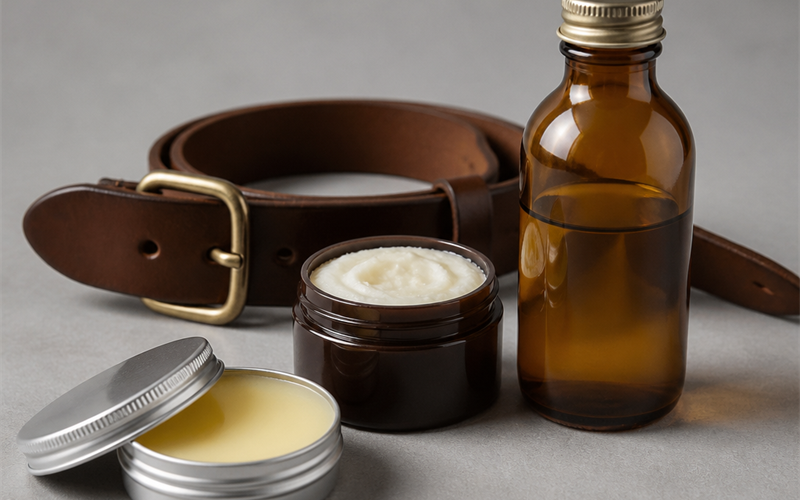
- Beeswax (blended) — natural honey-bee wax; sealing barrier; best for outdoor and workwear belts; water-resistance focus
- Mink oil — rendered mink fat; deep moisturizer; best for dry/neglected leather; darkens leather significantly
- Neatsfoot oil — rendered cattle leg bones; deep softener; best for stiff leather; use sparingly (can over-soften)
- Modern blends — Saphir, Leather Honey often combine these heritage ingredients in safer ratios
- Updated — May 2026 · By BELTLEY Editorial
The three most-cited heritage leather conditioners — beeswax, mink oil, and neatsfoot oil — predate modern synthetic and emulsion-based products by decades or centuries. Each was developed for specific leather problems in pre-industrial leatherwork, and each retains a specific role in modern belt care. Knowing which one suits your belt depends on the leather type, the wear context, and the condition of the leather right now. Wikipedia's beeswax entry covers the natural wax produced by honey bees; neatsfoot oil is rendered from cattle leg bones; mink oil is rendered from mink fat. Our full-grain leather belts and crocodile leather belts collections each respond differently to these heritage products.
Match the Jar to the Belt in Your Hand
Conditioner triage:
| Your situation | Go with |
|---|---|
| Outdoor/work belt, rain exposure | Beeswax — sealing first, conditioning second. |
| Dry, neglected, thirsty leather | Mink oil — deep moisture, but expect permanent darkening. |
| Stiff belt that needs softening | Neatsfoot, sparingly — over-application turns structure to noodle. |
| Crocodile or any exotic | None of these — reptile-specific conditioner only; heritage oils clog scale edges. |
The full product-to-leather map: BELTLEY's leather care guide.
What does beeswax actually do for leather?
Beeswax forms a water-resistant surface layer on leather while adding modest conditioning to the underlying fibers. Pure beeswax is too hard to apply directly — most beeswax-based leather products combine the wax with conditioning oils (often jojoba, almond, or carnauba) in a softer paste that's workable at room temperature. When rubbed into leather, the wax fills surface pores and creates a barrier that repels light moisture, while the oils penetrate slightly into the fibers.

Beeswax is the right choice for outdoor belts, workwear, CCW carry belts, and boots leather where water resistance matters. It's less suitable for refined dress belts because the wax creates a slightly textured matte finish rather than the satin sheen dress wearers want. The protection lasts roughly 3–6 months under normal wear before reapplication is needed. See our full-grain leather belts collection for examples that benefit from beeswax treatment.
When is mink oil the right choice?
Mink oil is the right choice when leather is dry, stiff, neglected, or heavily worn and needs deep moisturization fast. The oil is rendered from mink fat (or, in many modern "mink oil" products, blended with vegetable oils and synthetic stand-ins) and penetrates leather faster than most other natural oils because of its fatty acid composition. A single application can visibly soften stiff leather within hours.

The trade-off: mink oil darkens leather significantly, often permanently. The darkening is dramatic on light-colored leathers and noticeable even on dark browns. For belts where the original color is part of the aesthetic intent, mink oil is the wrong choice. For working belts, ranch belts, and heritage saddlery where darkening is acceptable or even desirable, mink oil is among the most effective conditioning options. Use sparingly — a thin film, not a soak.
Key stat: Pure mink oil darkens light tan leather by roughly 2–3 shades within a single application — a permanent color shift that can't be reversed without aggressive cleaning that would strip the leather's structure. Modern "mink oil" blends with reduced mink content cause less darkening but provide proportionally less deep-penetration conditioning.
What is neatsfoot oil and when should you use it?
Neatsfoot oil is rendered from the shin bones and feet of cattle (excluding the hooves) and has been used for centuries in heritage saddlery and leatherwork as a deep-penetration leather softener. The oil remains liquid at room temperature because of cattle leg's lower body temperature, which makes it especially good at penetrating cold or stiff leather without specialty heating.
Use neatsfoot oil for softening stiff leather — particularly new heavy-duty leather that needs breaking in, or aged leather that's become rigid from years of low-humidity storage. A single light application can restore flexibility within 24 hours. The caution: neatsfoot oil over-applied can over-soften leather and weaken its structural integrity. Apply a thin film once, let it absorb fully (24 hours), and assess before considering a second application. Don't apply repeatedly in short intervals.
Heritage conditioner comparison
| Product | Source | Best for | Caution |
|---|---|---|---|
| Beeswax (blended) | Honey bee wax + oils | Outdoor belts, water resistance, workwear | Matte finish; not for refined dress |
| Mink oil | Mink fat (animal) | Dry leather rescue, heavy-use belts | Darkens leather significantly |
| Neatsfoot oil | Cattle leg bones | Stiff leather, softening, breaking-in new heavy leather | Over-softens with repeated use |
| Lanolin | Sheep wool oil | Hand-feel softening, fine leather | Limited deep penetration |
| Carnauba wax | Brazilian palm leaf | Premium finishing, mirror shine | Hard, expensive, often blended |
| Modern synthetic | Petrochemical | Mass-market belts | Lacks heritage product's leather-friendliness |
For the modern synthetic-blend alternatives, see our Saphir vs Leather Honey vs Lexol comparison.
Can you use these heritage products on exotic leather?
With caution. Beeswax is generally safe on exotic leather (crocodile, alligator, ostrich) and provides useful water resistance, but apply lightly because exotic leather absorbs differently than cowhide. Mink oil is risky on exotic leather because the darkening effect is unpredictable on the natural scale patterns — what looks acceptable on cowhide can look uneven on crocodile. Neatsfoot oil should be avoided on exotic leather because it can over-soften the structured scales that give exotic leather its character.

For exotic leather belts, the safer modern choice is Saphir Renovateur or a specialty exotic-leather conditioner formulated for the specific leather type. See our crocodile belt vs. alligator belt guide for context on the leather differences.
What about modern blended products that contain these ingredients?
Most modern leather conditioners are blends — combining beeswax, mink oil (or stand-ins), neatsfoot oil, lanolin, jojoba, and carnauba wax in proprietary ratios. Saphir Renovateur, for example, contains mink oil, beeswax, and lanolin. Leather Honey contains oils that mimic neatsfoot's penetration profile. The blends balance the strengths and weaknesses of each pure ingredient.

For most belt owners, the right approach is using a quality blended conditioner rather than the pure heritage ingredients. Blends offer the benefits with reduced risks (less darkening, less over-softening, easier application). The pure heritage products remain useful for specific problems — beeswax for water resistance, mink oil for dry rescue, neatsfoot for stiffness — where their concentrated effect is the point. See our 90-day maintenance ritual for the right cadence of any conditioning regimen.
Are there ethical or sourcing concerns with these products?
Yes, worth noting. Mink oil is animal-derived from mink fat (a byproduct of the fur industry), which raises ethical concerns for some buyers. Many modern "mink oil" products are actually plant-oil blends with reduced or zero actual mink content — check the ingredient list if this matters to you. Neatsfoot oil is also animal-derived (cattle byproduct) but is generally less controversial because the cattle industry produces it as a secondary product. Beeswax is animal-derived (honey bee wax) but is widely accepted as an ethical animal product when sourced from well-managed apiaries.

Vegan alternatives include plant-oil blends (jojoba, almond, coconut), carnauba wax, and synthetic emulsions. These work well for most belt-care needs, though they don't fully replicate the deep-penetration profile of mink and neatsfoot for the most extreme conditioning cases.
The Bottom Line
Beeswax, mink oil, and neatsfoot oil are the three heritage leather conditioners that predate modern synthetic blends — and each retains a specific role. Beeswax for outdoor water resistance, mink oil for dry-leather rescue (accepting darkening), neatsfoot oil for softening stiff leather (used sparingly). For most belt owners, a modern blended conditioner like Saphir Renovateur covers 90% of belt-care needs. The pure heritage products are most useful for specific problems where their concentrated effect is the right tool. At BELTLEY, our recommendation for most customers is a quality blended conditioner for routine care; the heritage pure products are worth keeping in the leather-care kit for the specific situations they were originally designed to solve. Browse our full-grain leather belts, dress belts, and crocodile leather belts collections.
Related BELTLEY guides
- Saphir vs Leather Honey vs Lexol: Conditioner Comparison — modern blended alternatives
- The 90-Day Belt Maintenance Ritual That Doubles Lifespan — when and how often to apply
- The Worst "Care" Mistakes That Quietly Kill Leather Belts — over-application risks
- Pre-Conditioning a New Leather Belt Before First Wear — first-wear conditioning ritual
- Should You Polish a Leather Belt Like a Shoe? — why beeswax-based finishes ≠ shoe polish
Frequently Asked Questions
Q: Can I make my own leather conditioner with these ingredients?
Yes — DIY leather conditioners combining beeswax and oil (often coconut, jojoba, or olive oil) in a 1:3 to 1:4 wax-to-oil ratio are a common heritage recipe. Melt the wax slowly in a double boiler, add the oil, cool to room temperature in a small tin. The result is functional but lacks the refined performance of commercial blends. Worth doing for the experience, but not necessarily a long-term replacement for quality commercial products.
Q: Does mink oil really make leather waterproof?
No — mink oil increases leather's water resistance but doesn't make it waterproof. The oil penetrates and conditions the leather, which slows water absorption, but the leather still gets wet under prolonged exposure. For genuine water resistance, beeswax-based finishes are more effective because the wax creates a surface barrier.
Q: Is neatsfoot oil the same as "neat's-foot oil" or other spellings?
Yes — variant spellings (neatsfoot, neat's-foot, neatfoot) all refer to the same product. "Neat" is an archaic term for cattle. The modern industry standard spelling is "neatsfoot."
Q: How long do these conditioners last in storage?
Beeswax-based products: indefinitely if kept sealed. Mink oil: 2–5 years in sealed container; longer if refrigerated. Neatsfoot oil: 2–3 years sealed; can become rancid over time, indicated by off odor. Check products before applying to expensive belts.
Q: Can I mix these products on the same belt?
Avoid mixing pure products in the same application. The interactions are unpredictable. Apply one product, let it fully absorb (24+ hours), assess the result, and only then consider a different product if the first didn't fully address the leather's condition.
Q: Are these products safe for children or pets to be around?
Generally yes, though mink oil and neatsfoot oil have strong animal-product odors that some people find unpleasant. Keep products out of reach of children for ingestion safety. Pets occasionally find leather conditioners attractive due to the animal-fat content — store sealed.