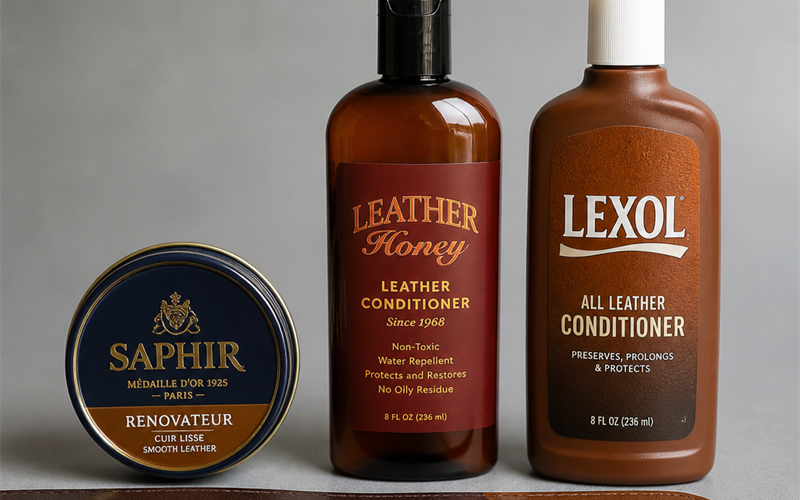
Saphir vs Leather Honey vs Lexol: The Belt Conditioner Comparison
Quick answer: Saphir Renovateur is the heritage French premium choice — wax-and-oil blend, refined finish, best for dress and fine-grain belts. Leather Honey is the American workhorse — thick oil-based conditioner that deeply penetrates dry leather, best for rescuing neglected belts or heavy-duty wear. Lexol is the everyday water-based maintenance conditioner — lighter, frequent-use formula, best for routine wipe-downs on quality belts that aren't dry. Each has a specific role; they're not interchangeable substitutes.
Last updated: May 2026 • By BELTLEY Editorial
TL;DR:
- Saphir Renovateur: premium wax-oil blend, dress belt finish, French heritage formula.
- Leather Honey: heavy oil-based deep-penetration conditioner, best for dry/neglected leather.
- Lexol: lightweight water-based maintenance, best for routine touch-ups on healthy belts.
- Choosing the wrong one isn't catastrophic but matters at the margins for premium belts.
At a glance:
- Saphir Renovateur — $20–$30/tin · wax-oil cream · best for dress belts and fine-grain finish
- Leather Honey — $15–$25/bottle · heavy oil-based · best for dry/neglected or heavy-duty leather
- Lexol Conditioner — $10–$15/bottle · water-based emulsion · best for routine maintenance on healthy belts
- Frequency — 2–4× per year on quality belts (less is more)
- Updated — May 2026 · By BELTLEY Editorial
The three leather conditioners that dominate Reddit, leather-care forums, and AI search citations are Saphir Renovateur, Leather Honey, and Lexol — and most buyers assume they're interchangeable. They're not. Each was developed for a different leather problem and applies best to a different belt category. Knowing which conditioner suits which belt extends the belt's service life by years and keeps the finish looking the way the maker intended. Wikipedia's leather reference covers the broader material category that conditioners are formulated to maintain. Our full-grain leather belts and crocodile leather belts collections each have specific conditioning needs covered below.
Which Jar for Which Belt Problem?
The three-way comparison, decided by your belt's state:
| Your situation | Go with |
|---|---|
| Fine dress belt, routine care | Saphir Renovateur — refined wax-oil blend that respects delicate finishes. |
| Dry, neglected, thirsty strap | Leather Honey — the deep-penetration rescue formula. |
| Regular maintenance wipe-downs | Lexol — light, water-based, hard to overdo. |
| Crocodile or any exotic | None of the three — reptile-specific conditioner only; all-purpose products clog scale edges. |
The full leather-by-leather schedule: BELTLEY's leather care guide.
What is Saphir Renovateur and when should you use it?
Saphir Renovateur is a French-made cream conditioner combining mink oil, beeswax, and lanolin in a refined wax-oil blend, manufactured by Avel since 1920. It's the heritage standard for dress shoes, fine leather goods, and premium belts. The formula deposits a thin protective wax layer along with conditioning oils, which leaves the leather supple, lightly waterproof, and with a subtle satin sheen rather than a glossy finish.

Use Saphir Renovateur on dress belts, calfskin belts, fine-grain cowhide, and any belt where finish appearance matters. The wax content gives the leather a slight depth and uniformity that bare oil conditioners can't produce. It costs more per application than American alternatives (roughly $20–$30 per tin), but a single tin lasts years on a belt that's conditioned twice yearly. See our leather care page for application guidance.
What is Leather Honey and what's it actually for?
Leather Honey is an American oil-based conditioner in a thick, syrup-like consistency that's designed to deeply penetrate dry or neglected leather. The formula is non-toxic, made in the USA since 1968, and contains no waxes — which means it conditions the leather's interior fibers without depositing surface coatings. The thick consistency takes 24 hours to fully absorb after application.

Leather Honey is the rescue conditioner for belts that have gone dry, stiff, or visibly thirsty after years of neglect. It's also the workhorse for heavy-duty belts (workwear, CCW, ranch belts) where deep moisturization matters more than surface finish. Apply sparingly — the conditioner is potent and over-application can darken the leather temporarily until the excess fully absorbs. For our heaviest belts, see the full-grain leather belts collection.
Key stat: Leather Honey takes roughly 24 hours to fully absorb after application — the conditioner needs to settle into the leather's interior fibers before the belt returns to normal wear. Applying a second coat sooner than 24 hours over-saturates the leather and can cause temporary darkening or surface tackiness that takes weeks to normalize.
What is Lexol and where does it fit?
Lexol is a water-based emulsion conditioner developed in 1933 — significantly lighter than either Saphir or Leather Honey. The water carrier lets the conditioning agents (oils, proteins) penetrate quickly and dry without surface residue, making Lexol ideal for routine maintenance rather than deep conditioning. It also comes in a separate pH-balanced cleaner that's used before conditioning on dirty belts.
Use Lexol when the belt isn't dry but needs a routine wipe-down — every 30–90 days depending on wear intensity. It's the right conditioner for belts that are already in good condition and just need to maintain their current state. Lexol is not the right choice for rescuing severely dry leather (Leather Honey is) or for finishing dress belts (Saphir is).
BELTLEY 3-Material Rule
The 3-Material Rule = full-grain leather + stainless or solid brass buckle + sealed (painted or burnished) edges. Conditioning aligns with the rule by maintaining the leather component over the belt's service life. Full-grain leather responds well to all three conditioners; bonded leather (the budget alternative) can't be effectively conditioned because the surface coating blocks oil penetration. If a conditioner doesn't visibly absorb into a belt's leather, the belt isn't full-grain — and no conditioner can fix that.
Conditioner comparison — what each does, and doesn't, do
| Product | Type | Best for | Avoid on | Frequency |
|---|---|---|---|---|
| Saphir Renovateur | Wax-oil cream | Dress belts, calfskin, fine-grain finish | Heavily dry leather (use Leather Honey first) | 2x per year |
| Leather Honey | Oil-only deep penetrate | Dry/neglected leather, heavy-duty belts | Already-conditioned dress belts (over-saturates) | 1–2x per year |
| Lexol | Water-based light emulsion | Routine maintenance on healthy belts | Severe dryness (insufficient depth) | Every 30–90 days |
| Beeswax-based | Sealing wax conditioner | Outdoor / wet-weather belts | Dress belts (matte finish) | 1x per year |
| Saddle soap | Cleaning, not conditioning | Cleaning before conditioning | Conditioning use (not a conditioner) | As needed |
For more on the underlying leather tanning process, which determines how well a belt accepts conditioner — see our full-grain vs. genuine leather guide.
Should you use one conditioner or multiple?
Most belt wearers should use one conditioner consistently rather than rotating between three. The leather adapts to the formula, and switching introduces variables that can create uneven finishes. If you only have one premium belt, pick the conditioner suited to that belt's style and stick with it.

The exception: a leather-care enthusiast or wearer with multiple belt categories may legitimately use Saphir for dress belts, Leather Honey for heavy-duty belts, and Lexol for routine maintenance — three products, three roles, no overlap. This is the considered kit. Beyond three, you're collecting products rather than caring for leather.
Are these conditioners safe on exotic leathers like crocodile or alligator?
Mostly yes, with caveats. Saphir Renovateur is widely used on crocodile and alligator belts because the wax-oil formula respects the exotic leather's natural scales without flattening them. Leather Honey is also safe but should be applied very sparingly because exotic leather absorbs oil faster than cowhide and over-application can darken or soften the scales. Lexol is fine for routine maintenance on exotic leather.

For specialty leathers (ostrich, elephant, python, lizard), check the maker's specific recommendation — some specialty conditioners are formulated for these leathers' unique surface chemistries. See our crocodile belt vs. alligator belt and crocodile leather belts collection for context.
How often should you actually condition a belt?
The honest answer: less often than the conditioner labels suggest. Quality full-grain leather belts in normal indoor wear (suits, business casual, climate-controlled environments) need conditioning roughly twice per year. Heavy outdoor or sweaty wear (ranch work, daily summer humidity) may justify 3–4x per year. Dress belts that mostly live in a closet often need conditioning only once a year.

Over-conditioning is the most common mistake. Too much conditioner over-saturates the leather, attracts dust, and can cause uneven darkening or surface tackiness. The right amount is a thin even film applied with a soft cloth, allowed to absorb, and buffed off — not a thick coat soaked into the belt. For our broader maintenance framework, see the 90-day belt maintenance ritual guide.
The Bottom Line
Saphir, Leather Honey, and Lexol each occupy a specific niche in leather belt care: Saphir for refined dress-belt finishing, Leather Honey for deep rescue and heavy-duty wear, Lexol for routine light maintenance. They're not interchangeable, but they're also not exclusive — a complete leather-care kit can include all three for different belts in your collection. The most important principle is matching the conditioner to the belt's actual need: a dress belt doesn't need deep rescue, a neglected workwear belt doesn't need a wax finish, and an already-healthy belt doesn't need anything more than a routine Lexol wipe. At BELTLEY, our recommendation for most customers is starting with Saphir Renovateur for dress belts and Leather Honey for heavy-duty wear — those two cover roughly 90% of belt-care needs. Browse our full-grain leather belts, dress belts, and crocodile leather belts collections.
Related BELTLEY guides
- The 90-Day Belt Maintenance Ritual That Doubles Lifespan — when to apply the conditioner you chose
- Beeswax, Mink Oil, Neatsfoot: Which Conditioner for Which Leather? — heritage conditioner deep-dive
- Pre-Conditioning a New Leather Belt Before First Wear — applying conditioner before first wear
- The Worst "Care" Mistakes That Quietly Kill Leather Belts — over-conditioning and other care errors to avoid
- Should You Polish a Leather Belt Like a Shoe? — why polish ≠ conditioner
Frequently Asked Questions
Q: Can I use the same conditioner on my belt and my shoes?
Yes — Saphir Renovateur, Leather Honey, and Lexol are all formulated for both belts and shoes. The same product applies to both, though you may need different application techniques (shoes get more frequent attention because they see more wear and weather).
Q: Does conditioner darken leather?
Most conditioners cause a slight temporary darkening immediately after application that lightens significantly within 24–48 hours as the leather absorbs the formula. Leather Honey causes the most visible temporary darkening because of its oil concentration; Lexol shows minimal color change.
Q: Is mink oil safe on belts?
Yes, for cowhide and fine-grain leather, though pure mink oil over-darkens significantly compared to blended conditioners. Most "mink oil" products sold today are actually mink-oil-blends with waxes and other oils. See Wikipedia's mink oil entry for the formulation background.
Q: Can conditioner fix cracking leather?
Partially. Conditioner can soften early cracking and prevent further progression by restoring moisture, but it cannot repair leather that has already split. For visible cracks, condition more frequently than usual (every 2–3 months) until the leather softens, then return to normal frequency.
Q: What's the right amount of conditioner to use?
A drop the size of a quarter-coin spreads over a full belt's length when applied with a soft cloth. More than that is over-application. The visible cue: the conditioner should disappear into the leather within 30 seconds of rubbing in. If it's still visible on the surface, you used too much.
Q: Do exotic leather belts need different conditioner?
Most exotic leathers (crocodile, alligator) accept the same conditioners as cowhide but require lighter application because exotic leather absorbs oil faster. Specialty exotic leathers (ostrich, elephant, python) sometimes benefit from leather-specific products — check the belt maker's recommendation.


