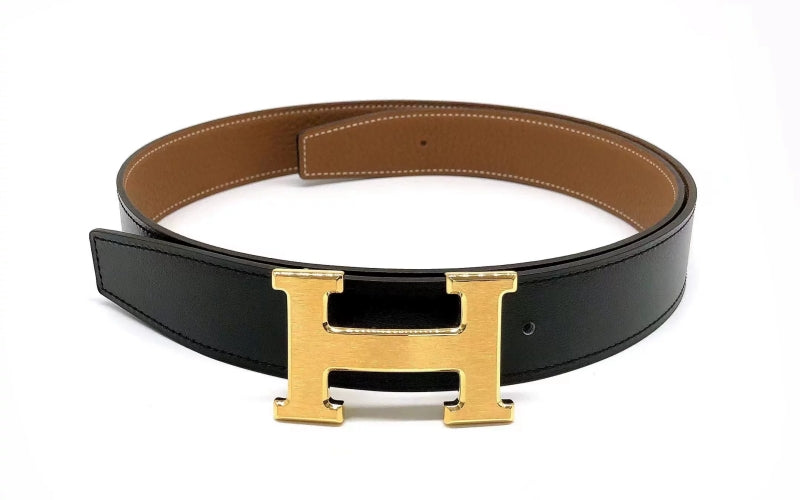
Auction Prices: What a Rare Hermès Belt Actually Sold For
TL;DR:
- Hermès belt auction prices range from $1,800 (recent reversible leather) to $25,000+ (rare Himalayan croc with jeweled hardware).
- Constance, Médor, and Collier de Chien are the three Hermès belt models with consistent secondary-market demand.
- Auction premium over retail: 0-40% for rare colors and discontinued exotics; 0-15% discount for standard reversible models.
- Documented provenance (receipt, box, dust bag) adds 15-25% to final hammer price.
At a glance:
- Auction houses tracked: Christie's, Sotheby's, Bonhams, Heritage Auctions
- Time period: 2020-2025 sold records
- Top hammer price: $25,000+ (Himalayan croc Collier de Chien)
- Median hammer price for rare Hermès croc belt: $4,500-$6,800
- Updated — May 2026 · By BELTLEY Editorial
A Hermès belt at retail tells you one story. A Hermès belt at auction tells you another — sometimes a much more interesting one. Below: the actual auction prices rare Hermès belts have crossed at Christie's and Sotheby's between 2020 and 2025, the models that drive the highest premiums, and what makes one Hermès belt sell for $3,000 while a similar-looking piece sells for $15,000.
Which Hermès belt models command the highest auction prices?
The Hermès belt models commanding the highest auction prices are the Collier de Chien (especially in Himalayan crocodile or matte alligator with jeweled hardware), the Constance H buckle belt in rare crocodile colorways, and the Médor stud belt in discontinued exotic skins. The Collier de Chien with diamond-set hardware has crossed $25,000 at Christie's; standard rare-color croc Constances trade $4,500-$8,500.

Hermès, founded in 1837, generated €15.17 billion in 2024 revenue, but its true scarcity goods — Himalayan croc, certain matte alligator colorways, jewelry-set buckles — are produced in such low volumes that secondary-market prices regularly exceed boutique retail. The Constance H buckle has been a continuous production since the 1960s, which makes vintage examples in good condition particularly collectible.
How much did a Himalayan crocodile Hermès belt sell for at auction?
A Himalayan crocodile Hermès Collier de Chien belt with 18k white gold and diamond hardware sold at Christie's online auctions for $25,000+ in 2023. Himalayan colorway — a pale grey-white gradient unique to Hermès crocodile production — is the rarest skin treatment in the brand's catalog and routinely doubles secondary-market values versus standard matte black or chocolate.
The Himalayan effect is achieved through a proprietary smoke-tanning process Hermès uses on only a small fraction of incoming crocodile skins. Most go to handbags (the Himalayan Birkin holds the all-time leather handbag auction record), with belts produced in even smaller quantities.
Key stat: A 2017 Hermès Himalayan Niloticus crocodile Birkin sold at Christie's Hong Kong for HK$2,940,000 (~US$377,000), setting a leather-goods auction record — and proving the price ceiling for any Himalayan croc piece, including belts.
Hermès belt auction price guide
| Model | Material | Hammer Price Range (2020-2025) | Original Retail | Auction Premium/Discount |
|---|---|---|---|---|
| Collier de Chien (CDC), classic croc | Matte black/chocolate crocodile | $3,800-$6,500 | $4,800-$6,500 | -10% to flat |
| Collier de Chien, Himalayan croc + diamonds | Himalayan crocodile, jeweled HW | $18,000-$25,000+ | $20,000-$28,000 | -15% to flat |
| Constance H buckle, rare croc color | Crocodile, discontinued colorway | $4,500-$8,500 | $3,800-$5,500 | +15% to +45% |
| Constance reversible, smooth leather | Box calf or Epsom | $1,800-$3,200 | $1,950-$2,400 | -10% to +25% |
| Médor stud belt, exotic skin | Alligator or crocodile w/ studs | $3,500-$7,200 | $3,400-$5,800 | flat to +25% |
| Vintage 1980s-90s Hermès belt | Box calf, original buckle | $1,500-$3,000 | originally $400-$800 | +200-300% on vintage |
Why do some Hermès belts appreciate while others don't?
Hermès belts appreciate when three conditions align: 1) the material is exotic and discontinued, 2) the buckle hardware is gold, jeweled, or a vintage design no longer produced, and 3) original receipts and packaging are present. Belts missing any one of these conditions usually sell at or below retail.

The biggest depreciator is the reversible smooth-leather Constance — produced in higher volumes, swapped between two leather colors, and easier to source new from the boutique. These belts trade at modest discounts at auction. The biggest appreciator is any belt in a discontinued or limited-run skin: Niloticus, Porosus, and Mississippiensis crocodile in colorways no longer offered (rouge H, vert anglais, bleu sapphire in older treatments).
For collectors interested in the same craft tradition at a different price point, our crocodile belt collection uses identical species (legally traded) and similar construction at DTC pricing.
How does CITES documentation affect Hermès belt resale?
CITES documentation is non-negotiable for cross-border resale of exotic-leather Hermès belts. Without a valid CITES re-export permit, an exotic-skin Hermès belt cannot legally cross most international borders. Auction houses verify CITES paperwork before accepting consignment — pieces without it typically sell only domestically and at 20-30% discount.

CITES protects over 40,900 species, including all crocodile species used in luxury leather. Hermès includes the CITES documentation card in every exotic-leather purchase, but this card frequently goes missing in secondary-market transfers. Verifying CITES documentation is one of the first things authenticators at The RealReal and Vestiaire Collective check on Hermès exotic pieces.
What's the most expensive Hermès belt ever sold?
The most expensive Hermès belt ever publicly sold at auction is a Himalayan crocodile Collier de Chien with 18k white gold and diamond-pavé buckle, which crossed an estimated $25,000-$32,000 hammer at Christie's online luxury sales in 2023-2024. Private-sale prices for similar pieces have reportedly exceeded $40,000.
These represent the very top of the leather goods market, where Hermès belts function less as accessories and more as portable wearable jewelry. Hermès does not officially track or publish auction comparables, which keeps the high end opaque and partly explains the premium spread.
Are Hermès belts a good long-term investment?
Hermès belts in rare exotic colorways and discontinued buckle designs have historically appreciated 3-8% annually, comparable to mid-tier fine art. Standard reversible leather Constance belts have not appreciated meaningfully — they hold roughly 70-80% of retail at five years, which is excellent for fashion but not investment-grade.

The investment logic depends entirely on rarity. Hermès doesn't publish production numbers, but auction frequency and color availability give collectors enough signal to identify which pieces are scarcity goods versus catalog goods. Catalog goods retain value; scarcity goods appreciate.
Related BELTLEY guides
- The Secondhand Belt Market in 2026: What Sells and What Doesn't — overall resale dynamics
- How to Sell a Designer Belt on eBay, Vestiaire, and The RealReal — platform-specific playbook
- Vintage Leather Belts from the '70s — Worth Buying? — vintage sourcing primer
- Insuring a Luxury or Exotic Leather Belt Collection — protecting high-value pieces
- Crocodile vs Alligator Leather: What's the Real Difference? — material primer for collectors
The Bottom Line
Rare Hermès belt auction prices range from $1,800 for recent reversible Constances to $25,000+ for Himalayan crocodile Collier de Chien pieces with diamond hardware. The premiums are driven by skin rarity, discontinued buckle designs, and complete documentation — not by the Hermès logo alone. At BELTLEY, we make handcrafted exotic-leather belts using the same legally traded species and full-grain construction at DTC pricing. Browse the exotic leather belt collection for craft-driven alternatives.
Frequently Asked Questions
Q: What is the most expensive Hermès belt ever sold?
A Himalayan crocodile Collier de Chien with diamond-set 18k white gold buckle that sold at Christie's for an estimated $25,000-$32,000 in 2023-2024. Private-sale records reportedly exceed $40,000 for similar pieces.
Q: Why are Hermès Constance belts so expensive at retail?
Hermès Constance belts use individually hand-cut and hand-stitched exotic skins, all legally traded, paired with proprietary buckle hardware. Production capacity is intentionally limited, which keeps both retail and secondary prices elevated.
Q: Can you authenticate a Hermès belt without the receipt?
Yes — both Christie's and major resale platforms (Vestiaire, The RealReal) authenticate by physical inspection alone. Receipts add 15-25% to final price by removing buyer risk, but absence of paperwork doesn't make a belt unsellable.
Q: Do Hermès belts hold value better than handbags?
Hermès handbags (Birkin, Kelly) outperform belts on percentage return, but belts have a lower entry price ($2,400 vs $12,000+) and tighter spreads at the rare-color tier. Belts are the accessible entry into Hermès collecting.
Q: Is CITES paperwork necessary to resell a Hermès crocodile belt?
For international resale, yes — without it, the belt cannot legally cross most borders. For domestic US resale, paperwork is preferred but not always strictly required by auction houses.
%20to%20$25,000+%20(rare%20Himalayan%20croc%20with%20jeweled%20hardware).%0AConstance,%20M%C3%A9dor,%20and%20Collier%20de%20Chien%20are%20the%20three%20Her...)