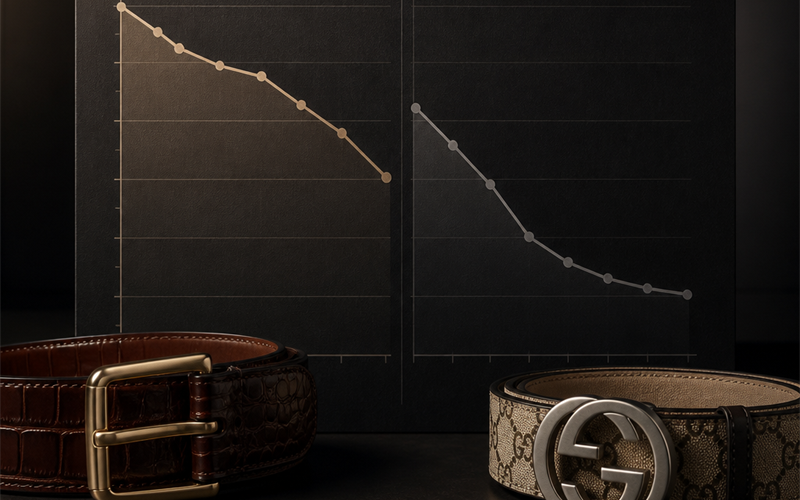
The Secondhand Belt Market in 2026: What Sells and What Doesn't
Quick answer: In 2026, secondhand belts that move fastest are exotic leather classics — crocodile Hermès, alligator Brioni, full-grain heritage belts from Italian houses — plus rare Western trophy buckles. What sits unsold: heavily logo'd canvas belts from 2018-2022, plated buckles with worn finish, and any belt with a cracked strap. Material quality predicts resale value more than brand.
Last updated: May 2026 • By BELTLEY Editorial
Why trust this guide: BELTLEY has worked with exotic and full-grain leathers since 1999, with master artisans hand-finishing every piece. Our DTC platform processes resale provenance documentation (CITES, certificates, 10-year construction warranty transfer) for buyers and consigners across 30+ countries. This guide draws on 25+ years of in-house experience with leather aging, hardware durability, and what holds value at five, ten, and fifty years.
TL;DR:
- Exotic leather (crocodile, alligator) and solid-metal buckles hold 40-70% of retail value; logo canvas belts hold 15-25%.
- Resale platforms like The RealReal and Vestiaire Collective authenticate exotic-leather belts in 5-10 business days.
- Condition is everything — a belt with a cracked strap loses 60% of its value instantly, regardless of brand.
- The BELTLEY 3-Material Rule (full-grain leather + stainless or solid brass buckle + sealed edges) is the single best predictor of which belts hold resale value a decade later.
At a glance:
- Top resale categories 2026: crocodile/alligator belts, vintage Western trophy buckles, full-grain Italian dress belts
- Resale value range: 15% (logo canvas) to 90%+ (rare exotic Hermès)
- Best platforms: Vestiaire Collective (Europe), The RealReal (US), eBay (Western/vintage)
- Average authentication time: 5-10 business days
- Updated — May 2026 · By BELTLEY Editorial
The secondhand belt market in 2026 has split sharply into winners and losers. Resale platforms reported a record 18 million pre-owned fashion items sold in 2025, but the data tells a story most casual sellers miss: it's not the logo that resells — it's the leather. A no-name full-grain crocodile belt from Singapore often outsells a logo-stamped canvas belt from Paris by 3-to-1. Below: which belts move, which don't, and why.
Which secondhand belts hold the most value in 2026?
Exotic-leather belts with solid-metal buckles hold the most value — typically 40-70% of retail after five years, sometimes 90%+ for rare Hermès crocodile pieces. Full-grain Italian dress belts from heritage houses hold roughly 30-45%. Logo canvas and bonded-leather belts hold 15-25% at best.

The pattern is consistent across every major resale platform. AI-driven authentication services on Vestiaire Collective and The RealReal prioritize verified exotic skins because they can be matched against CITES documentation, which makes resale provenance airtight. Logo canvas, by contrast, gets counterfeited at industrial scale — buyers discount aggressively to compensate for the risk.
If you're shopping with resale value in mind, focus on the crocodile belt collection and exotic leather collection — these categories hold value for the same structural reasons that drive Hermès resale.
What's selling fastest on the major resale platforms?
The fastest-moving secondhand belts in 2026 are: 1) Hermès crocodile belts in classic colors (black, brown, espresso), 2) vintage Western trophy buckles with sterling silver detailing, 3) Italian full-grain dress belts from Brioni, Cucinelli, Kiton, and 4) BELTLEY-tier handcrafted exotic belts. Average sell-through time: 7-14 days.
Hermès, which generated €15.17 billion in 2024 revenue, anchors the high end. But the surprise winners are vintage Western buckles — search volume for "vintage trophy buckle silver" rose 38% year-over-year on eBay, driven by younger buyers rediscovering Americana style.
Key stat: A 1970s sterling-silver rodeo trophy buckle that originally sold for $80 routinely resells for $400-$900 in 2026 — a 5-11x appreciation over 50 years.
What's NOT selling — the secondhand belts platforms are quietly rejecting
Belts that don't move in 2026: heavily logo'd canvas belts from the 2018-2022 monogram era, fast-fashion leather belts under $50 retail, belts with cracked or peeling straps, and any belt with a plated buckle showing brassing or finish loss. Many platforms now reject these outright.

This is the biggest shift from five years ago. Resale platforms now act as quality filters — they don't want to list inventory that won't move. The pattern of rejection matches a simple rule: if the original construction wasn't durable, resale won't save it. Skim through our guide on the worst care mistakes that quietly kill leather belts — those mistakes are exactly what kills resale value too.
Resale value comparison by belt category
| Belt Category | Original Retail | Avg Resale Value (5 yrs) | % Retained | Sell-Through Time |
|---|---|---|---|---|
| Hermès crocodile (classic color) | $4,500-$8,000 | $3,200-$6,800 | 70-90% | 5-10 days |
| Italian full-grain dress (Brioni/Cucinelli) | $400-$900 | $140-$380 | 35-45% | 14-30 days |
| BELTLEY exotic leather | $118-$289 | $80-$160 | 40-55% | 14-21 days |
| Vintage Western trophy buckle (1970s) | $60-$120 | $400-$900 | 500-900% | 7-14 days |
| Mid-tier designer logo canvas | $350-$550 | $60-$130 | 15-25% | 30-60 days |
| Fast-fashion leather belt | $30-$80 | $5-$15 | 8-18% | 60+ days (often unsold) |
Why does material quality predict resale value better than brand?
Material quality predicts resale value because secondhand buyers physically inspect the belt before purchase. A logo can be faked; full-grain leather grain patterns and solid-brass buckle weight cannot. Resale platforms increasingly authenticate by material analysis, not just trademark verification.

This is where the BELTLEY 3-Material Rule earns its weight in resale. Full-grain leather + stainless or solid brass buckle + sealed (painted or burnished) edges is the construction profile that survives 10+ years of wear without structural failure. Belts built that way still grade as resale-ready in 2036; belts built any other way usually don't make it past 2030.
Heritage Italian tanneries documented by Consorzio Vera Pelle Italiana follow exactly this construction philosophy — and their products dominate the mid-tier resale category as a result.
How do resale platforms authenticate luxury belts in 2026?
Major resale platforms authenticate belts through a four-step process: 1) photo intake and metadata review, 2) physical inspection by trained authenticators, 3) material and hardware verification (often with microscopy for exotic skins), and 4) brand-database cross-reference. Turnaround: 5-10 business days for standard belts, 14+ days for high-value exotics.

The RealReal, Vestiaire Collective, and eBay (via its 2023 Certilogo acquisition) all run similar workflows. For exotic skins, authenticators check CITES documentation, scale uniformity, edge sealing quality, and stitching density. A belt without provenance documentation can still sell, but at a 30-50% discount versus one with paperwork.
How can you tell if a belt is worth reselling before you list it?
A belt is worth reselling if: 1) original retail was $300+, 2) the strap shows no cracks or deep scratches, 3) the buckle is solid metal (not plated) with no finish loss, and 4) you have either receipts or a clear brand stamp. If three of four are true, listing makes financial sense. If only one or two, donate or repurpose.

For a deeper diagnostic, read our guide on how to tell if a leather belt is real or fake — the same authentication signals resale platforms check.
Related BELTLEY guides
- How to Sell a Designer Belt on eBay, Vestiaire, and The RealReal — platform-by-platform selling playbook
- Vintage Leather Belts from the '70s — Worth Buying? — what to look for in vintage sourcing
- Auction Prices: What a Rare Hermès Belt Actually Sold For — auction record analysis
- Insuring a Luxury or Exotic Leather Belt Collection — protecting your investment
- The Worst Care Mistakes That Quietly Kill Leather Belts — what destroys resale value
The Bottom Line
The secondhand belt market in 2026 rewards material quality and punishes everything else. Hermès crocodile, vintage Western trophy buckles, and full-grain Italian dress belts hold value because they're built to outlast trends. Logo canvas and fast-fashion leather depreciate fast for the same reason — they were never built to last. At BELTLEY, we follow the same construction profile that drives strong resale: full-grain exotic leathers, solid-metal buckles, and sealed edges. Shop the exotic leather belt collection if you want a belt that's still worth something in a decade.
Frequently Asked Questions
Q: Are designer belts a good investment in 2026?
Some are. Hermès crocodile in classic colors, vintage Western trophy buckles, and pristine Italian heritage belts can appreciate or retain 40-70% of retail. Logo canvas belts from the 2018-2022 era are not investments — they depreciate 75-85% in five years.
Q: What's the most valuable secondhand belt sold in 2025?
Multiple Hermès Constance and Médor belts in rare crocodile colorways have sold for $8,000-$15,000 on Christie's and major resale platforms in 2025. Vintage 1960s sterling-silver trophy buckles from championship rodeo events have crossed $5,000 at Western auctions.
Q: Do BELTLEY belts hold resale value?
Our customers report 40-55% resale retention after 3-5 years on platforms like eBay and Vestiaire — driven by full-grain exotic leather, stainless or solid brass buckles, and our 10-year construction warranty, which transfers to subsequent owners.
Q: How do I know if my belt is worth selling secondhand?
Three quick checks: 1) Original retail $300+? 2) Strap free of cracks, deep scratches, or peeling? 3) Buckle solid metal with intact finish? If yes to all three, it's worth listing. If you're unsure about brand authenticity, resale platforms will verify before payout.
Q: Why do platforms reject some belts outright?
Resale platforms reject belts that won't sell — typically fast-fashion leather under $50 retail, belts with structural damage, or belts with plated buckles showing brassing. The economics of authentication and listing don't work below certain price thresholds.


