Vintage Leather Belts from the '70s — Worth Buying?
Quick answer: Yes, vintage leather belts from the '70s are often worth buying — but only if the leather is still supple, the stitching is intact, and the buckle is solid metal (not plated). Premium 1970s American Western and European dress belts frequently outlast modern fast-fashion belts by 30+ years, but cheaper '70s "novelty" belts are usually past saving by 2026.
Last updated: May 2026 • By BELTLEY Editorial
Why trust this guide: BELTLEY has restored, evaluated, and built belts using the same heritage construction methods that defined 1970s American Western and Italian dress traditions. Our artisans regularly inspect vintage pieces for resale provenance and condition. We know which '70s construction choices survive into 2026 and which ones quietly fail at 30 years — the difference is in the leather, the buckle alloy, and the stitching density.
TL;DR:
- The '70s produced both excellent belts (heritage Western, Italian dress) and disposable ones (synthetic-backed novelty belts).
- Quality 1970s full-grain leather often outperforms modern bonded leather despite being 50+ years old.
- Buckle metallurgy is the key signal — solid brass and sterling silver from the '70s hold up; plated brass from the same era usually doesn't.
- The BELTLEY 3-Material Rule (full-grain leather + solid-metal buckle + sealed edges) is exactly the construction profile that's let the best '70s belts survive into 2026.
At a glance:
- Best 1970s belt categories: Western tooled leather, Italian dress belts, hand-stitched English bridle
- Typical 50-year survival rate: 60-70% (premium construction) vs 5-10% (novelty belts)
- Price range for collectible '70s belts: $40 (basic Western) to $900+ (rare trophy buckles)
- Key red flags: brittle leather, cracked plating, missing stitching
- Updated — May 2026 · By BELTLEY Editorial
The 1970s was a golden era for American leather goods — and also one of the worst for synthetic novelty belts. Both came out of the same decade. Walking into a vintage shop in 2026 means navigating between hand-tooled Texas saddle-maker belts that still feel new and synthetic-backed "leather-look" hippie belts that crumble at the touch. Below: how to tell which '70s belts are genuinely worth buying and which ones are best left on the rack.
At the Vintage Rack? Run This Check
'70s belt triage in four rows:
| Your situation | Go with |
|---|---|
| Supple leather, intact stitching, solid buckle | Buy it — quality '70s full-grain outlasts most modern mall belts. |
| Stiff, cracking at the holes | Pass — structural cracks don't restore, whatever the seller says. |
| Great buckle, dead strap | Buy for the buckle — mount it on a new full-grain strap and get the best of both decades. |
| Want the vintage character, new reliability | New veg-tan full-grain ($58+) earns the same patina with a 10-year warranty attached. |
The new-old-stock alternative: BELTLEY's full-grain collection.
Are 1970s leather belts higher quality than modern belts?
Premium 1970s leather belts are typically higher quality than mid-range modern belts because American and European tanneries used denser, slower-tanned full-grain hides and solid-brass or sterling-silver hardware as standard. However, low-end 1970s belts — particularly the "novelty" and synthetic-backed pieces — were no better than modern fast fashion and almost never survive intact.

The split is sharp. According to Wikipedia's vintage clothing entry, items more than 30 years old qualify as vintage if they "clearly reflect the styles and trends of the era." The '70s reflects two distinct eras: the heritage craftsmanship of working Western and tailored European pieces, and the disposable fashion of disco-era polyester accessories. Only the first category survives into 2026 as wearable goods.
What should you look for in a vintage 1970s belt?
Look for: 1) full-grain leather that still flexes without cracking, 2) hand-stitched or saddle-stitched seams (uniform but slightly imperfect), 3) solid metal buckle with no plating loss, 4) intact keeper loops, and 5) original tip/end with no fraying. If four of five check out, the belt has another 20+ years of life. If only one or two, walk away.
Flex the belt gently into a U-shape. Quality '70s full-grain leather flexes silently with no surface crack lines. Bonded or split leather from the same era usually shows a network of micro-cracks under flex — that's terminal damage from polyurethane backing failure. Our guide on how to tell full-grain from bonded leather covers the diagnostic in detail.
Key stat: Hand-stitched American Western belts from the 1970s have an estimated 60-70% survival rate in wearable condition into 2026 — versus 5-10% for mass-market polyester-backed novelty belts from the same decade.
Which 1970s belt categories are most worth buying?
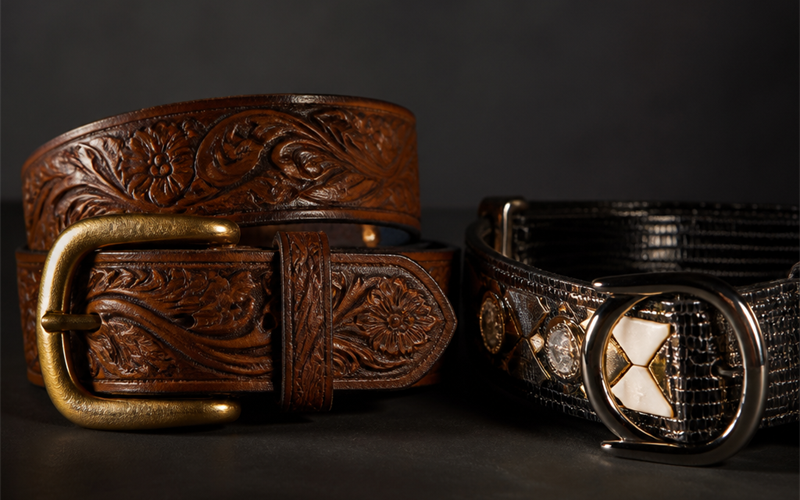
The most-worth-buying 1970s belt categories are: 1) hand-tooled Western/Texas saddle-maker belts with sterling-silver trophy buckles, 2) Italian dress belts from Brioni, Cucinelli, and Kiton, 3) English bridle leather belts from heritage makers, and 4) French Hermès and Lancel pieces with documented provenance. Avoid: synthetic-backed novelty belts, plated-buckle disco belts, and unbranded "leather-look" pieces.

Cowboy boot heritage tracks closely with belt quality — the same Texas, Oklahoma, and Kansas workshops that made working ranch boots also made working belts, and they're the pieces that survive in best condition. Champion belts and rodeo trophy buckles from this era hit auction prices of $400-$5,000 in 2026.
Vintage 1970s belt categories: survival and value
| Category | Original Price (1970s) | 2026 Resale Value | 50-Yr Survival Rate | Best Buying Sources |
|---|---|---|---|---|
| Hand-tooled Western with sterling buckle | $40-$120 | $300-$900 | 60-70% | Western auctions, eBay, estate sales |
| Italian dress (Brioni/Cucinelli) | $80-$180 | $180-$420 | 50-60% | European vintage shops, Vestiaire |
| English bridle leather | $30-$70 | $120-$320 | 70-80% | UK estate auctions, dedicated dealers |
| Hermès/French luxury | $60-$200 | $1,200-$4,000 | 45-55% | Christie's, Sotheby's, Vestiaire |
| Synthetic-backed novelty | $5-$15 | $5-$40 (camp value only) | 5-10% | Avoid for daily wear |
| Disco-era plated buckle | $10-$30 | $20-$80 | 10-20% | Avoid unless costume use |
Why does buckle metal matter so much on vintage belts?
Buckle metal matters because solid brass, sterling silver, and stainless steel from the 1970s remain structurally sound and visually intact 50 years later — while plated brass and pot metal from the same era almost always show brassing, pitting, or finish flaking. The buckle's underlying alloy is the single best survival predictor on any vintage belt.

Test by magnet: solid brass and sterling are non-magnetic; quality stainless is weakly magnetic at best. Pot metal and cheap zinc-alloy buckles are strongly magnetic and almost always plated. A 50-year-old plated buckle in pristine condition is a unicorn; a 50-year-old solid-brass or sterling buckle in great condition is common.
This is exactly why the BELTLEY 3-Material Rule — full-grain leather + stainless or solid brass buckle + sealed (painted or burnished) edges — predicts both vintage survival and modern resale value. The construction profile that survived the '70s is the same one that will survive the 2070s.
How can you tell if a vintage 1970s belt is authentic?
Authenticate by: 1) stitching density (6-9 stitches per inch on quality '70s belts; 10+ on cheap modern reproductions), 2) leather smell (vintage leather has a deep, dry, slightly smoky scent), 3) buckle hallmarks (sterling-silver pieces carry maker's marks and "925" stamps), and 4) wear patterns (genuine vintage wear is uneven; faked aging is uniform).

Maker marks on Western trophy buckles are particularly diagnostic. Heritage shops like Comstock Silversmiths, Vogt Silversmiths, and Sunset Trails stamped their work with traceable hallmarks. Modern reproductions usually don't.
Where can you buy authentic vintage 1970s belts in 2026?
Buy authentic vintage 1970s belts from: 1) eBay (best for Western and trophy buckles), 2) Vestiaire Collective (best for European luxury), 3) The RealReal (best for Hermès and high-end), and 4) regional estate auctions (best prices, highest risk). Avoid generic "vintage" Instagram resellers without verifiable provenance.

For modern belts built to match 1970s heritage standards, our crocodile belt collection and full-grain leather belt collection follow the same construction philosophy.
Related BELTLEY guides
- The Secondhand Belt Market in 2026: What Sells and What Doesn't — what holds value
- How to Sell a Designer Belt on eBay, Vestiaire, and The RealReal — selling platform playbook
- Auction Prices: What a Rare Hermès Belt Actually Sold For — auction records
- How to Tell Full-Grain from Bonded Leather — material identification
- Texas Belt Culture: Trophy Buckles, Boots, and Big Hats — Western heritage context
The Bottom Line
Vintage 1970s leather belts are worth buying when the leather still flexes without cracking, the buckle is solid metal, and the stitching is intact — which describes most premium American Western, Italian dress, and English bridle pieces from the era. They're not worth buying when they're synthetic-backed novelty pieces with plated hardware. The same construction profile that lets a hand-tooled Texas belt survive 50 years is what we follow at BELTLEY today. Browse the exotic leather belt collection to see what 50-year heritage construction looks like in 2026.
Frequently Asked Questions
Q: Are vintage 1970s leather belts safe to wear daily?
Yes, if the leather is still supple and the stitching is intact. A quality vintage full-grain belt with solid hardware can handle daily wear for another 15-25 years. Synthetic-backed novelty belts from the same era are not safe — they tend to fail mid-wear.
Q: How much should a vintage 1970s Western belt cost?
A quality 1970s hand-tooled Western belt with original sterling-silver buckle typically costs $300-$900 at auction in 2026, depending on maker mark, condition, and trophy provenance. Plain leather Western belts without notable buckles sell in the $80-$200 range.
Q: Can a 50-year-old leather belt still be conditioned back to life?
Sometimes. If the leather is dry but not cracked, a beeswax-based conditioner can restore flexibility. If the leather already shows crack lines or feels chalky, conditioning won't reverse the damage — the fiber structure has broken down.
Q: Why are vintage trophy buckles more valuable than the belts they came on?
Trophy buckles often outlast the original belt straps because they're solid sterling silver or solid brass. Many vintage Western buckles come to market detached from their original straps, which is normal and doesn't reduce value if the buckle's provenance is documented.
Q: Are 1970s synthetic "novelty" belts ever worth buying?
Rarely. Original-condition disco-era and hippie novelty belts have niche collector and costume value ($20-$80) but are not durable enough for regular wear in 2026.

.%20Premiu...)