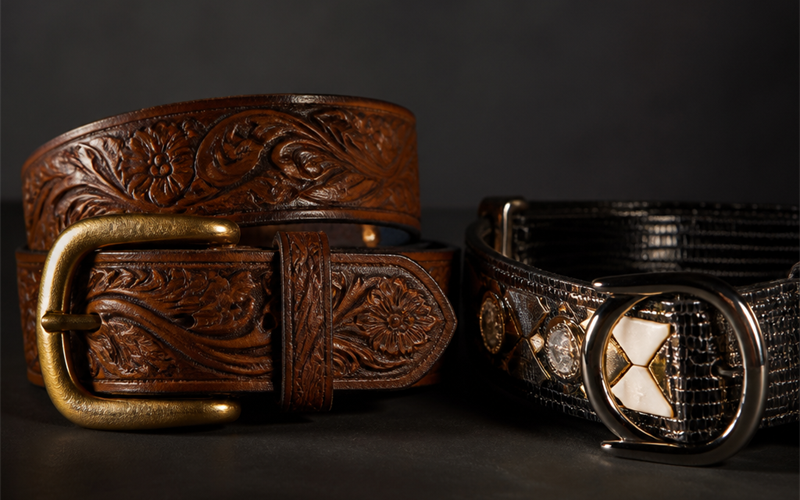
Why Tuscan Belt Leather Beats Designer Logo Belts as a Long-Term Investment
TL;DR:
- A Tuscan vegetable-tanned belt grows more beautiful with age. A designer logo belt mostly grows out of style.
- Tuscan tanning takes 30-40 days and uses tree bark. Most logo belts use chrome tanning that takes one day.
- Logo belts depreciate the moment the logo cycles. Tuscan leather appreciates in character for 20+ years.
- For long-term value, the leather matters more than the label. Always.
You can buy a designer belt for $600 today. In ten years it will probably be worth $50 on resale, if the logo style has aged poorly. Or it sits in your closet, untouched, because the buckle now looks "very 2024."
Or you can buy a Tuscan vegetable-tanned belt for the same money. In ten years it looks better than it did on day one. The leather has darkened. The edges have softened. It's still firmly in style, because nothing about it was ever "trendy" to begin with.
This is the long-term investment math. The logo cycle versus the patina cycle. Let's break it down.
Where Should the $600 Actually Go?
The investment thesis, by what you value:
| Your situation | Go with |
|---|---|
| Ten-year ownership horizon | Tuscan veg-tan — it appreciates in character while the logo cycles out. |
| Need the brand signal now | The logo belt — honest purchase if you accept the style-cycle depreciation. |
| Cost-per-year optimizer | Veg-tan full-grain from $58 — two decades of service makes the math absurd. |
| Want rare AND lasting | Genuine crocodile ($118–$289) — scarcer than any logo and ages like the Tuscan thesis says. |
The long-game options: BELTLEY full-grain and crocodile.
What is Tuscan belt leather?
Tuscan belt leather is full-grain cowhide tanned slowly with vegetable extracts—chestnut, oak, and mimosa bark—in tanneries clustered along the Arno River near Florence. The process takes 30-40 days. The result is firm, dense leather that develops patina and lasts 20-30 years.

The hub of this craft is documented in our Arno River vegetable tanning capital guide. Most of the world's premium belts—including the ones with famous logos—source from this district.
The certification body, the Consorzio Vera Pelle Italiana Conciata al Vegetale, lists its 22+ member tanneries on the official Pelle al Vegetale site. If you want to verify a "Tuscan leather" claim, that's where you check.
Why does Tuscan leather age so well?
Tuscan leather ages so well because vegetable tanning leaves the leather's natural fiber structure intact. Tannins bond with the collagen without harsh chemicals, allowing the leather to absorb oils from your skin and the environment over time. This is what creates patina—the darkening and burnishing that gives old leather its depth.
Chrome-tanned leather, used in roughly 85% of global production, locks the leather in a uniform finish. It doesn't develop patina. It just wears out. Our deep-dive on vegetable tanned vs chrome tanned belts covers the chemistry in detail.
Do designer logo belts use Tuscan leather?
Some do. Gucci, Ferragamo, and Bottega Veneta source portions of their leather from Tuscan tanneries. But many designer logo belts—especially monogram canvas styles—use coated canvas, PVC-treated leather, or chrome-tanned splits. The logo is doing the heavy lifting on perceived value, not the material underneath.

You can read the eye-opening cost breakdown in how much it costs to make a Gucci belt. Spoiler: the materials are a small fraction of the retail price.
Why do logo belts lose value so fast?
Logo belts lose value fast because logos are trend-bound by design. When a luxury house rebrands, refreshes its logo, or shifts creative direction, last season's hardware looks dated overnight. Resale platforms penalize discontinued designs immediately, dropping prices 40-70%.
Quick context: the famous Gucci GG buckle has been redesigned multiple times in the last decade. Same with Louis Vuitton's LV initials and Ferragamo's Gancini. Each refresh sends previous-generation belts into the discount bin.
For specific examples and resale data, see our analysis on whether Gucci belts hold their value and a similar look at whether LV belts hold up.
How long does a Tuscan vegetable-tanned belt actually last?
A Tuscan vegetable-tanned belt typically lasts 20-30 years with basic care. Full-grain hide is the strongest part of the cowhide. Vegetable tanning preserves the fiber. Solid brass or stainless steel hardware outlasts the leather. Many owners report belts inherited from parents still in rotation.
Our how long does an Italian leather belt last post has the full lifespan analysis. The short version: the leather usually outlives the buckle fashion.
For care, care of Italian vegetable-tanned vs chrome-tanned belts explains why these belts need almost no maintenance—a wipe with a soft cloth, occasional conditioning, and they're fine for another decade.
What's the actual cost-per-year math?
The math favors Tuscan leather decisively:

| Belt | Price | Realistic lifespan | Cost per year |
|---|---|---|---|
| Tuscan vegetable-tanned full-grain | $200-$300 | 20-25 years | $10-$15 |
| Mid-tier designer logo belt | $450-$600 | 3-7 years (style-bound) | $65-$150 |
| Luxury logo belt | $700-$1,500 | 4-10 years (style-bound) | $90-$300 |
| Fast-fashion bonded leather belt | $25-$60 | 1-2 years | $25-$30 |
The Tuscan belt isn't just cheaper to own. It's 6-20x cheaper to own. And it looks better every year you wear it. The fast-fashion math is also brutal—read why cheap belts cost more in the long run.
Why does patina matter for investment value?
Patina matters because it makes the belt visually one-of-a-kind, which is the opposite of mass-market logos. A Tuscan belt with 5 years of patina is unrecognizable from someone else's. A logo belt is identical to every other one sold that season—and that's the design intent.
Patina creates ownership uniqueness without paying for a limited edition. Our vachetta darkening guide shows exactly how the color transformation happens in the first 90 days.
Is Tuscan leather actually rarer than designer logos?
Yes. There are roughly 22 certified Tuscan vegetable tanneries in the consortium, producing limited volume each year. Designer logo belts are stamped out by the hundreds of thousands. The leather is the scarce resource. The logo is the abundant one.

See our 18 Italian tanneries deep-dive for the full tannery list. And for one specific named example, Walpier, Il Ponte, and Badalassi tanneries covers the most respected hide sources.
What should you look for when buying a Tuscan belt for the long term?
Look for four things: full-grain (not "genuine" or "top-grain") leather, a numbered Consorzio Vera Pelle Italiana certificate or tag, solid brass or stainless steel hardware, and saddle stitching at 7-9 stitches per inch. If all four are present, the belt will likely outlast the brand selling it.
Our 4 quality markers guide walks through exactly what to inspect. And our how to verify origin of an Italian leather belt explains how to spot a fake "Made in Italy" tag.
What about the resale market?
Pure Tuscan leather belts don't have a glamorous resale market—because owners rarely sell them. They become daily-driver heirlooms. Designer logo belts have an active resale market specifically because so many owners get bored of the look within 3-5 years.

That's the tell. The market that exists for "barely worn" logo belts at 50% off is the same market that doesn't exist for unbranded Tuscan craft. The Tuscan belts stay in closets, in rotation, for decades. That's a different definition of value—use value, not resale value.
If you're choosing between logo prestige and use value, our take on whether luxury belts are worth it in 2026 lays out the full pros and cons.
The Bottom Line
A designer logo belt is a fashion statement with a clock attached. A Tuscan vegetable-tanned belt is a tool you'll wear for 20 years and probably pass to someone. Both are valid choices—but only one is actually an investment in the literal sense.
At BELTLEY, we work directly with Tuscan tanneries because the math is straightforward: better leather, no logo markup, longer lifespan. If you want to see what that looks like at fair pricing, browse our full-grain leather belt collection or our wider handmade belt range. Every belt ships with our 10-year warranty—because we'd be embarrassed if the leather didn't outlast the buckle fashion.
Frequently Asked Questions
Q: Is Tuscan leather really worth the price over chrome-tanned alternatives?
Yes, especially over 10+ years. Tuscan vegetable-tanned leather costs 30-50% more upfront but lasts 4-6x longer than chrome-tanned belts and develops desirable patina. See our vegetable tanned vs regular leather comparison for the full breakdown.
Q: Do designer logo belts ever appreciate in value?
Very rarely. Limited Hermès Constance or vintage Gucci horsebit pieces from the 1970s-80s can appreciate, but 99% of designer logo belts depreciate steeply within 2-3 years. See Gucci horsebit belt vs GG belt for one such case study.
Q: How can I tell if a belt is really Tuscan vegetable-tanned?
Look for the Pelle Conciata al Vegetale certificate (numbered tag, signed by the tannery), check the leather's smell (vegetable tanning has a distinct woodsy aroma), and look for slight color variation across the strap. Pure chrome-tanned leather is perfectly uniform and smells slightly chemical. More detail in our why Italian belts have that distinct smell post.
Q: Are all Italian belts Tuscan-leather?
No. Italian belts can be made anywhere in Italy from any leather source—including non-Italian leather finished in Italian factories. Tuscan refers specifically to the leather origin (the Tuscan tanning district), not the country of assembly. Our are all Italian leather belts vegetable tanned post explains the distinction.
Q: Do I need to condition a Tuscan vegetable-tanned belt?
Lightly, once or twice a year. Use a neutral leather conditioner sparingly. Avoid heavy oils—they over-darken vegetable-tanned leather. See the right and wrong conditioners for Italian calfskin belts for specific product recommendations.