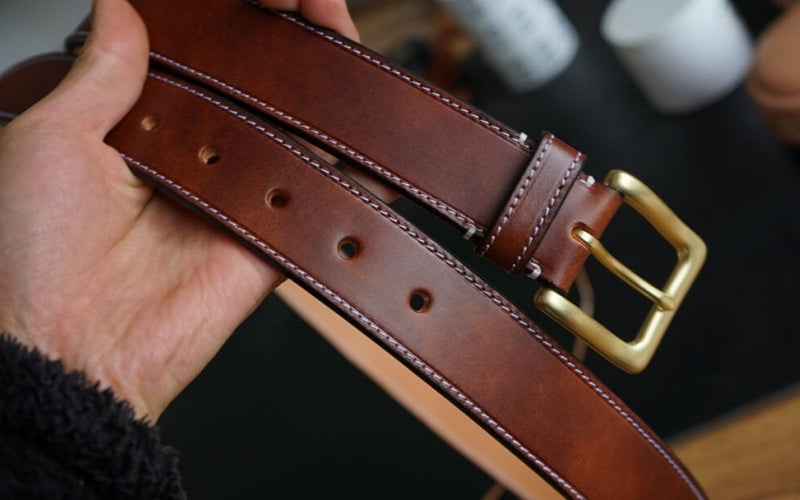
Vegetable-Tanned Leather Belt vs Regular Leather — Which Actually Wins?
TL;DR: Quick Answer
- Vegetable-tanned wins on durability (decades vs years), patina (gets gorgeous vs gets tired), and stretch resistance (holds shape vs sags). It's the superior belt leather. Period.
- "Regular leather" usually means chrome-tanned — processed with chemicals in 1-3 days. Cheaper. Softer. More colors. Also more likely to stretch, crack, and disappoint you.
- Veg-tan costs more upfront. Costs less per year. Because you divide the price by 15 years instead of 3.
- The honest answer: veg-tan is better for belts specifically. Chrome-tan is better for jackets, bags, and upholstery. Different tools. Different jobs.

Two belts. Both leather. Both look fine on the shelf. One lasts three years and dies quietly. The other lasts fifteen years and looks better at the funeral.
The difference? How the leather was tanned. Vegetable tanning uses tree bark and takes weeks. Chrome tanning (what most people call "regular leather") uses chemicals and takes days. That processing difference affects everything — how the belt feels, how it ages, how it stretches, and whether you'll still be wearing it when your kid graduates.
Here's the full head-to-head. No hedging. For a detailed explanation of what veg-tan actually is, our guide on what is a vegetable-tanned leather belt covers the process and characteristics.

Which Tannage Is Right for Your Belt?
For belts the winner is clear — but check your case:
| Your priority | Go with |
|---|---|
| Decades of service | Vegetable-tanned — it holds shape under daily tension where chrome-tan sags |
| Patina that improves with age | Veg-tan — chrome-tanned leather gets tired, not gorgeous |
| Soft feel and color variety, low budget | Chrome-tan is fine — just treat it as a 2–3 year purchase |
| Cost per year | Veg-tan — divide by 15 years instead of 3 and the "expensive" one wins |
BELTLEY's full-grain belts use the slow tannage on purpose. The head-to-head:
What's the Difference Between Vegetable-Tanned and "Regular" Leather?
"Regular leather" in most stores is chrome-tanned leather — processed with chromium salts in 1-3 days. Vegetable-tanned leather is processed with natural plant tannins over 2-8 weeks. Same animal hide. Completely different chemistry. The tanning method determines the leather's firmness, aging behavior, durability, color range, and environmental footprint.
According to Anvil Hide's belt comparison, the distinction is fundamental: chrome tanning is "quicker and cheaper to produce" while vegetable tanning creates leather with "better structural integrity for items needing dimensional stability such as belts and straps." Gentleman's Gazette's tanning comparison confirms that roughly 80-90% of the world's leather is chrome-tanned — making veg-tan the exception, not the rule.
When someone says "leather belt" without specifying, they almost certainly mean chrome-tanned. When a brand says "vegetable-tanned," they're telling you something. And they're charging you for it. Rightly so.

The Head-to-Head Comparison Table
Numbers first. Opinions later.
| Feature | Vegetable-Tanned Belt | Chrome-Tanned ("Regular") Belt |
|---|---|---|
| Tanning agent | Tree bark, leaves, plant matter | Chromium salts, chemicals |
| Processing time | 2-8 weeks | 1-3 days |
| Initial feel | Firm, structured | Soft, pliable |
| Break-in period | 3-7 days | None |
| Stretch resistance | Excellent — holds shape for years | Poor — sags and stretches over time |
| Patina | Rich, deepening, unique to wearer | Minimal to none |
| Lifespan (daily wear) | 10-20+ years | 2-5 years |
| Cost per year | ~$6-10 | ~$10-25 |
| Color range | Earth tones (natural palette) | Unlimited (accepts all dyes) |
| Water resistance | Low (improves with conditioning) | Moderate |
| Environmental impact | Lower (plant-based, biodegradable tannins) | Higher (chemical waste) |
| Skin sensitivity | Hypoallergenic (no chemicals) | Possible irritation (chromium) |
| Edge finishing | Burnishable (natural seal) | Requires edge paint |
| Smell | Natural, warm leather scent | Sometimes chemical odor |
| Weight | Heavier (denser fibers) | Lighter |
| Price range | $80-200 | $20-100 |
According to Scottsdale Belt Company's tanning comparison, the data is clear for belts specifically: "belts need vegetable tanned leather because it stays firm and doesn't stretch much." Buy Leather Online's belt-making guide confirms veg-tan as the professional choice for belt construction.

Which Lasts Longer?
Vegetable-tanned leather lasts dramatically longer — 10-20+ years for belts versus 2-5 years for chrome-tanned. The dense fiber structure created by slow plant-tannin penetration resists wear, stretching, and degradation in ways that quick-processed chrome-tan cannot match.
According to Proven Hands' durability comparison, chrome-tanned leather is "more likely to stretch out, lose its shape, and start looking tired way before a vegetable-tanned belt would." Hoplok Leather's belt guide ranks "full-grain vegetable-tanned cowhide" as "the undisputed best leather for belts" — lasting 15-20+ years with proper care.
The cost-per-year math:
| Belt | Price | Lifespan | Cost Per Year |
|---|---|---|---|
| Budget chrome-tan | $25 | 1-2 years | $12.50-25/year |
| Mid-range chrome-tan | $60 | 3-5 years | $12-20/year |
| Quality veg-tan | $120 | 15 years | $8/year |
| Premium veg-tan | $180 | 20+ years | $9/year |
The "expensive" belt is cheaper. Again. This pattern keeps showing up in leather. Our guide on are full-grain leather belts worth the investment breaks down the full value calculation.

Which Ages Better?
Vegetable-tanned leather wins this category so completely it's almost unfair. Veg-tan develops a rich patina — darkening, gaining character, and actually improving its appearance over time. Chrome-tanned leather mostly just gets older. Sometimes it cracks. Sometimes it peels. It rarely gets better.
According to Galen Leather's veg-tan guide, patina development is "one of the defining hallmarks of vegetable tanned leather" — normal wear darkens the leather as air, light, and skin oils do their work. Axess Wallets' comparison adds that chrome-tanned leather "tends to age poorly, losing its luster and often cracking or peeling over time."
Veg-tan aging: Scratches blend in. Color deepens. Surface develops a glossy warmth. Your belt at year five looks better than your belt at year one. People ask where you got it. You say "five years ago" and they're impressed twice.
Chrome-tan aging: Color fades. Surface coating can crack or peel. Stretching creates an unflattering droop. Your belt at year three looks like it needs replacing. Nobody asks where you got it.
For a full breakdown of how different leathers age, our guide on the truth about leather belt durability covers every scenario.

Which Stretches Less?
Vegetable-tanned. Not close. This is one of the most important metrics for belts specifically — and it's where chrome-tanned leather fails most visibly.
According to Proven Hands' work belt guide, veg-tan is "sturdy, resists stretching, and molds to your waist over time for a fit that gets better with every wear." Chrome-tanned leather "doesn't have the same backbone" — Leathercraft Masterclass notes that chrome-tan's softer fiber structure makes it "prone to sagging and stretching."
What this means daily: A veg-tan belt notched to hole 3 stays at hole 3 for years. A chrome-tan belt notched to hole 3 gradually stretches to hole 4, then hole 5. You keep tightening. The belt keeps giving up. Eventually, the belt sags between loops. You look like your pants are quitting.
A full-grain leather belt in vegetable-tanned leather eliminates this problem entirely. The fiber density maintains tension across the belt's entire lifespan.

Which Is Better for the Environment?
Vegetable tanning has a smaller chemical footprint. It uses plant-based tannins that are renewable and biodegradable. Chrome tanning uses chromium salts that require careful waste management to prevent water and soil contamination.
According to Von Baer's chrome-tan guide, chrome tanning "involves chemicals like chromium salts that can pollute water and soil" if not handled properly. Andriiart's veg-tan belt guide confirms that veg-tan leather is "free from toxic chemicals, heavy metals, and synthetic substances."
One important caveat: Collective Fashion Justice's analysis notes that "there are no significant differences between the footprint of vegetable and chromium leather tanning processes" when measuring total environmental impact — including water usage, land use, and processing energy. Veg-tan is greener in chemical terms. The full picture is more complex.
The honest environmental take: Veg-tan is better than chrome-tan on chemical safety and biodegradability. But neither is "eco-friendly" in absolute terms. Both are byproducts of the meat industry. Both use water and energy. Veg-tan is the better choice for environmentally conscious buyers — not the perfect one.

When Does Chrome-Tanned Actually Make Sense?
Chrome-tan isn't bad leather. It's just bad belt leather. For other products, it's often the better choice.
Chrome-tan wins for:
- Jackets and clothing — Softness matters. Nobody wants a stiff jacket.
- Handbags — Drape, color range, and lightweight feel are priorities.
- Upholstery — Needs to stay soft permanently. Stretching is fine.
- Bright-colored accessories — Veg-tan can't match chrome-tan's color spectrum.
- Fashion belts (occasional wear) — If you wear a belt once a month, stretching isn't a concern.
Veg-tan wins for:
- Daily-wear belts — Structure, stretch resistance, and longevity matter most.
- Work belts / tool belts — Must hold weight without sagging. How to Make a Belt ranks veg-tan as the definitive choice.
- Heritage / buy-it-for-life products — Patina is the point.
- Holsters and straps — Dimensional stability is non-negotiable.
For belts specifically, the verdict is clear. Veg-tan wins every metric that matters for something wrapped around your waist 300+ days a year. Our casual belts collection and dress belts collection are built with this principle in mind.

The Bottom Line
Vegetable-tanned leather belt vs regular leather? For belts, veg-tan wins on durability (10-20+ years vs 2-5), patina (improves vs declines), stretch resistance (holds shape vs sags), and cost-per-year (half the price over time).
Chrome-tanned leather wins on initial softness, color variety, and upfront price — advantages that matter for jackets and bags but not for a belt you'll wear 300 days a year. The "regular" leather belt is regular because it's cheaper to make. The veg-tan belt costs more because it's made to last.
At BELTLEY, our full-grain leather belts are crafted for the long game — dense, structured leather with stainless steel hardware that won't quit before the leather does. 10-year warranty. Free worldwide shipping. Browse the men's collection or women's collection and invest in the belt that invests back.
Frequently Asked Questions
Q: Is a vegetable-tanned belt better than a regular leather belt?
For belts specifically, yes. Vegetable-tanned leather resists stretching, develops a rich patina, lasts 10-20+ years, and holds its shape through daily wear. Chrome-tanned ("regular") leather is softer and cheaper but stretches, sags, and shows wear within 2-5 years. Veg-tan is the superior belt leather by every long-term metric.
Q: Why are vegetable-tanned belts more expensive?
The tanning process takes 2-8 weeks (vs 1-3 days for chrome), uses natural plant tannins (more expensive than bulk chemicals), and involves smaller-batch production. You're paying for time, materials, and craftsmanship — but the cost-per-year is actually lower because the belt lasts 3-4x longer.
Q: Will a chrome-tanned belt stretch out?
Yes — it's one of the most common complaints. Chrome-tanned leather's softer fiber structure makes it prone to stretching under daily tension. You'll gradually move to tighter holes as the belt elongates. Vegetable-tanned leather resists this stretching due to its denser, firmer fiber structure.
Q: Does regular leather develop patina like veg-tan?
Rarely. Chrome-tanned leather is much less likely to darken or develop character with age. It tends to fade, crack, or peel instead of improving. Vegetable-tanned leather's patina — where the leather darkens and gains a glossy, rich surface — is a defining characteristic that chrome-tan cannot replicate.
Q: Is vegetable-tanned leather more eco-friendly than chrome-tanned?
In chemical terms, yes — veg-tanning uses renewable plant tannins instead of chromium salts. However, the full environmental picture is more complex when accounting for water usage, energy, and land use. Veg-tan is the better choice for chemical safety and skin sensitivity, but neither process is zero-impact.
Q: Should I choose veg-tan or chrome-tan for my first quality belt?
Vegetable-tanned, in brown or black. It'll be stiff for the first week, then mold to your body and look better every month for the next decade-plus. The break-in period is short. The payoff is years of a belt that gets compliments instead of replacements.
,%20patina%20(gets%20gorgeous%20vs%20gets%20tired),%20and%20stretch%20resistance%20(holds%20shape%20vs%20sags).%20It's%20the%20superior%20belt%20leather.%20Pe...)