Texas Belt Culture: Trophy Buckles, Boots, and Big Hats
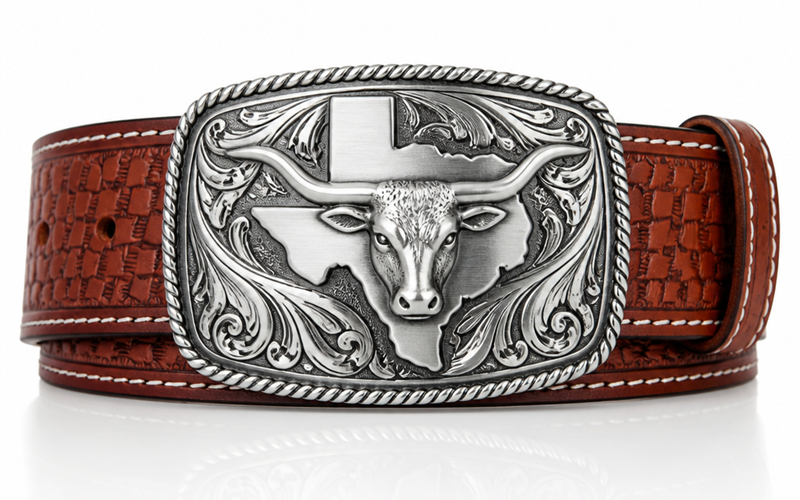
Quick answer: Texas belt culture centers on three things: a hand-tooled full-grain leather strap (typically 1.5" wide), an oversized "trophy buckle" earned at a rodeo or commissioned to mark a personal milestone, and boots that match the leather. It's not fashion — it's a regional uniform with roots in 19th-century vaquero work-wear, codified through 20th-century rodeo competition, and still worn daily across rural and urban Texas in 2026.
Last updated: May 2026 • By BELTLEY Editorial
Why trust this guide: BELTLEY makes belts to the same construction spec — full-grain leather, solid-metal buckle hardware, sealed edges — that has defined Texas working belts since the 1860s. We source full-grain leather from tanneries that supply both heritage Western bootmakers and our own production. This guide reflects on-the-ground reporting from Texas rodeo communities and decades of artisan practice in the same construction tradition.
TL;DR:
- A Texas belt is built around the buckle — usually a hand-engraved trophy buckle earned at competition or commissioned privately.
- Trophy buckles range from $80 (entry-level rodeo) to $5,000+ (sterling silver, gold overlay, custom engraving).
- The full outfit — belt, boots, hat — follows leather-color matching rules that signal regional sub-cultures (Houston oil, West Texas ranch, Austin music scene).
- Texas elevated the cowboy boot to State Footwear in 2007 — belts are governed by the same heritage logic.
At a glance:
- Standard Texas belt width: 1.5" (38mm)
- Trophy buckle weight range: 4-12 oz (entry to ceremonial)
- Average lifespan of quality hand-tooled Texas belt: 25-40+ years
- Major Texas leather towns: El Paso, Nocona, Mercedes, Houston
- Updated — May 2026 · By BELTLEY Editorial
In most of America, a belt is a strap that holds your pants up. In Texas, a belt is a statement of where you've been, what you've won, and who taught you to ride. The trophy buckle worn through a hand-tooled leather strap is the single most recognizable accessory in American regional dress — and the rules for wearing it are stricter than most outsiders realize. Below: how Texas belt culture actually works, why the trophy buckle came to dominate it, and how the rules apply to anyone wearing this look in 2026 without disrespecting the tradition behind it.
What defines a "Texas belt"?
A Texas belt is defined by four elements: 1) a full-grain leather strap, typically 1.5" wide and often hand-tooled with floral, basketweave, or rope patterns, 2) an oversized buckle in sterling silver, solid brass, or German silver — usually larger than a credit card, 3) sized to thread through Western-cut jeans with belt loops 1.75" or wider, and 4) constructed by a regional saddle-maker or boot-shop with documented heritage.

The width matters. Standard dress belts in New York or London run 1.25" (32mm); Texas belts run 1.5" (38mm) almost universally. The reason is functional: 1.5" was the width Western jean belt loops were originally cut for, and the heavier strap holds up a heavier buckle without bowing. Our 1.5" wide belt collection follows the same proportional logic.
Where does Texas belt culture come from?
Texas belt culture comes from 19th-century Mexican vaquero tradition, codified by Texas cattle-driving outfits in the 1860s-1880s, and elevated to spectator status through rodeo competition starting at the 1883 Pecos rodeo. The trophy buckle as a wearable award emerged in the 1920s, replacing earlier ribbons and medals. By the 1950s, the buckle was the recognized symbol of Western achievement across Texas.
Texas's role isn't accidental. According to Wikipedia's cowboy boot entry, "the original boot called 'cowboy boot' was specifically from Texas," with bootmakers in cattle-ranching towns like Nocona producing both boots and belts as paired sets. The state designated the cowboy boot as official State Footwear in 2007 — codifying a heritage that includes belts as the second leg of the cowboy uniform.
How do trophy buckles work — what do they actually mean?
Trophy buckles are awarded at rodeo events, livestock shows, ranching competitions, and increasingly at corporate and civic milestones. Each buckle is engraved with the event name, year, category, and sometimes the winner's name. Wearing a trophy buckle you didn't earn is a serious cultural breach in Texas Western communities — comparable to wearing military medals you didn't receive.

The hierarchy of trophy buckles roughly tracks: 1) PRCA Pro Rodeo finals buckles (highest), 2) state-level rodeo association buckles, 3) county and youth rodeo buckles, 4) livestock show champion buckles, and 5) commissioned commemorative buckles for personal milestones (weddings, business anniversaries). All of these are legitimate; the only "fake" buckle is one with another person's name engraved on it.
Champion belts — used in boxing and MMA — share design DNA with trophy buckles, but they're worn over the shoulder in ceremony. Trophy buckles are worn daily, on a regular belt, until the next bigger one replaces them.
Key stat: A 1970s sterling-silver rodeo trophy buckle that originally retailed for $80 routinely resells for $400-$900 in 2026 — a 5-11x appreciation over five decades, driven by collector demand for documented heritage pieces.
Texas belt outfit categories: regional sub-cultures
| Sub-Culture | Belt Strap | Buckle Style | Boot Match | Hat Style |
|---|---|---|---|---|
| West Texas Ranch | Hand-tooled, mid-brown, basketweave | Working sterling, 4-6 oz | Brown roper or stovepipe | Light beige felt or straw |
| Houston Oil | Dark espresso, smooth or subtle tool | Heavy sterling w/ gold overlay | Polished alligator or ostrich | Black felt, sharp brim |
| Austin Music | Black or distressed brown, hand-tooled | Vintage 1970s buckle | Black or two-tone roper | Worn felt, low crown |
| Dallas Society | Polished black or burgundy crocodile | Smaller engraved silver | Black ankle boot or alligator | Often no hat |
| Mercedes/Valley | Tooled with hand-painted detail | Mexican silver, conchos | Pointed vaquero boot | Palm-leaf hat |
How wide should a Texas belt be?
A Texas belt should be 1.5" (38mm) wide — the standard width for Western jean belt loops and the proportion that balances a full-size trophy buckle without looking dainty. Some heavy ranch belts go 1.75" (45mm), particularly for the largest commemorative buckles, but 1.5" is the default across rodeo, ranch, and Western dress contexts.

This is the proportion that BELTLEY's men's belt collection defaults to for Western-cut pieces. Anything narrower than 1.25" (32mm) reads as East Coast dress and looks structurally wrong with a Western jean cut or full-size buckle.
How do Texans match belt to boots?
Texans match belt to boots through three rules: 1) leather color: belt and boots should share the same primary color family (brown with brown, black with black — espresso pairs with cordovan but not with caramel), 2) finish level: hand-tooled belt pairs with hand-tooled or natural boot; smooth polished belt pairs with polished or exotic boot, and 3) leather origin: exotic-skin belt (crocodile, alligator) typically signals a more formal occasion and pairs with exotic-skin boot.
The look-fail most outsiders commit is mixing finish levels — a polished black ostrich boot paired with a casual hand-tooled brown belt reads as confused dress. Inside Texas, this signals "tourist" instantly. Our guide on matching belt to shoes covers the broader rule set; Texas applies it more strictly than most regions.
Can outsiders wear Texas belt style without disrespect?
Yes — Texas belt style is broadly welcoming to anyone who wears it with respect for its working roots. The two rules: 1) don't wear a competition trophy buckle you didn't earn, and 2) don't wear cheap costume Western pieces in actual Texas settings. A plain (non-engraved) trophy-style buckle is universally acceptable; an engraved "Texas State Rodeo Champion 2008" buckle worn by someone who didn't win it is not.

Commissioning a personalized non-competition buckle (with initials, family name, or commemorative date) is the standard solution for non-rodeo participants who want the look without the cultural overreach. Texas bootmakers and silversmiths in El Paso, Mercedes, and Nocona offer custom buckles starting around $200 with full provenance.
What buckle metals are most authentic in Texas culture?
The most authentic buckle metals in Texas culture are: 1) sterling silver (.925 marked, often with overlay accents), 2) German silver (nickel alloy, more affordable than sterling but durable), 3) solid brass (lighter, often used on working ranch buckles), and 4) gold overlay on sterling (highest tier, common on championship buckles). Plated buckles, while common at tourist shops, signal inauthenticity to insiders.
This is also exactly where the BELTLEY 3-Material Rule — full-grain leather + stainless or solid brass buckle + sealed (painted or burnished) edges — converges with Texas tradition. Texas working belts have followed essentially this construction profile since the 1860s, because it's the configuration that survives daily ranch wear. Same logic, modern execution. Browse the full-grain leather belt collection for pieces built to this Texas-compatible spec.
How long does a quality Texas belt last?
A quality hand-tooled Texas belt with a solid metal buckle lasts 25-40+ years with periodic conditioning. The leather develops a patina that's prized, not avoided — many ranch families pass belts between generations, with new buckles swapped onto the same heritage strap as the original owner moves up through rodeo or business milestones.

The trophy buckle itself is essentially indestructible. Sterling-silver and solid-brass buckles from the 1950s-70s routinely show up in 2026 mounted on fresh straps — confirming that the buckle is the asset, the strap is the consumable, and the combined system can last a century with rotation.
Related BELTLEY guides
- Vintage Leather Belts from the '70s — Worth Buying? — Western trophy buckle sourcing
- The Secondhand Belt Market in 2026: What Sells and What Doesn't — trophy buckle resale dynamics
- How to Match a Belt to Shoes — universal color matching rules
- New York Finance Belt Code vs LA Creative Class Belt Code — other regional belt dialects
- The Belt in Fashion History — Decade by Decade — broader heritage context
The Bottom Line
Texas belt culture is one of the few American regional dress codes that's still genuinely lived — not revived, not ironic, not costume. The trophy buckle, the 1.5" hand-tooled strap, and the matched boot remain a daily uniform across Texas in 2026, from West Texas ranches to Houston boardrooms. The same construction principles that built ranch belts in 1880 — full-grain leather, solid-metal buckle, sealed edges — are what we follow at BELTLEY. Browse the men's belt collection for pieces built to last across decades the way Texas heritage belts always have.
Frequently Asked Questions
Q: Is it disrespectful to wear a trophy buckle if you didn't win a rodeo?
It depends. A plain trophy-style buckle (engraved with initials or generic Western motifs) is universally acceptable. A competition-engraved buckle with a specific event, year, and sometimes another person's name is considered disrespectful when worn by anyone other than the winner.
Q: What's the difference between a Western belt and a Texas belt?
Texas belts are a subset of Western belts, characterized by 1.5" width, hand-tooled full-grain straps, and oversized trophy-style buckles. Other Western traditions (Montana, Wyoming, Arizona) vary in width, tooling complexity, and buckle conventions.
Q: How much does a quality Texas belt cost?
Entry-level hand-tooled Texas belts start around $150-$250 for the strap alone. A complete outfit with a sterling-silver trophy buckle typically runs $400-$900. Championship-quality pieces with gold overlay and custom engraving can exceed $3,000.
Q: Where can I buy an authentic Texas belt?
Authentic Texas belts come from heritage bootmakers and saddle shops in El Paso, Nocona, Mercedes, and Houston. Major brands include M.L. Leddy's, Pinto Ranch, and Vogt Silversmiths for buckles. Online, eBay's vintage trophy-buckle market is the largest secondary source.
Q: Are exotic-leather belts (alligator, ostrich) accepted in Texas culture?
Yes — exotic-leather belts are common at the dress-Western end of Texas style, particularly in Houston and Dallas. They typically pair with matched exotic-leather boots and are worn at fundraisers, business events, and formal Western occasions rather than ranch work.
Q: Can women participate in Texas belt culture?
Absolutely. Women's barrel racing, breakaway roping, and ranch sorting all produce trophy buckles, and women's Texas dress has the same belt-buckle-boot logic. Buckle sizes for women's competition belts run slightly smaller (4-7 oz vs 6-12 oz), but the cultural rules are identical.


,%20an%20oversized%20%22trophy%20buckle%22%20earned%20at%20a%20rodeo%20or%20commissioned%20to%20mark%20a%20per...)