Upgrading From a $30 Belt to Calfskin: Is It Really That Different?
TL;DR:
- Yes — the difference between a $30 department-store belt and a quality calfskin belt is immediately visible and tactile.
- A $30 belt is usually bonded or split leather with hollow plated hardware — built to fail within 6–24 months.
- A quality calfskin belt is full-grain leather with solid metal hardware — built to last 15+ years.
- The visible differences: edge finishing, surface uniformity, buckle weight, leather feel, color depth.
- Cost-per-wear after 5 years: the quality belt is cheaper.
You've been wearing the same $30 belt for years. It still works — sort of. The edges are fraying, the buckle finish is flaking, and the leather has cracked at the most-used hole. You're considering an upgrade but you're not sure if a $200 calfskin belt is really five times better than what you have. Honest answer: yes. The differences are obvious within five seconds of putting one on.
This guide covers exactly what changes when you upgrade from a cheap belt to a quality calfskin belt — what you'll see, feel, and notice. By the end you'll know whether the upgrade makes sense for you, or whether your current belt is fine for what you need.
What is actually inside a $30 department-store belt?
A typical $30 department-store belt is made from bonded leather (leather scraps pulped and glued together) or split leather (the bottom flesh layer of a hide), with a thin printed surface coating to simulate grain. The buckle is usually plated zinc alloy — hollow, lightweight, with chrome or gold-tone plating that flakes off within months. The construction is glued, not stitched, and the edges are heat-pressed rather than burnished.

The $30 belt anatomy:
- Outer layer: Thin split leather or PU coating with stamped fake grain
- Inner layer: Bonded leather scraps or cardboard-fiber backing
- Construction: Glued together, not stitched
- Buckle: Hollow plated zinc alloy
- Edges: Heat-pressed or painted, not burnished or stitched
- Lifespan: 6–24 months before structural failure
Britannica's leather entry defines bonded leather as the lowest tier of products that can legally be called "leather" — and notes that bonded leather has only a small fraction of the durability of full-grain. The $30 price tier nearly always lives in this bottom tier.
What's actually inside a quality calfskin belt?
A quality calfskin belt is made from a single piece of full-grain calfskin hide (typically 0.6–1.2mm hide thickness for dress belts), with stitched edges, burnished or hand-finished perimeters, and solid metal hardware (stainless steel or solid brass). The construction is built to flex without delaminating, the hardware is solid throughout, and the edges hold their finish for decades.

The quality calfskin belt anatomy:
- Leather: Single piece of full-grain calfskin — no laminations, no glued layers
- Construction: Edge-stitched perimeter for structural integrity
- Buckle: Solid stainless steel or solid brass — same metal throughout
- Edges: Burnished, beveled, sometimes hand-finished with wax
- Holes: Punched cleanly with finished interior edges
- Lifespan: 15+ years with care
We covered the construction quality details in our 4 quality markers of a calfskin belt post — the visible differences in stitching, edge work, buckle weight, and leather suppleness are how you spot quality versus cosmetic-only luxury.
What do you actually feel and see when you upgrade?
The upgrade is obvious within five seconds. The first thing you notice is weight — a quality calfskin belt feels substantially heavier than a $30 belt of the same dimensions, because the leather has more density and the buckle is solid metal rather than hollow plated alloy. Next is the leather surface — uniform color, fine grain, no plasticky shine. Then the edges — smooth and rounded vs sharp and painted. Then the buckle weight in your hand — cool, solid, substantial.
What you'll feel in the first 30 seconds:
- Heft — about 1.5–2x heavier than a cheap belt of the same size
- Leather suppleness — flexes smoothly, doesn't crease sharply
- Buckle solidity — no hollow rattle, no plastic-feeling hinge
- Edge smoothness — fingertips run along the edge without catching
- Stitching evenness — visible if present, neat and consistent
What you'll see over the first week:
- Color depth that doesn't look painted on
- Grain pattern that's natural, not stamped
- Buckle finish that doesn't show fingerprint smudges
- Stitching that holds tension without loose threads
Carl Friedrik's leather education content walks through exactly these field-test indicators. None of them require expertise — they're visible to anyone who picks up the two belts side by side.
Is the price difference actually justified?
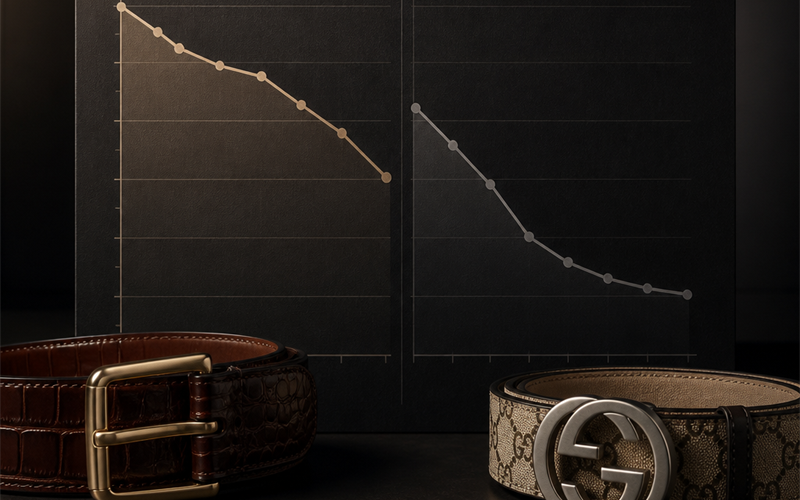
Yes, when you do the math over time. A $200 quality calfskin belt at 15-year lifespan = $13.30 per year. A $30 cheap belt at 1-year lifespan = $30 per year, plus the time and effort of shopping for replacements every season. The break-even point comes around year 4. After that, the calfskin belt is pure savings — and you've been wearing significantly better quality the entire time.

The 10-year cost comparison:
| Year | Cheap Belt Total | Calfskin Belt Total |
|---|---|---|
| 1 | $30 | $200 |
| 3 | $90 | $200 |
| 5 | $150 | $200 |
| 7 | $210 | $200 ← break-even |
| 10 | $300 | $200 |
| 15 | $450 | $200 |
And this assumes the cheap belt costs stay flat. In reality, $30 belts are getting cheaper in quality (more PU, less leather) while the prices stay similar. The real-world math is even more brutal for the cheap-belt approach.
We covered the broader value argument in our life expectancy of a calfskin belt post. The case isn't "calfskin is luxury" — it's "calfskin is rational over time."
What else changes besides the belt itself?
The upgrade affects outfits in subtle but real ways. A quality calfskin belt makes the rest of your outfit look more put-together — even with the same shirt, pants, and shoes. The belt sits at the visual midpoint of your outfit, and when it stops looking cheap, the whole outfit benefits. A great pair of shoes with a $30 plastic-looking belt creates visual dissonance; the same shoes with a quality calfskin belt creates a coherent outfit.

What changes after the upgrade:
- Outfit cohesion improves — the belt no longer "downgrades" the rest of the look
- Confidence increases — small but real, the kind of detail you notice
- Compliments shift — from "nice shoes" to "you look sharp" (people register the whole frame)
- Daily routine simplifies — one belt that always works vs rotating cheap belts as they fail
- Storage becomes easier — you stop accumulating dead belts in a drawer
The compounding effect: better belt → notice the belt-shoe matching mistakes → upgrade other parts of the wardrobe → eventually look genuinely well-dressed without spending dramatically more. The first quality belt is often the entry point into a more intentional wardrobe.
What's the right entry-level calfskin upgrade?
The right entry-level calfskin upgrade is a polished black or dark brown full-grain calfskin belt in 32mm width, with a stainless steel single-prong frame buckle, priced $150–$300 from a DTC brand. This is the spec that delivers the full quality upgrade without paying Brand Tax for a designer logo. Below $150 is hard to do honestly with full-grain calfskin. Above $300 you're paying for branding, not better leather.

What to look for in the listing:
- "Full-grain calfskin" specifically — not "calfskin leather" or just "leather"
- "stainless steel" or "solid brass" buckle — not "alloy" or "plated"
- "Stitched edges" — not just glued or heat-finished
- A real warranty (5–10 years on materials and construction)
- Honest measurements (width, length, hide thickness) in the description
What to skip:
- Belts labeled "genuine leather" only — that's the lowest tier of real leather
- Belts under $80 calling themselves "premium" or "luxury" — math doesn't work
- Belts with brand logos visibly on the buckle — that's Brand Tax pricing
- Belts with no warranty or vague return policy
We covered the right specs to look for in our 4 quality markers of a calfskin belt post.
The Bottom Line
The difference between a $30 belt and a quality calfskin belt is real, immediate, and worth the upgrade. You'll feel it in the first 5 seconds — weight, suppleness, buckle solidity — and you'll see it for the next 15 years. The cost-per-wear math favors quality after year 4. The wardrobe-coherence benefit kicks in immediately. The only buyers who shouldn't upgrade are the ones genuinely wearing belts only a few times a year — for everyone else, this is one of the highest-return upgrades in menswear.
At BELTLEY, our calfskin belts sit at the DTC price point where the math works: $100–$148 for full-grain calfskin, stainless or solid brass hardware, stitched edges, 10-year warranty. No Brand Tax for a logo, no $30 fast-fashion compromise. The belt is built to outlast the warranty and earn back its cost in three to four years of replaced-cheap-belt savings.
If you've been waiting for the right time to upgrade, browse our calfskin belt collection — and skip the next ten years of $30 replacements.
Frequently Asked Questions
Q: Is a $30 belt really that bad?
For occasional wear, no — it's adequate. For daily wear, the build quality means you're replacing it every 1–2 years, and the cosmetic differences compared to a quality belt are immediately visible. Daily wearers benefit most from upgrading.
Q: How do I know if I need to upgrade?
If your current belt has cracked, frayed, lost color at the buckle, or shows hardware corrosion, it's already past its useful life. If you notice the belt looking "cheaper" than the rest of your outfit, that's also a signal.
Q: What's the cheapest belt that's actually worth buying?
Around $80–$120 for honest full-grain leather from a smaller maker. Below that, the math forces compromises — bonded leather, plated hardware, glued construction. Above $300 you're often paying for branding more than build.
Q: Will I really notice the difference?
Yes, immediately. Pick up both belts side-by-side and the differences in weight, edge finish, and buckle feel are obvious. Wear them and the difference in how the rest of your outfit looks is also immediate.
Q: Can I keep wearing my old belt for casual?
Sure — if it's still structurally fine. But if you upgrade to a quality calfskin belt, you'll likely stop reaching for the old one within a few weeks. The downgrade feeling is real.