Calfskin vs Full-Grain Leather Belt: Which Lasts Longer?
TL;DR:
- Full-grain cowhide belts last the longest in pure years — 20 to 30+ with care, sometimes a lifetime.
- Calfskin belts typically last 10–20 years with care, and look better doing it in formal settings.
- The "longer" answer depends entirely on how you wear it. Calfskin wears out faster under jeans-and-boots abuse; full-grain looks out of place under a tuxedo.
- What actually kills both leathers isn't time — it's neglect, water, dryness, and being folded the wrong way.
- A 10-year warranty (like ours) only matters if you also do the 5-minute-a-season care routine.
Asking "which lasts longer, calfskin or full-grain?" is a bit like asking "which lasts longer, a dress shoe or a hiking boot?" The honest answer is it depends on what you do with it. But there's a real, useful answer once you compare them in the same conditions — and the data leans one way more clearly than most people realize. Let's get into it.
Which Outlives Which — For Your Wardrobe?
The lifespans differ less than the use cases do:
| Your situation | The answer |
|---|---|
| Maximum raw years | Full-grain cowhide — 20–30+ with care, sometimes a lifetime |
| Formal wear, most days | Calfskin — 10–20 years and it looks better doing it under a suit |
| Jeans-and-boots life | Full-grain — calfskin wears faster under abuse it wasn't built for |
| Either one | Condition it twice a year — neglect kills both leathers faster than time does |
Both are backed by the 10-year warranty; the maintenance half lives in the care guide. What "lasting" really means:
The Quick Answer: Which Lasts Longer?
In a head-to-head fair fight where both belts get equal abuse, full-grain cowhide outlasts calfskin — usually by 5–15 years. Cowhide has 2–4× the thickness, a coarser grain that hides damage, and a fiber structure built for stretching and stress. Calfskin is denser per millimeter, but there's just less of it to wear through.

That said, "lasting" isn't only about years. A calfskin belt that looks beautiful for 15 years beats a cowhide belt that looks ugly after 5. We'll get into that in a minute.
What Does "Lasting" Even Mean for a Belt?
A belt "lasts" when it still functions safely and looks the way you want it to. Functional failure (cracking, tearing, buckle failure) is one thing. Aesthetic failure (creased, scratched, faded beyond repair) is another. Calfskin and full-grain leather fail in different ways at different speeds.
A full-grain cowhide belt rarely fails functionally — it just gets uglier (or more "characterful," depending on your taste). A calfskin belt rarely fails functionally either, but it loses its dress-appropriate appearance faster if you treat it like a work belt. So when comparing lifespan, ask yourself: am I measuring "still holds my pants up" or "still looks right with a suit"? They're different finish lines.
If you want the full philosophy on how belt durability actually works, our piece on the truth about leather belt durability is a good companion read.
How Long Does a Calfskin Belt Last?
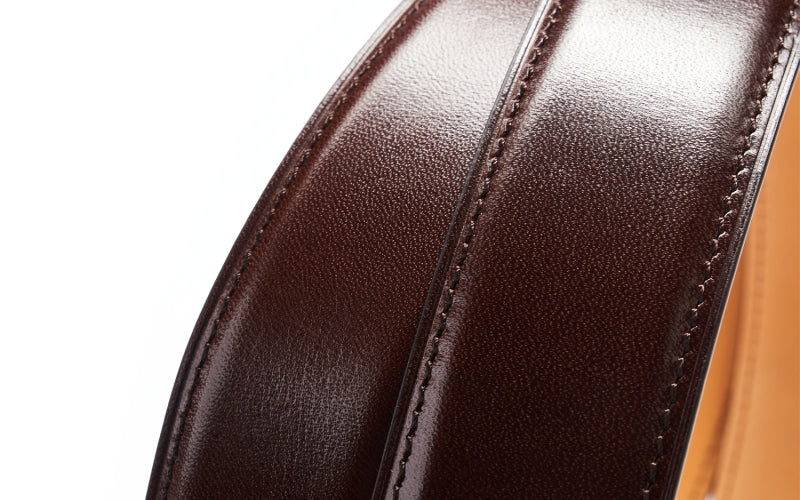
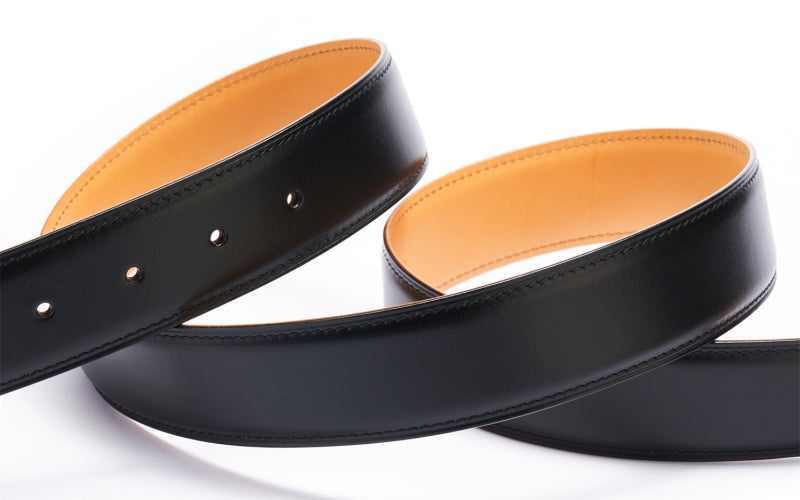
A well-made calfskin belt, worn regularly and cared for, lasts 10–20 years. Worn occasionally and conditioned twice a year, it can clear 25. The thinner profile (0.6–1.2 mm finished) means there's less material to wear through, but the tight grain resists cracking and tearing impressively well for its weight.

The catch: calfskin shows everything. A scratch on a smooth black calfskin belt looks dramatic where the same scratch on a rough work belt vanishes into the texture. Most light scratches buff out with a soft cloth and a touch of conditioner, but deeper damage eventually reads as "this belt has seen things." For background on what calfskin is and why it behaves this way, see our complete guide to calfskin leather.
Calfskin lives its best life under a suit, paired with dress shoes, and rotated with a second belt. Treat it like a leather watch strap and it'll outlast the watch.
How Long Does a Full-Grain Cowhide Belt Last?
A full-grain cowhide belt typically lasts 20–30+ years. Many become heirloom pieces, passed down or worn daily for decades. The combination of 2.5–5 mm thickness, full intact grain layer, and natural oils built into the fibers makes full-grain the longest-lasting belt leather on the market.
That's not marketing — it's structural. Full-grain leather keeps the entire top layer of the hide, including the strongest fibers, instead of sanding them off the way top-grain does. We covered the grain hierarchy in detail in full-grain vs. top-grain leather, and our deep-dive on how long a full-grain leather belt actually lasts walks through real-world wear patterns.
Properly tanned full-grain — ideally vegetable-tanned, from a Leather Working Group certified tannery — gets better looking over time. That's the magic. It develops a patina the way good denim develops fade.
Browse our full-grain leather belts collection to see the range.
Why Full-Grain Wins on Raw Toughness
It comes down to three things:
- Thickness. A 4 mm cowhide strap has four times the material between you and a failure point than a 1 mm calfskin strap. Math.
- Coarser grain. Bigger, more spread-out hair follicles in adult cowhide mean small scratches disappear into the natural texture. Calfskin's glass-smooth surface shows every mark.
- Natural oil content. Adult cowhide hides retain more natural lipids that resist drying and cracking, especially when vegetable-tanned slowly. According to Encyclopaedia Britannica's leather production overview, traditional vegetable tanning preserves these oils far better than fast chrome methods.
The trade-off: full-grain cowhide is too thick, too rugged, and too matte-looking for a tailored suit. You wouldn't wear hiking boots to a wedding. Same idea.
Why Calfskin Wins on Refined Wear
If "lasting" means "still looks dressy after a decade," calfskin pulls ahead. Here's why:

- Tighter grain holds a polish. Calfskin shines up like new with a soft cloth. Full-grain cowhide doesn't really polish — it patinas.
- Crisper dye. The fine surface absorbs dye evenly, so a black calfskin belt stays black for years. Coarse cowhide can lighten unevenly.
- Better with formal hardware. Slim polished buckles look right on calfskin's refined surface. They can look wrong on chunky work-belt leather.
A 15-year-old calfskin belt that's been rotated and conditioned still passes for a black-tie event. A 15-year-old full-grain work belt looks like it has stories — great for jeans, wrong for a tux.
What Actually Kills Leather Belts?
Most belts don't die of old age — they die of neglect. The top killers, in order: prolonged moisture, complete drying out, sharp folding, salt exposure, and being stored crammed in a drawer instead of hung or rolled. Both calfskin and full-grain are vulnerable, just on different timelines.
Specifically:
- Water — leaves rings, stiffens the fibers, and accelerates cracking once dry.
- Heat and sun — bake out the natural oils.
- Folding — creates permanent stress lines that eventually crack.
- Salt and sweat — corrode the fibers and dull the finish.
- Skipping conditioner — the silent killer. Leather needs feeding every 3–6 months.
A 5-minute-per-season care routine doubles the lifespan of either leather. We laid out the full method in our leather care guide. Stick a reminder in your calendar. Future-you will be glad.
Calfskin vs Full-Grain Belt Lifespan: Side-by-Side
| Factor | Calfskin Belt | Full-Grain Cowhide Belt |
|---|---|---|
| Typical lifespan (with care) | 10–20 years | 20–30+ years |
| Thickness | 0.6–1.2 mm | 2.5–5 mm |
| Resists scratches? | Shows them more | Hides them in grain |
| Develops patina? | Subtle sheen | Rich, dramatic patina |
| Stretches over time? | Slightly | Yes, conforms to wearer |
| Best wardrobe match | Suit, dress shoes | Jeans, boots, casual |
| Conditioner frequency | Every 3–6 months | Every 6 months |
| Weak point | Visible scratches | Bulky for formalwear |
| Heirloom potential | Possible | Likely |
Which Belt Lasts Longer For Your Lifestyle?
The right answer depends less on the leather and more on your week. If most of your belt-wearing happens in suits, blazers, or dress shirts, a calfskin belt will last longer in its proper role than a full-grain cowhide belt awkwardly forced into formal duty. If your week looks like jeans and boots, a full-grain belt will outlast a calfskin belt that wasn't built for that abuse.

Quick decision logic:
- Mostly formal/business → start with calfskin. Our Classic Calfskin Dress Belt is built for it.
- Mostly casual/rugged → start with full-grain cowhide. Browse the full-grain belts collection.
- Both wardrobes → own one of each. They're not competing — they're complementary.
Either way, BELTLEY backs both with a 10-year warranty on materials and construction. Details on our warranty page. Real longevity is partly leather, partly craftsmanship, and partly the brand standing behind it.
The Bottom Line
If you're forcing a single answer: full-grain cowhide lasts longer in raw years. But "longer" only matters if the belt still does what you bought it for, and a 30-year-old work belt isn't going to save you at a wedding any more than a 20-year-old dress belt will survive a construction site. The smart move isn't picking a winner — it's matching the leather to the life. At BELTLEY we make both because the same customer often needs both: one belt for the suit, one belt for the weekend, both built to outlast the trends. Pick the one that fits your week, condition it twice a year, and either leather will outlast every cheap belt you'd otherwise burn through in the meantime.
Frequently Asked Questions
Q: Which leather belt has the longest lifespan?
Full-grain cowhide, in pure years — typically 20–30+ with care. Crocodile and alligator can technically last longer in some conditions, but among standard belt leathers, full-grain cowhide is the workhorse champion.
Q: Is calfskin durable enough for everyday wear?
Yes — if "everyday" means office, business casual, or rotating with a second belt. For daily denim-and-boots wear, full-grain cowhide is a better long-term match. See our breakdown of how long luxury belts last for more on real-world lifespans.
Q: Do leather belts really last 20+ years?
A well-made full-grain belt absolutely can. We've seen vintage cowhide belts still in service after 30+ years. The two prerequisites: real full-grain leather (not bonded or "genuine") and basic care every few months. Cheap belts crack inside 2 years.
Q: What is the best leather for a belt that lasts?
For raw longevity, full-grain vegetable-tanned cowhide. For longevity in dressy use, calfskin. For absolute lifetime status-symbol durability, exotic leathers like crocodile. Match the leather to the role and any of them will outlast the average belt.
Q: How can I make my leather belt last longer?
Condition every 3–6 months, wipe with a dry cloth after each wear, never store folded, keep it out of prolonged sun and water, and rotate between at least two belts so each one gets to rest. That routine doubles most belts' lifespans — full details in our leather care guide.