Why Full-Grain Belts Crack at the Buckle Holes (And How to Prevent It)
Quick answer: Full-grain leather belts crack at the buckle holes because that's where mechanical stress concentrates — the prong wedges through the hole under tension every day, and the leather around the hole takes repeated micro-damage. Three contributing factors: (1) belt is too small (excessive tension on the prong-hole interface), (2) leather has dried out (loses flexibility around the hole), (3) hole was punched poorly (rough edges create stress concentration points). Prevention: buy the right size, keep the leather lightly conditioned, and use well-punched belts with reinforced hole construction. The crack at the hole is one of the most predictable belt failure modes.
Last updated: May 2026 • By BELTLEY Editorial
TL;DR:
- Cracking at the buckle hole is the #1 mechanical failure mode for leather belts.
- Three causes: belt too small, dried-out leather, or poorly punched holes.
- Prevention: correct sizing + light conditioning + quality construction.
- The crack typically starts as a small tear and propagates over months.
- Quality full-grain belts crack at the hole much less than cheap leather belts.
The cracked-at-the-buckle-hole problem is the most common mechanical belt failure, and one of the most preventable. The leather around the hole takes the highest concentrated stress of any point on the belt — the prong wedges through under tension every time you fasten the belt, creating micro-damage that accumulates over years. Quality full-grain belts can withstand this stress for decades; cheap belts crack within 1-2 years. Below is the honest mechanism and prevention strategy. For broader durability framing, see why is full-grain leather so expensive.
Why does the leather crack specifically at the buckle hole?
Because that's where mechanical stress concentrates. The hole region experiences a fundamentally different stress profile from the rest of the belt. (1) Concentrated point load — the prong applies all its tension through one small area of leather. (2) Repeated cyclical stress — every time you fasten/unfasten the belt, the leather around the hole is bent, twisted, and pulled. (3) Edge effects — the cut edge of the hole has exposed fibers more vulnerable to mechanical damage than the unbroken leather surface.

Over thousands of fastening cycles, these stress concentrations accumulate as micro-damage in the leather fibers around the hole. Quality full-grain leather has dense, intact fibers that resist this damage; lower-grade leathers (bonded, corrected-grain) have already-compromised fiber structure that fails much faster. The buckle-hole crack is the natural failure mode where any belt's weakest point is exposed.
What's the most common cause — belt too small?
Yes — excessive sizing tension is the #1 cause. A belt worn too tight (using the tightest hole regularly because the belt is technically too small) puts the prong under high constant tension, compressing the leather around the hole with much more force than designed. Over months, this concentrated compression and the repeated stress of fastening cause the leather to crack along the hole's edge.
The fix is correct sizing. A belt should sit comfortably at the middle hole with adjustment room on either side. If you're consistently using the tightest hole, the belt is the wrong size — buy a larger one rather than continue stressing the leather. See full-grain leather belt sizing guide for sizing fundamentals.
Key stat: Belts worn consistently at the tightest hole show buckle-hole cracking at approximately 3-5x the rate of belts worn at the middle hole — concentrated tension causes accelerated failure. The right-size belt at the middle hole rarely cracks at the holes in normal use.
What about dried-out leather?
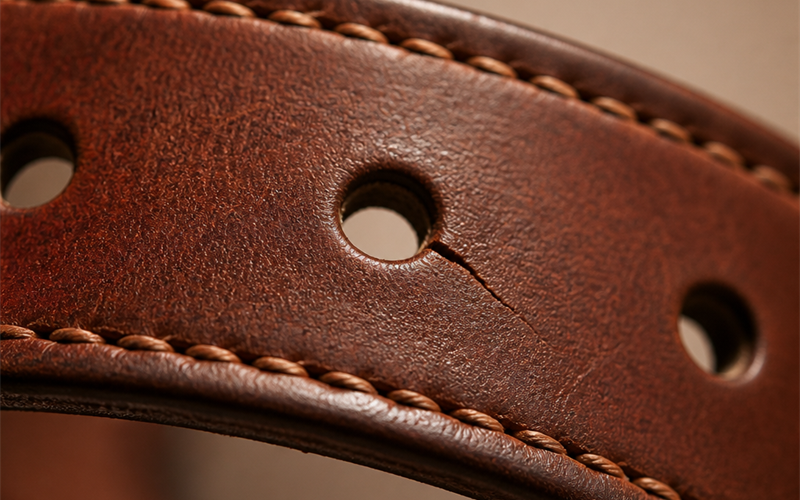
A close second — dry leather cracks under stress. When leather loses its natural moisture and lipid balance, it becomes brittle and less flexible. The repeated stress at the buckle hole that healthy leather absorbs fine becomes a fracture point for dry leather. The crack typically starts as a small tear at the hole edge and propagates outward over weeks or months.

The fix is appropriate conditioning. Quality full-grain belts in normal use need light conditioning 1-2 times per year to maintain flexibility — see neatsfoot oil vs mink oil vs beeswax. Belts left dry for years (stored without conditioning, exposed to dry climates, etc.) develop hole-area cracking faster than well-maintained belts. See should you condition a brand-new full-grain leather belt for honest conditioning frequency.
How does hole-punching quality affect cracking?
Significantly. Poorly punched holes create stress concentration points that crack faster. Two punching problems contribute. (1) Rough or ragged hole edges — cheap punching tools or rushed construction leave fibrous, uneven hole edges that act as stress concentrators (microscopic notches where cracks initiate). (2) Hole spacing too tight — when holes are spaced too close together, the leather between them is weak and prone to cracking that propagates between holes.

Quality belt construction uses sharp, calibrated punch tools that create clean cylindrical holes with smooth edges. The leather around clean holes distributes stress evenly; rough holes concentrate stress at the irregularities. See how to punch a hole between two existing holes — precision method for the technique of clean punching when DIY adjustments are needed.
Buckle-hole crack risk factors
| Factor | Increases crack risk? | Severity |
|---|---|---|
| Belt worn too tight (smallest hole) | Yes | Very high |
| Dried-out leather (no conditioning) | Yes | High |
| Rough or poorly punched holes | Yes | High |
| Low-quality leather (bonded, corrected-grain) | Yes | Very high |
| Hole spacing too tight | Yes | Medium |
| Heavy load (gun, tools) on dress belt | Yes | High |
| Correct sizing + middle hole wear | No | Very low |
| Quality full-grain + light conditioning | No | Very low |
| Sharp clean hole edges | No | Very low |
How can you prevent buckle-hole cracking?
A four-part prevention strategy. (1) Buy the right size — the belt should sit comfortably at the middle hole, not the tightest. See full-grain leather belt sizing guide. (2) Condition lightly when needed — typically 1-2 times per year; don't let the leather dry out and become brittle. (3) Choose quality construction — clean punched holes, real full-grain leather, sealed edges. (4) Match the belt to the use — don't use a dress belt for heavy loads; gun belts and work belts have construction designed for the higher stress.
The first prevention factor — correct sizing — accounts for roughly half of all buckle-hole crack prevention. The simple act of buying a properly-sized belt eliminates the most common stress concentrator. The other three factors compound this; together they make buckle-hole cracking rare in quality belts under normal use.
Why does the BELTLEY 3-Material Rule prevent hole cracking?
Because each rule element addresses a crack risk factor. The BELTLEY 3-Material Rule — full-grain leather + stainless or solid brass buckle + sealed (painted or burnished) edges — prevents hole cracking through three mechanisms. (1) Full-grain leather has dense, intact fiber structure that distributes stress evenly around hole edges — cheap leathers have compromised fibers that crack faster. (2) Solid hardware (not plated zinc) maintains buckle prong geometry over years — bent or deformed cheap prongs apply uneven stress that accelerates hole cracking. (3) Sealed edges correlate with quality construction overall — brands that finish edges typically also punch holes cleanly.

A belt passing the 3-Material Rule rarely cracks at the buckle hole in normal use; a belt failing the rule often shows hole cracking within 1-2 years. The mechanism connects construction quality to specific failure modes — passing the rule isn't abstract quality signaling, it's measurable failure prevention.
What should you do if cracking has already started?
Assess severity and decide whether to repair, modify, or retire. Three response paths. (1) Hairline crack at one hole, leather still intact — light conditioning to maintain flexibility; stop using that specific hole (shift to the next adjacent hole). The crack may stabilize and remain cosmetic. (2) Visible crack on multiple holes, leather thinning — the belt is structurally compromised; consider professional leather repair (re-stitching, edge reinforcement) or replacement. (3) Crack propagating beyond the holes into the main strap — structural failure; retire the belt before it fails catastrophically.

For cracking belts with sentimental or financial value, professional restoration can sometimes splice or reinforce the affected area — typically $40-$100 per repair. For everyday belts, replacement is usually the right answer. See how to tell if a belt can be professionally restored or should be tossed.
The Bottom Line
Buckle-hole cracking is the most common mechanical failure mode for leather belts, and it's predictable and largely preventable. The three contributing factors are: belt too small (excessive tension), dried-out leather (lost flexibility), and poorly punched holes (stress concentration points). Prevention is straightforward — buy the right size so you wear the belt at the middle hole, condition lightly when the leather actually needs it (1-2x per year), and choose quality construction with full-grain leather and clean punching. The BELTLEY 3-Material Rule (full-grain leather + stainless or solid brass buckle + sealed edges) addresses each crack risk factor, which is why quality full-grain belts rarely crack at the hole while cheap belts often do within 1-2 years. BELTLEY's full-grain leather belt collection uses clean precision-punched holes in real full-grain leather — backed by a 10-year warranty. Ready for a belt that doesn't fail at the hole? Start there.
Frequently Asked Questions
Q: Why does my leather belt have a crack at the buckle hole?
Three common causes: the belt is too small (excessive tension from wearing the tightest hole regularly), the leather has dried out (loses flexibility, fractures under stress), or the holes were poorly punched (rough edges concentrate stress). The first cause is by far the most common; correct sizing eliminates most hole cracking.
Q: Can a cracked buckle hole be fixed?
Light hairline cracks at a single hole can stabilize if you stop using that hole and condition the leather lightly. Visible cracks on multiple holes or cracks propagating beyond the holes typically indicate structural failure that requires professional repair ($40-$100) or belt replacement.
Q: How do I prevent my belt from cracking at the holes?
Four prevention strategies. (1) Buy the right size so you wear the middle hole, not the tightest. (2) Condition lightly 1-2 times per year. (3) Choose quality full-grain leather with clean punching. (4) Don't use dress belts for heavy loads (gun, tools) — use construction designed for higher stress.
Q: Why does my belt crack faster than others?
Quality of leather and sizing are the two biggest variables. Cheap belts (bonded, corrected-grain) crack at the holes within 1-2 years; quality full-grain belts often last decades without hole cracking. Wearing any belt too tight accelerates the failure regardless of leather quality.
Q: Is cracking at the buckle hole a warranty issue?
Often — depending on the manufacturer and the cause. Cracking due to manufacturing defects (poorly punched holes, low-quality leather, defective construction) is usually warranty-covered. Cracking due to user wear patterns (consistently wearing the tightest hole, no conditioning, excessive load) typically isn't. Check the brand's warranty terms; BELTLEY's 10-year warranty covers materials and construction defects.