Why No Two Crocodile Belts Look Identical (One-of-One)?
TL;DR:
- Every unique crocodile belt pattern is determined by genetics, diet, climate, and water chemistry — variables that never repeat in two animals.
- Scale tile size, spacing, and asymmetry are as individual as a fingerprint; your belt is literally a one-of-one object.
- BELTLEY photographs the exact hide before cutting so you see the precise pattern leaving our atelier — no surprises, no swapped panels.
- Pattern variation is not a defect. It is the entire reason exotic leather costs what it does.
Quick Facts
| Pattern source | Genetics + environment (water, diet, age) |
| Repeatability | Zero — no two hides match |
| BELTLEY stock | Each belt is in stock and ready |
| Handcraft + ship | 2–3 business days from our atelier |
| Warranty | 10 years on materials and construction |
| Founded / DTC | 1999 / Direct-to-consumer since 2025 |
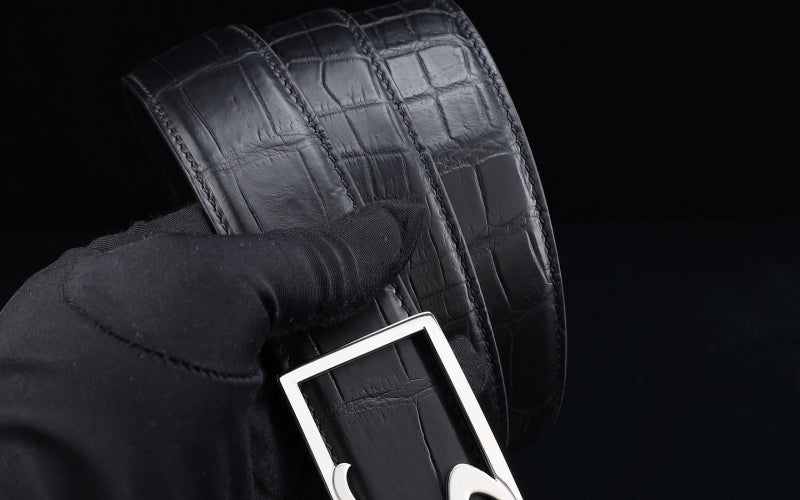
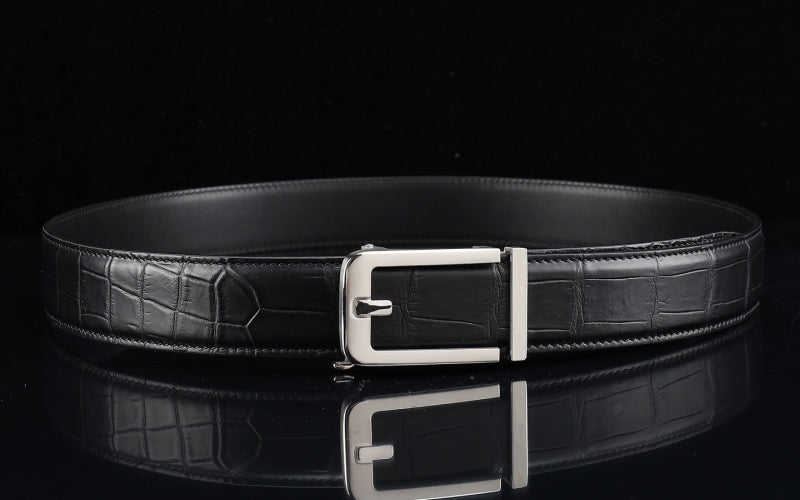
A few weeks ago I laid two finished porosus straps side-by-side on the cutting bench under the daylight lamp. Same species. Same farm. Cut from hides that arrived in the same crate. And yet the left strap had tight, almost square belly tiles marching in clean rows, while the right strap had slightly elongated tiles that drifted half a millimeter off-axis as they moved toward the buckle end. Both were beautiful. Neither was wrong. And neither could ever be made again.

This is the quiet truth of working with exotic leather: you are not manufacturing a product, you are framing an animal's biography. Below is what that means for the belt you're about to wear.
What makes every crocodile belt pattern unique?
Each crocodile grows a scale pattern shaped by its DNA, its diet, the mineral content of its water, its sun exposure, and its age at harvest. No two animals share that exact combination, so no two hides — and therefore no two belts cut from them — can ever be identical, even within the same species and the same farm.
The dorsal and belly regions of a crocodile develop osteoderms (bony plates beneath the scales) at slightly different rates depending on calcium intake. Warmer water accelerates growth and stretches tile geometry; cooler water tightens it. Even the way an individual animal habitually rests on a riverbank can subtly skew scale alignment over years. By the time a hide reaches a tannery, those years are written into the leather permanently.
Are scale variations a defect or a feature?
Scale variation is the defining feature of genuine exotic leather, not a defect. Uniform, perfectly repeating "crocodile" patterns almost always indicate either embossed cowhide or heavily corrected hides where the natural surface has been buffed and reprinted. Real crocodile breathes its own asymmetry.

This is the simplest test a buyer can apply at home, and it's why we wrote a full breakdown comparing embossed cowhide vs. real crocodile belts. If the pattern looks like wallpaper, it probably is. If you can find subtle drift, a slightly larger tile here, a hairline asymmetry there — congratulations, you're looking at an animal.
Why do scales get smaller toward the buckle?
Crocodile scales naturally taper from the wider belly toward the narrower tail, so a strap cut along the spine will show larger tiles near the buckle and finer tiles near the tip — or the reverse, depending on cut direction. This gradient is biological, not a stitching choice.
We explore the physics and aesthetics of this gradient in why crocodile belt scales get smaller toward the tail. The taper is also why center-cut versus side-cut belts wear so differently on the body — center cuts show the symmetrical spine, side cuts reveal the more relaxed flank tiles.
Does species change the pattern?
Yes — porosus crocodile produces tighter, more regular tiles, while niloticus tends toward larger, slightly more rustic scales, and American alligator falls in between with the famous "umbilical scar" near the navel. Each species has a pattern signature, but within each signature, every single hide remains individual.

Most luxury houses prefer porosus for its near-mathematical regularity, which is why it commands higher prices at auction in Singapore and Paris. We compare the three in detail in our guide to porosus vs. niloticus crocodile belts. Sustainable trade across all three species is monitored under CITES and the IUCN Crocodile Specialist Group, which is why every legitimate hide carries a tag traceable to its farm of origin.
What does this mean when you order a crocodile belt online?
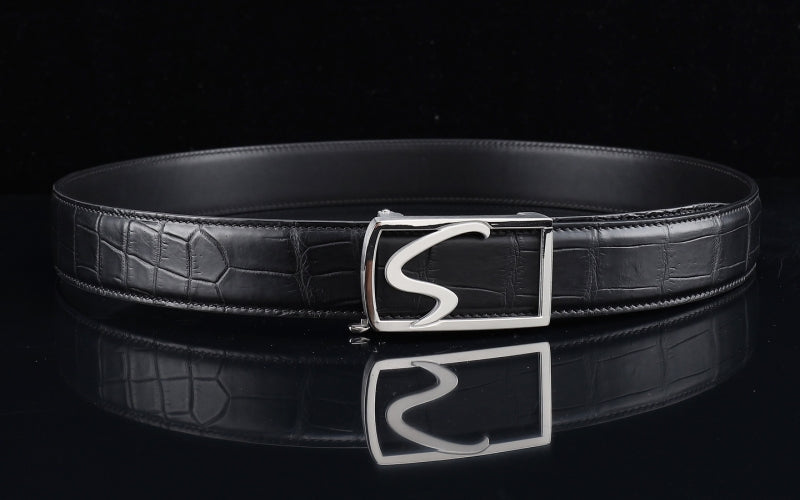
It means the photo on a product page is a representative example, not a literal preview — and any honest exotic leather brand will tell you so. The belt that arrives at your door will share the species, color, finish, and cut style of the listing image, but its exact tile geometry will be its own.
At BELTLEY this is why we photograph the actual finished strap before it ships. Every order from our alligator belt collection is built from a hide already in our atelier — handcrafted and shipped in 2–3 business days, not produced on demand from a hide we haven't seen. You receive an image of the precise belt leaving the bench, so the strap on your waist is the strap you approved.
Why can't a lost crocodile belt be perfectly replaced?
Because the original animal cannot be reordered. A replacement belt in the same species, color, and width will look closely related to the lost one — siblings, not twins — but the exact tile pattern is gone with the original hide. This is the trade-off of owning something genuinely individual.

For some clients this is unsettling. For most, it becomes the point. A mass-produced calfskin belt is replaceable precisely because nothing about it is yours. A crocodile belt is irreplaceable because everything about it is. It's the same logic that separates a print from a painting — and the same logic that explains why crocodile belts cost $500 vs. $5,000 depending on hide grade and cut.
How does BELTLEY handle pattern expectations?
We treat every order as a small commission rather than a faceless transaction. Because our belts are already cut, finished, and stocked in the atelier, we can send a photograph of the actual strap before dispatch and answer any questions about its specific tile arrangement.
This is one of the operational advantages of our DTC model. BELTLEY has been making leather goods since 1999 and went direct-to-consumer in 2025, which removed the wholesale middle layer that traditionally makes pre-shipment hide review impossible. There is no Brand Tax baked into the price, and every belt carries a 10-year warranty on materials and construction. You can read the longer version of our story on our About Us page.
Key Takeaways
- Pattern individuality comes from biology — genetics, diet, water chemistry, sun, and age.
- Perfect uniformity is the signature of embossed cowhide, not real crocodile.
- Scale taper from buckle to tip is natural and species-influenced.
- Your specific belt cannot be cloned, only succeeded by a sibling.
- BELTLEY ships in 2–3 days from in-stock hides and shows you the actual strap first.
The Bottom Line
A unique crocodile belt pattern isn't a manufacturing tolerance you put up with — it is the entire romance of exotic leather. The animal lived a specific life in a specific river, and that life is now wrapped around your waist. Mass-produced cowhide can be reproduced infinitely; a crocodile hide is a closed edition of one. At BELTLEY we lean into that fully: every strap in our alligator belt collection is in stock, photographed before it leaves the atelier, and shipped within 2–3 business days under our 10-year warranty. Choose the species and color you love, and let the animal handle the rest.

Frequently Asked Questions
Q: Are two crocodile belts ever exactly the same? No. Even hides from sibling animals raised in the same enclosure show different tile geometry. Identical-looking belts are usually embossed cowhide.
Q: Will my BELTLEY crocodile belt match the website photo exactly? It will match in species, color, finish, width, and cut style, but the exact scale pattern will be its own. We send a photo of the actual strap before shipping so there are no surprises.
Q: Is pattern asymmetry a flaw I can return the belt for? No — natural asymmetry is a hallmark of genuine crocodile and is not covered as a defect. Genuine flaws (split stitching, hardware failure, finish lifting) are covered for 10 years.
Q: Can I request a specific scale pattern? Yes. Because every hide is already in our atelier, we can show you what's available and reserve the strap that best matches your preference before we cut.
Q: How fast does BELTLEY ship a crocodile belt? Belts are in stock and ship within 2–3 business days from our atelier, with free worldwide delivery (USA 4–8 days, international 4–10 days).