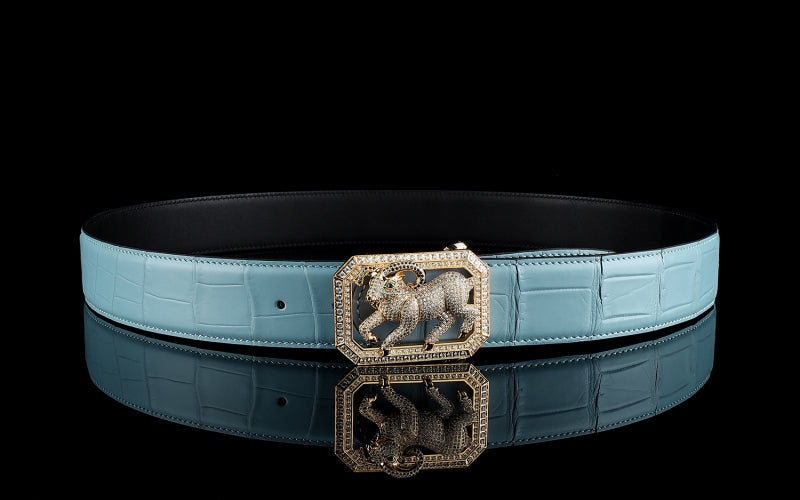
Porosus vs Niloticus Crocodile Belt: The Connoisseur's Guide
TL;DR:
- Porosus (saltwater crocodile, Crocodylus porosus) — small, tight, symmetrical scales with a visible pore. Most prestigious, most expensive.
- Niloticus (Nile crocodile, Crocodylus niloticus) — larger, bolder, rectangular scales. Dramatic, more accessible.
-
Hermès stamps: caret
^= Porosus, two dots••= Niloticus, underscore_= American alligator. - For a belt (not a bag), visible scale geography matters more than species prestige.
- A well-made Niloticus belt from a DTC brand often outperforms an entry-tier designer Porosus on cost-per-wear.
Quick Facts
- Porosus belt at Hermès: $4,000–$6,000+ retail
- Niloticus belt at Hermès: $2,500–$3,500
- Porosus belt at BELTLEY (DTC fair pricing): Niloticus only, $118–$289
- Hide width needed for one-piece belt: 40+ cm
- Years a properly cared crocodile belt lasts: 15–25
- CITES status: Both species, Appendix II (regulated)
If you've spent more than ten minutes researching luxury crocodile belts, you've hit the same wall every serious buyer hits: two scientific names that sound nearly identical, wildly different price tags, and a luxury industry that does very little to explain why. Porosus or Niloticus? The answer determines whether you pay $400 or $4,000 for what looks, to the casual eye, like the same belt.
This guide cuts through the marketing fog. You'll learn how to identify each species on sight, where they come from, what the Hermès stamps actually mean, and — most importantly — which one belongs on your waist. We'll also explain why the scale geography of a belt demands a slightly different decision framework than the one you'd use for a handbag.
In our own workshop, we inspect 8–12 Niloticus hides for every order before selecting the 4–5 we'll cut. The differences described below aren't theoretical — they're the daily judgment calls our cutters make when sourcing belt-grade leather.
Porosus or Niloticus: The Buyer's Shortcut
The connoisseur's question, answered by what you actually value:
| Your priority | Go with |
|---|---|
| Maximum prestige, tightest scales | Porosus — the saltwater crocodile is the apex hide, priced accordingly |
| Bold pattern at accessible pricing | Niloticus — larger, dramatic scales; the smart-money exotic |
| It's for a belt, not a bag | Scale geography matters more than species prestige on a 1.38" strap — details below |
| Cost-per-wear thinking | A well-made Niloticus at DTC pricing ($118–$289) beats an entry designer Porosus |
BELTLEY's crocodile collection is built on Niloticus for exactly that reason. The species science:
What Is the Difference Between Porosus and Niloticus Crocodile?
Porosus has small, tight, symmetrical scales with a visible single-hair pore in each scale. Niloticus has larger, broader, rectangular scales and no visible pore. Porosus is rarer, more expensive, and yields finer-grained leather. Niloticus is bolder, more accessible, and produces dramatic scale gradients.

Both species fall under the Crocodylus genus, but their hides behave very differently once tanned. Porosus skins yield finer-grained leather prized for its uniformity — every scale is roughly the same size as its neighbor, creating a near-mathematical symmetry across the belt. Niloticus skins, by contrast, produce a hide where scales grow noticeably larger toward the center and shrink toward the flanks, giving each belt a more dramatic visual rhythm. Industry data published through the IUCN Crocodile Specialist Group confirms that Porosus consistently commands higher hide-auction prices than any other crocodilian species used in fashion.
The visible pore on Porosus is the single most reliable identifier. Each scale carries one tiny dot — the remnant of a hair follicle the species evolved long ago. Niloticus scales lack this pore entirely.
Where Do Porosus and Niloticus Crocodiles Come From?
Porosus is native to Southeast Asia and Northern Australia, living in saltwater estuaries and tidal rivers. Niloticus is native to sub-Saharan Africa, primarily in freshwater rivers, lakes, and swamps. Both are now farmed under strict CITES regulation rather than hunted in the wild.
Hermès farms its Porosus stock primarily in Australia, where the Northern Territory's saltwater crocodile farms supply some of the most prized hides on the global market. Niloticus farms cluster around Zimbabwe, Kenya, and South Africa, where the warm freshwater habitat matches the species' native range. The geographic split matters because farming environment directly affects skin quality — Porosus hides are typically smaller, so a single belt strap may use one Porosus belly, where the same length might come from a smaller portion of a Niloticus hide.
Every legal crocodile belt sold today carries a CITES Appendix II export certificate. If a seller can't produce one, the belt either isn't real crocodile, or it isn't legal. We cover the legal trail in our guide on whether crocodile and alligator belts are legal in the USA.
How Do You Identify Porosus vs Niloticus on a Belt?
Look at three things: scale size, scale shape, and pore presence. Porosus shows small, tight, square scales (4–6mm) with a single pinpoint pore in each scale. Niloticus shows larger, rectangular scales (6–10mm) with no pore and a more elongated shape. Porosus scales are uniform; Niloticus scales taper from spine to flank.

A few practical tests you can run in under thirty seconds:
| Test | Porosus | Niloticus |
|---|---|---|
| Scale size at belt center | 4–6 mm square | 6–10 mm rectangular |
| Pore visibility | Yes — one tiny dot per scale | No pore |
| Scale uniformity | Highly uniform across width | Larger at center, smaller at flanks |
| Surface feel | Tighter, denser, smoother | Slightly more raised relief |
| Hermès stamp | Caret ^
|
Two dots ••
|
The Hermès marking system — first decoded publicly by collector forums and now confirmed by authentication services like Rebag — is the industry shorthand. Porosus gets the caret ^, Niloticus gets two dots ••, and an underscore _ denotes Mississippi alligator. If you've ever wondered how to spot a real one, our crocodile authentication checklist walks through every visual marker step by step.
In our own quality-control process, we use a 10x loupe to verify pore presence on every Niloticus hide before it enters the cutting room — the absence of a pore is one of the fastest ways to detect embossed cowhide passed off as crocodile.
Which Is More Expensive — Porosus or Niloticus?
Porosus is significantly more expensive. A Porosus belt typically costs 40–80% more than a comparable Niloticus belt at the luxury tier. At Hermès, a Porosus Constance belt can retail for $4,000–$6,000, while a Niloticus version of the same style runs $2,500–$3,500.
Three structural reasons drive the price gap:
- Lower yield per hide. Porosus crocodiles are smaller on average, and only the belly section is used for premium leather goods. A typical Porosus hide produces 1–2 luxury belts; a larger Niloticus hide may yield 3–4.
- Slower growth. Saltwater crocodiles take longer to reach harvest size in farm conditions, increasing per-hide cost.
- Brand demand. Hermès, Brioni, and Stefano Ricci preferentially source Porosus, creating sustained competition for limited supply.
The price gap on the secondary market is even sharper. A vintage Hermès Porosus Birkin can fetch double its Niloticus equivalent at auction, according to data published by major luxury auction houses. For belts, the resale spread is narrower — but Porosus still holds value better. We cover this dynamic in our crocodile belt resale value analysis.
Key Takeaways (so far)
- Porosus = smaller scales, visible pore, higher price, Hermès caret stamp
- Niloticus = larger scales, no pore, lower price, Hermès two-dot stamp
- Porosus hides yield 1–2 belts; Niloticus yields 3–4
- Both species are CITES Appendix II regulated and legally sold worldwide
Why Does Hermès Use Both Species?
Hermès uses both because each delivers a distinct aesthetic, not because one is universally superior. Porosus suits buyers who want quiet, refined uniformity. Niloticus suits buyers who want bold, sculptural scale drama. The house treats them as parallel options, not as a luxury hierarchy.

The pattern character is genuinely different. A Porosus belt photographs as a smooth, almost geometric grid — the scales blur into a single textured surface from across a room. A Niloticus belt reads as individual scales even at a distance, with strong shadow lines between each one. Stylists working on quiet luxury looks tend to specify Porosus. Stylists building statement looks lean Niloticus. Both species share the same 10–25 year wear lifespan when properly cared for, so the choice really is aesthetic rather than functional.
This is also why the Hermès stamp system treats both species as equals on the marking — neither carries a "premium" indicator beyond the species symbol itself. Coverage from PurseBlog's Hermès exotic leather analysis reaches the same conclusion: prestige is buyer-driven, not house-imposed.
Is Porosus Really Worth the Premium for a Belt?
For most buyers, no. The Porosus premium makes more sense for handbags where the entire surface is visible. On a belt — where the strap is partly hidden under jacket vents and only 6–8 inches show in profile — the species difference is far less noticeable to onlookers, even if you can feel it in the hand.

Here's the honest math. A high-quality Niloticus belt from a DTC craftsman runs $300–$500. The same construction in Porosus from a designer house starts at $2,500. You're paying roughly 5–8x more for a leather grain that, on a 1.38" belt strap, occupies maybe 12 square inches of visible real estate. For a Hermès Birkin, the calculation flips because the bag is a focal piece. For a belt, it rarely does.
Porosus is worth the premium if you're a leather connoisseur who wants the best, you collect crocodile pieces, or you're matching a specific Hermès accessory. For everyone else, a beautifully made Niloticus belt delivers 90% of the visual impact at 20% of the cost.
Why Scale Geography Matters More on a Belt Than a Bag
A belt forces the leather into a long, narrow strip — typically 1.18" to 1.5" wide and 36"–44" long. That geometry has consequences. Niloticus scales, which grow larger near the spine and shrink toward the flanks, create a visible "scale gradient" along a belt's length when the cut runs along the centerline. Porosus, with its uniform scaling, looks identical from buckle to tip.
Whether that gradient is a feature or a flaw is a matter of taste. Some collectors specifically seek the gradient because it's a fingerprint of authenticity — no two Niloticus belts look identical. Others want the meditative regularity of Porosus. Belt cut also matters: a center-cut belt maximizes scale size in the middle, while a side-cut belt sacrifices drama for uniformity. Standards published by the Leather Working Group on hide topology confirm this gradient is most pronounced in Niloticus hides over 1.5 meters long, which are the typical source for premium belt straps.
Which Crocodile Belt Should You Buy?
Buy Niloticus if you want maximum visual drama, a more accessible entry into exotic leather, or you appreciate one-of-a-kind scale gradients. Buy Porosus if you prioritize uniform refinement, you collect Hermès, or you're willing to pay a 5x premium for connoisseur-grade subtlety. For 80% of first-time exotic-leather buyers, Niloticus is the smarter purchase.

A practical decision framework:
- First exotic belt under $500 → Niloticus from a DTC artisan brand
- Gift for a leather enthusiast → Niloticus with a signature buckle (more visible drama)
- Pairing with an Hermès Constance H buckle → Porosus to match house standards
- Investment / collector piece → Porosus, ideally vintage with documented provenance
- Daily wear with suiting → Either species in matte finish, black or espresso
For deeper context on entry points, our crocodile leather belt price guide breaks down what you actually get at each tier.
The Bottom Line
The Porosus vs Niloticus question isn't about which crocodile is "better" — it's about which one is right for your eye, your wardrobe, and your budget. Porosus delivers uniform, almost meditative refinement at the highest price point in the leather industry. Niloticus delivers bold, sculptural pattern drama at a fraction of the cost. Both are genuinely luxurious, both age beautifully with proper care, and both will outlast most other belts in your closet by a decade.
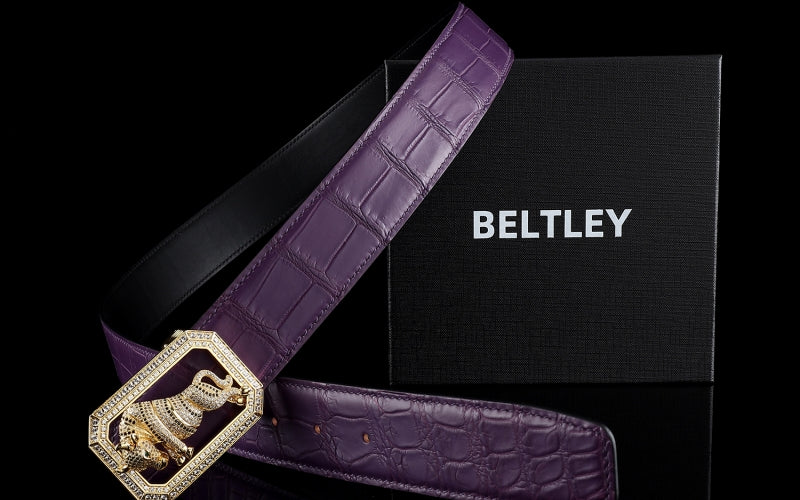
At BELTLEY, we work exclusively with Niloticus hides sourced from CITES-compliant farms, and we hand-finish each belt in small batches in our workshop. That sourcing-and-craft model is how we deliver designer-tier crocodile belts at $118–$289 — without the Brand Tax that pushes Porosus into five-figure territory at heritage houses. Our 10-year warranty covers structural defects on every piece. If you're choosing your first crocodile belt, start with a black Nile crocodile belt — it's the most versatile, most photographed, and most likely to become the belt you reach for on the days that matter.
Browse the BELTLEY Crocodile Belt Collection →
Frequently Asked Questions
Q: Is Porosus the same as saltwater crocodile?
Yes. Porosus is the species name for Crocodylus porosus, the saltwater (or estuarine) crocodile. It's the largest living reptile species and produces the most expensive crocodile leather in the world.
Q: Is Niloticus crocodile the same as Nile crocodile?
Yes. Niloticus refers to Crocodylus niloticus, the Nile crocodile, native to sub-Saharan Africa. Most Niloticus leather sold today comes from regulated farms in Zimbabwe, Kenya, and South Africa.
Q: How can I tell Porosus from Niloticus on a belt I already own?
Check scale size and pore presence. Porosus has small (4–6mm), square scales with a tiny pinpoint pore in each. Niloticus has larger (6–10mm), rectangular scales with no pore. On a Hermès piece, look at the stamp: caret ^ is Porosus, two dots •• are Niloticus.
Q: Is alligator leather different from both Porosus and Niloticus?
Yes. American alligator (Alligator mississippiensis) is a separate species with no scale pore, more rounded scale corners, and slightly softer hide character. Hermès marks alligator with an underscore _. See our full alligator vs crocodile belts guide.
Q: Which luxury brands use Porosus crocodile?
Hermès, Brioni, Stefano Ricci, and Berluti use Porosus regularly. Hermès farms its own Porosus supply in Australia, while several smaller European houses source through tanneries in Singapore and France.
Q: Does Porosus or Niloticus last longer?
Both deliver 15–25 years of daily wear with proper care. Durability depends far more on tanning quality, edge finishing, and storage than on species. A well-tanned Niloticus belt will outlast a poorly tanned Porosus one. See our crocodile leather belt durability guide.
Q: Are Porosus belts a good investment?
Vintage Hermès Porosus pieces hold value well on the secondary market. Buying new Porosus purely as an investment is risky — luxury exotic markets are cyclical. Buy a Porosus belt because you love how it looks, not because you expect to flip it.
By the BELTLEY artisan team — handcrafting exotic leather belts since 1999. Last updated: May 10, 2026.
%20%E2%80%94%20small,%20tight,%20symmetrical%20scales%20with%20a%20visible%20pore.%20Most%20prestigious,%20most%20expensive.%0A%0ANiloticus%C2%A0(Nile%20crocodile,%C2%A0Crocodylus%20nilot...)