Crocodile Leather Belt Price: What You'll Actually Pay in 2026
You've seen crocodile leather belts priced at $90 on Amazon and $3,500 at a luxury boutique. That's a 3,800% difference for what appears to be the same product. So what does a crocodile leather belt actually cost — and more importantly, what should it cost?
The answer depends on the species of crocodile, the cut of the hide, the tanning method, the hardware, and whether you're paying for craftsmanship or a logo. T
his guide breaks down every factor that affects the crocodile leather belt price so you can buy with confidence and avoid overpaying.

What Should You Pay? Start Here
The $90-to-$3,500 spread makes sense once you know which buyer you are:
| Your situation | What to know |
|---|---|
| You found "crocodile" under $100 | Almost certainly embossed cowhide — a genuine hide plus CITES paperwork can't exist at that price. Check for pores and irregular scales before paying anything |
| You want genuine croc at a fair price | $118–$500 from a DTC maker — real hide, real craftsmanship, no boutique rent baked in. BELTLEY's genuine crocodile belts run $118–$289 |
| You're eyeing a $1,500+ designer belt | The hide inside is the same tier — the rest is Brand Tax. Read the markup section below |
| You want proof before buying | Ask for proof of legal sourcing and look for visible scale pores — both are non-negotiable for genuine croc |
BELTLEY's crocodile & alligator belts sit in the fair-price tier by design. Here's the full cost anatomy:
The Real Price Range of Crocodile Leather Belts
The crocodile belt cost spans a wide spectrum. Here's what the market looks like in 2026:
| Category | Price Range | What You Get |
|---|---|---|
| Embossed / Faux Crocodile | $25 – $80 | Cowhide stamped with a crocodile pattern. Not real exotic leather. |
| Caiman Crocodile | $80 – $200 | Genuine reptile skin, but a smaller, more affordable species. Stiffer feel. |
| Genuine Crocodile / Alligator (DTC) | $98 – $300 | Real crocodile or alligator leather, sold direct-to-consumer without retail markup. |
| Genuine Crocodile (Retail Brands) | $300 – $700 | Same quality leather, but with retail distribution costs baked in. |
| Luxury Designer Brands | $700 – $3,500+ | Premium hides with significant brand markup. Hermès has sold diamond-encrusted crocodile belts exceeding $500,000. |
The sweet spot for genuine quality without brand inflation sits between $98 and $300 — especially from brands that sell directly to customers and cut out the middlemen.
At BELTLEY, our crocodile belts range from $118 to $289, which reflects the actual cost of premium materials and expert craftsmanship without the Brand Tax that inflates prices at department stores and designer boutiques.

Why Crocodile Leather Belt Prices Vary So Much
A $90 belt and a $900 belt can both carry the label "crocodile." Understanding why requires looking at five key variables.
1. Species of Crocodilian
Not all crocodile leather is created equal. The species determines the texture, flexibility, scale pattern, and ultimately the price of a crocodile belt. We'll cover this in detail in the next section.
2. Cut of the Hide
Two primary cuts dominate the belt market:
- Belly cut: Smooth, supple scales with a refined appearance. This is the premium cut, offering the softest feel and most elegant look. It costs more because the usable belly area of each hide is limited.
- Hornback cut: Features the raised, ridged scales from the animal's back. More textured and rugged-looking. Generally less expensive than belly cuts, though Australian saltwater hornback commands high prices due to its dramatic appearance.
3. Tanning Quality
Raw crocodile hides cost between $9 and $40 per centimeter of belly width. For a standard 35 cm hide, that's $315 to $1,400 just for the raw material — before any tanning begins.
The tanning process itself can take two to four weeks and involves multiple steps: soaking, descaling, degreasing, chrome or vegetable tanning, dyeing, and finishing. Only a handful of specialized tanneries worldwide can process crocodile leather to a high standard. This scarcity drives costs up further.
4. Hardware and Construction
A belt isn't just leather. The buckle, stitching, edge finishing, and liner all contribute to the final crocodile leather belt price:
- stainless steel buckles resist corrosion and maintain their finish for years
- Brass buckles develop a rich patina over time
- Hand-stitching outlasts machine stitching but requires skilled labor
- Full-grain leather liners add structure and comfort
Cheap belts cut corners here — flimsy zinc-alloy buckles, bonded leather backing, and glued (not stitched) construction.
5. Brand Markup and Distribution
This is the biggest variable. A crocodile belt that costs $120 to produce might retail for $150 from a DTC brand or $800 from a luxury label. The leather is comparable. The difference is rent, wholesale margins, advertising budgets, and the "prestige premium."

Crocodile Species and How They Affect Price
The term "crocodile belt" covers several distinct species, each with its own characteristics and price bracket.
Saltwater Crocodile (Crocodylus porosus)
- Origin: Australia, Southeast Asia
- Characteristics: Large, symmetrical belly scales. Highly prized for its uniform pattern.
- Price impact: Premium pricing. Raw hides from Australian farms are among the most expensive in the world.
- Best for: Dress belts and formal accessories where a clean, refined look matters.
Nile Crocodile (Crocodylus niloticus)
- Origin: Africa (Zimbabwe, South Africa, Zambia)
- Characteristics: Slightly smaller scales than saltwater, excellent durability. Well-regulated farming industry.
- Price impact: Mid-to-high range. More accessible than saltwater but still a premium hide.
- Best for: Versatile belts that work for both business and casual wear.
American Alligator (Alligator mississippiensis)
- Origin: United States (Louisiana, Florida, Texas)
- Characteristics: Softer, more pliable than crocodile. Slightly more irregular scale patterns. Contains a distinctive umbilical scar on belly cuts.
- Price impact: Often the most expensive due to limited supply, strict U.S. regulations, and high demand from luxury brands. Alligator hides are generally 20-30% more costly than equivalent crocodile hides.
- Best for: Luxury designer belts and high-end accessories.
Caiman (Caiman crocodilus / Caiman latirostris)
- Origin: Central and South America
- Characteristics: Smaller animal, bonier scales with calcium deposits that make the leather stiffer. Less supple than true crocodile or alligator.
- Price impact: The most affordable genuine crocodilian leather. Significantly cheaper than the species above.
- Best for: Entry-level exotic belts. A good starting point if you want genuine reptile leather on a budget, though the stiffness and durability don't match higher-grade species.
Key takeaway: If you see a "genuine crocodile belt" priced under $100, it's almost certainly caiman. That's not necessarily bad — just know what you're getting.
The Hidden Costs Behind Every Crocodile Belt
Understanding why genuine crocodile commands premium pricing requires looking at the supply chain from farm to finished belt.
Farming and Sourcing
Crocodile farming is a specialized, regulated industry. Animals require 2-4 years of growth before their hides are ready for harvest. During that time, they need controlled environments, specific diets, and veterinary care. CITES (Convention on International Trade in Endangered Species) regulations govern every step, adding compliance costs.
Tanning: An Art and a Science
Only a small number of tanneries worldwide — concentrated in Singapore, Italy, France, and the United States — have the expertise to tan crocodile hides properly. The process involves:
- Soaking and rehydration (1-2 days)
- Descaling and liming to remove keratin
- Degreasing — crocodile hides contain more natural oils than cowhide
- Chrome tanning or vegetable tanning (vegetable tanning takes longer but produces a richer, more natural finish)
- Dyeing — penetrating color into the dense scale structure
- Glazing and finishing — creating the final sheen and hand-feel
This entire process takes 2-4 weeks per batch and requires specialized equipment and chemicals. A single mistake can ruin an entire hide worth hundreds of dollars.
Hand Cutting and Assembly
Unlike cowhide, crocodile leather cannot be die-cut by machine. Every piece must be cut by hand to work around natural imperfections, scars, and variations in the scale pattern. A skilled cutter might spend hours on a single belt, matching scale alignment and ensuring symmetrical appearance.
At BELTLEY, our artisans hand-select each hide and match the scale pattern to the belt width, ensuring every exotic leather belt has a cohesive, intentional look — not a random strip chopped from whatever section was convenient.

Luxury Brand Markup vs. DTC Pricing
Here's where the crocodile leather belt price conversation gets interesting. Let's trace the journey of a belt through two different business models.
Traditional Luxury Retail Model
| Cost Component | Amount |
|---|---|
| Raw hide + tanning | $80 – $200 |
| Hardware (buckle, keeper) | $15 – $40 |
| Labor (cutting, stitching, finishing) | $30 – $60 |
| Total production cost | $125 – $300 |
| Wholesale markup (2-2.5x) | $250 – $750 |
| Retail markup (2-2.5x) | $500 – $1,875 |
| Final retail price | $500 – $1,875+ |
That's two layers of markup before the belt reaches you. Add luxury brand positioning, flagship store rents, and celebrity endorsements, and prices climb even higher.
Direct-to-Consumer Model
| Cost Component | Amount |
|---|---|
| Raw hide + tanning | $80 – $200 |
| Hardware (buckle, keeper) | $15 – $40 |
| Labor (cutting, stitching, finishing) | $30 – $60 |
| Total production cost | $125 – $300 |
| DTC margin (1.2-1.5x) | $150 – $450 |
| Final DTC price | $98 – $300 |
Same leather. Same craftsmanship. 60-80% less than the traditional retail price.
This is exactly the model BELTLEY operates. By selling directly through our website, we eliminate wholesale and retail markups entirely. Our men's belts and women's belts reach you at prices that reflect genuine material and labor costs — not brand ego.
How to Spot a Genuine Crocodile Belt Worth Its Price
Before spending $100 or more on a crocodile belt, verify you're getting the real thing. Here's what to look for:
Scale Pattern
Genuine: Irregular, asymmetrical scales that vary in size across the belt. No two sections look identical. You'll see natural transitions from larger belly scales to smaller side scales.
Fake (embossed): Perfectly uniform, repetitive patterns. The "scales" are stamped into cowhide with a machine press, creating an unnaturally consistent look.
Pore Test
Look at the center of individual scales under good light. Genuine crocodile leather has a tiny pore in each scale — a follicle mark from the original skin structure. Embossed leather will be completely smooth within each stamped "scale."
Touch and Flex
Real crocodile leather feels surprisingly soft and supple. When you bend it, the creases should be subtle and recover quickly. Fake crocodile-embossed leather tends to feel stiffer and more plastic-like, with creases that remain visible after bending.
Umbilical Scar
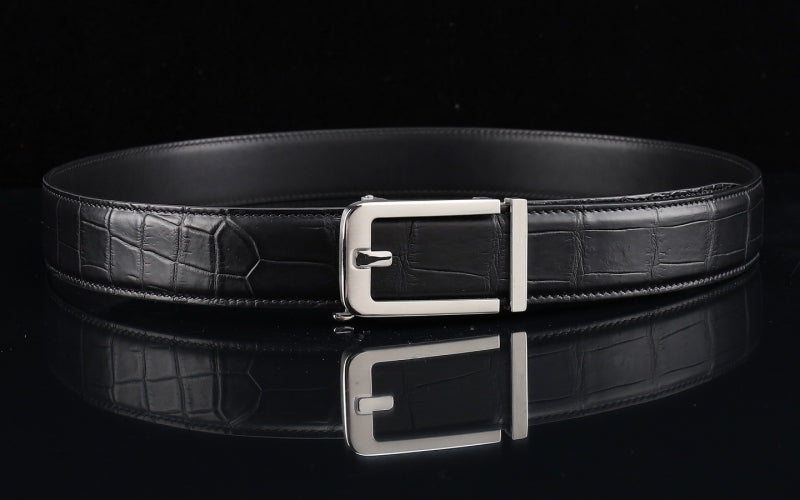
On belly-cut belts, look for the umbilical scar — a cluster of small, tightly packed, irregular scales where the animal's yolk sac was attached. This feature is impossible to replicate on embossed leather and is your most reliable authentication marker.
Edge and Backing
Check the belt's edge and interior. A quality crocodile belt should have:
- Clean, painted or burnished edges (not raw or fraying)
- A full-grain leather liner (not bonded leather or fabric)
- Even, tight stitching (hand-stitching is ideal)
Hardware Quality
The buckle tells you a lot. Genuine crocodile belts from reputable makers pair with solid metal buckles — stainless steel, brass, or sterling silver. If the buckle feels lightweight, plasticky, or has visible flaking, the belt's leather quality is likely questionable too.
What Makes a Crocodile Belt Worth the Investment
A genuine crocodile leather belt isn't just an accessory — it's a long-term investment. Here's why the price is justified when you buy from the right source.
Durability That Outlasts Fashion Trends
Crocodile leather is one of the most durable natural materials available. The dense fiber structure resists tearing, stretching, and surface damage far better than standard cowhide. A well-maintained crocodile belt can last 15-20 years or more — making the cost-per-wear remarkably low.
For comparison: a $40 fast-fashion belt that lasts 18 months costs you about $27 per year. A $150 crocodile belt that lasts 15 years costs you $10 per year.
Timeless Style
Crocodile leather never goes out of fashion. The same belt works with a suit in a boardroom, dark jeans at a dinner, or chinos on a weekend. It's one of the few accessories that genuinely transcends dress codes.
Aging Gracefully
Unlike synthetic materials that degrade, genuine crocodile leather develops a richer patina over time. The scales become more pronounced, the color deepens, and the leather softens further with wear. Your belt looks better at year five than it did on day one.
Warranty and Confidence
Look for belts backed by meaningful warranties. At BELTLEY, every belt comes with a 10-year warranty covering materials and construction defects, plus free worldwide shipping and a 30-day hassle-free return policy. That's how confident we are in the craftsmanship.
To keep your crocodile belt in peak condition, follow our leather care guide — proper conditioning and storage make the difference between a belt that lasts a decade and one that dries out in a few years.
Where to Buy a Crocodile Leather Belt at a Fair Price
Based on everything we've covered, here's a framework for smart buying:
Set your budget realistically. For genuine crocodile or alligator leather (not caiman, not embossed), expect to spend $98 to $300 from a DTC brand or $300 to $700+ from traditional retailers.
Prioritize DTC brands. Companies that sell directly eliminate the double markup of wholesale and retail. You get the same quality leather and craftsmanship at a fraction of the price.
Check the details before you buy:
- What species of crocodilian is used?
- Is the hide belly-cut or hornback?
- What material is the buckle (stainless steel, brass, zinc alloy)?
- Is there a warranty?
- Does the brand offer returns?
Avoid "too good to be true" deals. A "genuine crocodile belt" for $30 on a marketplace site is either caiman, embossed cowhide, or outright fake. The raw hide alone costs more than that.
Consider the full value proposition. Factor in warranty coverage, free shipping, return policies, and customer service. A slightly higher upfront price from a brand that stands behind its product is better than saving $20 on a belt with no recourse if something goes wrong.
Browse BELTLEY's full collection of exotic leather belts to see what genuine crocodile craftsmanship looks like at fair, transparent prices — backed by our 10-year warranty and 100% satisfaction guarantee.
The Bottom Line
The crocodile leather belt price you pay should reflect three things: the quality of the leather, the skill of the craftsman, and the integrity of the brand. It should not reflect a celebrity endorsement budget or a Fifth Avenue lease.
Genuine crocodile belts from reputable DTC brands cost between $98 and $300. That's a fair price for an accessory handcrafted from one of the world's most luxurious materials — one that will outlast dozens of cheaper alternatives and look better with every year of wear.
Key Takeaways:
- Genuine crocodile belt prices range from $98 (DTC) to $3,500+ (luxury brands) — the leather quality can be identical
- Species matters: saltwater crocodile and American alligator command the highest prices; caiman is the most affordable
- The tanning process alone takes 2-4 weeks and requires specialized facilities, justifying premium pricing
- DTC brands eliminate 60-80% of traditional retail markup
- Always verify authenticity through scale pattern, pore test, and umbilical scar before buying
- A genuine crocodile belt is a 15-20 year investment, making the cost-per-wear extremely competitive
Ready to own a handcrafted crocodile belt at a price that respects both the material and your wallet? Explore BELTLEY's crocodile belt collection — every piece is made by master artisans, backed by a 10-year warranty, and shipped worldwide for free
Frequently Asked Questions
Q: How much does a real crocodile leather belt cost?
A genuine crocodile leather belt typically costs between $98 and $700, depending on the species, cut, and brand. DTC brands like BELTLEY offer genuine crocodile belts starting at $118 by eliminating retail middlemen, while luxury designer labels charge $700 to $3,500+ for comparable leather quality with added brand premium.
Q: Why are crocodile belts so expensive?
Crocodile belts are expensive because of the scarcity of quality hides, the complex tanning process (which takes 2-4 weeks), and the requirement for hand-cutting and hand-stitching. Raw crocodile hides cost $9-$40 per centimeter of belly width, and only a handful of specialized tanneries worldwide can process them to a high standard.
Q: Is a crocodile belt worth the money?
Yes, if you buy from a reputable source. Genuine crocodile leather is one of the most durable natural materials, lasting 15-20 years with proper care. At $150 for a belt that lasts 15 years, your cost-per-wear is about $10 per year — far less than replacing cheap belts every 1-2 years. Check our leather care guide to maximize your belt's lifespan.
Q: What is the difference between crocodile and alligator belt prices?
American alligator hides are generally 20-30% more expensive than crocodile hides due to stricter U.S. farming regulations and limited supply. Alligator leather is also softer and more supple. However, both produce exceptional belts, and the price difference narrows significantly with DTC brands that source efficiently.
Q: How can I tell if a crocodile belt is real or fake?
Check for three things: irregular scale patterns (fake embossed leather has perfectly uniform patterns), tiny pores in the center of each scale (embossed leather is smooth), and the umbilical scar on belly-cut belts — a cluster of small, tightly packed scales that's impossible to replicate. Also, real crocodile feels soft and supple, while fakes tend to feel stiff.
Q: What is the cheapest type of genuine crocodile belt?
Caiman is the most affordable genuine crocodilian leather, with belts available from $80 to $200. Caiman has bonier scales with calcium deposits, making it stiffer than true crocodile or alligator. It's a solid entry point for exotic leather, though it lacks the suppleness and longevity of higher-grade species.
Q: How long does a crocodile leather belt last?
With proper care, a genuine crocodile leather belt can last 15-20 years or more. The dense fiber structure of crocodile skin resists tearing and stretching better than cowhide. Regular conditioning, keeping the belt away from excessive moisture, and proper storage will maximize its lifespan. BELTLEY backs every belt with a 10-year warranty for added peace of mind.
Q: Are crocodile belts cheaper online than in stores?
Generally, yes. Online DTC brands bypass the wholesale-to-retail markup chain that adds 200-400% to in-store prices. A crocodile belt that retails for $600 in a department store might cost $150-$250 from a direct-to-consumer brand online — with the same or better leather quality and craftsmanship.