How to Tell If a Crocodile Belt Is Genuine: 6 Definitive Tests
TL;DR:
- Genuine crocodile leather has irregular scale patterns, biological ISO sensory pores, and a natural grain on the flesh side — embossed fakes have none of these
- The umbilical scar, bend test, and buckle weight are fast secondary checks that take under 60 seconds
- A seller who can provide CITES supply chain documentation is the strongest possible proof of authenticity
The crocodile leather belt market has a fake problem. Modern embossing technology can stamp convincing scale patterns into cowhide at a fraction of the cost of genuine reptile skin — and plenty of sellers rely on buyers not knowing the difference. AMTAN (American Tanning & Leather Association) estimates that embossed and synthetic "crocodile pattern" leather vastly outnumbers genuine reptile leather in the global market, and the gap keeps widening.
The six tests in this guide are what professional leather buyers and luxury goods authenticators actually use. Some take seconds. Some require closer inspection. Together, they give you a reliable answer on any belt you're evaluating — whether you're shopping in a store, buying online, or verifying something you already own. Browse BELTLEY's handcrafted crocodile and alligator belts to see how genuine exotic leather looks and feels from a brand that sources transparently.
Why Authenticating a Crocodile Belt Matters
A genuine Grade 1 Nile crocodile leather belt costs $150–$500+. A convincing embossed fake costs the seller $15–$40 to produce. That margin is the entire reason the problem exists — and why authentication knowledge is worth having before you spend real money.

Beyond price, there's a conservation and legal dimension. Genuine crocodile leather from legitimate sources is CITES-regulated and farm-traceable. Fakes exist outside this system entirely, and some products sold as "crocodile" are actually caiman — a related but legally distinct and lower-grade reptile that's often mislabeled. Leather Naturally's reptile leather facts and myths guide documents how widespread mislabeling is in the exotic leather market and why the distinction matters for both buyers and conservation outcomes.
Knowing how to tell if a crocodile belt is genuine protects your wallet, ensures you're getting what you paid for, and — indirectly — supports the regulated farming systems that fund crocodile habitat conservation.
Does Genuine Crocodile Leather Have Visible Pores?
Yes — and this is the most reliable single test. Genuine crocodile leather has tiny biological pores called Integumentary Sensory Organs (ISOs) on each scale. These appear as small, irregular openings — one to three per scale, placed asymmetrically. Embossed leather either has no pores at all, or shows uniform decorative dots pressed into the surface by the stamping mold.
Use your smartphone camera on maximum zoom, or a 10x loupe if you have one. On genuine crocodile leather, the pores are visible as actual openings into the leather surface — not marks on top of it. They vary in size and placement from scale to scale, because they were formed biologically, not mechanically.
A peer-reviewed study published in PMC (NIH) on Nile crocodile leather quality confirms that ISO pore presence and distribution is one of the primary grading criteria used by professional tanneries — the same logic used here. If the pores look too uniform, too perfectly circular, or are absent entirely, the leather is not genuine crocodile.
How Do Scale Patterns Reveal a Fake?
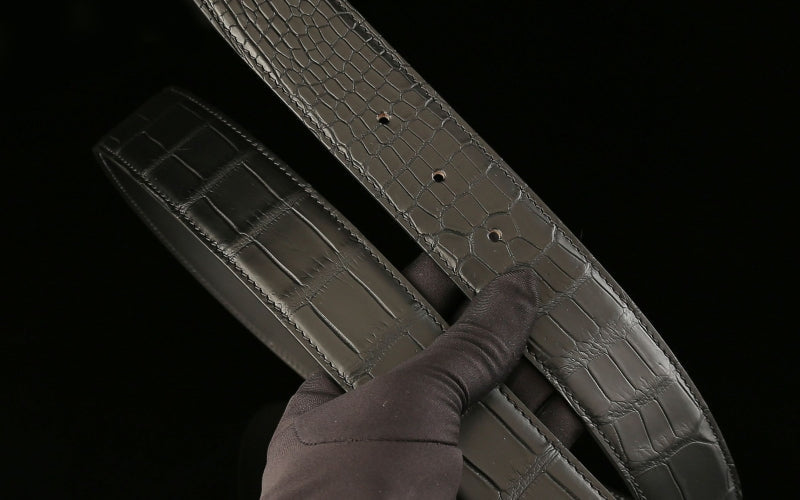
Genuine crocodile leather never repeats. The scale pattern varies continuously across the hide because each scale grew as an individual biological plate. On embossed leather, the pattern was stamped from a single mold — so it repeats at regular intervals. Hold the belt at arm's length under good light and look for a pattern cluster that reappears every few inches. If you find one, it's fake.

The scale size variation also tells a story. On belly-cut crocodile leather, scales are largest in the center of the belly panel and taper toward the edges where they meet the side leather. No single section of a genuine belt has perfectly uniform scale size from edge to edge. Panam Leathers' grading guide for crocodile skins explains exactly how scale consistency affects Grade 1 vs. Grade 2 classification — useful context for understanding what natural variation looks like in practice.
For a detailed breakdown of how scale patterns differ between crocodile, alligator, and caiman, see our guide on alligator vs. crocodile belts.
What Is the Umbilical Scar and Does My Belt Have One?
The umbilical scar is a small, distinctive patch on genuine alligator and crocodile belly leather where the umbilical cord attached before birth. It appears as 2–4 scales with a slightly different texture or faint discoloration compared to surrounding scales, typically near the center of the belly panel. Its presence is near-certain proof of authentic belly-cut leather — no embossing process can replicate it.
Not every belt will show the umbilical scar — its visibility depends on exactly where the panel was cut from the hide. Smaller belts or those cut from the edge of the belly may not include it. But when it is present, it's unambiguous: a biological feature that varied from animal to animal and cannot be faked systematically.
Acadian Leathers' guide to identifying alligator and crocodile leather describes the umbilical scar's appearance in detail and confirms its status as one of the most trusted authenticity markers used by experienced exotic leather buyers.
The Bend, Feel, and Flesh-Side Tests
Three quick physical checks that don't require any tools:

The bend test: Gently fold a section of the belt (away from the buckle, mid-strap) and observe how it creases. Genuine crocodile belly leather creases smoothly along natural flex lines between scales — the individual scales flex independently. Embossed leather creases stiffly across the stamped pattern, often showing cracking or surface stress at the fold lines. Taza Leather's authentic alligator belt identification guide confirms that the bend test is one of the most reliable fast-authentication methods for exotic leather.
The feel test: Run your thumbnail lightly across several scales. On genuine crocodile leather, you feel the edge of each individual scale — a slight, natural resistance as your nail moves from one plate to the next. On embossed leather, the surface feels smoother and flatter because the "scales" are surface impressions in a single continuous hide.
The flesh side: Flip the belt over. Genuine crocodile leather has a natural, slightly uneven grain on the back — visible fiber structure, not perfectly smooth. Embossed products typically have a uniform, machine-smooth back surface or a bonded synthetic lining.
How Does Hardware Quality Signal Authenticity?
Genuine crocodile leather belts are paired with solid metal buckles — brass or stainless steel — that feel noticeably heavy for their size. Counterfeit crocodile belts consistently use zinc alloy or hollow die-cast buckles that feel light and look slightly dull. The buckle weight test takes three seconds and flags most fakes immediately.

Pick up the belt and cup just the buckle in your palm. Solid brass or stainless steel has real density — it should feel substantial. Zinc alloy fakes feel hollow and light. Look at the buckle face: genuine hardware has crisp, clean edges, even plating with no visible mold flashing or inconsistent finish.
The stitching at the buckle attachment is equally telling. Genuine exotic leather goods use tight, evenly tensioned waxed thread or heavy-duty stitching that lies flat against the leather. On fakes, stitching is often looser, misaligned, or replaced entirely by contact adhesive. BG Leather Bags' crocodile belt identification guide identifies hardware quality and stitching tension as two of the three most reliable counterfeit markers in exotic leather belts.
At BELTLEY, every crocodile belt uses a stainless steel buckle — the same grade used in surgical instruments — and is backed by a 10-year warranty on materials and construction. That level of guarantee isn't possible with counterfeit materials.
Is Caiman Being Sold as Crocodile?
Yes — frequently. Caiman (Caiman crocodilus) is a South American reptile related to but legally distinct from true crocodiles. Its leather is lower grade, stiffer, and contains calcium-reinforced bony plates (osteoderms) embedded in the scales. It is regularly mislabeled and sold as "crocodile leather" in the market. Feeling for those hard, embedded nodules is how you catch it.
Run your fingers firmly across the scales. On genuine Nile or saltwater crocodile leather, the scales feel smooth and supple. On caiman leather, you'll feel hard, rigid nodules embedded within or beneath the scale surface — these are the calcium rivets, remnants of the bony osteoderm structure. The leather also flexes more stiffly overall.
Price is a secondary signal: caiman leather retails significantly below Nile crocodile or alligator, so a belt priced at $60–$120 and marketed as "genuine crocodile" is almost certainly caiman at best, or embossed cowhide at worst. Our guide on identifying the four main crocodilian leathers and the detailed breakdown in crocodile leather types for belts cover this mislabeling problem fully.
The CITES Paper Trail: The Ultimate Proof
No visual test is as definitive as documentation. Every legal Nile crocodile or alligator hide leaving a licensed farm carries a numbered CITES tag — a non-reusable identifier attached to the raw skin and traceable through the supply chain to the farm of origin. A seller who can provide this documentation has nothing to hide.

Bangkok Bootery's guide to CITES certificates for exotic leather explains exactly what the certificate contains, how the permit number system works, and what to ask a seller for. At the import level, the U.S. Fish & Wildlife Service's CITES export programs govern all legitimate exotic leather entering the country — understanding this framework tells you what "legitimate" actually means in practice.
A reputable brand selling genuine crocodile leather belts should be able to trace their hide sourcing to a CITES-licensed tannery. If a seller cannot or will not provide this information, treat that as a significant red flag. For a full breakdown of what's legal and what isn't in the US market, see our guide on whether alligator and crocodile belts are legal in the USA.
It's also worth noting that research published in DNA for Species Identification in Leather (ResearchGate) confirms that molecular authentication via DNA is now used by regulatory agencies and high-stakes buyers to verify species claims in luxury goods — a reminder that the most serious buyers don't rely on visual checks alone.
The Bottom Line
Knowing how to tell if a crocodile belt is genuine comes down to stacking tests. No single check is foolproof in isolation — but running the ISO pore test, scale asymmetry check, bend test, and hardware weight check together takes less than two minutes and catches virtually every fake. Add the CITES documentation request for online purchases, and you've covered every angle.
The counterintuitive truth: a genuine crocodile belt isn't harder to find than a fake — it's just harder to find at a fair price. Most of the premium you pay at traditional luxury houses goes to Brand Tax, not better leather. At BELTLEY, our Nile crocodile belts are handcrafted from legally sourced hides, fitted with stainless steel hardware, and priced without the markup. Check our crocodile leather belt price guide to understand what genuine should cost — then explore the full BELTLEY crocodile and alligator belt collection and buy with confidence.
Frequently Asked Questions
Q: What is the single fastest test to tell if a crocodile belt is genuine?
The ISO pore test. Use your smartphone camera at maximum zoom or a 10x loupe to look at the individual scales. Genuine crocodile leather has tiny, asymmetrical biological pores on each scale — actual openings into the leather surface. Embossed fakes either have no pores or show perfectly uniform dots pressed into the surface.
Q: Can I tell a genuine crocodile belt from a fake just by the price?
Price is a useful filter but not definitive. A genuine Nile crocodile or alligator belt starts around $150 and typically runs $200–$500+ for quality construction. Anything marketed as "genuine crocodile" under $100 is almost certainly embossed cowhide or caiman. However, high price alone doesn't guarantee authenticity — some sellers charge premium prices for mislabeled product.
Q: What is the difference between caiman and genuine crocodile leather?
Caiman is a South American reptile whose leather contains hard calcium-reinforced nodules embedded in the scales — you can feel them as rigid bumps when you press the surface firmly. True Nile crocodile and alligator leather is smooth, supple, and free of these embedded plates. Caiman is often mislabeled as crocodile and sold at inflated prices.
Q: Does a genuine crocodile belt always have an umbilical scar?
Not always. The umbilical scar is present on belly-cut leather, but whether it appears on a finished belt depends on the exact panel cut. Smaller belts or those cut from the edge of the belly panel may not include it. Its presence is a strong authenticity marker, but its absence doesn't confirm a fake — use it alongside the pore and scale tests.
Q: What should I ask a seller to prove a crocodile belt is genuine?
Ask for CITES supply chain documentation — traceability to a licensed tannery or farm of origin. A legitimate seller can point to their sourcing. Also ask what species the leather is (Nile crocodile, alligator, caiman) and whether it's belly or hornback cut. Sellers who can answer these questions clearly and specifically are far more trustworthy than those who respond with generic "genuine crocodile leather" claims.
Q: Is embossed crocodile leather the same as genuine crocodile leather?
No. Embossed leather is cowhide (or synthetic material) with a scale pattern mechanically stamped into the surface. It shares no material properties with genuine reptile leather — different structure, different durability profile, different aging behavior. The term "crocodile embossed" or "crocodile print" should always be disclosed clearly by sellers. "Genuine crocodile leather" means actual reptile hide.