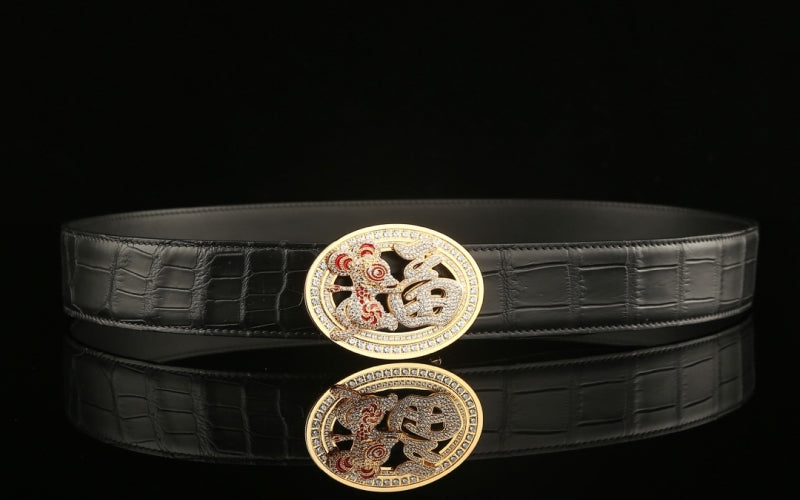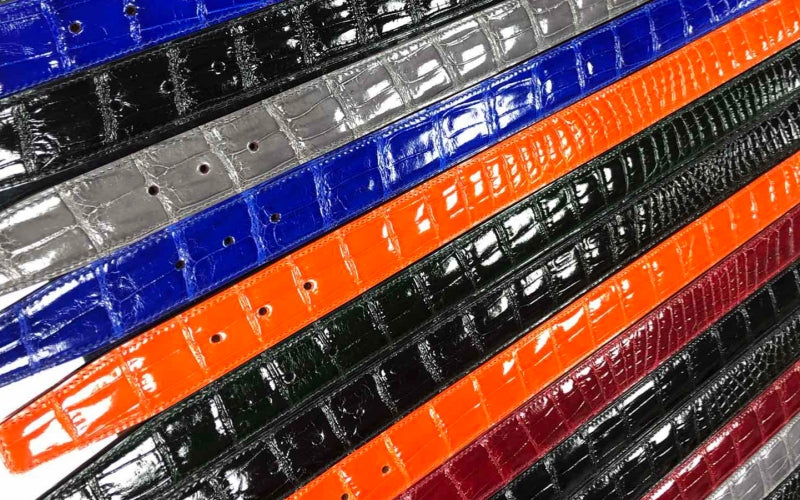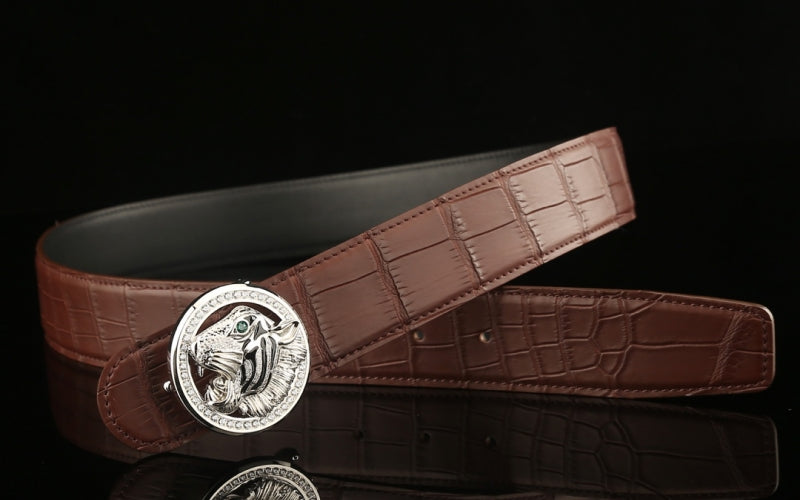
Crocodile Leather Belt Durability: How Long Does It Really Last?
TL;DR:
- A well-maintained crocodile leather belt lasts 20–25+ years — two to three times longer than premium full-grain cowhide.
- Durability comes from a dense, interlocking collagen fiber structure that resists tearing, abrasion, and deformation under pressure.
- With conditioning every 3–4 months and proper storage, crocodile leather essentially outlasts the trends that made you buy it.
A belt gets flexed, buckled, and worn against friction every single day. Most leather belts tap out after five to seven years. A crocodile leather belt barely shows its age at that point. Understanding why requires a look at what's actually happening at the material level — not just marketing language, but measurable structural advantages that translate directly into lifespan.
Whether you're considering your first exotic leather belt or want to know whether the price tag is justified, this guide gives you the data and the maintenance protocol to make an informed call.
How Long Does a Crocodile Leather Belt Last?
A properly maintained crocodile leather belt lasts between 20 and 25 years — and often longer with rotation and regular conditioning. This puts it well ahead of full-grain cowhide (10–15 years) and far beyond bonded or genuine leather, which rarely survives past five years of daily wear.

The lifespan varies based on three variables: how often it's worn, how it's stored, and whether it's conditioned regularly. Belts worn daily and never treated will dry out and crack. Belts that are rotated across a small collection, conditioned seasonally, and stored flat or loosely rolled can remain structurally sound for decades. At BELTLEY, our crocodile and alligator belts are backed by a 10-year warranty on materials and construction — a commitment that reflects what we see from properly cared-for hides in the field.
For a deeper look at the lifespan comparison across materials, see our guide on what is the most durable leather belt.
What Makes Crocodile Leather So Strong? The Biology Behind the Hide
Crocodile leather's durability isn't accidental — it's structural. The hide is composed of densely packed collagen fibers arranged in a three-dimensional interlocking weave beneath each scale. A peer-reviewed study published in the Journal of Bionic Engineering via Springer Nature confirmed that crocodilian collagen fibers display the standard 67 nm D-periodicity of Type I collagen — the same high-strength fibril configuration found in tendons. The fibers run in multiple directions simultaneously, meaning the material resists tearing from any angle, not just one.

The tensile strength of finished alligator leather sits around 2,500 PSI — the force required to rupture the hide. That's roughly double the tensile strength of standard top-grain cowhide. The scale architecture compounds this: each scale overlaps its neighbors and sits over a dense collagen pad that distributes impact and abrasion across a wide area rather than concentrating stress at a single point. Biology Insights' breakdown of crocodile skin mechanics describes this arrangement as one of the most abrasion-resistant structures found in any animal hide.
This is why crocodile leather remains the preferred material for objects that need to survive decades of mechanical stress — belts, watch straps, briefcase handles, and wallet edges all benefit from the same structural advantage.
Crocodile Leather Belt vs. Full-Grain Cowhide: Which Lasts Longer?
Crocodile leather outlasts full-grain cowhide by a significant margin — typically two to three times longer under equivalent conditions. Full-grain cowhide is the most durable standard leather and lasts 10–15 years. Crocodile leather, with its denser fiber structure and natural scale protection, regularly reaches 20–25 years and beyond.
This doesn't make full-grain cowhide a poor choice — it remains excellent value and develops a beautiful patina over time. But the comparison is meaningful for buyers evaluating cost-per-year. A crocodile belt priced at $200–$299 that lasts 25 years costs roughly $8–$12 per year. A full-grain cowhide belt at $80 that lasts 12 years costs around $6–$7 per year. The gap narrows considerably when you account for the crocodile belt's superior abrasion resistance, the fact it won't need replacing as often, and its ability to hold visual quality far longer.
For a detailed side-by-side, read our guide on alligator vs. crocodile belts. If you're evaluating whether the price is worth it, are alligator or crocodile belts worth it walks through the long-term value case directly.
The 3 Factors That Determine How Long Your Belt Lasts
Crocodile leather's structural advantages only hold if the hide stays hydrated and isn't subjected to sustained heat or moisture. Here's what actually shortens lifespan:

1. Dehydration (the most common cause of cracking) Exotic leather loses moisture over time, especially in climate-controlled environments. Dry collagen fibers lose flexibility and begin to split at stress points — the buckle hole, the fold, and the tip. A PubMed-indexed study on collagen packing and leather stiffness found a direct correlation between moisture content and mechanical performance; well-hydrated leather is measurably more flexible and fatigue-resistant. Conditioning every 3–4 months with an exotic-specific conditioner (not a generic leather cream) prevents this entirely.
2. Buckle friction and stress concentration The area immediately behind the buckle bears the most repeated stress. A belt worn at the same hole every day develops micro-fatigue at that point. Rotating between two or three holes and using a quality buckle with a smooth prong (rather than a rough cast surface) reduces localized wear significantly.
3. Storage conditions Coiling a belt tightly and storing it in a humid closet accelerates both cracking and mold. Flat storage or a loose roll in a dry, ventilated space keeps the hide in neutral condition between wears.
For a full maintenance routine, our leather care guide covers exotic-specific conditioning in detail. And if you're already seeing early cracks, how to keep leather belts from cracking offers a step-by-step recovery protocol.
Does Crocodile Leather Crack Easily?
Crocodile leather does not crack easily under normal wear conditions — but it will crack if it becomes severely dehydrated. Unlike full-grain cowhide, which shows gradual surface wear before cracking, crocodile leather often appears visually intact until a stress point fails suddenly. The key difference is the scale joints: the unscaled areas between and beneath scales are the most vulnerable to dryness-induced cracking, not the scales themselves.

This means conditioning isn't just recommended — it's structurally necessary. The scales themselves are highly abrasion-resistant and won't scuff under normal use. The inter-scale tissue needs consistent moisture to stay flexible. Apply a dedicated exotic leather conditioner in a thin layer, let it absorb fully, and buff lightly. Avoid silicone-based products, which sit on the surface rather than penetrating the collagen matrix.
The Bottom Line
Crocodile leather belt durability comes down to biology: a multi-directional collagen fiber network and scale architecture that out-performs every common leather alternative in tensile strength and abrasion resistance. A 20–25 year lifespan isn't marketing copy — it's a structural reality, provided the hide stays conditioned and isn't subjected to sustained heat or moisture.
At BELTLEY, every crocodile belt is handcrafted in small batches by master artisans who work exclusively with full-scale exotic hides, paired with stainless steel buckles that won't corrode or pit over the same timeframe as the leather. We back each piece with a 10-year warranty on materials and construction because we know what properly sourced and crafted exotic leather is capable of.
If you're ready to invest in a belt that outlasts every fashion cycle, explore the full crocodile and alligator belt collection — with free worldwide shipping and a 30-day hassle-free return policy.
Frequently Asked Questions
Q: How long does a crocodile leather belt last?
A well-maintained crocodile leather belt lasts 20–25 years or more. That's roughly two to three times longer than premium full-grain cowhide under similar conditions. Regular conditioning (every 3–4 months) and proper storage are the two biggest factors in achieving that lifespan.
Q: Does crocodile leather crack over time?
Crocodile leather cracks when it becomes severely dehydrated — typically from infrequent conditioning, prolonged heat exposure, or dry storage conditions. The scales themselves are highly crack-resistant; the inter-scale tissue is where dryness-related failure occurs. Consistent conditioning prevents this almost entirely.
Q: Is crocodile leather stronger than regular leather?
Yes. Crocodile leather has a tensile strength of approximately 2,500 PSI, roughly double that of standard top-grain cowhide. The interlocking collagen fiber structure provides multi-directional resistance to tearing and abrasion that conventional hides can't replicate.
Q: How do you condition a crocodile leather belt?
Use an exotic-specific leather conditioner — not a generic leather cream or silicone spray. Apply a thin layer every 3–4 months, let it absorb for 15–20 minutes, then buff with a clean cloth. Avoid heat-drying and keep the belt away from direct sunlight during storage.
Q: Are crocodile leather belts worth the price?
At $150–$299, a quality crocodile belt costs roughly $8–$12 per year over its lifespan — comparable to a mid-range cowhide belt when measured over time. Add the superior material quality, distinctive visual texture, and handcrafted construction, and the cost-per-use case holds up well for buyers who prioritize durability and craftsmanship over logo-driven pricing.