Center-Cut vs Side-Cut Crocodile Belt: The Connoisseur's Difference
TL;DR:
- A center-cut crocodile belt runs the strap along the absolute centerline of the belly, where scales are largest, square, and most symmetrical. One hide produces one center-cut belt.
- A side-cut crocodile belt offsets the strap to one side of the belly, picking up smaller, less uniform scales. One hide produces 2–3 side-cut belts, lowering per-belt cost.
- The visual tell: center-cut shows perfectly symmetrical scale rows on both sides of an invisible spine. Side-cut shows asymmetric scale gradient.
- Hermès, Brioni, and top-tier houses use center-cut almost exclusively for premium belts. Most $300–$600 belts use side-cut.
- A center-cut belt typically costs 40–80% more than a side-cut belt from the same brand and same hide.
Quick Facts
- Center-cut belts per hide: 1
- Side-cut belts per hide: 2–3
- Center-cut price premium: 40–80%
- Hermès flagship cuts: Center-cut Porosus and Niloticus
- Visible profile section when worn: 6–8 inches
- Lifespan difference between cuts: Zero (both last 15–25 years)
The cut is the most invisible quality decision in a crocodile belt — and the one connoisseurs check first. Two belts can come from the same crocodile, share the same buckle, and use the same edge paint, yet one will sell for $400 and the other for $1,200. The reason isn't fraud. It's where the strap was cut from the hide. Center-cut versus side-cut is the difference between using the most expensive square inches of a crocodile or the second-best ones — and unless you know what to look for, you'd never spot it.
This guide covers exactly how to identify each cut, why luxury houses obsess over it, and when paying the center-cut premium is genuinely worth it. In our own workshop, the cut decision is the first call our cutters make on every hide — and the one most likely to determine whether the finished belt commands a $400 or $800 price tag.
Center or Side Cut: What Should You Order?
The connoisseur question, answered by buyer type:
| Your situation | Go with |
|---|---|
| Statement dress belt, scale symmetry matters | Center-cut — the mirror-image scale rows are what trained eyes notice first. |
| First croc belt, value-focused | Side-cut — same hide, same durability, meaningfully lower price. |
| Buying sight-unseen online | Look for straight-on product photos showing the center scale line — symmetry can't be faked in a clean photo. |
| Gift where the box gets opened publicly | Center-cut belly — the cut that photographs and impresses at arm's length. |
Both cuts, honestly labeled: BELTLEY's crocodile belts, $118–$289.
What Is a Center-Cut Crocodile Belt?
A center-cut crocodile belt has its strap cut directly along the centerline of the belly, where the scales are largest, most square, and most symmetrical. The center row of scales runs straight down the middle of the belt, with mirrored scale rows on either side. This is the most expensive cut because it uses the most prized real estate of the hide and yields only one belt per crocodile.

The center of a crocodile's belly is anatomically special. The scales at this midline are the largest the animal produces — sometimes called "tile scales" because of their square, slab-like geometry. They're also the most uniform: each scale on the left mirrors a scale of the same size on the right, creating the symmetrical pattern that defines premium crocodile leather. The center belly section commands roughly double the per-square-inch price of side belly leather in commercial tannery grading.
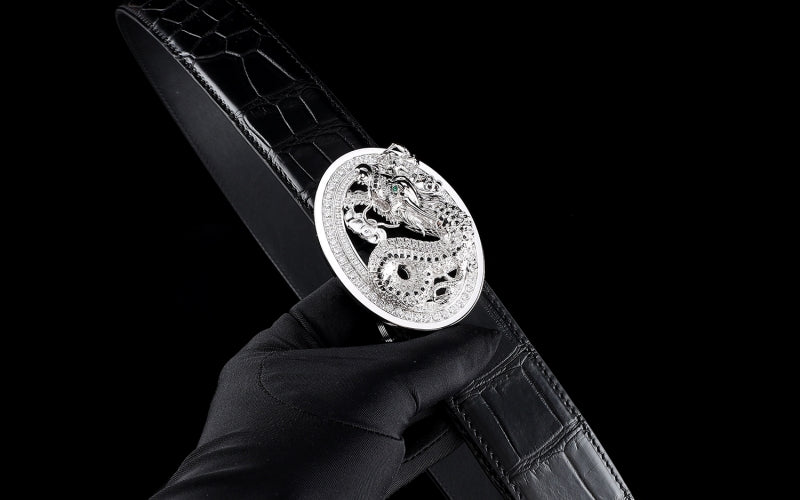
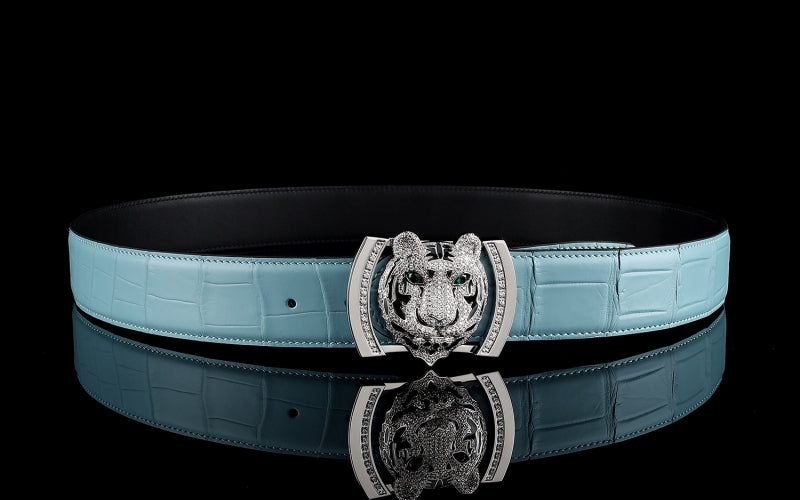
When you see a center-cut belt photographed, the symmetry is unmistakable. The pattern reads as a meditative grid that holds steady from buckle tip to belt tip. There's no visible scale gradient, no shrinking pattern, no asymmetry.
What Is a Side-Cut Crocodile Belt?
A side-cut crocodile belt has its strap cut offset from the centerline, taking leather from the side of the belly. The scales are smaller and less uniform than center-cut. The pattern shows a visible gradient — scales shrink toward one edge of the belt — because that edge of the strap is closer to the flank of the animal.
Side-cut isn't lower quality leather; it's lower-grade visual real estate. The hide is the same crocodile. The tanning is identical. Only the cutting position differs. By offsetting the cut, the manufacturer can produce 2–3 belts from a single hide instead of one — which is why side-cut belts dominate the $300–$600 price segment where one-belt-per-crocodile economics would push prices much higher.
The side-cut economics make exotic leather accessible to a much broader buyer base. Without it, a real one-piece crocodile belt would start at roughly $700 minimum. Our crocodile leather belt price guide covers this dynamic in detail.
How Do You Tell Center-Cut from Side-Cut on Sight?
Lay the belt flat and check three things: bilateral symmetry, scale-size consistency from edge to edge, and the position of the largest scales. Center-cut shows perfect mirror symmetry, uniform scale size across the belt's width, and the largest scales running down the middle. Side-cut shows asymmetric pattern, a visible scale-size gradient, and largest scales positioned to one side.

| Visual feature | Center-cut | Side-cut |
|---|---|---|
| Symmetry | Perfect bilateral mirror | Asymmetric, no clear mirror line |
| Scale-size consistency | Uniform across belt width | Larger one side, smaller the other |
| Largest scales | Centered down the middle | Offset toward one edge |
| Visible "spine" | Yes — straight line down middle | No clear spine |
| Pattern uniformity | Holds buckle to tip | May vary along length |
| Hide yield | 1 belt per hide | 2–3 belts per hide |
The simplest check most experienced buyers use: place a finger down the visual centerline of the belt and trace it from buckle to tip. On a center-cut, the finger follows a line where the scale rows mirror each other perfectly. On a side-cut, the centerline doesn't exist — there's no symmetry axis to trace.
In our workshop, we mark the spine line on every Niloticus hide before cutting; that line determines whether the resulting belt will be a center-cut or side-cut piece. Our how to tell if a crocodile belt is genuine and Porosus vs Niloticus crocodile belt guide cover related identification frameworks.
Key Takeaways
- Center-cut = perfect bilateral mirror, largest scales, 1 belt per hide
- Side-cut = asymmetric gradient, smaller offset scales, 2–3 belts per hide
- The "centerline finger trace" test reveals the cut in 5 seconds
- Visible profile when worn = 6–8 inches; that's where the cut matters most
- Center-cut commands a 40–80% price premium — usually worth it for statement pieces only
Why Does the Cut Matter More Than Most Buyers Realize?
The cut determines how the belt photographs, how it ages, and how it reads to anyone who knows crocodile leather. A center-cut belt looks deliberately tailored from across a room. A side-cut belt looks luxurious but slightly less composed. The difference is more visible in profile (the side view people see when you wear it) than in flat-lay product photos.
The wear-side visibility is the part most buyers underestimate. When a belt is worn, only 6–8 inches of strap show in profile — the section between the buckle and the first keeper loop. On a center-cut belt, that visible strip displays the largest, most uniform scales the animal produced. On a side-cut belt, it may display the smaller, more chaotic flank scales. The same belt strap that looks identical in a flat-lay photograph looks visibly different at conversation distance.
This is also why our black crocodile belt staple guide emphasizes that the visible profile section is the part of the belt that signals expense.
Which Cut Do Luxury Houses Use?
Hermès, Brioni, Stefano Ricci, and top-tier houses use center-cut almost exclusively for their flagship crocodile belts. Most mid-tier and DTC brands use a mix — center-cut for premium lines, side-cut for accessible price points. Designer logo belts (Gucci, LV, Ferragamo) typically use side-cut because the brand stamp is the focal point.

The Hermès position is the strictest in the industry. Hermès uses center-cut Porosus and Niloticus for its premium belt and bag straps as standard practice — with deliberate attention to scale-size matching across the entire piece. The brand's pricing reflects the one-belt-per-hide economics.
Mid-tier and DTC brands face a more nuanced trade-off. Selling exclusively center-cut means quadrupling the average price point and excluding most first-time exotic-leather buyers. Selling exclusively side-cut means losing the connoisseur segment. Most credible DTC brands carry both, with clear product-listing language about which cut each belt uses — and price the difference accordingly.
Does Belt Direction Affect the Cut?
Yes, traditionally crocodile belt straps run head-to-tail orientation, meaning the buckle end uses the head-side of the belly and the tip end uses the tail-side. This places the largest scales near the buckle, where the visible profile section sits when worn. Reversing the orientation is technically possible but considered a manufacturing error in luxury construction.

The direction matters because crocodile belly scales naturally taper from head to tail — they're slightly larger near the front legs and slightly smaller near the rear legs. Premium makers cut the strap so the head-end becomes the buckle-end, putting the largest visible scales in the wearer's profile view. The detail is invisible to most buyers but instantly obvious to leather specialists. Our crocodile leather types for belts guide covers the broader cut and orientation framework.
Is Center-Cut Always Worth the Premium?
Center-cut is worth the premium if you wear the belt photographed, you collect crocodile pieces, you're matching against a designer-house standard, or you genuinely care about scale symmetry as a craft signal. For daily wear under suiting where only the tip section is visible, side-cut delivers nearly identical visual impact at 40–60% lower cost.
A practical decision framework:
- Choose center-cut if: the belt is a statement piece, you wear it for occasions where it gets photographed, you're investing $700+ regardless, or scale uniformity is non-negotiable to you
- Choose side-cut if: this is your first crocodile belt, you wear it primarily under jacket vents, your budget is under $700, or the buyer is unlikely to ever notice the difference
For buyers building a multi-belt rotation, the smartest combination is one center-cut piece for occasions and 1–2 side-cut pieces for daily wear. Same logic applied to watches in the Rolex pairing guide — high-tier for visibility, accessible-tier for everyday rotation.
How Much More Does a Center-Cut Belt Cost?
A center-cut crocodile belt typically costs 40–80% more than a comparable side-cut belt from the same brand and same hide species. At designer-house prices, the gap can widen to 100% or more. The math reflects pure hide economics: one hide yields one center-cut belt or 2–3 side-cut belts.

The premium isn't speculative or trend-driven — it's locked to the underlying hide yield math, which is why it persists across both DTC and designer-house pricing tiers. Industry data on luxury accessory pricing from Bain & Company confirms the center-cut premium has been stable across decades.
The Bottom Line
The cut is the silent connoisseur signal in crocodile belts. Center-cut delivers perfect bilateral symmetry, the largest scales the animal produced, and the visual coherence that luxury houses charge a premium for. Side-cut delivers nearly identical leather in nearly identical construction at a meaningfully lower price — at the cost of asymmetric pattern that only specialists tend to notice. Most buyers will be perfectly happy with side-cut. Connoisseurs and statement-piece buyers should pay for center-cut.
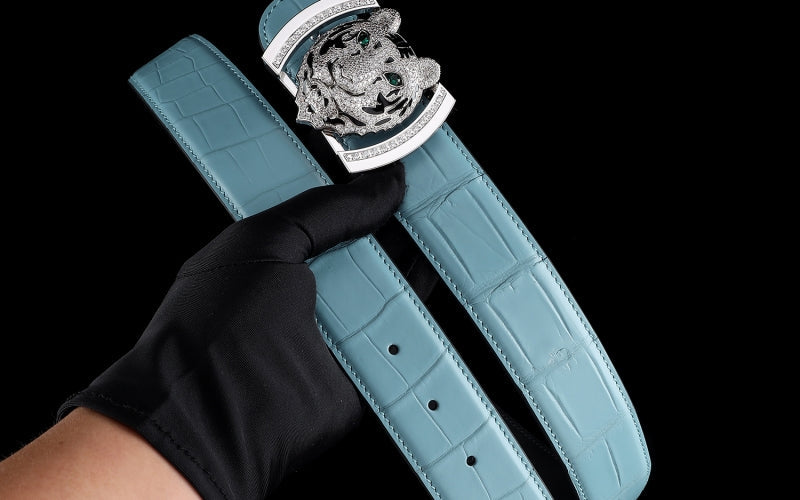
At BELTLEY, our standard crocodile belts use carefully positioned cuts that maximize visible scale symmetry across the strap profile. Out-of-stock or custom pieces are made to order in roughly 3 weeks, including hide selection. The Black Nile Crocodile Automatic 1.5" is engineered for the broadest wardrobe coverage at accessible pricing. For buyers seeking center-cut construction with maximum scale uniformity, our Black Crocodile Belly Cut with Gold Tiger Buckle shows the dedicated belly-cut treatment in its most visible expression.
Browse the BELTLEY Crocodile Belt Collection →
Frequently Asked Questions
Q: Is center-cut the same as belly cut?
Center-cut is a more specific term within belly cut. All center-cut belts are belly cuts, but not all belly cuts are center-cut — side-cut belts also come from the belly, just from the offset section. See our hornback vs belly cut crocodile belt guide for the broader anatomy.
Q: Can I tell center-cut from side-cut from a product photo?
Sometimes. Premium brands typically photograph belts flat with consistent lighting, where bilateral symmetry is visible. If the product image shows a belt with clearly mirrored scale rows on both sides of an invisible centerline, it's likely center-cut. Asymmetric patterns indicate side-cut.
Q: Does center-cut last longer than side-cut?
Not measurably. Both cuts use the same hide section (belly), the same tanning, and the same construction techniques. Lifespan depends on care, storage, and edge construction — not cut position.
Q: Why don't more brands disclose whether their belts are center-cut?
Because most buyers don't ask. The terminology is connoisseur-level vocabulary that hasn't entered mainstream luxury marketing. Brands that compete on price typically don't draw attention to cut position because the answer favors competitors using center-cut.
Q: Is a center-cut alligator belt the same idea as center-cut crocodile?
Yes — the concept applies identically to American alligator. Center-cut alligator belts run the strap along the belly midline, take the largest tile-scale section, and command a similar premium over side-cut alligator. See our alligator vs crocodile belts guide for species comparison.
Q: What about hornback belts — are those center-cut?
No. Hornback belts use the back of the crocodile (above the spine), not the belly. They feature the bony osteoderm-covered scales rather than the smooth belly tiles. Hornback is a completely different cut category. Our belly cut vs hornback crocodile belt post covers the difference.
Q: Should my first crocodile belt be center-cut?
For most first-time buyers, no. Side-cut delivers 80–90% of the visual impact at 40–60% lower cost, which makes it the smarter entry point into exotic leather. Reserve center-cut for your second crocodile belt or for a dedicated statement piece.
By the BELTLEY artisan team — handcrafting exotic leather belts since 1999. Last updated: May 10, 2026.