Embossed Cowhide vs Real Crocodile Belt: 7 Fast Tells (2026)
TL;DR:
- The single most reliable test is the pore check — every real crocodile scale has a visible pinpoint pore. Embossed cowhide has none.
- Scale uniformity is suspicious. Perfect, mathematically identical scales = embossed cowhide. Real crocodile shows subtle natural variation between scales.
- Edge inspection beats every visual test. Real crocodile shows leather grain visible inside each scale line; embossed cowhide is uniform thickness.
- Price under $100 for "genuine crocodile" = almost certainly embossed cowhide.
- No CITES certificate = not real crocodile. Cross-border crocodile sales legally require documentation.
- Hornback patterns are easier to fake than belly patterns — be extra skeptical of "hornback" embossed belts.
Quick Facts
- Time required for all 7 tests: Under 2 minutes
- Detection accuracy of these 7 tests: Over 95% of fakes
- Real one-piece crocodile belt price floor: $300
- Pores per scale on real crocodile: 1 pinpoint per scale
- Pores per scale on embossed cowhide: 0
- CITES status of real crocodile: Appendix II (mandatory documentation)
The fake crocodile belt market is bigger than the real one, and most buyers can't tell the difference until they've owned both. A skilled embossed cowhide belt can fool the casual eye at three feet — but every fake breaks down under seven specific tests that take less than two minutes total. If you're shopping crocodile under $1,000, especially online, these seven tells are the difference between buying a 20-year heirloom piece and an $80 cowhide belt sold at a $300 markup.
This guide walks through each test in order of reliability. You don't need a magnifying glass or a leather-science background — just the belt itself, decent lighting, and a willingness to look closely. In our own quality-control process, every incoming hide passes through tests 1, 2, 3, and 6 before it ever reaches the cutting room.
Run the Test That Fits Your Situation
Seven tests below — start with the one you can do right now:
| Your situation | Start with |
|---|---|
| Photos only (shopping online) | Scale uniformity — mathematically identical scales = embossed; real croc varies |
| Belt in hand | The pore check — every real crocodile scale has a pinpoint pore; embossed has none |
| Checking the price tag | Under $100 "genuine crocodile" = almost certainly embossed cowhide |
| About to pay real money | Demand the CITES certificate — no paperwork, no purchase |
Every belt in the crocodile collection passes all seven, papers included. The tests in order:
Why Is Embossed Cowhide So Often Sold as Crocodile?
Embossed cowhide is sold as crocodile because the markup is enormous, the casual buyer can't tell the difference, and the legal labeling requirements are weaker than buyers assume. A pressed cowhide belt costs $20–$40 to manufacture and routinely retails as "genuine crocodile leather" at $150–$400. The fake-crocodile economy is one of the largest sub-categories in the counterfeit luxury leather market.

The deception works because most online buyers shop on photos, and good macro photography of embossed cowhide reads as crocodile to the untrained eye. Sellers exploit ambiguous language — "crocodile leather," "genuine crocodile-embossed leather," "real leather with crocodile pattern" — that can mean either species or pattern. Industry research from the Leather Working Group and consumer protection investigations document fake-crocodile fraud as a persistent problem across both marketplace and standalone-store retail. Our real vs fake crocodile leather belt guide covers the broader fraud landscape.
The seven tests below are the same ones leather authentication services and customs inspectors use to identify embossed counterfeits.
Test 1: Look for Visible Pores in Each Scale
Real crocodile leather shows a single tiny pore — a former hair follicle — in nearly every scale. Hold the belt under direct light at a slight angle. Each scale should display a pinpoint dot, sometimes called a "sensory pit." If every scale is smooth and poreless, the belt is embossed cowhide.
This is the single most reliable visual test. Embossing dies cannot replicate pores reliably — pores are biological features that exist as tiny depressions in the original leather, and pressing a die onto cowhide produces uniform scale shape but no internal scale detail. A few high-end fakes simulate fake pores by re-embossing or punching, but the fake pores are uniform in size and position; real pores vary slightly from scale to scale.
The rule: every real crocodile scale has one pore. Every embossed cowhide scale has zero. Some species exception: American alligator has no pore but has the umbilical scar instead, which embossed cowhide cannot replicate. Our Porosus vs Niloticus crocodile belt guide and alligator vs crocodile belts post cover the species-specific markers.
Test 2: Check Scale Uniformity Across the Belt
Real crocodile shows subtle natural variation between scales — slightly different sizes, slightly different shapes, slightly different orientations. Embossed cowhide shows mathematically identical scales because they came from a repeating die. If every scale is a perfect copy of every other scale, the belt is fake.

Look at five or six scales in a row. On real crocodile, you'll see scales that are almost the same size but not quite — a 5mm scale next to a 4.8mm scale next to a 5.1mm scale. The differences are small but visible. On embossed cowhide, the scales are identical because the die is a single repeating pattern. The pattern often even repeats noticeably every 2–4 inches, where the embossing tool's seam appears.
This test is fastest with a camera zoom. Photograph a 4-inch section of the belt and zoom in. Real crocodile reveals organic variation. Embossed cowhide reveals mechanical repetition.
Test 3: Inspect the Edge of the Belt
Look at the cut edge of the belt — the side profile where the leather is sliced. Real crocodile shows leather fiber structure that varies between the scale line areas and the smooth scale tops. Embossed cowhide shows uniform leather thickness with no internal structure differences. Edge inspection is the most diagnostic test most buyers skip.
The edge tells the truth that the surface tries to hide. Real crocodile leather has structural depth: the scale "valleys" between scales are deeper than the scale "peaks," and the cut edge shows that variation. Embossed cowhide has no structural difference between peaks and valleys — the entire leather is one uniform thickness, with the pattern merely pressed into the surface.
A practical edge check: run your fingernail along the cut edge of the belt. On real crocodile, you'll feel slight bumps where the natural scale structure varies. On embossed cowhide, the edge is perfectly smooth because the leather is uniform thickness throughout. Our how to tell if a crocodile belt is genuine guide covers this in more depth.
Key Takeaways
- Pore test = single most reliable check (every real scale has one)
- Scale variation = real; identical pattern = fake
- Edge inspection reveals structural depth (real) vs uniform thickness (fake)
- Smell, flex, CITES, and price math each catch additional fakes
- Combined accuracy: 95%+ of fakes detected in under 2 minutes
Test 4: The Smell Test
Real crocodile leather has a distinctive earthy, slightly musky animal smell from the natural oils and tanning chemistry. Embossed cowhide smells like cow leather — heavier, more uniform, often with chemical undertones from the pattern-pressing process. The smell test is subjective but surprisingly reliable for buyers who own both.

Smell the belt directly, ideally close to the cut edge where the leather chemistry is most exposed. Real crocodile has a slightly different aromatic profile than cowhide — less leathery, more animal. Some buyers describe real crocodile as smelling "alive," while cowhide smells "tannery." If you've ever smelled a real Hermès crocodile bag, you know the scent. If the belt smells like a regular cowhide belt, that's what it is.
This test works best when the belt is new. Older, conditioned crocodile belts may smell similar to cowhide because applied leather conditioners cover the natural scent.
Test 5: The Flex and Bend Test
Real crocodile flexes with subtle independent scale movement — each scale moves slightly relative to its neighbors. Embossed cowhide bends as a single uniform sheet because the leather thickness is uniform and the scales are surface-level only. Bend the belt into a tight curve and watch the surface.
The flex test reveals what the eye misses. Real crocodile, especially Niloticus and American alligator, has natural scale articulation — the scales can flex slightly without the leather cracking, because the natural valleys between scales act as hinge points. Embossed cowhide has no such hinges; the scales are pressed into the surface but the underlying leather is one solid sheet.
Tightly bend the belt around your fist or against a desk edge. On real crocodile, individual scales appear to lift slightly at their edges. On embossed cowhide, the entire leather flexes as one piece with the embossed pattern stretching uniformly. This test is also why caiman belts crack so quickly — the calcium content prevents proper scale articulation, as our caiman vs crocodile vs alligator belt guide explains.
Test 6: Demand the CITES Certificate
Every real crocodile belt sold legally in the US, EU, UK, Japan, and Australia must be accompanied by a CITES Appendix II export certificate documenting the species and farm origin. If the seller cannot produce a CITES certificate, the belt is either embossed cowhide or contraband.

The CITES system is the strongest legal authentication available, and embossed cowhide manufacturers have no need for it because cowhide is unregulated. A reputable crocodile belt seller will either provide the certificate at point of sale or be able to produce it on request. Sellers who hesitate, claim it's "with the manufacturer," or say it's "not necessary for this piece" are signaling that the belt isn't real crocodile.
For online purchases, ask before buying. Reputable brands answer in minutes; fake-belt sellers go silent. Our where to buy real crocodile leather belt online guide covers verified sellers.
Test 7: Apply the Price Math
A real one-piece crocodile belt cannot be sold profitably under $300 at the absolute floor. Anything advertised as "genuine crocodile" below that price is overwhelmingly likely to be embossed cowhide, multi-piece spliced construction, or counterfeit. The math doesn't allow for a sub-$200 real crocodile belt.
The cost floor breaks down as: $80–$200 for the legally sourced hide, $30–$80 for tanning, $40–$80 for cutting and edge work, $20–$50 for hardware, $30–$60 for skilled labor. That totals $200–$330 in raw production cost — which is the absolute lowest a real crocodile belt can profitably retail for, and only at the very bottom of the DTC pricing range. We covered this math fully in our why some crocodile belts cost $500 and others $5,000 breakdown.
If a seller is offering "genuine crocodile" at $79, $129, or even $199, the economics literally cannot work. The belt is either embossed cowhide misrepresented as crocodile or counterfeit luxury sourced through illegal supply chains.
What Should You Do If You Already Bought a Fake?
If you already bought a belt that fails these tests, request a refund through the platform you purchased on (eBay, Amazon, and most marketplaces honor "not as described" claims for misrepresented luxury). For credit card purchases, file a chargeback within 60–120 days citing material misrepresentation. Document the failed tests with photos before returning.

For longer-term protection, our how to tell a good quality leather belt and how to choose a good leather belt guides establish broader buying frameworks. Embossed cowhide belts can be excellent value when sold honestly as embossed cowhide — the issue is only the misrepresentation.
The Bottom Line
The seven tests above take less than two minutes and catch over 95% of embossed-cowhide fakes sold as crocodile. The pore test alone catches most. Edge inspection and CITES documentation catch the rest. The seller who passes all seven is genuine; the seller who fails any one of them is selling cowhide at a crocodile price. Real crocodile costs what it costs because the inputs and labor cost what they cost — there's no shortcut, no breakthrough, no clever sourcing that beats the math.
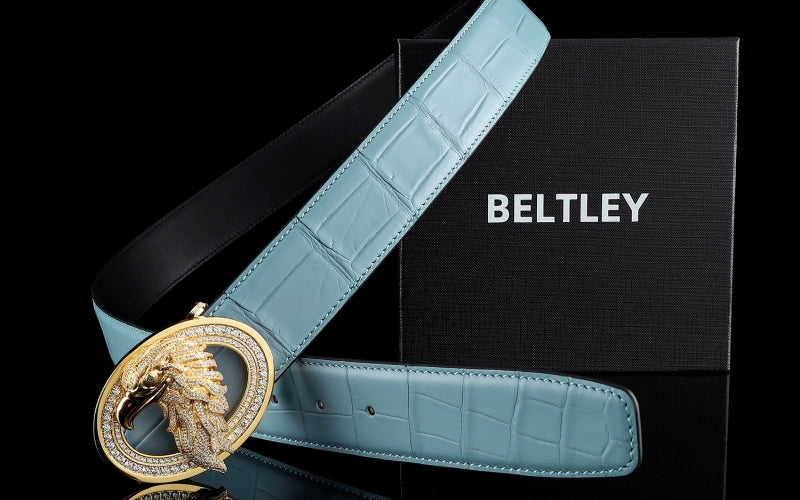
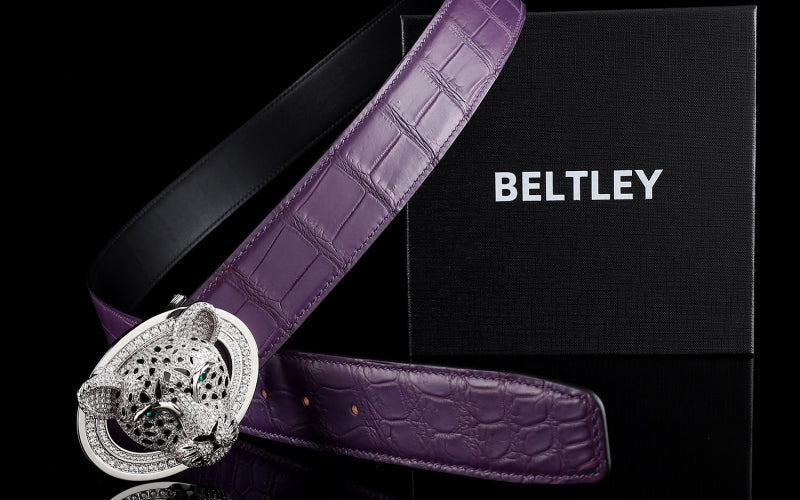
At BELTLEY, every crocodile belt is made from legally and responsibly sourced exotic leather backed by official import documentation, hand-finished edge work, and a 10-year warranty that we couldn't honor on embossed cowhide. Out-of-stock or custom pieces are made to order in roughly 3 weeks. If you've been comparing a $129 "crocodile" belt to a $400 real one and trying to decide which is the better deal, the seven tests above are the answer — and the Black Nile Crocodile Automatic 1.5" is the structurally honest version of what real crocodile costs.
Browse the BELTLEY Crocodile Belt Collection →
Frequently Asked Questions
Q: Can embossed cowhide ever pass for real crocodile in person?
Briefly, at conversation distance, under poor lighting. At three feet under daylight, the differences are visible to anyone who knows what to look for. Under macro photography or close inspection, the differences are obvious within seconds.
Q: Is embossed cowhide a bad leather?
No. Embossed cowhide can be high-quality cowhide leather with a pressed pattern, and it has legitimate value as an affordable alternative to exotic leather. The problem is only when sellers misrepresent it as real crocodile to charge crocodile prices.
Q: How long does an embossed cowhide belt last?
A well-made embossed cowhide belt typically lasts 5–10 years with proper care. Real crocodile typically lasts 15–25 years. The lifespan difference is real but smaller than the price difference suggests.
Q: Is "genuine leather" with crocodile pattern the same as real crocodile?
No. "Genuine leather" is a leather-grade term meaning split or low-grade cowhide. "Genuine leather with crocodile pattern" means embossed split-grade cowhide — typically the lowest tier of leather sold under any luxury labeling. See our is a genuine leather belt real leather post for the leather-grade hierarchy.
Q: Do embossed cowhide belts have CITES certificates?
No. Embossed cowhide is regular cow leather with a pressed pattern; it is not regulated under CITES because no exotic species was used. Any seller claiming a "CITES certificate" on embossed cowhide is misrepresenting the product.
Q: What's the cheapest real crocodile belt available?
Approximately $300 from DTC brands operating without retail overhead. Below that price floor, the math doesn't support genuine one-piece construction with documented CITES sourcing. Any "crocodile" belt below $100 is overwhelmingly likely to be embossed cowhide.
Q: Should I buy embossed cowhide if I can't afford real crocodile?
Yes, if it's sold honestly as embossed cowhide at an appropriate price ($40–$120). A high-quality embossed cowhide belt is a legitimate and useful product. The issue is only with sellers who misrepresent embossed cowhide as crocodile to charge a crocodile premium.
By the BELTLEY artisan team — handcrafting exotic leather belts since 1999. Last updated: May 10, 2026.