Where to Buy a Real Crocodile Leather Belt Online (And How to Avoid Fakes)
TL;DR:
- Trusted sources for genuine crocodile belts online: DTC exotic leather brands, specialty exotic leather retailers, and established heritage belt makers — not general marketplaces.
- Red flags for fakes: repeating identical scale patterns, no visible pores, plastic-like texture, suspiciously low prices (under $100), and vague product descriptions that say "crocodile-style" or "croc-embossed."
- Price reality: authentic crocodile leather belts start around $118–$289 from DTC brands and $400–$800+ from heritage luxury houses. Below that floor, you're almost certainly buying embossed cowhide.
The online exotic leather market has a counterfeiting problem. Embossed cowhide — regular leather stamped with a crocodile-like scale pattern — is sold under descriptions like "genuine crocodile grain," "croc-embossed leather," and occasionally just "crocodile leather belt" with no further qualification. For buyers who don't know what to look for, the difference is nearly invisible in a product photo. This guide tells you exactly where to look, what to verify, and which signals separate a legitimate seller from one selling pressed imitations.
What Makes an Online Crocodile Belt Seller Trustworthy?
A trustworthy online seller of genuine crocodile leather belts specifies the exact species (Nile crocodile, saltwater crocodile, American alligator, caiman), names the hide cut (belly or hornback), and backs the product with a meaningful warranty. Vague descriptions, no species information, and return policies measured in days rather than weeks are reliable indicators of a seller who can't defend the authenticity claim.

Species transparency is the most important filter. Crocodile and alligator are CITES-regulated materials — reputable sellers comply with international trade documentation requirements and are willing to state that compliance directly. A seller who lists "crocodile leather" without identifying the species cannot confirm what they're actually selling. AMTAN's guide to spotting genuine vs. embossed exotic leather — published by one of the oldest alligator tanneries in the United States — recommends treating species identification as a minimum qualifying requirement before any purchase.
For context on what legally qualifies as genuine crocodile in the US market, our guide on are alligator or crocodile belts legal in the USA covers the CITES framework that governs legitimate sales.
The 3 Types of Online Sellers (And Which to Trust)
Not all online channels carry equal authenticity risk. Understanding the three seller categories helps you allocate your due diligence correctly.

1. DTC Exotic Leather Brands (Highest Trust) Direct-to-consumer brands specializing in exotic leather have skin in the game — their entire business model depends on the authenticity claim. They source from verified tanneries, control the supply chain, and typically offer meaningful warranties. BELTLEY's crocodile and alligator belt collection is built on this model: every hide is sourced from Grade 1 belly-cut material, backed by a 10-year warranty on materials and construction. Other legitimate DTC options include W.Kleinberg (handcrafted in the USA), Sherrill & Bros. (caiman belly specialists), and Southern Trapper (saltwater and hornback specialists).
2. Specialty Exotic Leather Retailers (High Trust) Established specialty retailers — brick-and-mortar heritage stores with an online presence — generally maintain the same sourcing standards as DTC brands. Tony Lama, J.McLaughlin, and Roger Ximenez all carry genuine crocodile belts with provenance backing. Prices are typically higher to account for retail margins, but the authenticity risk is low.
3. General Marketplaces — Amazon, eBay (Highest Risk) Genuine crocodile belts exist on Amazon and eBay, but third-party marketplace listings are the primary vector for embossed imitations. Sellers on these platforms face minimal consequences for misleading descriptions, and product photos rarely reveal enough detail to confirm authenticity. If you buy from a marketplace, restrict your search to listings from identified brands — not anonymous third-party sellers — and verify the same species, cut, and warranty criteria you'd apply anywhere else.
How to Spot a Fake Crocodile Belt Before You Buy
Genuine crocodile leather has specific physical characteristics that embossed imitations cannot replicate. Knowing what to look for in product photography and descriptions filters out fakes before you spend a dollar.
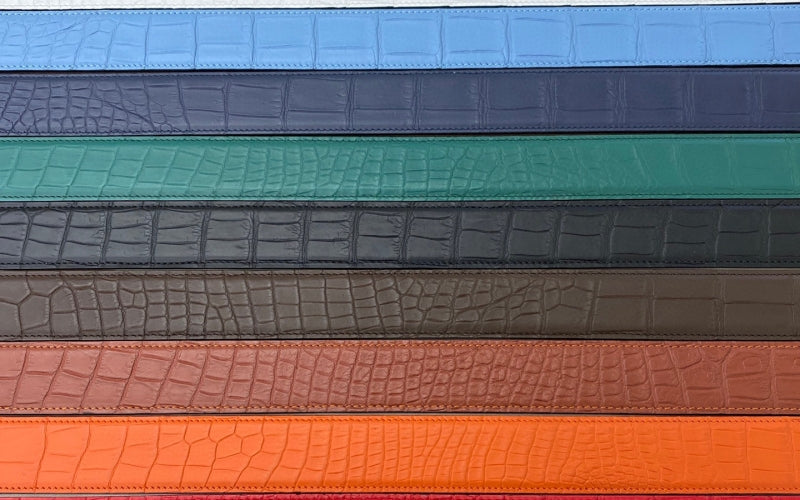
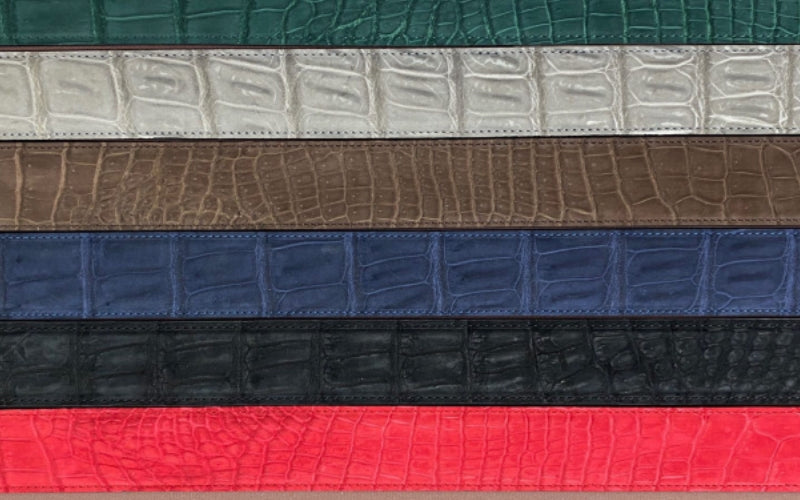
Scale pattern irregularity: Real crocodile scales are naturally asymmetrical — no two are identical in size or shape. The pattern shifts gradually from larger central scales to smaller peripheral ones. Embossed leather uses a stamped die that repeats. If the scale pattern looks perfectly regular or tiles visibly, it's embossed. As Biker Ring Shop's authentication guide notes, genuine crocodile is "beautifully chaotic like a human fingerprint" — the irregularity is the authentication marker.
Visible pores: Each genuine crocodile scale contains a single tiny sensory pore. On real leather, scattered pores are faintly visible at the center of individual scales. Embossed leather is completely smooth within the "scales" — no pores, no texture variation inside the scale face.
Suppleness and feel: Genuine Grade 1 belly-cut crocodile leather is soft and pliable from the first touch. Embossed cowhide or bonded leather is stiffer, often with a slightly plasticky surface texture. This is harder to assess from a product page, but sellers who describe their belts as "stiff" or recommend a "break-in period" on a belly-cut piece are a yellow flag.
Scale edge definition: On real crocodile, the recessed lines between scales are sharp and slightly irregular in depth. On embossed leather, the lines are uniform and look mechanically pressed — consistent depth, consistent width, consistent angle.
For a deeper technical breakdown of what distinguishes genuine exotic leather from embossed alternatives, Taza Leather's guide to spotting genuine alligator skin belts covers pore structure and scale anatomy in detail.
Is Amazon a Safe Place to Buy a Real Crocodile Belt?
Amazon is a higher-risk channel for genuine crocodile leather belts, but not an impossible one. Embossed imitations significantly outnumber authentic pieces in marketplace search results, and product descriptions frequently use ambiguous language designed to imply authenticity without legally claiming it.

Safe Amazon purchases are possible when you buy directly from a named brand's official storefront (not a third-party reseller), the listing identifies the exact species, and the price is consistent with genuine exotic leather. A $45 "genuine crocodile belt" on Amazon is not genuine crocodile leather — the raw hide alone costs more than that to source and tan. For a clear price-to-authenticity calibration, our crocodile leather belt price guide breaks down what different price points actually reflect in terms of material quality and construction.
How Much Does a Real Crocodile Leather Belt Cost Online?
A genuine crocodile leather belt from a DTC brand costs between $150 and $299. Heritage and luxury retailer pricing runs $400 to $800 or more for the same material with higher margin built in.

These price ranges reflect actual material costs: Grade 1 crocodile hide, tannery processing, precision cutting, and quality hardware. The DTC model — which eliminates wholesalers and retail middlemen — is the reason quality crocodile leather is now accessible below the $300 threshold without compromising on the hide itself. That's the core argument behind are alligator or crocodile belts worth it — cost-per-year over a 20+ year lifespan puts genuine exotic leather in a competitive position against mid-range cowhide belts that need replacing every five to seven years.
Anything priced below $100 for a full crocodile belt is embossed leather, bonded leather, or caiman with significant hide defects. The material economics simply don't allow genuine Grade 1 crocodile at that price point.
Pre-Purchase Checklist: What to Verify Before You Click "Buy"
Use this checklist for any online crocodile belt purchase:

- Species named explicitly — "Nile crocodile," "saltwater crocodile," "American alligator," or "caiman" (caiman is real exotic leather but lower-tier than full crocodile)
- Hide cut identified — belly, hornback, or backstrap
- Grade claim or quality statement — Grade 1 or equivalent quality language
- Warranty offered — minimum 1 year; 10 years signals genuine confidence in material quality
- Return policy — 30 days minimum; sellers confident in authenticity offer easy returns
- Scale pattern photos — close-up product images showing natural asymmetry and pore visibility
- Price in range — $150+ for DTC; $400+ for heritage retailers; anything lower is a red flag
- CITES compliance — for international orders, the seller should confirm legal export documentation
At BELTLEY, every one of these boxes is checked: species-identified Grade 1 hides, 10-year warranty, 30-day returns, free worldwide shipping, and close-up photography on every product listing. See our full crocodile and alligator belt collection to compare directly. For more on what separates quality exotic leather from the alternatives, is alligator leather good quality gives a straight answer with material data.
The Bottom Line
Buying a real crocodile leather belt online comes down to three things: choosing the right channel, knowing the authentication signals, and understanding the price floor below which genuine exotic leather simply cannot exist. DTC exotic leather brands and established specialty retailers are the safest sources. General marketplaces require significantly more due diligence.
BELTLEY was built specifically around the DTC model — no Brand Tax, no middleman markup, Grade 1 exotic hides at prices that reflect the material rather than the marketing. Free worldwide shipping (USA 4–8 days), a 30-day hassle-free return policy, and a 10-year warranty mean you can verify the product in person with zero risk. Explore the full crocodile and alligator belt collection and see why the smart money skips the markup.
Frequently Asked Questions
Q: Where is the best place to buy a genuine crocodile leather belt online?
The safest sources are DTC exotic leather brands (BELTLEY, W.Kleinberg, Sherrill & Bros.) and established specialty retailers (Tony Lama, Southern Trapper, Roger Ximenez). These sellers identify the species, back the product with warranties, and have reputations built on authenticity claims. General marketplaces like Amazon and eBay carry higher risk due to embossed imitations sold under misleading descriptions.
Q: How can I tell if a crocodile belt is real or fake?
Real crocodile leather has an irregular, non-repeating scale pattern, faint pores visible at the center of individual scales, and a naturally supple feel. Embossed fakes have a stamped, repeating pattern, no visible pores inside the scales, and a stiffer or slightly plastic surface texture. Price is also a signal — genuine crocodile belts cost $150 or more; anything significantly below that is embossed leather.
Q: Are crocodile belts on Amazon real?
Some are, some aren't. Named-brand storefronts on Amazon occasionally list genuine crocodile belts, but third-party marketplace sellers frequently use ambiguous language ("crocodile grain," "croc-style") to imply authenticity. Always verify species identification, price consistency with Grade 1 material, and return policy before purchasing through any marketplace.
Q: How much should I pay for a real crocodile belt?
Expect to pay $150–$299 from a DTC exotic leather brand, or $400–$800+ from heritage luxury retailers. Below $100, the material is almost certainly embossed cowhide or caiman with significant defects, not full-grade crocodile leather. The DTC price range reflects the same Grade 1 hides at a fair price without retail margin markup.
Q: Do I need any documentation when buying a crocodile belt online?
For domestic US purchases, no documentation is required from the buyer — CITES compliance is the seller's responsibility. For international orders, reputable sellers provide export documentation confirming the hide is from a legally farmed or harvested source. If a seller cannot confirm legal export compliance for an international shipment, that's a significant red flag.