Why Crocodile Belt Scales Get Smaller Toward the Tail?
TL;DR:
- Crocodile belly scales are largest near the chest and shrink, narrow, and become more rectangular as they move toward the tail — this is anatomy, not a flaw.
- The most coveted belts are cut from the center belly (largest, most symmetrical tiles); side and tail cuts are still beautiful but show smaller, tighter pattern.
- Reading scale gradient on a finished belt tells you which part of the hide it came from — and roughly what it should cost.
- BELTLEY sources center-cut Porosus and Niloticus bellies, keeps belts in stock, and ships handcrafted in 2–3 days — never weeks.
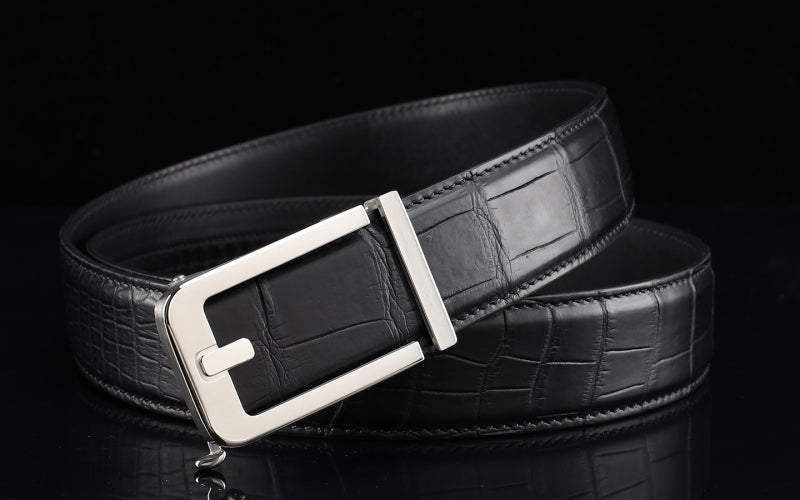
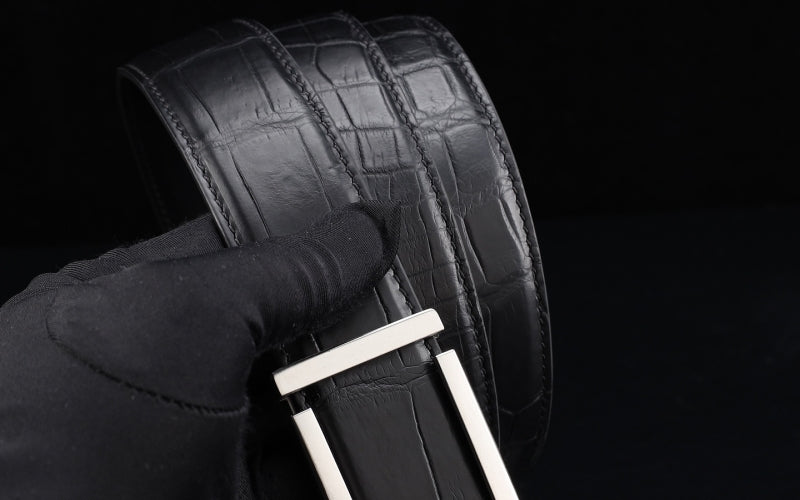
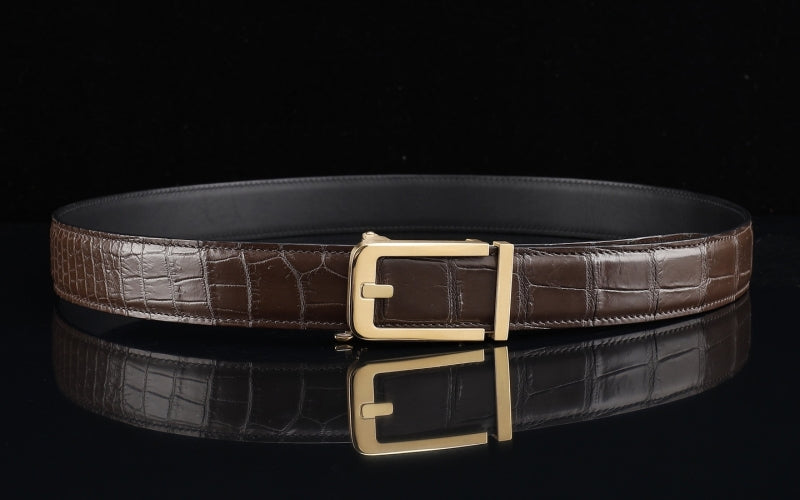
When you run your thumb across a real crocodile belt, you feel something a printed cowhide can never fake: a rhythm of tiles that grow, shrink, and shift shape across the strap. That crocodile belt scale pattern isn't a stylistic choice by the tannery. It's a fingerprint of where the leather sat on a living animal — and once you learn to read it, you'll never look at an exotic belt the same way again. If you're new to the category, our guide on Porosus vs. Niloticus crocodile belts is the natural companion to this piece.
Quick Facts
| Fact | Detail |
|---|---|
| Largest belly scales | Chest / upper belly — broad, square, symmetrical |
| Smallest belly scales | Tail base and flank — narrow, rectangular, tightly packed |
| Premium cut | Center-cut belly strap (single hide, one belt) |
| Typical hide yield | 1 saltwater crocodile = 1–2 premium belts |
| Scale shape change | Square → rectangular → small uniform tiles |
| Why it matters | Larger, symmetrical tiles command 2–4x the price |
Why do crocodile belly scales get smaller toward the tail?
Crocodile belly scales get smaller toward the tail because the animal's body narrows there. The ventral scales (called scutes) grow in rows that follow the crocodile's skeleton. As the torso tapers from rib cage to hips to tail base, each row has less width to fill — so the tiles compress, shorten, and become more rectangular. It's pure biology.

Crocodilians have grown this way for roughly 95 million years, and the patterning is consistent across living species (Crocodile — Wikipedia). A tanner can't change it; a designer can only choose which section of the hide to cut. That single choice — where on the belly the strap comes from — is the biggest invisible price driver in the entire exotic belt category.
What part of the crocodile makes the prettiest belt?
The center-cut belly — specifically the chest-to-mid-abdomen section — makes the prettiest crocodile belt. This zone produces the largest, most square, most symmetrical tiles, with a clean central spine line. A 1.5" wide center-cut strap can show four to five glossy tiles across, mirrored left-to-right.
This is why you'll see Hermès, Brioni and other top houses quietly market "ventral central" or "centre belly" cuts at premium tiers — the visual rhythm is unmistakable. At BELTLEY, the same rule guides our sourcing: every belt in the alligator and crocodile collection is cut from the center belly first, with side material reserved for smaller goods. For the deeper trade-offs, see center cut vs. side cut crocodile belt.
Are side-cut and tail-cut belts lower quality?
Side-cut and tail-cut belts are not lower quality leather — the hide is the same animal, tanned the same way. They simply show a different visual pattern: smaller tiles, less symmetry, sometimes a visible flank-to-belly transition. Many buyers actually prefer the tighter rhythm.

Three honest distinctions:
- Center cut — large square tiles, perfectly mirrored, formal and dressy.
- Side cut — medium tiles trending rectangular, a softer asymmetric look that pairs well with casual tailoring.
- Tail-base cut — small, uniform, almost mosaic-like tiles; ideal for thin 1" straps and women's belts.
Durability is identical across cuts. Crocodile belly is dense, fibrous, and one of the strongest leathers in the world — which is part of why a well-made belt can last decades and is covered by our 10-year warranty.
How do top brands cut belts to feature the best scale gradient?
Top brands template the strap so the largest tiles sit at the buckle end (the visible front), and let the gradient taper naturally toward the tip that tucks through the loop. The eye is drawn to the buckle area first, so that's where the showpiece scales belong.
A skilled cutter will also align the central spine line — the faint seam between left and right tile rows — exactly down the geometric center of the strap. Misalignment by even 2mm reads as "off" to a trained eye. This is one of the slowest, most judgment-heavy steps in belt making, and it's why a single artisan at our workshop will sometimes reject three hide sections before approving one. For context on hide economics, see how many crocodiles to make one belt.
A craft moment from our workshop
The first time I watched our master cutter mark a Porosus belly, he spent forty minutes with a piece of chalk and a paper template before a single blade touched leather. He kept rotating the hide under the lamp, looking for the spine line. "If I cut this two centimeters left," he said, "I save twenty percent of the hide. If I cut it correctly, I save the belt." That hide became one belt. The off-cuts went to a card wallet. Nothing was wasted, but nothing was rushed — and that, more than anything, is what you're paying for in real exotic leather.

How can you read scale grading on a finished belt?
Read scale grading by counting tiles across the strap width and checking symmetry: 4–5 large symmetrical tiles across a 1.5" strap means center cut; 6+ smaller tiles or visible asymmetry means side or tail cut. Also check that the spine line runs straight down the middle without drifting.
A quick field checklist:
- Tile count across width — fewer, larger tiles = closer to chest.
- Tile shape — square = center; rectangular = side; small and uniform = tail base.
- Spine alignment — straight and centered = high-grade cut.
- Gradient direction — largest tiles should sit at the buckle end on a well-templated belt.
- Edge finish — hand-painted edges in matching color signal a workshop that didn't cut corners elsewhere.
This is also the fastest way to spot a fake. Embossed cowhide cannot reproduce a true biological gradient — every "tile" is identical because it came from a single press plate. We unpack the giveaways in embossed cowhide vs. real crocodile belt.
Why does this anatomy translate into such different prices?
A center-cut Porosus belt can cost 3–4x a tail-cut version of the same hide because center material is finite — one crocodile yields only one or two strap-length center sections. Side and tail cuts use the rest of the hide, which is why prices fan out so widely across the category.

Sustainable, traceable exotic leather is also tightly regulated. Legal crocodile leather entering the supply chain is tracked under CITES permits and monitored by the IUCN Crocodile Specialist Group, which adds cost but is non-negotiable for any legitimate brand. We break down the full price math in why crocodile belts cost $500 vs $5,000.
Key Takeaways
- Belly scales shrink toward the tail because the animal narrows — pure anatomy.
- Center cut = largest, most symmetrical tiles = the premium look.
- Side and tail cuts are equally durable, just visually tighter and less symmetrical.
- Read a belt by counting tiles across the strap and checking spine alignment.
- BELTLEY sources center-cut bellies first, keeps belts in stock, ships in 2–3 days.
The Bottom Line
The next time someone tells you a crocodile belt is "just a belt," show them the scale gradient and explain what they're actually looking at — the chest-to-tail anatomy of a 95-million-year-old lineage, sliced into a single strap by a human hand. That story is why exotic leather has never been mass-produced and never will be. BELTLEY has been working with master leather artisans since 1999, went DTC in 2025 to remove the Brand Tax, and keeps every belt in stock so your order ships handcrafted in 2–3 days — not the 4–8 weeks the legacy houses still quote. Browse the full exotic leather belt collection or read more about our sourcing on the About Us page.
Frequently Asked Questions
Q: Why are crocodile belly scales bigger than back scales?
The belly is soft, smooth, and unarmored because the animal lies on it; back scales are bony osteoderms used for protection. Only belly leather is used for fine belts — back skin is too rigid and irregular.
Q: What's the difference between Porosus and Niloticus scale patterns?
Porosus (saltwater crocodile) tiles are smaller, tighter, and more uniform — considered the most prestigious. Niloticus (Nile crocodile) tiles are larger and more square. Both grow in the same chest-to-tail gradient. See our Porosus vs. Niloticus comparison for full detail.
Q: Can a belt be made from one continuous piece of belly?
Yes — and it should be. A premium center-cut belt is a single, unjoined strap of belly leather. Any seam in the middle of an exotic belt indicates patched or pieced material, which is a quality red flag.
Q: Does scale size affect durability?
No. Tile size is purely cosmetic. The collagen density and fiber structure of crocodile belly leather are the same from chest to tail, which is why all BELTLEY exotic belts carry the same 10-year warranty regardless of cut.
Q: How long does a BELTLEY crocodile belt take to ship?
All BELTLEY belts are in stock. Each order is hand-finished and shipped within 2–3 business days, with free worldwide delivery (USA 4–8 days, international 4–10 days). No multi-week waits.
By the BELTLEY Editorial Team — Last updated May 11, 2026