Crocodile Umbilical Scar: The Hidden Authentication Mark
TL;DR:
- The "umbilical scar" is a small star or rosette pattern on the belly of a crocodile or alligator hide where the umbilical cord once attached.
- It is one of the strongest visual proofs that a belt is genuine exotic leather — embossed cowhide cannot replicate it convincingly.
- It appears more pronounced on American alligator than on saltwater or Nile crocodile.
- Some buyers see asymmetry; connoisseurs (and houses like Hermès) treat it as a stamp of authenticity.
- BELTLEY does not hide the scar — we let you choose belts with or without it.
If you have ever run your fingertip across a crocodile belt and felt a tiny burst of irregular scales — like a starburst frozen in the leather — you have just touched the crocodile umbilical scar. Most luxury brands edit it out of marketing photos. We don't. This guide explains exactly what that mark is, why it appears, why it matters for authentication, and how to decide whether you want a belt that shows it. If you'd like a primer on how belly leather differs from back leather first, see our center cut vs side cut crocodile belt guide.
Quick Facts: The Umbilical Scar at a Glance
| Detail | Answer |
|---|---|
| Other names | Umbilical button, navel mark, belly rosette, star scar |
| Location on hide | Belly, roughly center, slightly off the spine line |
| Shape | Star, rosette, or fingerprint-like swirl of small irregular scales |
| Most visible on | American alligator (Alligator mississippiensis) |
| Less visible on | Saltwater crocodile (Porosus), Nile crocodile (Niloticus) |
| Authentication value | Very high — extremely difficult to fake |
| BELTLEY policy | Disclosed, photographed, and customer's choice |
What Exactly Is the Crocodile Umbilical Scar?
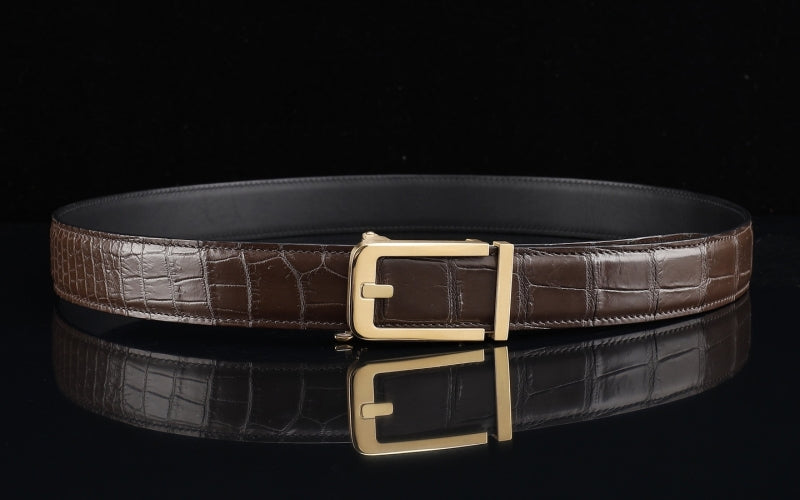
The crocodile umbilical scar is a small, star-shaped or rosette-patterned cluster of irregular scales on the belly of an alligator or crocodile, formed where the umbilical cord attached the hatchling to its yolk sac before birth. It is a natural, permanent biological mark, not a defect or damage.

Think of it as the reptilian equivalent of a human navel — except instead of a soft indentation, it shows up as a swirl that interrupts the otherwise neat tile pattern of belly scales. Because alligators and crocodiles hatch from eggs with an external yolk sac connection, every individual carries this mark for life. You can read more about the species' biology on the American alligator Wikipedia page.
Why Does the Scar Appear on Some Belts and Not Others?
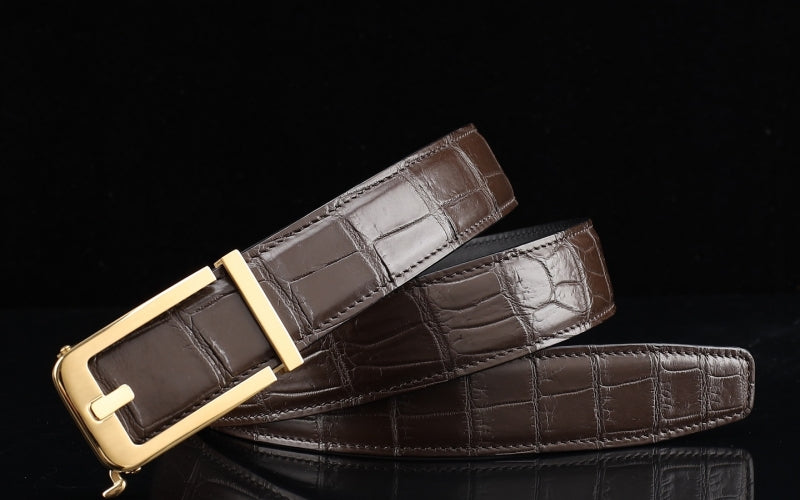
Whether a belt shows the umbilical scar depends entirely on which part of the hide the strap was cut from. A belt cut from the dead-center of the belly will usually include it; a belt cut from the flank or cheek will not. Hide layout, not authenticity, decides the outcome.

A single alligator hide yields only a handful of premium belt straps. Tanneries map each hide carefully — center cut for the most symmetrical tile pattern, flank cut for cleaner runs without the navel, hornback for the dramatic dorsal ridge. If you want a deeper look at why placement matters so much, our Porosus vs Niloticus crocodile belt comparison walks through hide anatomy in detail.
Is the Umbilical Scar Proof a Crocodile Belt Is Real?
Yes — the presence of a clean, organic umbilical rosette is one of the most reliable visual authenticators of real exotic leather. Modern embossing machines can imitate scale tiles, but they cannot convincingly reproduce the irregular, three-dimensional swirl of a true umbilical scar. It is the single mark counterfeiters consistently fail to fake.

Embossed cowhide relies on repeating dies pressed into the leather. The dies produce uniform tiles, but the umbilical area requires asymmetric, hand-tooled disruption that mass production cannot match. If you suspect a belt may be printed cowhide rather than genuine reptile, our guide on embossed cowhide vs real crocodile belt shows seven other tells. Industry conservation bodies such as the IUCN Crocodile Specialist Group maintain documentation on legal trade and farm-sourced hides — every authentic, traceable hide carries this birth mark.
Alligator vs Crocodile: Where the Scar Is Most Visible
The umbilical scar is most pronounced on American alligator because of its larger, more uniform belly tiles, which make any irregularity stand out. On saltwater (Porosus) and Nile (Niloticus) crocodile, the surrounding scales are smaller and more varied, so the scar blends in more subtly.
Louisiana and Florida farm-raised American alligators — the source of most US-finished exotic belts — produce hides with the cleanest tile geometry in the industry, which paradoxically makes the navel mark more visible. The Louisiana Alligator Advisory Council tracks this farm-to-finish supply chain. Saltwater crocodile, prized by European houses, has tighter umbilical clustering that some buyers actually prefer because it reads as decorative rather than disruptive. For a head-to-head, see our American alligator vs Nile crocodile belt breakdown.
Flaw or Feature? How Connoisseurs Read the Mark
To a casual buyer the umbilical scar can read as asymmetry or imperfection. To a connoisseur it reads as a signature — proof of biological origin, hand-selection, and the kind of honest material storytelling that mass-luxury brands often airbrush out. Hermès openly positions the scar on certain Birkin and Kelly bags as a focal point.

The split is generational and cultural. Younger Smart Money buyers — the customers BELTLEY was built for in 2025 when we transitioned to DTC after twenty-six years of B2B craftsmanship — increasingly favor the scar precisely because it cannot be faked, mass-produced, or AI-generated. It is a small rebellion against synthetic perfection. If you want to understand why we built the brand around this kind of transparency, read our About Us page.
The First Time I Cut Around One
Last winter our master cutter laid out a 38 cm Louisiana alligator belly destined for three 1.25-inch belts. The umbilical rosette sat almost perfectly between the second and third strap. He could have shifted the cut a quarter-inch and lost it entirely. Instead he asked me what I wanted. I told him: cut it dead center on the second strap. That belt sold within forty-eight hours to a customer in Singapore who specifically wrote in the notes: "I want the one with the star."
Why the Scar Costs the Same — Not Less
A belt that shows the umbilical scar is not a discount item. The hide costs the tannery the same. The cutter, edge-painter, and stitcher spend the same hours. If anything, a center-cut belt with a clean rosette commands a premium in the resale market because it is provably authentic. Pricing it lower would be punishing nature.

This is the heart of the no-Brand-Tax philosophy we explain in why crocodile belts cost $500 vs $5,000. Heritage houses charge ten times what the materials and labor warrant. We charge what the belt actually costs to make, plus a fair margin — and we keep BELTLEY belts in stock with a 2 to 3 day handcraft-and-ship window, so you are not waiting six months for an "atelier reservation."
Key Takeaways
- The crocodile umbilical scar is a natural belly mark — a star or rosette where the umbilical cord attached at hatching.
- It is one of the most reliable authenticators of real exotic leather; embossed cowhide cannot fake it.
- Whether your belt has one depends on the cut placement on the hide, not on quality.
- Connoisseurs treat it as a feature; Hermès intentionally highlights it on bags.
- BELTLEY discloses the mark openly and lets you choose — both options ship in 2 to 3 days.
The Bottom Line
The crocodile umbilical scar is the most honest mark a luxury belt can carry. It tells you the animal was real, the hide was hand-selected, and the brand selling it has nothing to hide. After twenty-seven years working with exotic leathers, we built BELTLEY around exactly this kind of transparency: no airbrushing, no Brand Tax, no six-month waitlists — just real hides, master craftsmanship, and a 10-year warranty that backs it up. Browse our full alligator belt collection or the wider exotic leather belt range to see which belts show the star and which run clean.
Frequently Asked Questions
Q: Is the umbilical scar on a crocodile belt a defect?
No. The umbilical scar is a natural biological mark formed where the umbilical cord attached at hatching. It is not damage, not a tannery flaw, and does not affect the strength or longevity of the leather. Many collectors actively seek it out as proof of authenticity.
Q: Do all crocodile and alligator belts have an umbilical scar?
No. Only belts cut from the center of the belly typically show it. Belts cut from the flanks, sides, or hornback (the spine ridge) usually do not. A single hide produces both — which is why two belts from the same animal can look quite different.
Q: Why do some luxury brands hide the umbilical scar in photos?
Mass-luxury houses often retouch it out of marketing imagery to project an idealized, uniform look. Independent and DTC brands like BELTLEY tend to show it openly because it doubles as proof of authenticity and aligns with a transparency-first ethos.
Q: Can fake or embossed leather replicate the umbilical scar?
It is extremely difficult. Embossing dies produce repeating, symmetrical patterns; the umbilical scar is irregular, three-dimensional, and unique to each animal. If a belt shows a convincing rosette, it is almost certainly real exotic leather.
Q: Should I pay less for a belt with an umbilical scar?
No. The hide cost, labor, and craftsmanship are identical. In the secondary market, center-cut belts with a visible scar often hold their value better because authenticity is provable at a glance.